Cadential structures in English sixteenth-century instrumental music: using CRIM Intervals to analyze an In Nomine corpus
Erik Bergwall (Uppsala University)
This article presents a methodology for using the web-based CRIM Intervals software to analyze cadences in a corpus of music. Specifically, I examine the cadences in the English In Nomine repertoire, looking at their structure and how they correspond to Thomas Morley’s definition of closes. This is all discussed in relation to the various tools available in the CRIM Intervals, as well as to the general questions of musical similarity posed by Richard Freedman in the CRIM (‘Citations: the Renaissance Imitation Mass’) project.
Supplementary materials available at: https://github.com/CRIM-Project/Essays_Experiments/tree/main/Bergwall
Introduction
Although the contrapuntal structure of cadences (or clausulae) was described in many music theory treatises of the Renaissance period, the functions and classifications of such cadences in actual Renaissance repertoire have been debated widely by modern day scholars. The basic notion of two voices approaching an octave or unison by step in contrary motion seems simple enough in theory, and could easily be applied in contrapuntal writing or improvisation. The problem arises, however, in current analyses when trying to pin down and define cadential patterns and usages. The simple two-voice contrapuntal module known as clausula vera and its cadential voices cantizans and tenorizans (see Figure 1) was treated in a wide variety of ways by Renaissance composers. In their compositions, we can identify additional cadential voice functions (CVFs) such as the bassizans and altizans as well as spot innumerable ways the four voice functions could be modified, interrupted, evaded, ornamented, or combined. Furthermore, theorists’ writings do not explain or cover all possible variations. Michèle Fromson has examined the different approaches by modern scholars to classify cadences in her article-review of Karol Berger’s (1987) and Bernhard Meier’s (1988) books on musica ficta and mode respectively. As she writes, ‘Renaissance musicians rarely defined cadences with the specificity or consistency to enable us to locate and classify every articulation that appears to function cadentially’ (Fromson 1991, 179). It is clear from Fromson’s article that it is not possible to rely solely on Renaissance music theorists to understand or interpret cadences, but that one also needs to define and analyze cadences according to the questions and aims of the particular research. For example, the cadence can be thought of as a formal function, demarcating sections or phrases in a composition, but just as well a contrapuntal module, used as a building block in the compositional process. Moreover, a cadence spotted in the written score might not be perceived as such. Making a group of Renaissance music scholars listen to the same piece and raise their hands when they hear whatever they understand to be a cadence (as we did during the workshops in the CRIM@Tours Conference in June 2022) is enough to see that the typical cadential voice functions can be used without being perceived as a cadence.
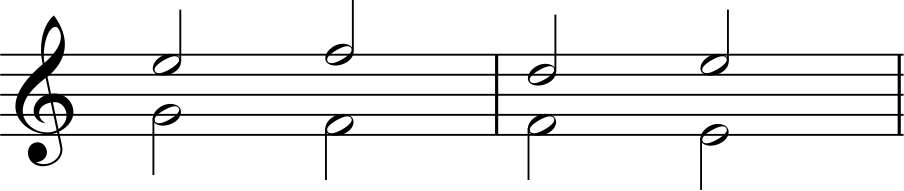
Figure 1a. Typical motion of the cantizans (upper voice, moving one step up) and tenorizans (lower voice, moving one step down). Meier 1988: 91).

Figure 1b. A clausula vera ternary suspension, consisting of cantizans and bassizans. Meier: 1988: 91).
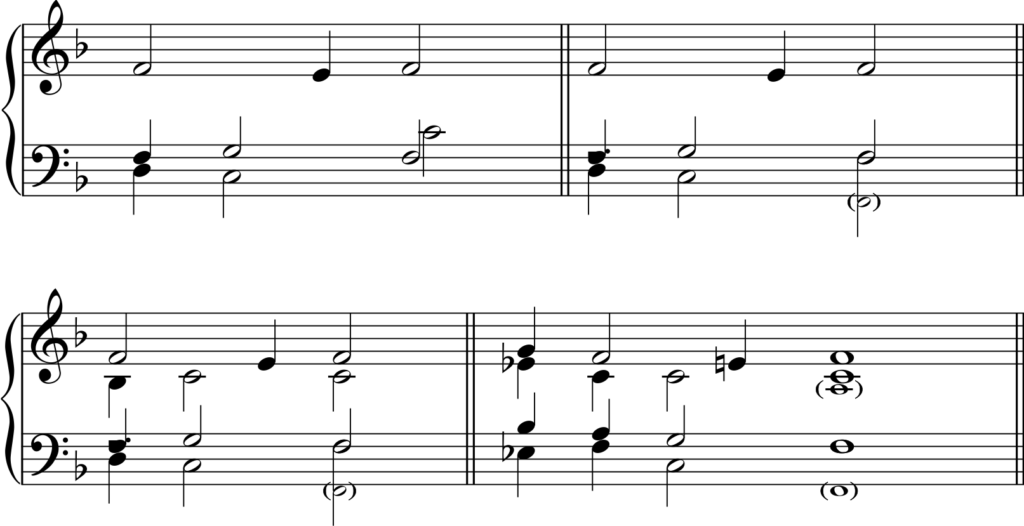
Figure 1c. Typical combinations of cantizans, tenorizans and bassizans in a three-voice texture (upper example), and with an added altizans in four-voice texture (lower example). Meier 1988: 93).
The challenge in analyzing cadences, then, lies in the process of 1) finding a definition that suits the research questions, and 2) locating actual cadences and explain or interpret their function in the actual piece. Computer software may help the researcher to analyze cadential patterns and structures in an unbiased way, regardless of aural perception or experience-based expectations. Making a computer search for cadential voice functions or cadence patterns in an encoded music file requires the researcher to define in detail what should be regarded as a cadence in the actual case, and what should fall outside of the definition. The computer challenges the researcher’s prejudices, and often finds unexpected results. An unexpected result may provide new information, or another exemption from the defined rule, which could then be fed into the software to make it ‘learn’ and redefine the search criteria. This article explores ways in which the CRIM project and its interactive Intervals software can do just that. In the following section, I will explain and discuss the software before going on to exploring a methodology for analyzing cadences in the particular corpus of In Nomines.
CRIM Intervals and Cadence Problematics
Important for the internal workings of the Intervals software and code is the concept of contrapuntal modules as discussed primarily by Antila and Cumming (Antila and Cumming 2014) and Schubert and Cumming (Schubert and Cumming 2015). A contrapuntal module is a two-voice combination of successive vertical intervals. Describing the first interval, thereafter the melodic motion of the lower voice followed by the second vertical interval resulting from that motion, the melodic motion of the upper voice can thus be extrapolated. In Figure 2, quoted from Schubert’s and Cumming’s article, these n-grams can be seen in the triangles below the staff. In CRIM Intervals, a simple clausula vera as seen in Figure 1a would have the 2-gram 6_-2, 8, where the first number corresponds to the first interval, the second number to the melodic motion, and the third number to the resulting interval.
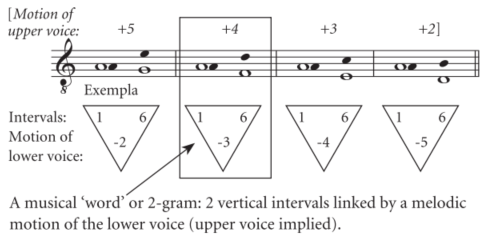
Figure 2. Two-voice contrapuntal modules explained as a series of vertical intervals resulting from the melodic motion of the lower voice. Image quoted from Schubert and Cumming 2015: 578.
The CRIM Intervals is an online, open-source software designed and developed as a Python library by Freedman et al (Freedman et al 2020–). As the authors explain, “CRIM Intervals builds on the foundation of Music21, and like Music21 works with encoded scores in a variety of formats (MEI, MusicXML, Midi, etc.). It works in local terminal versions, but also is available in a series of user-friendly Jupyter Notebooks” (Morgan, Russo-Batterham, and Freedman). In short, one is able to upload an encoded score to a Jupyter Notebook and perform various analyses with commands in Python code.
The definitions of the different CVFs in CRIM Intervals are based on those introduced by Bernhard Meier (1988, 89–101) and presented above. The cadence identifier code and labeling system in CRIM Intervals are written and defined by Alexander Morgan (Morgan 2023). Morgan’s cadence definitions are based on his earlier research of ternary suspensions, where a tenorizans or bassizans creates a dissonance with a syncopated cantizans or altizans. If ending with a perfection, these ternary suspensions are ‘largely synonymous with cadences’ (Morgan 2019, 52). Similarly, in at least English Renaissance terminology the word ‘cadence’ often referred to a syncopation itself (Herissone 2000: 158; Morley 1597: 144; Owens and Freedman 2023). In CRIM Intervals, then, cadences are defined as ternary suspensions, and a cantizans is always syncopated. Non-syncopated cadences are currently not detectable in the cadence finder, as it is difficult to distinguish these events from other contrapuntal modules with the same content (Morgan 2023).
The cadence finder labels CVFs as they occur in the cadence. For example, the ‘CT’ label corresponds to a standard cantizans-tenorizans cadence where the cantizans is above the tenorizans. If the position of the two voices is reversed, the label will be ‘TC’. However, cadential voices are often ornamented, they can evade their target note, or sometimes even drop out completely. To find irregular motion in a cadential voice, the cadence finder builds on a library of examples from the Renaissance repertoire. Thus, additional labels corresponding to irregular or evaded motion in the different cadential voices make it easy to see and analyze the cadence’s internal structure. For instance, whereas the label ‘C’ is given to a cantizans motion, ‘c’ is given to an evaded cantizans, and ‘y’ to a cantizans that drops out right before reaching the potential octave or unison. For the definition of all the different CVF labels, see Figure 3.
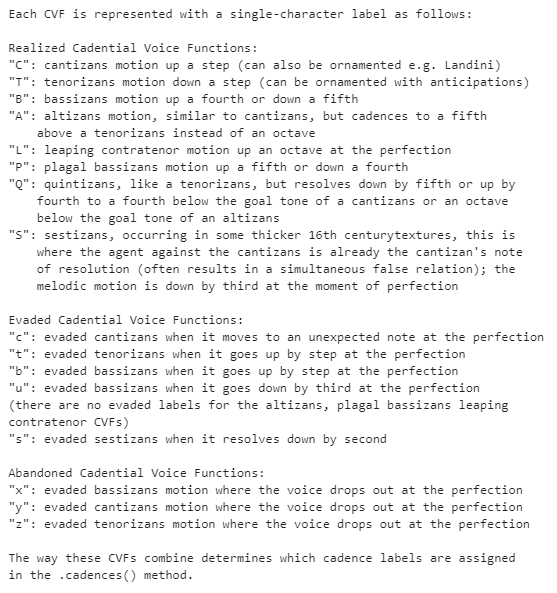
Figure 3. Label definitions of different cadential voice functions in CRIM Intervals, from https://github.com/HCDigitalScholarship/intervals/blob/cd87155ebadfc8ee2832ea287a338a145f57c1d5/intervals/main_objs.py#L1647
CRIM Intervals also assigns different cadence labels to the different combinations of cadential voice functions that are found in each cadence. Two basic labels are, for example, the Authentic cadence (with a realized or evaded bassizans voice function) and the clausula vera (the typical cantizans–tenorizans cadence seen in Figure 1b). Even if a cantizans–tenorizans pair of voices are present in the cadence, the code will classify it as Authentic if a bassizans is also present. The same goes if any of the upper voices are evaded. Thus, a choice has been made to redefine the cadence from a two-voiced structure based on the typical tenor and cantus motions to that of three voices. At the same time, however, the importance of the tenorizans is removed. This choice might not equal the choice another researcher would make. The issue is also discussed by Fromson, who problematized Karol Berger’s definition of the Renaissance cadence as essentially a two-voice structure. Fromson pointed out that the disadvantage with such a definition appears when ‘two two-voice cadences seem to occur simultaneously’, that is, when the 1-7-1 formula is combined both with the 2-1 and 5-1 formulae (Fromson 1991: 189). How should these situations be labeled? How is a ‘CTB’ cadence different from a ‘CB’ cadence? How to define these textures is probably a matter best discussed in relation to the music in question rather than decided upon in advance. Therefore, I will now move on to look at the cadential structures in actual repertoire.
In Nomine repertoire
As the name ‘Citations: the Renaissance Imitation Mass’ indicates, the Imitation Mass tradition of the sixteenth century constitutes the main body of repertoire to be analyzed within the CRIM project. Above this choice of repertoire, however, the project is driven by a central question about similarity in music. More specifically, it ‘grapples with allusive relationships among musical works of the sixteenth century, and with the challenges of modeling scholarly annotations of these connections in the digital domain’ (Freedman: 2018-2022). In this article, I explore the way the CRIM Intervals software is able to analyze repertoire outside of the intended repertoire but still inside the question of similarity in music. By working with the English so-called In Nomine repertoire, I will show that Intervals is indeed capable to extract and present very useful information of other genres than the Imitation Mass tradition, aiding researchers in analyzing large corpora of digitally encoded music.
Although the In Nomine corpus is not part of the Imitation Mass tradition per se, it is still part of a tradition where imitation and intentional borrowing of composed material played a large role in its creation and proliferation. Whereas imitation or parody masses mostly used motets as models to imitate, the In Nomine tradition did the reverse: modeled a new composition on the framework of a movement of one single mass. Following the setting of the words ‘In nomine Domini’ by John Taverner in his mass Gloria Tibi Trinitas, English composers of the sixteenth century began to write instrumental – or perhaps rather, textless – works based on the cantus firmus of the Taverner setting (see Figure 4). As Zoe Tall Weiss argues, ‘instrumental’ composition is a different thing compared to the sixteenth-century In Nomine repertoire, which was ‘circulated in manuscripts … that compile textless music, and it is only in the early-seventeenth century that they become associated with the performance tradition of aristocratic viol consort playing’ (Tall Weiss 2021: 92–93). Extant compositions amount to more than 150 works by 58 composers, ranging from four to seven voices. In this essay I have limited myself to analyze only four-voice works. An equal number of voices makes it easy to compare voice roles and textures, and the majority of these four-voiced pieces are composed within the sixteenth century. As is argued by Zoe Tall Weiss in her dissertation on the In Nomine repertoire, the extant sixteenth-century In Nomine works seems to have been composed in two waves: the first one in the 1550s–1570s, and the second in the 1590s–early 1600s (Tall Weiss 2021: 37). Thus, the repertoire is chronologically coherent with very few exceptions. While Tall Weiss in her study chose to exclude works from any composer born after 1575, this choice makes less sense in my own study, as it would apply only to three composers of four-part In Nomines: Orlando Gibbons (1583–1625), John Ward (c1589–1638), and Thomas Weelkes (1576–1623). Ward’s In Nomines stick out stylistically as they are written in faster note values and seem to have more leaps that would be awkward for a singer. I have still chosen to include them in the corpus as it seemedinteresting to compare them to the other pieces. Thus, my corpus consists of 34 In Nomines by 22 composers (see full list in the Appendix).
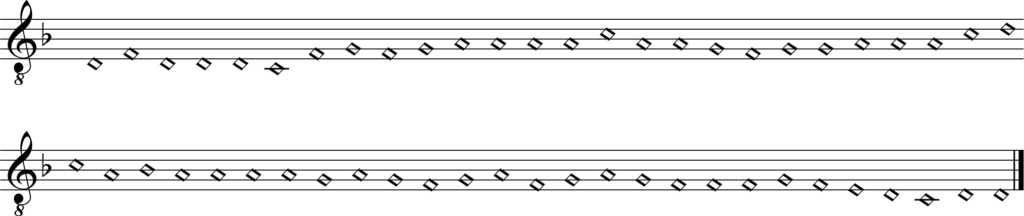
Figure 4. The In Nomine cantus firmus, originally the chant Gloria tibi trinitas from the Sarum rite.
Tall Weiss analyzed the music from social and intertextual contexts, also looking at its function as a bridge between vocal and textless polyphony. As she has suggested, composing an In Nomine in the sixteenth century meant to compete with and respond to works by other composers, signaling ‘membership within both a compositional lineage that connects to John Taverner and other pre-Reformation composers and a contemporary community of professional musicians’ (Tall Weiss 2021: 11). Analyzing cadences within this repertoire may thus reveal traces of these compositional conversations and borrowings as well as reaching a better understanding of how cadences was used structurally and functionally.
Defining a cadence
For this study, I take the cadence definitions by Thomas Morley in his A Plaine & Easie Introduction to Practicall Musicke (1597) as a point of departure. When explaining cadences, it seems Morley is first and foremost describing a typical syncopated cantizans motion: ‘A cadence we call that, when coming to a close, two notes are bound together, and the following note descendeth’ (Morley 1597: 73). However, while a cantizans is defined by Meier as the voice reaching the octave by an ascending step, Morley, strictly speaking, is focusing on the syncopation before the perfection (Example 1). So when the student Polymathes presents the Master a composition not making use of such a syncopation formula, the Master complains that ‘you haue left out the Cadence at the close’, explaining that ‘a Cadence must alwaies bee bound or then odde, driving a small note through a greater which the Latins … call Syncopation’ (Morley 1597, 151–52). Thus, the structure known today as a cadence, Morley calls a close. And Morley’s ‘cadence’ would be the suspension leading to a ‘close’. (For a deeper study of Morley’s cadence examples, see Owens and Freedman 2023 in this collection.)
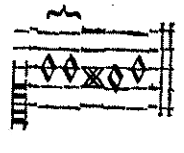
Example 1. Morley’s definition of a cadence.
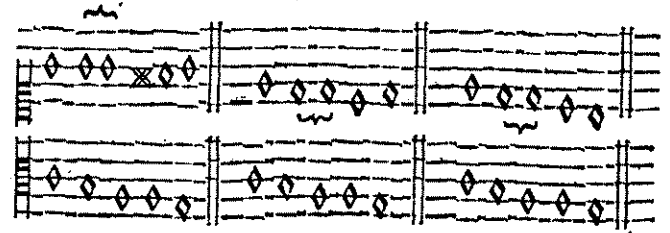
Example 2. Morley’s ‘examples of well taking a discord with a Cadence’.
Morley also states that ‘there is no comming to a close, speciallie with a cadence without a discord, and that most commonly a seventh bound in with a sixth when your plainsong descendeth’ (Morley 1597: 73). Here Morley describes a common clausula vera cadence with a seventh resolving to a sixth before going to the octave (Example 2). Later in the text he adds that the ‘best way of closing’ is with a bassizans-cantizans close, seen in Example 3, where the lower voice descends a fifth (or ascends a fourth) to form an octave with the upper voice (Morley 1597: 74). Morley is, by the way, not alone in describing the clausula bassizans in terms of the best way to form a close – Dressler in 1563 and Burmeister in 1606 make similar statements (Meier 1988: 93).
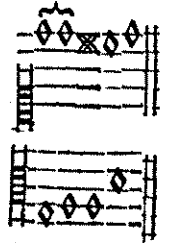
Example 3. The ‘best way of closing’ according to Morley.
It is also clear that Morley prefers a cantizans with a syncopation. In the part explaining composition in three voices he says: ‘without a Cadence in some one of the parts, either with a discord or without it, it is vnpossible formallie to close’. And although it is possible to write a syncopation without a dissonance, Morley clearly discourages it, calling it a fault ‘not so grosse, and yet must be told’.
Taking Morley’s definitions into consideration, then, working with a corpus of In Nomines, CRIM Intervals and the cadence finder, I have tried to answer the following questions:
- What kind of cadences can we see in this corpus? What typical CVFs are used, and in what combinations?
- How is Morley’s ‘best way of closing’ used in the repertoire? Which are the final tones of these cadences?
- What common cadential features can be found between the works of the corpus?
I have not focused on cadence labels like Authentic or clausula vera, as I judged it more important to show the individual combinations of CVFs in each cadence.
Analysis
This In Nomine project consisted of three phases. First, a small test corpus of five compositions was created. These were selected to reflect a range of techniques and styles, and included the In Nomines by Taverner, Tye, Tallis #1, Preston, and Gibbons. The pieces were transcribed in Sibelius software and then exported to MusicXML format, which can be read by CRIM Intervals. The second phase consisted of double-checking the output of the analysis of the test corpus with a manual analysis carried out beforehand. Any false positives (what the software identified as a cadence but I did not) or false negatives (what I identified as a cadence but the software did not find) was then reported and discussed with Alexander Morgan, who added the modules of the false negatives to the library of cadence definitions in CRIM Intervals. The third phase consisted of transcribing all the remaining 29 In Nomines, adding them to the corpus and performing analysis with the cadence finder. This way, I hoped to find cadence formulas that were not yet implemented in CRIM Intervals, but could be added so to get a more complete picture of the cadences in the larger corpus.
In the first analysis of the smaller test corpus, the computer found 32 cadences. In the manual analysis, I recognized another 19. The reason that the Intervals software did not find these cadences mostly had to do with certain cantizans ornamentations that were yet to be added to the list of patterns used by the computer.
False negatives
One of several ornamentation patterns among the false negatives was a typical ‘under-third’ cadence found in Taverner’s In Nomine at m. 21 (Example 4). There seemed to be at least one similar cadence in Gibbons’s piece at m. 41, though slightly varied rhythmically. I was later able to use the CRIM Intervals modules tool to search the whole corpus for the Taverner ornamentation, which resulted in a few more hits. Perhaps most interesting was White’s first In Nomine, which used the exact same ornamentation pattern in an almost identical cadence between the same notes of the cantus firmus (Example 4). Byrd also used it in a phrygian cadence in his In Nomine II, m. 28.
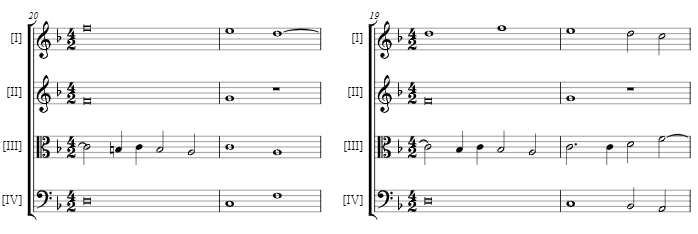
Example 4. Shared ornamentation pattern between Taverner (left), and White # 1 (right).
Another similarity between two false negatives can be seen in Example 5. In Tallis’ piece at m. 51, the two upper voices form a cantizans—tenorizans duo while the bassizans in the bass voice drops out at the moment of perfection. Its role is instead taken over by [III], leaping down a fifth from an A to a D. This might be a way of avoiding parallel octaves with [II]. The cadence finder identifies cantizans (C), tenorizans (T), and bassizans that drops out (x), but the role of voice [III] is complex and was therefore not detected. Glancing over the list of false negatives, I noticed a similar situation in Tye’s In Nomine, m. 43, although in this case Tye did not have to avoid parallel octaves, and he turned the cantus firmus note into an ornamented cantizans.
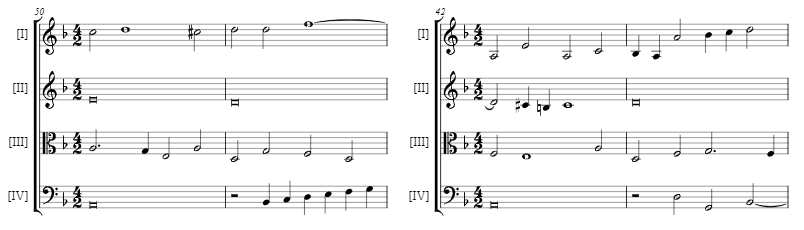
Example 5. Comparison of false negatives in Tallis #1 (left) and Tye (right).
The method of manually analyzing a smaller corpus to find false positives and negatives before dealing with the larger corpus was very fruitful. By adding the false negatives to the list of cadence definitions, there were more hits in the larger corpus as well. The first computer-assisted analysis of the large corpus, which at that time did not include the list of false negatives, resulted in 273 hits. When the list of false negatives were added, a second analysis resulted in 329 hits, which is a twenty-percent increase. A couple of other false negatives was then added before a third search, and the final number of cadences found turned out to be 332 (find the complete output in CSV format here on GitHub: https://github.com/CRIM-Project/Essays_Explorations/tree/main/Bergwall). This number will probably increase when the cadence definitions list is further updated, and it would be interesting at a later point to manually analyze the entire corpus to see how many more false negatives could be found.
Filtering the results
The CRIM Intervals cadence finder does not only check for cadences involving cantizans, tenorizans and bassizans, but also label certain altizans cadences. As Morgan (2019) has described, cantizans and altizans are both classified as patients in an agent-patient syncopation formula, where the agent, such as the tenorizans or bassizans creates the dissonance. In such a formula, either one of the patient voices can together with an agent form a syncopation dissonance identified as a cadence by the cadence finder. As I am looking at closes per Morley’s definition, I do not consider cadences without a cantizans. Thus, I used the Jupyter notebooks to filter out the altizans cadences. The total number of cadences was then reduced to 311.
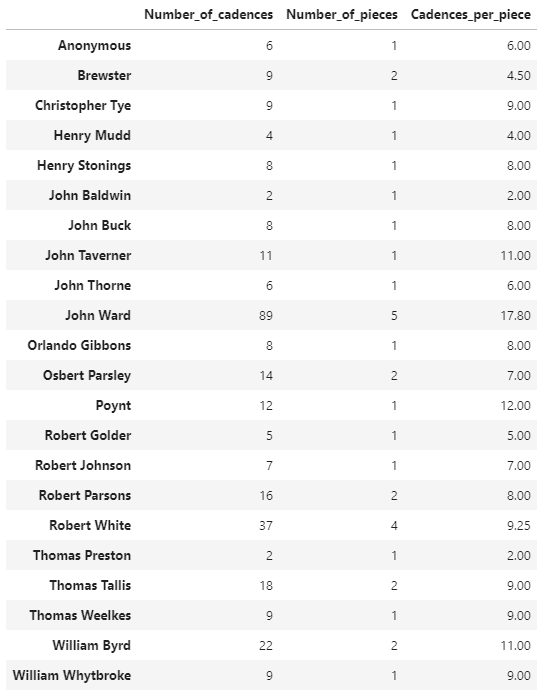
Figure 5. Number of cadences grouped by composer. Picture from notebook in CRIM Intervals.
Grouping composers’ cadences by number, as seen in Figure 5, we can see a high density of cadences in the compositions by John Ward, and almost no cadence at all in the In Nomines by Baldwin and Preston. This is connected to the compositional style. Ward often builds his In Nomines on modules with repeating dissonant suspensions (Example 6a), while for example Baldwin experiments with rhythmic figures in consonant counterpoint (Example 6b). As mentioned above, Ward’s pieces can be useful as a comparison to the earlier In Nomines. To make for a more balanced comparison among the more chronologically and stylistically coherent pieces, however, I chose to exclude Ward’s cadences in the dataframe. This reduced the number of cadences further to 222.
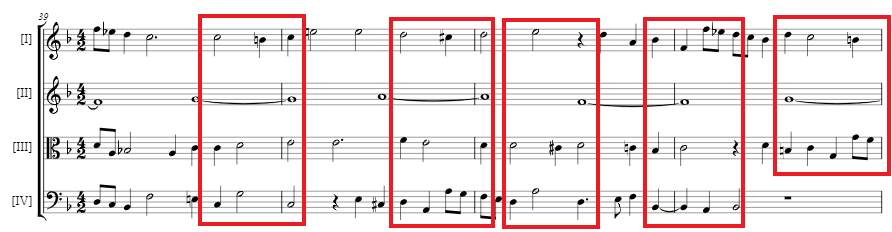
Example 6a. Frequently occuring cadences in Ward #1.
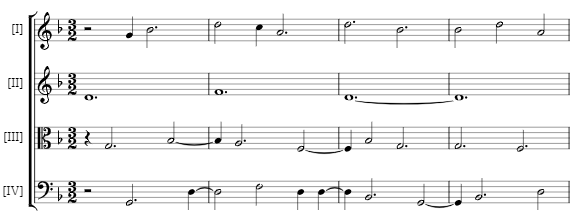
Example 6b. Consonant counterpoint in Baldwin #1.
Examples of certain CVF combinations
The possibility to group the data according to different parameters is one of the big strengths of CRIM Intervals and Jupyter notebooks. What kind of cadences, for example, can be found in this corpus? Grouping the cadences by types in CRIM Intervals, we can see that the clausula vera unsurprisingly has more than twice the occurrences of the authentic cadence (Figure 6a). We can learn more if we group the clausula vera by composer, as done in Figure 6b. However, this does not tell us much about the internal relations between CVFs, which might be more interesting from a structural point of view. In the cadence finder’s dataframe seen in Figure 7, there are more details that can explain the internal structure of the cadences. The CVFs column is particularly interesting, as it displays the labels of the cadential voice functions.
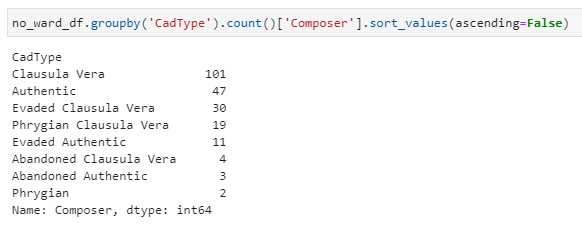
Figure 6a. Cadence types in the corpus.
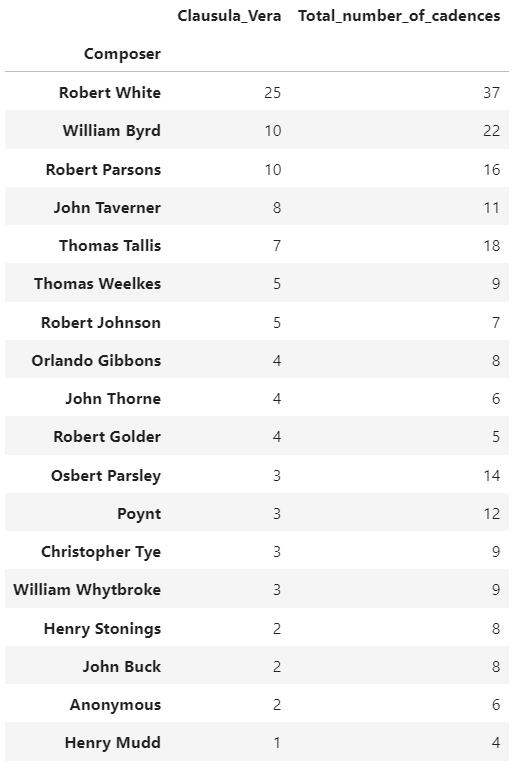
Figure 6b. Clausula vera cadences in different composers’ In Nomines

Figure 7. First rows of the cadence finder’s outputted dataframe
In some cases, the cadence finder was unable to identify a cadence tone, which can be seen in Figure 7, index row 4, ‘Tone’ column. This occurs when the cantizans (or altizans) evades its goal tone. I noticed that several cadences having no Tone had the CVF combination ‘Tc’; a tenorizans above an evaded cantizans. Most of these cadences were instances of a relatively weak suspension where the cantizans is a punctuated minim moving down by step. In Example 7, this occurs in voices [I] and [III]. The target note for this cadence would be D, but D is already in the bass. This would probably not be perceived as a cadence by anyone, but it might be argued that it is still a cadential structure realized within a bigger texture. What instead might be perceived as a cadence is the non-dissonant 3_-5, 8 module between voices [II] and [IV], both reaching an octave in m. 10.
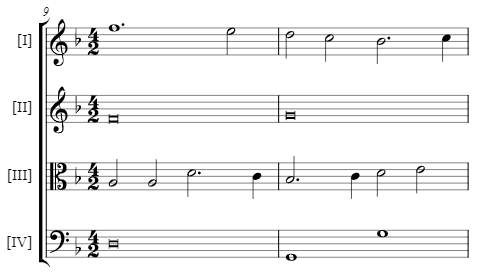
Example 7. Evasion of cantizans below tenorizans in Byrd #1, m. 9-10.
In contrast to ‘Tc’, ‘cT’ usually indicates a regular clausula vera where the cantizans is evaded by an upwards leap of a fourth. In Ward #3, m. 51, the cantizans leaps a tritone from C-sharp to F while the cantus firmus stays put on an A, which may be another sign of his instrumental style. As seen in Examples 8a-c, Anonymous, Johnson and Parsons all leap from F to B-flat when the cantus firmus goes from C to D (all pieces have transposed cantus firmi in the top voice). Parsons in his first In Nomine, m. 26 also leaps from C to F, here as a part of the cantus firmus. Thus, it seems composers would evade a cantizans in different ways depending on its position above or below the tenorizans. There may of course be other kinds of evasions when other CVFs are present as well.
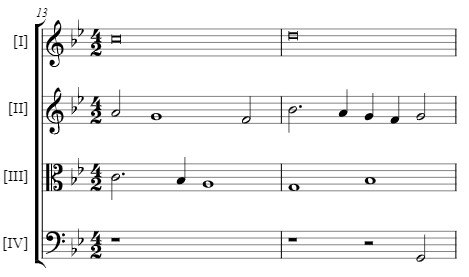
Example 8a. Evasion of cantizans in Anonymous, m. 13-14
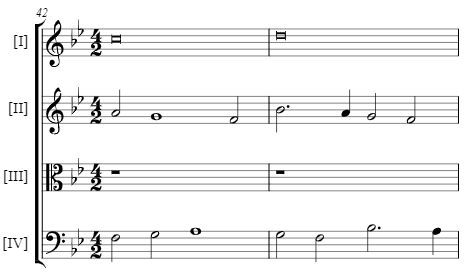
Example 8b. Evasion of cantizans in Johnson, m. 42-43
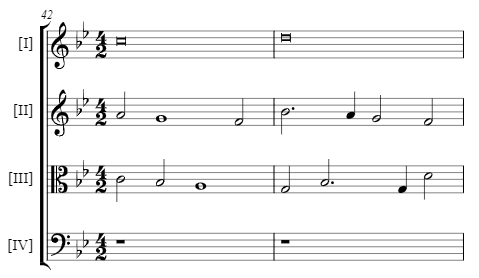
Example 8c. Evasion of cantizans in Parsons #2, m. 42-43
As the current cadence finder in CRIM Intervals looks for suspension-based cadential formulae, punctuated figures such as that in Example 9 also get defined as cadences. This kind of module does not have the same cadential weight as when the moment of perfection occurs on a metrically strong position and the syncopated note is not cut short. In Example 9, m. 33 is a varied repetition of m. 32; the difference being the ornamented cantizans. In the world of Morgan’s cadence finder, this makes all the difference, as m. 32 does not contain any suspension. Seeing that m. 33 is a varied repetition, however, it is easy to argue that the true resolution to the E occurs on the third beat in the measure instead of the second, as is indicated by the cadence finder.

Example 9. Detected cadence in Tallis #1 at m. 33, second beat.
One question remaining from looking at the false negatives in Example 5 was if there are more cases of tenorizans switching function to bassizans halfway, creating a 2-5-1 motion. This is tricky to investigate in the cadence finder, as the tool only finds bassizans that acts as agents in a dissonant suspension. Instead it is useful to search for the module 7_4, 3_-5, 8 or its compound intervals. This search will not pick up any evaded motions, and the only match found was indeed limited to the Tallis cadence already mentioned. Searching for evaded motions, found by just entering the module 7_4, 3, yielded a couple more results. One was found in Tallis #2, voice [III], m. 16-17 (Example 10a). In this case the 2-5 motion is a result of ending a phrase on the first beat, then leaping up a fourth to start a new soggetto. There would be no sharped C in voice [I], as it would result in a leap of a diminished fourth to F in the next measure. Nevertheless, voice [III] turns out to be a tenorizans switching to bassizans as it ends up leaping down a fifth at the first beat of m. 17. Another 7_4, 3 module was found in Ward #2, m. 22-23 (Example 10b). Here the bassizans motion is evaded in voice [III], while completed in voice [IV].

Example 10a. Switch from tenorizans to bassizans in Tallis #2.

Example 10b. A 7_4, 3 module in Ward #2.
Non-dissonant suspensions and Morley’s ‘best way of closing’
Although most bassizans indeed function as agents in a ternary suspension formula, there will sometimes be voices performing a non-dissonant bassizans. Is there a way of searching for these non-dissonant suspensions? Using the tools available in CRIM Intervals, I was able to create a Jupyter notebook that searched my corpus for these particular instances. This notebook can be downloaded via GitHub: https://github.com/CRIM-Project/Essays_Explorations/tree/main/Bergwall. As seen in Figure 8, the search combined three different methods. First, I searched for a combined durational ratio and melodic 2-gram that corresponded to a cantizans suspension. The durational ratio between a syncopated semibreve and a minim is ½=0.5. The durational ratio between the minim and next note could be anything, as I wanted to allow for any note value at the moment of perfection. This was then combined with a search for modules corresponding to 3_-5, X, where X could be any interval. This method worked very well, and catched also all the normal bassizans detected by the cadence finder. As seen in Figure 8, a search with this notebook created a table with the pitches and voices of the bassizans and corresponding cantizans. After filtering out the normal bassizans, I was left with seven hits, listed in Examples 11a-g below. Granted, this search does not find instances where the cantizans is ornamented or otherwise metrically irregular. My notebook should be seen as a test, however, and it would be interesting to develop it further.
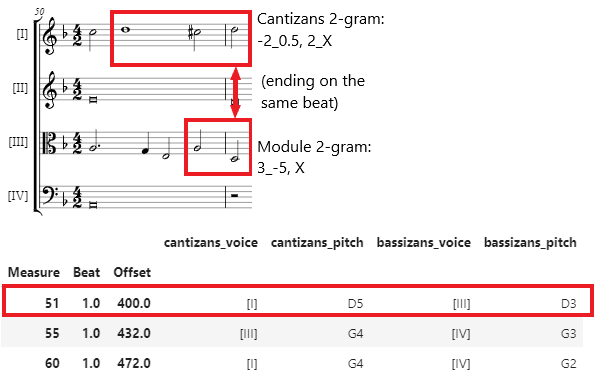
Figure 8. Combining two search methods to find non-dissonant bassizans.
The non-dissonant bassizans in Examples 11a-g show different characteristics, and they do not seem to have much in common. In Parsley and Tye, the bassizans voice enters as a soggetto. In Buck, Parsons, and Thorne, the bassizans note is approached by step from below. These and other similarities are common contrapuntal patterns, so the benefit of the non-dissonant bassizans search would perhaps primarily be to detect bassizans not detected by the cadence finder.
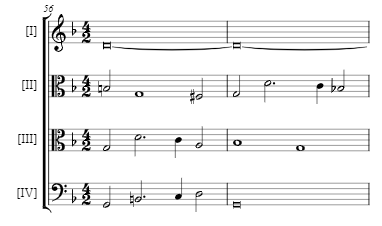
Example 11a. Non-dissonant bassizans in Buck, m. 56-57
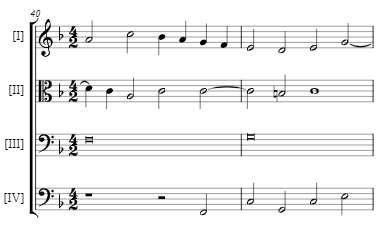
Example 11b. Non-dissonant bassizans in Parsely, m. 40-41
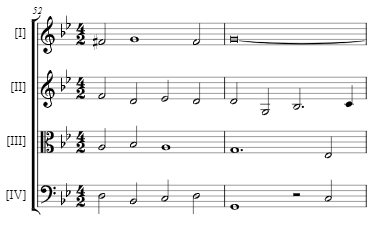
Example 11c. Non-dissonant bassizans in Parsons #1, m. 52-53
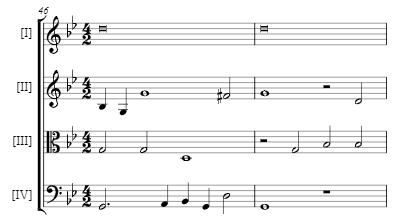
Example 11d. Non-dissonant bassizans in Parsons #2, m. 46-47
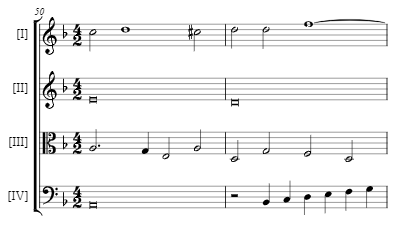
Example 11e. Non-dissonant bassizans in Tallis #1, m. 50-51
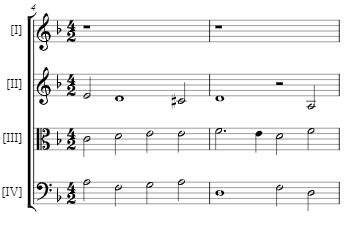
Example 11f. Non-dissonant bassizans in Thorne, m. 4-5
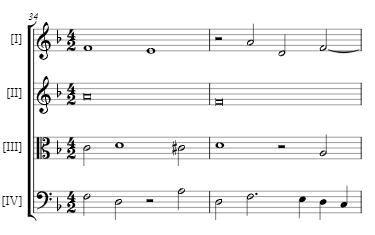
Example 11g. Non-dissonant bassizans in Tye, m. 34-35
Where in the pieces do Authentic cadences occur? The scatterplots in Figure 9 were made in Jupyter notebooks based on the data from the cadence finder. All In Nomines are about the same length, so a rough visualization of when cadences occur is seen along the x-axis. One might have expected to find cadences with bassizans CVF more towards the end, but it seems they are quite evenly distributed. There are some Authentic cadences to G in the last measures, which might involve a plagal cadence in the pieces with one flat in the signature, or the final chord in pieces with two flats in the signature. There are also several instances of clausula vera leading to G in the final measures. D is quite naturally the most common cadential tone overall, but Authentic cadences in D seem to be concentrated to the middle of the pieces compared to clausulae verae in D, that are evenly distributed.
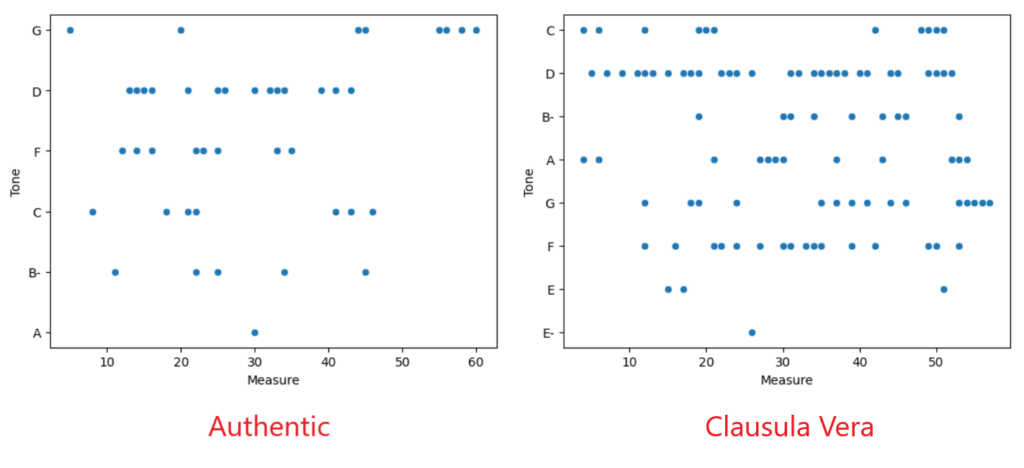
Figure 9. Tones and positions of Authentic cadences and clausula vera
Conclusions
In this study, I have exemplified ways of analyzing a corpus of music using CRIM Intervals and its cadence finder. The article is by no means meant to be an exhaustive study of either the cadence finder or the In Nomine corpus, but rather show how I have worked with CRIM tools and explored how I could use them to answer my questions.
It is my experience from working with these tools that CRIM Intervals challenges the bias of the researcher. If I have searched for a particular cadence and ended up getting modules that I did not consider cadences, I have had to reflect upon what definitions I am using. Usually, it is not the machine that is dumb, it is I that have to adjust my search parameters.
The cadence finder is a powerful tool, and it will become even better as more and more pieces are analyzed and false negatives reported. It would be useful to develop a cadence finder that detects non-dissonant and non-syncopated cadences as well, and that can work in tandem with the module-based cadence finder. My notebook finding non-dissonant bassizans is one attempt of this, and I believe it can be easily further developed to catch also ornamented cantizans and non-dissonant tenorizans. The notebook developed by Owens and Freedman (2023) is another attempt. When attempting additional module-based search operations together with examples 10a and 10b, I became aware that using module search to find certain cadential motions can not be done without some difficulty. The main problem is passing tones or ornaments breaking up the sought-after module. It would probably be possible to avoid this problem to a certain extent by limiting the search to find notes only at certain metric intervals.
The output dataframe from the cadence finder contains a lot of information, and it is easy to combine and group these data in various ways. Research questions are great to have as a point of departure, but I found that by just glancing over the dataframe, or filtering it in various ways, new questions were prompted and new connections became visible. Thus, it would be interesting to keep investigating how CRIM Intervals could aid music research going forward.
Appendix: List of pieces in corpus
| Composer | Title | Transcribed from |
| Anonymous | In Nomine | MB 44 |
| Baldwin, John | Upon In Nomine | MB 45 |
| Brewster | In Nomine I | MB 44 |
| Brewster | In Nomine II | MB 45 |
| Bucke, John | In Nomine | MB 45 |
| Byrd, William | In Nomine I-II | TByE 17 |
| Gibbons, Orlando | In Nomine | MB 48 |
| Golder, Robert | In Nomine | MB 45 |
| Johnson | In Nomine | MB 1 (2011) [#45a] |
| Mudd, Henry | In Nomine | MB 44 |
| Parsley, Osbert | In Nomine I-II | MB 44 |
| Parsons, Robert | In Nomine I-II | MB 44 |
| Poynt | In Nomine | MB 44 |
| Preston, Thomas | In Nomine | MB 44 |
| Stonings, Henry | In Nomine | MB 44 |
| Tallis, Thomas | In Nomine I-II | MB 44 |
| Taverner, John | In Nomine | MB 44 |
| Thorne, John | In Nomine | MB 44 |
| Tye, Christopher | In Nomine | MB 45 |
| Ward, John | In Nomine I-V | MB 83 |
| Weelkes, Thomas | In Nomine | MB 45 |
| White, Robert | In Nomine I-IV | MB 44 |
| Whytbroke, William | In Nomine | MB 44 |
MB = Musica Britannica
TbyE = The Byrd Edition
References
Antila, Christopher, and Julie Cumming. 2014. “The VIS Framework: Analyzing Counterpoint in Large Datasets.” In Proceedings of the 15th International Society for Music Information Retrieval Conference, 71–76.
Berger, Karol. 1987. Musica Ficta: Theories of Accidental Inflections in Vocal Polyphony from Marchetto Da Padova to Gioseffo Zarlino. Cambridge: Cambridge University Press.
Freedman, Richard. 2018-2022. “CRIM: Citations: The Renaissance Imitation Mass Project.” Accessed December 17, 2022. https://crimproject.org/about/home/.
Freedman, Richard, Alexander Morgan, Freddie Gould, Oleh Shostak, Trang Dang, et al. 2020-. “CRIM Intervals.” Accessed December 18, 2022. https://github.com/HCDigitalScholarship/intervals.
Fromson, Michèle. 1991. “Cadential Structure in the Mid-Sixteenth Century: The Analytical Approaches of Bernhard Meier and Karol Berger Compared.” Theory and Practice 16: 179–213.
Herissone, Rebecca. 2000. Music Theory in Seventeenth-Century England. Oxford monographs on music. New York: Oxford University Press.
Meier, Bernhard. 1988. The Modes of Classical Vocal Polyphony: Described According to the Sources. New York: Broude Brothers.
Morgan, Alexander. 2019. “Renaissance Ternary Suspensions in Theory and Practice.” Intégral 33: 47–71. https://www.esm.rochester.edu/integral/33-2019/morgan/.
Morgan, Alexander. 2023. “Automated Detection of Renaissance Cadential Voice Functions and Cadences” http://richardfreedman.sites.haverford.edu/.
Morgan, Alexander, Daniel Russo-Batterham, and Richard Freedman. “Musicologists and Data Scientists Pull Out All the Stops: Defining Renaissance Cadences Systematically.”.
Morley, Thomas. 1597. A Plaine and Easie Introduction to Practicall Musicke. London: Peter Short.
Owens, Jessie Ann, and Richard Freedman. 2023. “The Rest Is Silence: Thomas Morley’s Concept of the Close.” http://richardfreedman.sites.haverford.edu/.
Schubert, Peter, and Julie Cumming. 2015. “Another Lesson from Lassus: Using Computers to Analyse Counterpoint.” Early Music 43 (4): 577–86.
Tall Weiss, Zoe. 2021. “The Sixteenth-Century in Nomine: Networks of Mobility, Influence, and Intertextuality.” Ph.D. Cornell University.
Supplementary Files:
CSV table of cadences found in the corpus: https://github.com/CRIM-Project/Essays_Explorations/blob/main/Bergwall/Bergwall_innomine_cadences_23-01-16.csv
Jupyter Notebook used in this analysis: https://github.com/CRIM-Project/Essays_Explorations/blob/main/Bergwall/Bergwall_find_non_dissonant_bassizans.ipynb