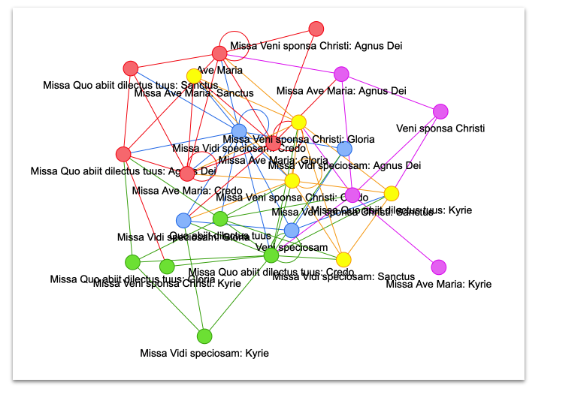
A New Kind of Computational Publication
The two dozen Essays and Experiments assembled here represent the collective insights of a group of scholars–musicologists and data scientists–who over the last three years have been exploring Renaissance counterpoint in novel ways. Above all, our group was interested to explore a series of fundamental questions:
- What is similarity in music?
- How might borrowing and transformation help us understand the rich tradition of Renaissance counterpoint, itself a art of combination and recombination?
- How might digital tools help us to make sense of these practices, and inaugurate new modes of research, learning, and scholarly communication?
Readers unfamiliar with the work of the CRIM Project in recent years might like to read the below about the scope, methods, and tools found these essays. Others might be ready to explore the Essays and Experiments, particularly through the several themes that recur throughout the collection:
- Ars combinatoria: Lorenz, Margot + Schubert, Ory, Tupper
- Building Communities and Mapping Knowledge: Russo-Batterham and Sanfilippo + Freedman
- Cadences: Bergwall, Morgan, Morgan + Russo-Batterham + Freedman, Owens, Winter
- Classroom Connections: Garcia Rodriguez, Taschetti + Toffetti, Cumming + Praskurnin + Margot + Schubert
- English Traditions: Bergwall, Owens + Freedman, Winter
- French Connections: Frisch, Praskurnin
- Iberian Traditions: Cuenca-Rodriguez, Garcia Rodriguez, Puentes-Blanco
- Lots of Lasso: Stroh and Praskurnin
- Madrigals and Masses: Cumming, Ignesti
- Self-Reflections (Lasso, Palestrina and Victoria): Puentes-Blanco, Praskurnin, Sugg, Taschetti + Toffetti
What is similarity in music?
The allusiveness of musical discourse is so fundamental to the Western tradition that it is hard to imagine a work that does not in some way make reference to some other composition, type or topic. Indeed, over the last 1000 years music has continued to reference earlier pieces, from the layered polyphony of medieval motets to the rampant borrowing of George Frideric Handel, from the topical allusions of film music to looped sampling heard in hip-hop. Citations: The Renaissance Imitation Mass (CRIM) focuses on an important but neglected part of this allusive tradition: the so-called “Imitation” or “Parody” Mass of the sixteenth century, in which short sacred or secular pieces were transformed into long five-movement cyclic settings of the Ordinary of the Catholic Mass: Kyrie, Gloria, Credo, Sanctus, and Agnus Dei. The resulting works are far more than collections of quotations. The sheer scope of the transformation required the composer to re-think the model, adapting pre-existent melodies to fit new words, while shifting, extending, or compressing ideas in new musical contexts and to meet new expressive purposes. If counterpoint is a craft of combinations, then the Imitation Mass involves the art of recombination on a massive scale. These works offer an unparalleled way to learn how composers heard (and understood) each other’s music.
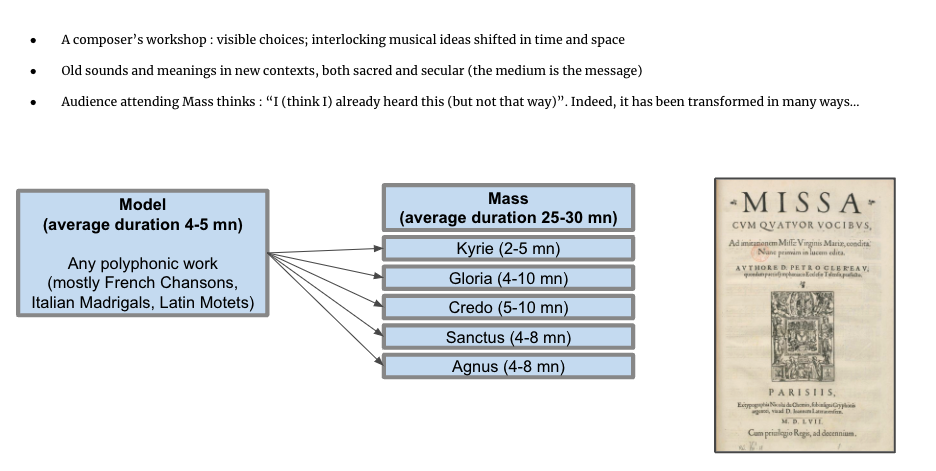
Figure 1: The Renaissance Imitation Mass at a Glance
Why did Mass composers of the sixteenth century borrow in this way? And what effects did such transformations have upon listeners? Clerics like Bishop Cirillo Franco (a cleric associated with the Council of Trent during the 1560s) and St. Peter Canisius (a Jesuit preacher whose teachings were widely read in Renaissance Munich) famously complained of the non-liturgical and even profane influences that might obscure or corrupt the words of the Mass. And yet composers (even figures like Orlando di Lasso in Munich and Giovanni Pierliugi da Palestrina in Rome) persisted in using all sorts of sacred and secular polyphonic models in their Masses. Perhaps composers as well as listeners actually found the interplay between meanings of the Mass and the lyrics of the borrowed material spiritually engaging or even enlightening, as modern scholars (and CRIM participants) David Crook and Jessie Ann Owens have argued. On a purely musical level the composers of Imitation Masses (there are many hundreds of them in the repertory of sixteenth century music) reveal extraordinary inventiveness as they put contrapuntal patterns heard in their models through a series of displacements, recombinations, transformations, and rehearings in the five movements of the Ordinary as they were sung over the course of the larger drama enacted by the Mass itself. No wonder that composers sometimes seem to have competed with each other to see who might make the grandest transformation of a famous model.
Our capacity to measure the Imitation Mass, however, has been dampened by two basic factors: the sheer number of possibilities for contrapuntal elaboration, and the idiosyncratic ways in which individual scholars have sought to explain and exemplify them. The CRIM project, with its digital capacities for managing citations, claims, and counter-claims in a collaborative environment, answers both of these key challenges in ways that will set the stage for the investigation of related corpora as well. It will open the digital investigation of the inner workings of musical counterpoint to new generations of students and emerging scholars, drawing musicologists into conversation with each other, and into collaborative projects with specialists in Renaissance studies, data science and the digital humanities more broadly.
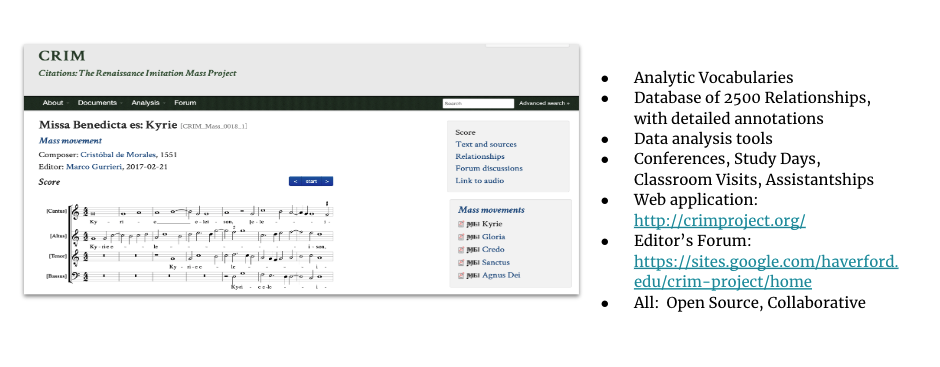
Figure 2: The CRIM Web Application
CRIM During the Last Three years
We first considered these questions in a series of colloquia convened at the CESR in Tours, and in sessions held at scholarly conferences on both sides of the Atlantic, culminating in two workshop conferences during 2022: CRIM@Tours and CRIM@Haverford.
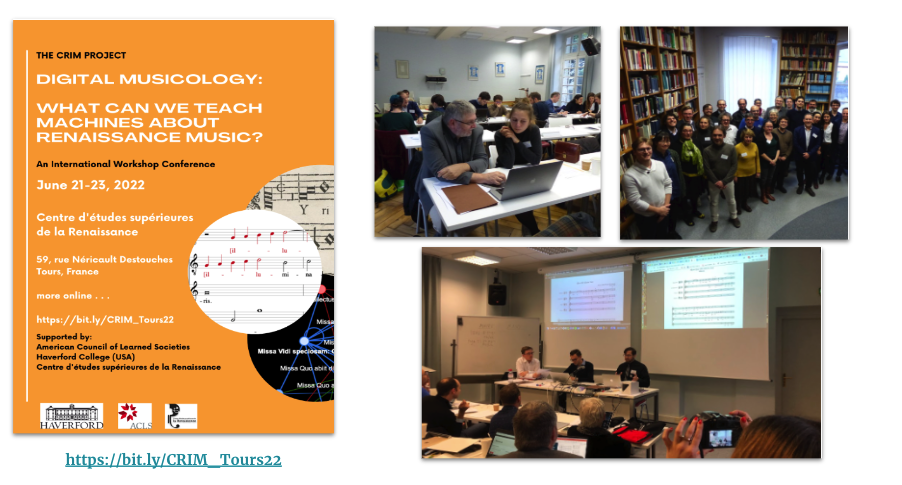
Figure 3: CRIM@Tours June 21-23, 2022
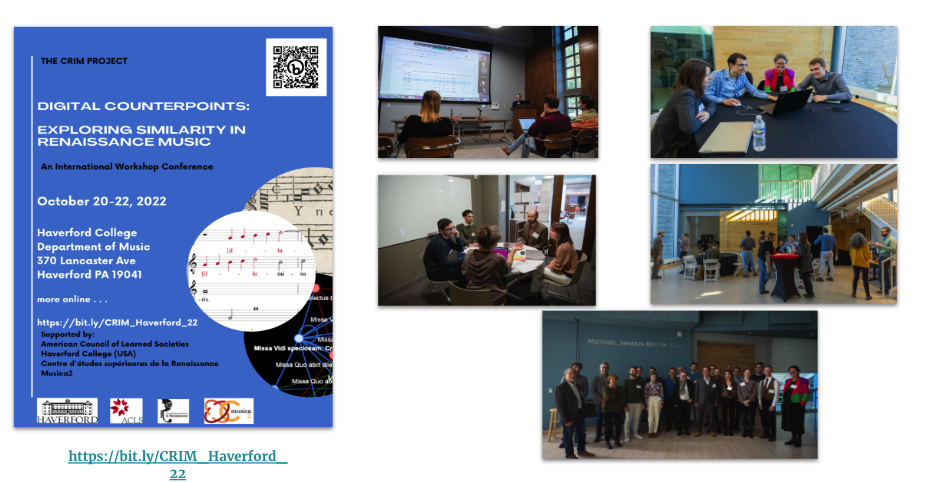
Figure 4: CRIM@Haverford, October 20-22, 2022
Meanwhile we explored developed, and refined a series of digital tools that might advance our work. Thanks by a generous Digital Extensions grant from the American Council of Learned Societies, the last three years have been particularly rich (although whether because or in spite of COVID-19 pandemic is hard to tell). Our initial plans for a quick series of meetings and two summers of analysis were disrupted, of course. But meanwhile, the technical team got busy, and very creative. By the time we were ready to begin recruiting, training and gathering our cadre of participants, the project had acquired some new and unexpected capabilities in the form of CRIM Intervals, which began during the Summer of 2020 with the help of undergraduate Haverford student assistant Freddie Gould. Building on the music21 Python library created by Mike Cuthbert (Massachusetts Institute of Technology), Freddie created the groundwork for CRIM Intervals, which we imagined as a mechanical eye for encoded scores.
At first CRIM Intervals was capable of little more than counting notes. By the start of the Fall 2020 (remote) semester, and under the guidance of Daniel Russo-Batterham in Melbourne and Alex Morgan, we saw a still better pathway ahead that would soon radically transform the work of our human analysts in exciting ways through the use of Pandas: Python for Data Analysis. In the Summers of 2021 and 2022, a total of three more undergraduate students (Trang Dang, Linh Le, and Oleh Shostak), now working in collaboration with independent developer Alexander Morgan (himself an expert on Renaissance counterpoint) turned CRIM Intervals into a powerful engine of collaborative learning, discovery and interpretation. Its presence is felt everywhere in our work, and has produced a palpable sense of excitement among participants wherever we introduce it. And when we at last gathered in Tours (June 2022) and Haverford (October 2022) were particularly productive precisely on account of the palpable need for face-to-face encounters after the long months of isolation. The results of these gatherings (and the many private tutorials sustained on Zoom and Slack) have paid off handsomely in the form of digital publications, classroom encounters, and a strong sense of shared purpose.
The full scope of what CRIM Intervals can do is impossible to describe in detail here, but through its capacity to make quick work of finding notes, rhythms, melodies, harmonies, counterpoint, and even high-level patterns like cadences and points of imitation, it has transformed the work of CRIM analysts (see Figure 5, and the more detailed explanation below and at https://crimproject.org/about/crim_intervals/). Now participants can spend more of their time explaining and interpreting the connections between pieces rather than simply finding the patterns in the first place. And thanks to Pandas and its related suite of data analysis, the possibilities for exploring complex networks of similarity are virtually limitless. These Essays and Experiments testify to the exciting possibilities now before us. It has transformed our work, and quite possibly the analysis of Renaissance music more broadly.
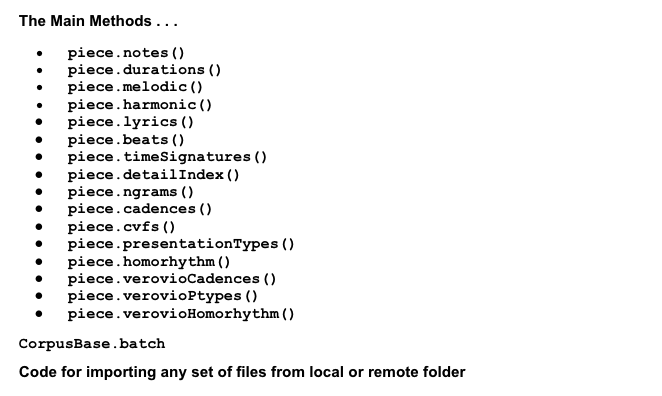
Figure 5. Main CRIM Intervals Methods at a Glance. For illustrations of many of these, see below.
In their recent paper for this collection Sylvain Margot and Peter Schubert aptly described the benefits of working with the CRIM Intervals tools. Through it, they found a way not so much to answer their analytic questions, but rather to expose their own biases. Writing of the inevitable gap between their own stance as modern analysts and that of composers of the distant past, they observe that:
There are two ways to deal with this uncertainty, we could try to read more historical treatises more carefully, or we could try to be more “objective,” that is to find a way not to let our biases interfere, or at least to make them more explicit. In the following pages we take the latter view, interrogating the role the computer might have in the conventional analysis of individual pieces of Renaissance music (as opposed to corpus study). As we will show, it not only makes it easier to answer certain questions, it causes us to reimagine the role of the analyst.
Sylvain Margot and Peter Schubert. 2023. “With Baccusi in the Jacuzzi; or, How I Learned to Stop Worrying and Love Numbers.” CRIM Essays and Experiments, ed. Richard Freedman. Haverford College and CRIM Project.
Margot and Schubert are unique in stating the effect so clearly. But all CRIM participants recognize how digital tools force us to make explicit things we know only implicitly, and through long experience with this music. In playing back the results of our formulations to us, our algorithms make us newly aware of biases we did not know we had. This is another of the frequently contradictory effects of digital work: exposing the human in the machine. These tools cannot think, but they materialize thought in ways that force us to reflect on our own methods. Indeed, the process of “tool criticism” was identified during our CRIM@Tours conference by Professor Frans Wiering (Utrecht University) as perhaps the most interesting and important part of the process (see Wiering’s slides from the CRIM@Tours meeting).
It is thus tempting, as CRIM developer Daniel Russo-Batterham put it in his essay for this collection, to divide the CRIM into “tool creators” and “tool users.” But the dichotomy is better understood as a continuum. It is true, for instance, that CRIM Intervals began as the work of a very few. It is also true that the students and scholars who first encountered the system found it something altogether alien, and decidedly unmusical in its literalism. But even before gaining any sort of technical proficiency in developing the tools themselves, users were ready to offer feedback on what worked well and what did not, shaping debates on where future work should be focussed. And as CRIM Intervals moved to the interactive Jupyter Notebook platform, the interactive process of criticism, experimentation, and improvement became still more rapid.
Such direct involvement in the creation, refinement, and interrogation of tools, has in turn prompted individuals to explore with new methods, and new insights about the music, both in its details and from a distance. These essays and experiments are the first fruits of these efforts.
CRIM Vocabularies
One recurrent challenge throughout the CRIM project was how to balance what we might call the “expressivity” of our concepts (how well they allow users to say what they want about the piece or patterns in question) with their “legibility” (how well they lend themselves to formalized connections with related items in the CRIM ecosystem, and beyond). Debates about the vocabulary of musical types, for example, have often involved long debates about terminology (two researchers call the same thing by different names) or taxonomy (in essence how many categories to use in describing some general category or class). All scholarship relies on common vocabularies. Those of us interested in music theory are endlessly concerned with the terms we use and what they mean: whether they derive from a historically informed understanding of how musicians of the past explained their craft, or whether the concepts are of our own, modern, devising.
But in addition to the value of such common vocabularies for human discourse, the move to the digital domain also obliges us to think about controlled vocabularies: categories that can be modeled as classes and attributes. CRIM participants understood that without these models we could not search our observations very effectively. We also had to balance the needs of accurate discovery (which demands clear-cut definitions and categories) with the need for expressivity (when we need to say something subtle or unique about a passage). Providing an endless number of categories to suit each analyst’s needs will not help, since it overwhelms everyone with choices and risks making each person a kind of intellectual island. And so during some key conversations in the Summers of 2020 and 2021 the editorial team built consensus around options that make the most sense for the stories that CRIM needs to tell: similarity and transformation. Throughout these essays readers will thus encounter a number of recurring concepts from our controlled vocabularies of Musical Types and Relationship Types (they are amply documented in the Editor’s Hub for CRIM). Even for musicologists, the specialized vocabularies of Renaissance counterpoint can be unfamiliar, abstract terrain. Participants nevertheless quickly acclimated to them, and recognized the value that a shared vocabulary holds for any interpretive community.
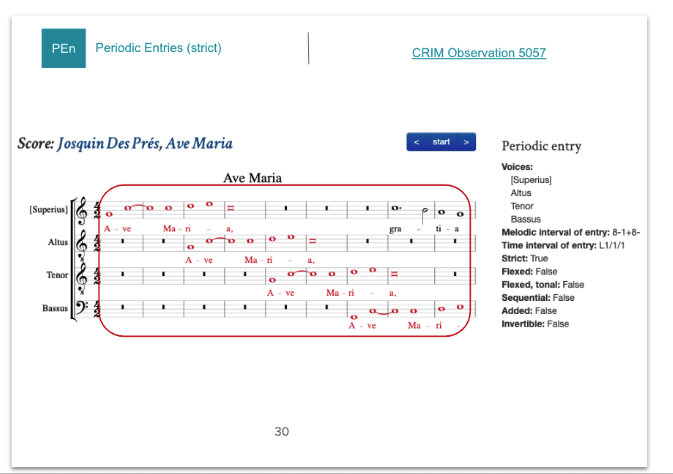
Figure 6: CRIM Vocabularies: A Sample Musical Type
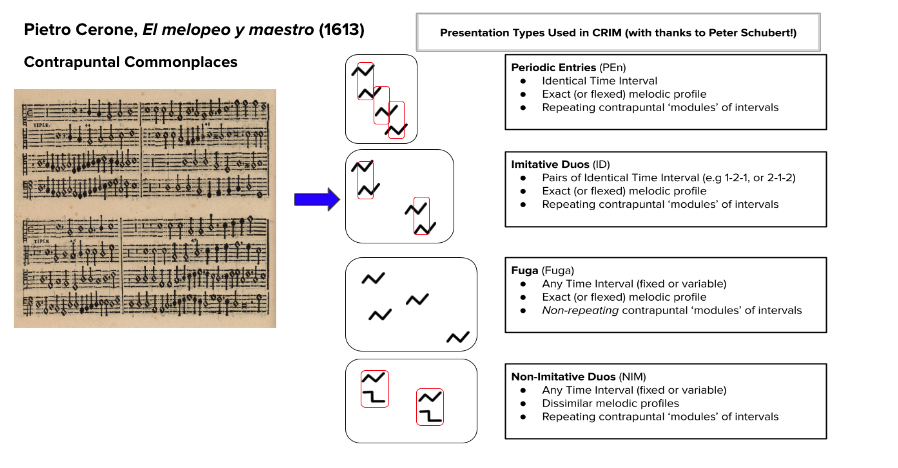
Figure 7: Various Imitative Types
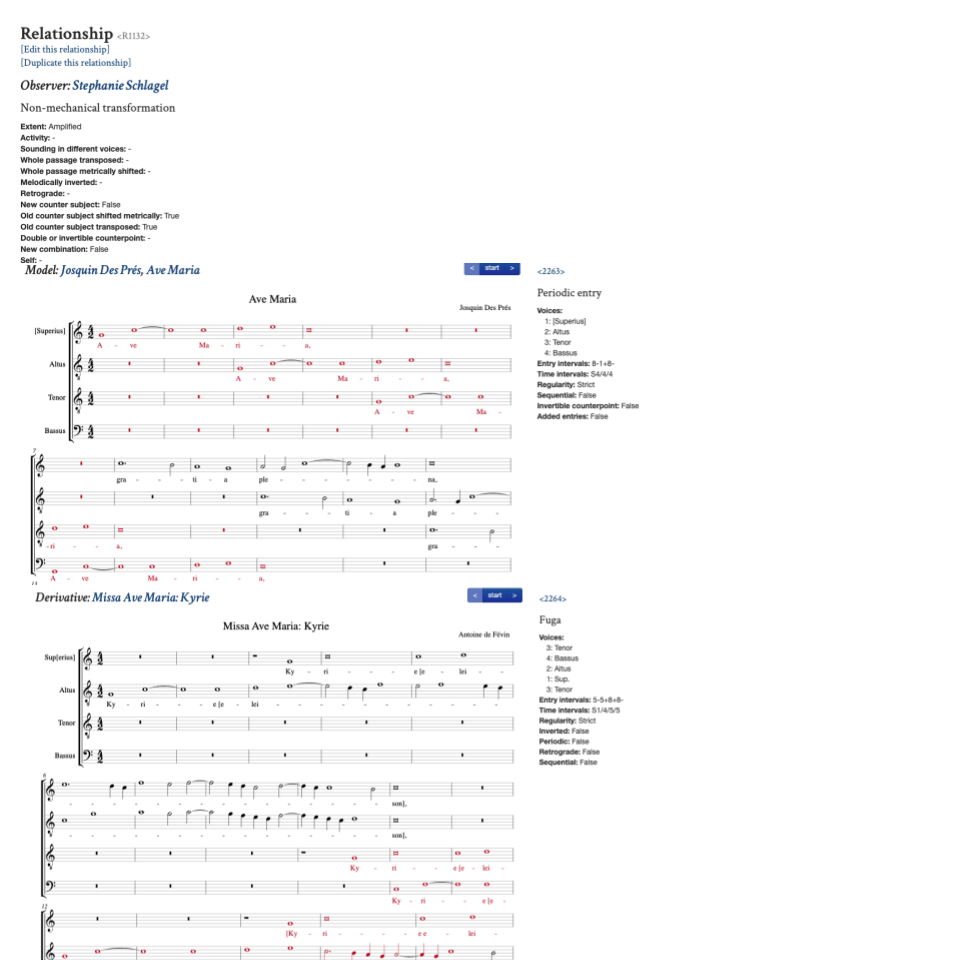
Figure 8: CRIM Vocabularies: A Sample Relationship (https://crimproject.org/relationships/1132/)
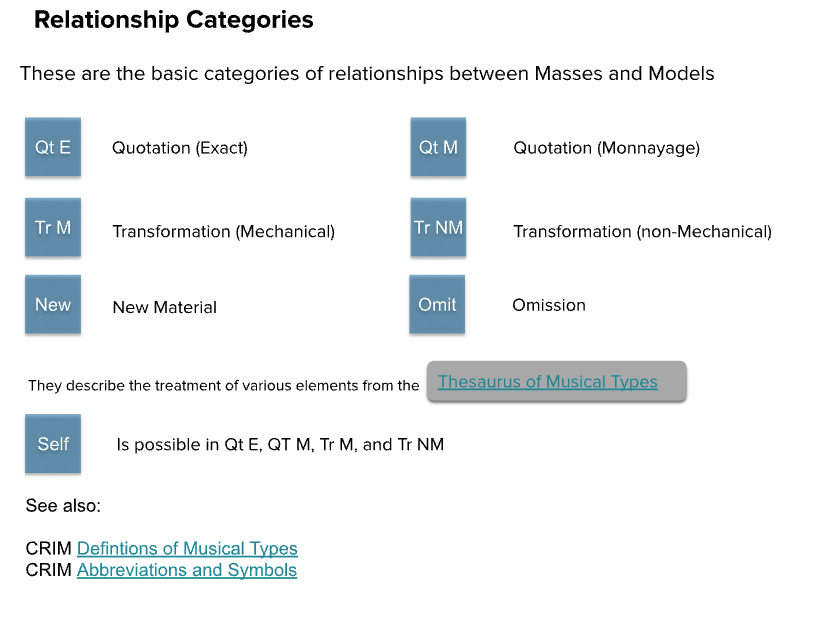
Figure 9: The Relationship Types at a Glance
The Impact of CRIM Intervals
As Margot and Schubert discovered in the course of their work with CRIM Intervals, the systematic aspect of machine analysis can in fact also teach us a lot about our assumptions, once we try to put them into algorithmic form. This, too, is prompting some reflection on the concepts we use in explaining music, and particularly music of the distant past. And so in the essays assembled here you will often find contributors catching themselves in the act of analysis as they move from an initial ‘estimation’ of the particular problem at hand, through a phase of ‘investigation’ (often invoking systemic or machine tools) and finally ‘explanation’ of what was learned, and how the methods might be refined. The nomenclature at work in the digital humanities is often forbidding. Although they were at first greeted as something quite strange, eventually CRIM participants began to speak this lingo, too: terms like n-grams, Levenshtein distances, false positives and negatives, and other concepts from data science crept into the conversations, and (in turn) into the collective consciousness. It would be hard to say exactly how or when this came about: whether the result of weekly Zoom meetings, individual tutorials, or peer-to-peer sessions during the CRIM@Tours meetings. But by the CRIM@Haverford meeting in October 2022 a kind of mental switch had flipped, with a new focus on problem solving and skill acquisition as a key focus of the work.
We are hardly finished, of course, but I think that both individually and collectively we sense that success for CRIM (and the digital humanities more generally) rests not just in “learning how to code,” but rather (as Russo-Batterham puts it in his essay for this collection) in learning how to ask pertinent questions about data, and in learning how to apply human intelligence to the results of our queries. This sense of shared purpose is certainly among the most important outcomes of the last three years of work. It is to be sensed everywhere in the CRIM Essays and Experiments.
Readers will also discover that these essays sometimes bring together what at first seem to be contradictory viewpoints: at times focusing on intimate details of counterpoint in particular passages, but also at times zooming out to regard things from the standpoint of dozens or even hundreds of instances of a pattern at once, and across an entire group of compositions. The rapid shift between micro and macro levels can certainly produce a disorienting kind of intellectual vertigo. But if we think more deeply about it, the advent of a kind of mechanical ear (or at least eye) for music offers us a way to put borrowing and style into dialogue with each other. They are both forms of similarity, after all. Now armed with tools like CRIM Intervals and the citation engine of the CRIM Project itself, the authors of the Essays and Experiments can begin to test our assumptions about where one ends and the other begins.
Classroom Connections
CRIM is a kind of classroom in its own right, albeit one in which teachers and students exchange roles with surprisingly fluidity. This is yet another of the contradictions of digital scholarship. And thus perhaps it should not be too surprising that several participants were eager to find ways to bring CRIM and its digital tools into their own classrooms. Marina Toffetti and Gabriele Taschetti were leaders in this respect, and reported frequently on their experiences teaching CRIM musical concepts and CRIM Intervals, too, with students at Padua University. This was also something of a two-way conversation, as student insights helped us to improve the CRIM tools in various ways.
Toffetti and Taschetti were soon joined by others, as we prepared pedagogical modules for students in Madrid (Esperanza Rodríquez-Garcia and soon María Elena Cuenca-Rodríguez). Meanwhile I made virtual visits to still others involved in CRIM: students at Université de Tours (Philippe Canguilhem and David Fiala), in a joint presentation-workshop with Maura Sugg for students at Case University (David Rothenberg), and others, too. One of the great success stories of CRIM in fact worked in the opposite direction: undergraduate Jonathan Stroh first encountered CRIM during my virtual visit with students of Franz Körndle (Augsburg University). Completely unfamiliar with either code or Renaissance counterpoint, Stroh mastered both of them in an astonishingly short time, and produced a fine interpretive essay for the collection.
Meanwhile at McGill University, two teams (Margot and Schubert; Praskurnin and Cumming) piloted classroom modules that taught CRIM methods and tools to over three dozen bright music students at one of the finest programs in North America. Back at Haverford, this past Fall I launched a course (Encoding Music) that was an instant hit with a mixed population of smart musicians, data scientists, and others. There have been workshops for others, too, including members of the Music Encoding Initiative pedagogy group, and the Renaissance Society of America’s Days of Digital Learning. The results of each of these classroom encounters (as we call them) have been compelling. CRIM was certainly not meant as a pedagogical project, but it has involved learning at every stage, and it seems only natural that it will continue to play out in classrooms (or classroom-like settings) in various institutions.
Some CRIM Tools in Brief
CRIM Intervals is best learned by doing. But here you can discover where to find the code, where to find the training materials, and see how patterns are discovered and reported. The methods shown here are used throughout the Essays and Experiments.
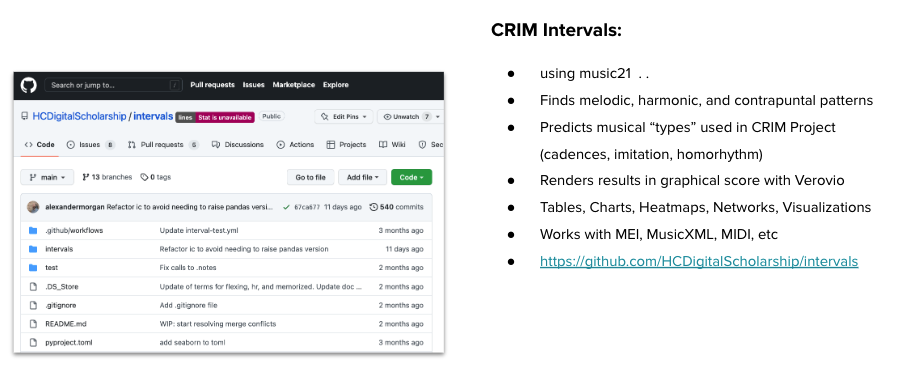
Figure 10: CRIM Intervals on Github (https://github.com/HCDigitalScholarship/intervals)
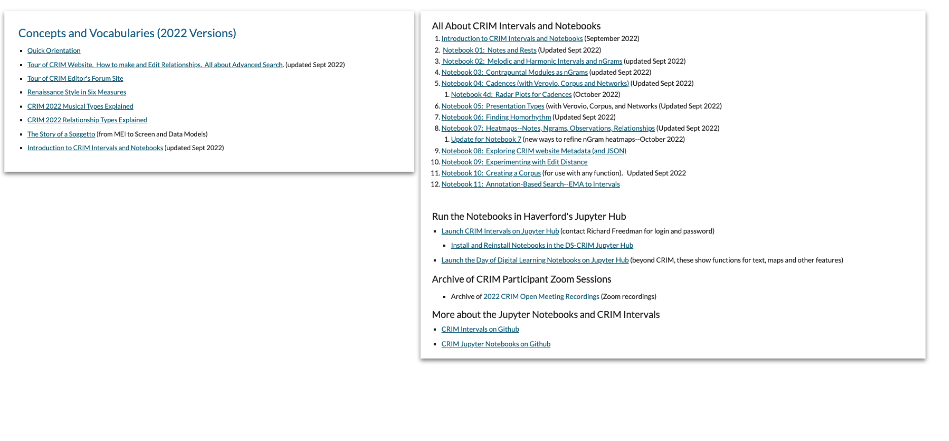
Figure 11: Learning to Use CRIM Intervals. Visit https://sites.google.com/haverford.edu/crim-project/search-and-analysis to find tutorials and links to load Jupyter Notebooks via Haverford’s Digital Scholarship server, or install them locally.
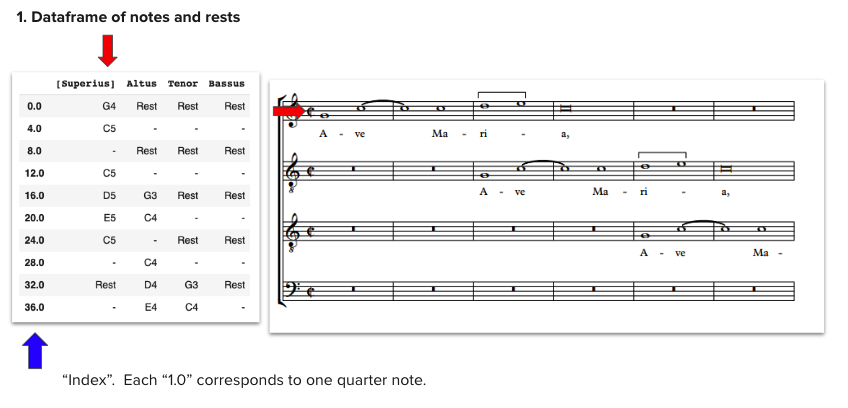
Figure 12: A dataframe of notes. Each voice is a column. The left-hand “index” column tracks movement through time. Each values of “1.0” represents one quarter-note duration. As in many computational systems, the first position is “zero”.
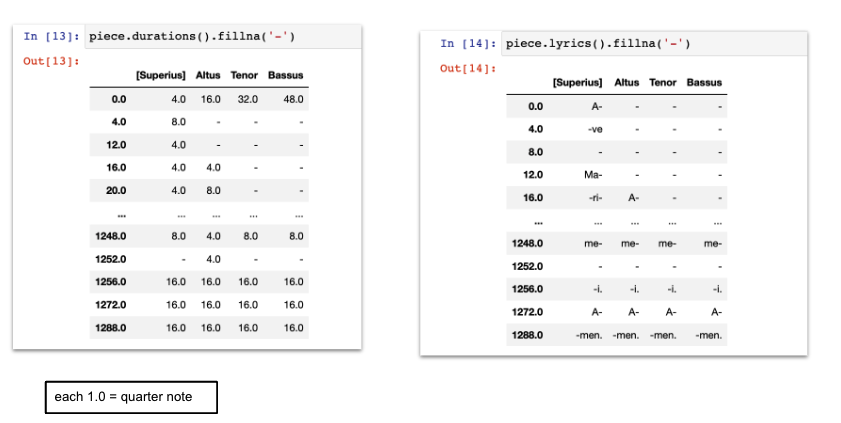
Figure 13: Dataframes of durations (expressed with quarter-note as 1.0) and lyrics.
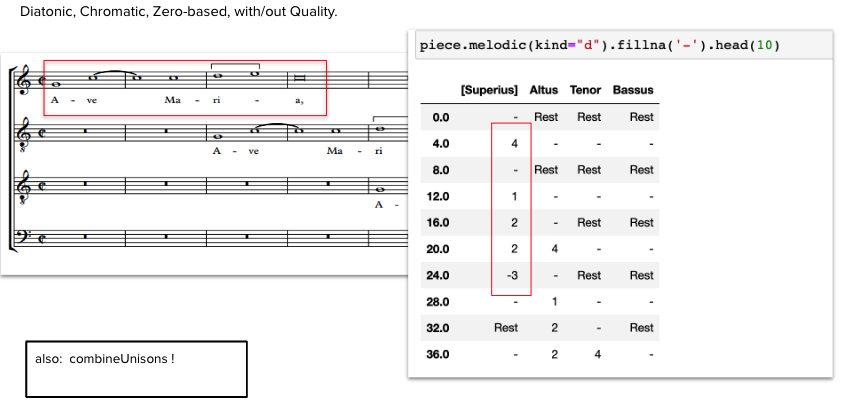
Figure 14: Melodic intervals can be identified according to various schemes: diatonic, chromatic, with or without quality, etc.
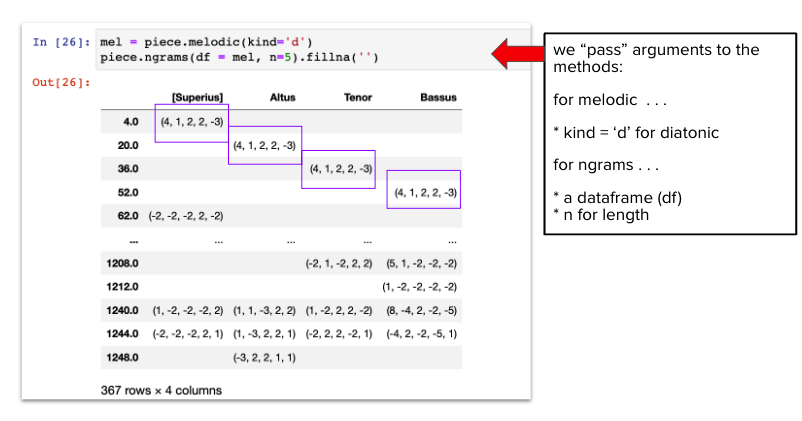
Figure 15: n-grams are strings of events of length “n”: melodic intervals, durations, lyrics.
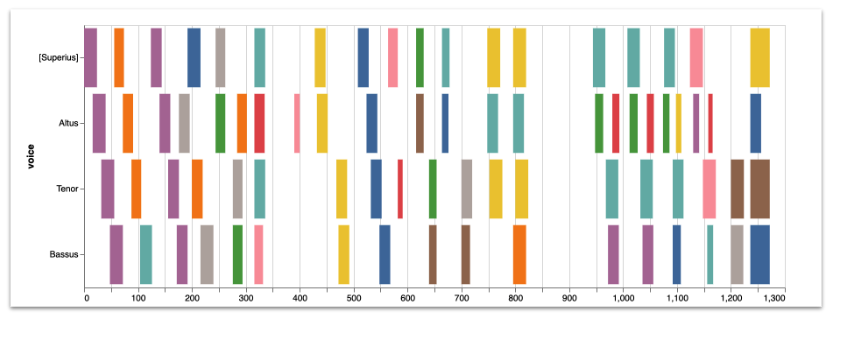
Figure 16: A heatmap of important melodic entries, which here make visible points of imitation, homorhythm, and other textures.
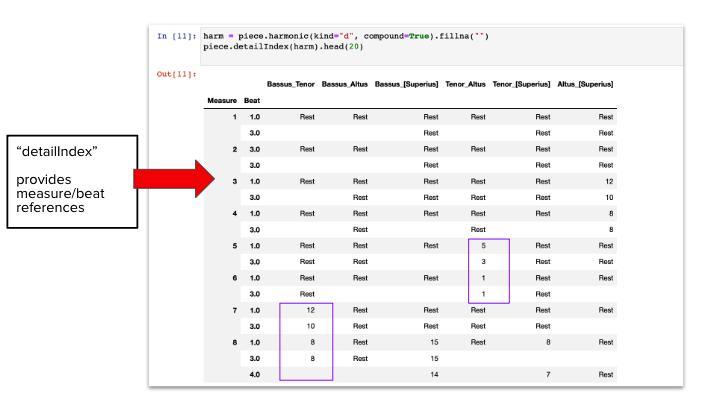
Figure 17: Harmonic intervals can be diatonic, chromatic, compound, simple, etc.
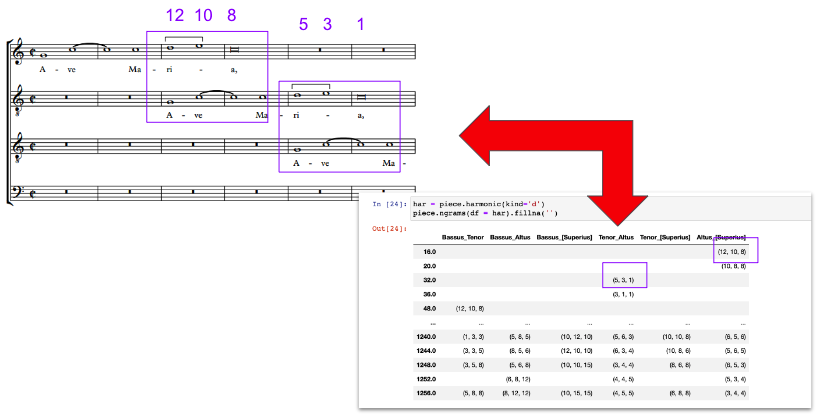
Figure 18: Harmonic n-grams can likewise be diatonic, chromatic, compound, simple, etc.
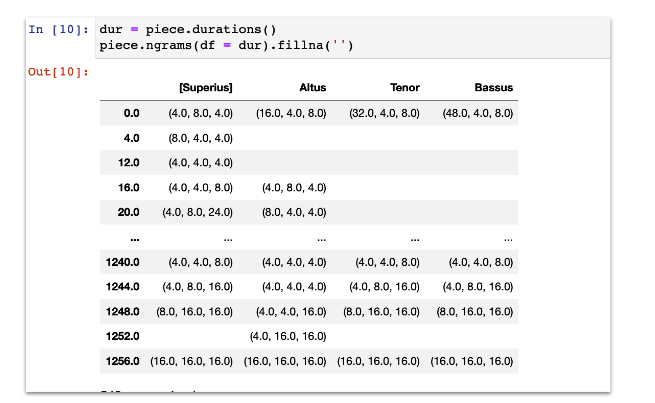
Figure 19: n-grams are strings of events of length “n”–in this case durations.
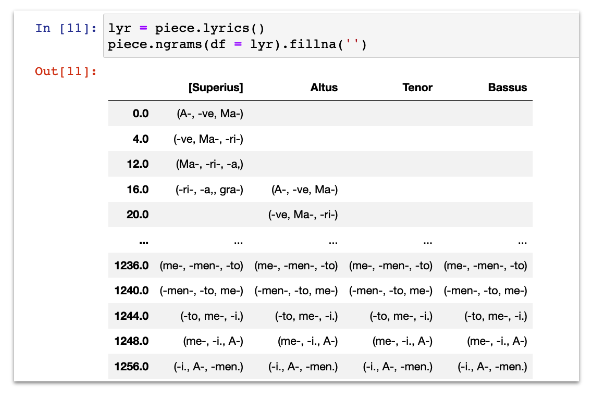
Figure 20: n-grams are strings of events of length “n”–in this case lyrics.
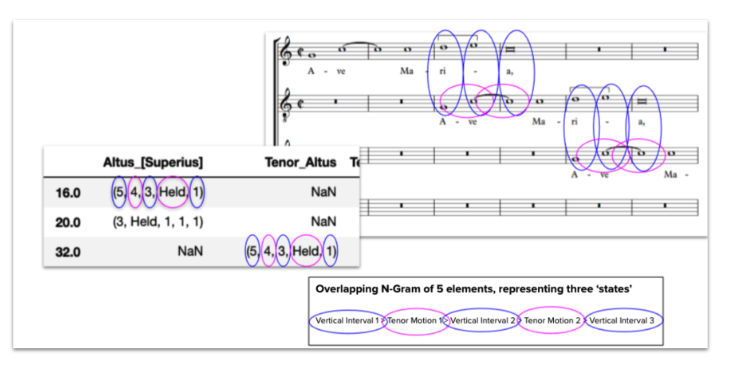
Figure 21: Modular n-grams combine harmonic and melodic movement to describe contrapuntal pairs precisely.
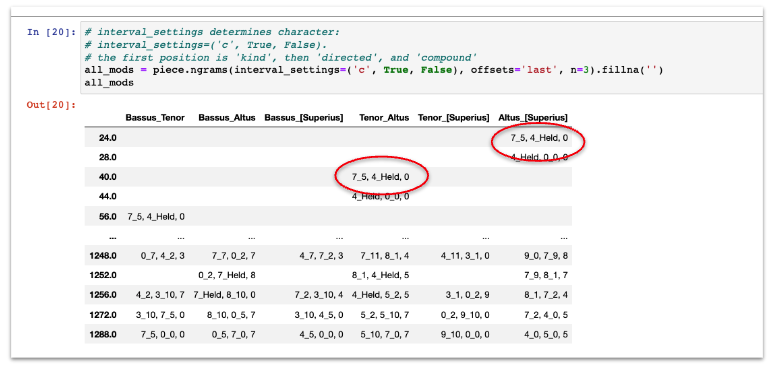
Figure 22: Modular n-grams combine harmonic and melodic movement to describe contrapuntal pairs precisely.
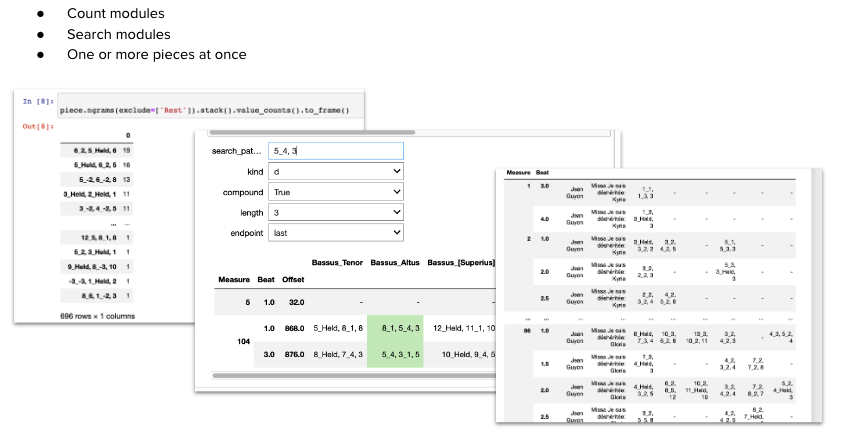
Figure 23: CRIM Intervals finds and counts modular n-grams in one piece or an entire corpus.
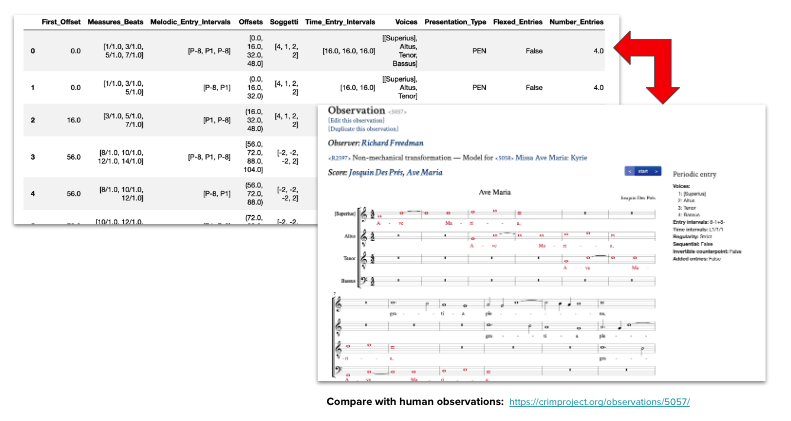
Figure 24: Algorithmic prediction of presentation types. CRIM Intervals correctly identifies the location and details of periodic entries, imitative duos, and fuga, corroborating (and often exceeding) human accuracy at the same task.
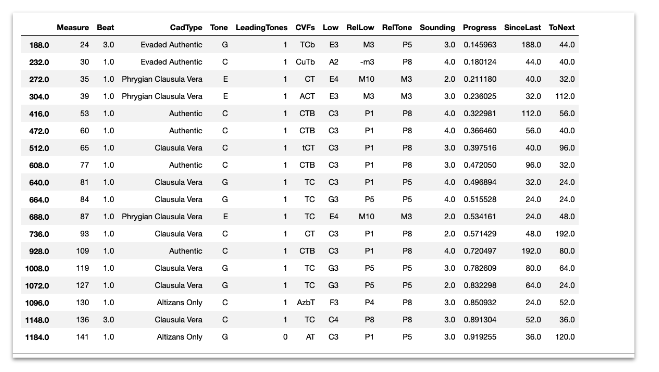
Figure 25: Algorithmic cadence detection in one piece, showing cadence types, tones, voices, and other details.
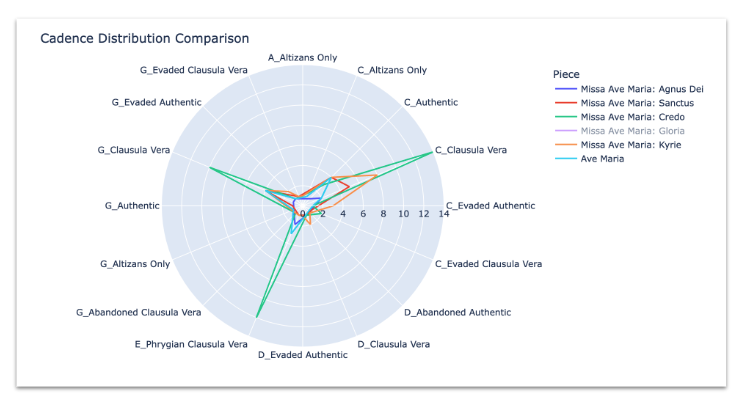
Figure 26: A radar plot of cadences in a model and the Mass that derives from it. Thus while the Mass changes aspects of the contrapuntal combinations heard in the model it does not occupy any new tonal space. The shapes of the radar plot differ only in degree, not orientation.
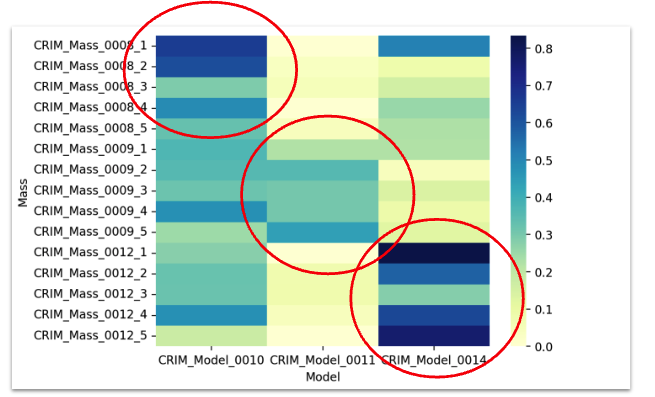
Figure 27: Algorithmic measurement of melodic similarity. The dark blue areas indicate which of three models and three Mass share a high percentage of important soggetti. The system correctly identifies which Masses derive from which model. But in this case it also shows a high degree of similarity between all of these Masses and one particular model. As it happens, all of these pieces are by the same composer: Claudin de Sermisy. Is this showing us something about Claudin’s style?