CRIM tools and their use in a pedagogical context: in search of soggetti in Palestrina’s missa Veni sponsa Christi (1599)
Marina Toffetti (University of Padua) [MT]
https://orcid.org/0000-0002-4266-6009
Gabriele Taschetti (University of Padua) [GT]
https://orcid.org/0000-0003-3268-0912
The Jupyter Notebook used in the preparation of this essay and its related pedagogical projects can be found at: https://github.com/CRIM-Project/Essays_Experiments/tree/main/Taschetti%20and%20Toffetti
In the essay below, the contributions of the two authors are indicated by their initials: MT and GT
Abstract
In recent years analytical tools developed under CRIM, particularly CRIM intervals, have shown their increasing accuracy and versatility to an ever-growing number of users, proving helpful in assisting the analyst in carrying out some research tasks. This article will show how these same tools can be helpful in a teaching context and help beginner analysts perform some basic research (such as identifying soggetti within an imitative composition, observing where they are placed, how they are used, and the like), contributing to motivate them to study Renaissance music.
In particular, this article presents the results of two teaching experiences held at the University of Padua in the last two academic years, in which some CRIM tools were used in the classroom to facilitate the learning of music analysis based on the case study of Palestrina’s motet Veni sponsa Christi and the corresponding imitation mass by the same composer. The article also provides some reflections arising from these experiences.
The Teaching Context [MT]
The path of experimentation of the CRIM tools, developed as part of Citations: The Renaissance Imitation Mass (Freedman, R., Fiala, D. Russo-Batterham, D., Viglianti, R., Walter, M. 2014–), started from a preliminary question: can the CRIM tools help to analyze polyphonic music? and if so, can they also be helpful in a teaching context? To answer this double question, we first chose a case study, i.e. the missa Veni sponsa Christi of Palestrina and its model, and analyzed it with the CRIM tools. At first, we focused on finding the soggetti within the Mass and reflected on the results’ breadth, pertinence and reliability. In the presence of results that are not entirely satisfactory (as they are partial or irrelevant), we refined the search criteria and obtained a more significant number of relevant results and fewer irrelevant ones.
Using the various tools (multiplied and improved over time) made available within the CRIM project, we immediately realized how much they could be helpful in a teaching context, if only properly adapted. Therefore, we adapted some of them and made them more accessible and easy to use. In addition, we used some devices for visualizing the results developed by the CRIM team that proved very valuable in facilitating the use of the analysis tools.
Two Teaching Experiences
The following reflections arose from some experiences in the use of CRIM tools carried out in the past two academic years as part of the Analysis of Musical Forms and Compositional Techniques classes (from here on “Analysis”), taught by Toffetti as part of the master’s degree program in Performing Arts and Multimedia Production at the University of Padua. The ways in which CRIM has been used in the classroom have also changed over time, as the project team gradually refined the various tools. During the 2019-2020 academic year the topic of computer-assisted analysis was only briefly mentioned to the students. During some lessons, the CRIM website was shown, illustrating some of the project’s goals and pointing out the presence of tools of potential interest for those interested in musical analysis. At that stage, the advantages offered consisted primarily in the availability of numerous musical scores, the possibility of consulting and commenting on the results of analyses conducted by different scholars, and the possibility of contributing your own analysis.
The actual experimentation in the use of CRIM tools took place in the last two academic years. In particular:
- in the 2021-2022 academic year the course of Analysis hosted a seminar (CRIM@Padua1: “Can Machines Help Us Analyse Music?”) held together with Richard Freedman and Daniel Russo-Batterham, with the collaboration of four “tutors” (Enrico Caon, Cristina Cassia, Chiara Comparin and Gabriele Taschetti), i.e. young researchers – or senior/PhD students – who had already been previously involved in similar musical analysis initiatives and therefore could act as a link between teachers and students (we reported on this experience at the CRIM@Tours2 international meeting in June 2022);
- in the 2022-2023 academic year the same course of Analysis was enriched by 10 hours of supplementary teaching held by Gabriele Taschetti (CRIM@Padua2 2023), expressly dedicated to the use of the CRIM tools in the classroom. For this purpose, some of the CRIM notebooks already prepared within the CRIM project were adapted to make them more user-friendly (some simplified notebooks were presented during a workshop at CRIM@Haverford in October 2022).
At the end of the classes, students were required to carry out group analysis work. Each group identified all occurrences of one of the four soggetti of the motet Veni sponsa Christi (Veni sponsa Christi / accipe coronam / quam tibi Dominus / praeparavit in aeternum) within the imitation Mass, and analyzed their polyphonic use. The results were presented in a written paper to be submitted and discussed as part of the final examination. In the papers, the results of the machine-assisted research were reported, commented on, and compared with those achieved through traditional analysis.
The case study: Palestrina’s Veni sponsa Christi Mass and its model [MT]
If intertextuality, whether implicit or explicit, voluntary or unconscious, affects the music of every place and era (Caraci Vela 2009), there are moments in the history of music in which the interaction and reciprocal interpenetration of different compositions (by the same or different composers) assumes particularly evident pervasive characteristics. Among these periods is the Renaissance, especially if one considers the imitative sacred polyphonic repertoire and, in particular, the corpus of explicitly imitative masses, within which we recognize a dense network of references of different nature still largely to be investigated (on the phenomena of rewriting and reworking that affected Palestrina and Victoria, see Filippi 2008). The CRIM project was set up to study these repertoires with new and more effective tools that allow faster searches within large corpora. To understand for what purpose such instruments can be used and how they can prove useful for analysis, we have chosen as a case study the Mass Veni sponsa Christi by Giovanni Pierluigi da Palestrina and its model (Palestrina’s Veni sponsa Christi motet): two compositions by the same author that share the same soggetti and some of their presentation types (Schubert 2007).
The Musical Text: Sources and Editions
Palestrina’s Mass Veni sponsa Christi was published posthumously in 1599 within the ninth book of masses for four, five and six voices (Palestrina 1599; RISM A/I P 683), which was subsequently reprinted in 1608 (RISM A/I P 684). The very “title” of the Mass, Missa Veni sponsa Christi, represents an explicit paratextual reference, which, as music reveals, refers to the motet of the same name by Palestrina based on the same soggetti.
The motet Veni sponsa Christi by Palestrina appears in the collection Motecta festorum totius anni, which constitutes the composer’s first book of motets for four voices (Palestrina 1564). Although the first surviving print of this collection is dated 1564 (RISMA/I P 699), the book was probably printed for the first time in 1563 (the problem of dating this collection is dealt with exhaustively in Filippi 2003). The book achieved great success: if we include the now lost editio princeps, we calculate as many as 13 issues between 1563 and 1622 (Filippi 2003).
Since Palestrina is perhaps the most successful polyphonist of all time, we can count on several modern editions of both the first book of motets including Veni sponsa Christi (Espagne [1875]; Casimiri 1939; Filippi 2003; Ackermann 2008), and of the posthumous collection of masses for 4, 5 and 6 voices which includes the corresponding imitation Mass (Haberl 1886; Bianchi 1958). However, given that CRIM is based on encoded editions in MEI format of all the compositions, we made use of the digital files accessible on the CRIM website (Gurrieri 2017; Gurrieri, Besson and Freedman 2017), substantially matching, at least concerning the essential parameters of pitch and duration of the notes of each voice, to the results published in the most recent critical editions (Filippi 2003; Ackermann 2008). The CRIM tools – and in particular CRIM intervals (Freedman, R., Morgan, A., Gould, F., Russo-Batterham, R., Dang, T. 2020–) – provide aid for studying different aspects of the contrapuntal language of imitative masses, including the set of relationships that exist between Palestrina’s Mass and its model. (The Mass and motet are available on CRIM as https://crimproject.org/pieces/CRIM_Model_0019/ and https://crimproject.org/masses/CRIM_Mass_0019/.)
A Digression: Polyphony Versus Liturgical Melody
Although the present work focuses on how Palestrina used the soggetti of the motet within the Mass, to better contextualize the compositions examined here it would be useful to broaden the perspective and address the topic of the provenance of the soggetti of the motet. As is known, the four soggetti do not represent original motivic material, but entertain intertextual relations with at least one version (if not more) of the antiphon Veni sponsa Christi, traditionally sung at the second vespers In commune virginum (the question of the liturgical and/or paraliturgical destination of the motets of Palestrina’s first book of motets is preliminarily addressed in Filippi 2003, but undoubtedly deserves further investigation).
For purely indicative purposes, we tried to identify, among the liturgical melodies known today, those that show a melodic outline at least close, if not corresponding, to that of the soggetti used by Palestrina, using for this purpose the Cantus database (https://cantus.uwaterloo.ca/). As stated on the website homepage, “Cantus is a database of the Latin chants found in manuscripts and early printed books, primarily from medieval Europe. This searchable digital archive holds inventories of antiphoners and breviaries – the main sources for the music sung in the Latin liturgical Office – as well as graduals and other sources for music of the Mass.” Like many databases, Cantus is also being continuously implemented: “New phases of the project include adding chant melodies to existing records and indexing other types of chant manuscripts, including processionals, pontificals, and sources that contain sequences”, which is the reason why each search requires continuous updates.
At the present stage, we searched for the textual incipit “Veni sponsa” together with the string that corresponds to the first 5 notes (i.e. the first 4 intervals) of the first soggetto attested in Palestrina’s motet and Mass (D B D E D) using the search mode “Exact matches + transpositions”. In this way, the search returns six results with the same melodic incipit. Two of them refer to melodies with a profile that is substantially corresponding, although not exactly coinciding, with that employed by Palestrina in the motet and the Mass.
The first source, whose place of origin is unknown, is a late 13th-early 14th-century Franciscan antiphonary preserved in the Bibliothèque des Cordeliers in Fribourg (CH-Fco, ms. 2, fol. 243r-244r; reproduction: http://www.e-codices.unifr.ch/en/fcc/0002/243r; transcription: https://cantus.uwaterloo.ca/chant/257270). The second source identified, held at the München, Bayerische Staats- und Stadtbibliothek (D-Mbs, Ms. CIm 4304, fol. 053r / 8), is an antiphoner from the Benedictine monastery of Sts. Ulrich and Afra in Augsburg, written in 1519 by the illuminator Frater Leonhard Wagner (reproduction: https://www.digitale-sammlungen.de/en/view/bsb00060183?page=109; transcription: https://cantus.uwaterloo.ca/chant/374368). However, both melodies are attested in witnesses geographically and chronologically distant from the Roman milieu of the second half of the 16th century in which Palestrina was active and in which the music we are discussing was composed.
This is not the place to address, let alone exhaust, a topic that is certainly susceptible to further investigations and development connected with the progressive implementation of databases. It remains to be hoped, however, that CRIM, hitherto mainly used to establish connections between polyphonic masses and their respective polyphonic models, will in the near future be able to dialogue with other already existing databases and extend its field of observation to monodic materials (traditional melodies, liturgical and otherwise) as well. Thanks to a network of related incipits and/or n-grams in interconnected corpora, it would then become easier to study the relationship not only between different soggetti used in the polyphonic context, but also between these and any pre-existing liturgical melodies.
Moving back to the article’s main topic, after choosing the case-study, we put some teaching strategies in place to facilitate its analysis in a teaching context. Specifically, we worked on an ideal strategy for searching the subjects, then critically evaluated the results (par. 4), and finally presented them in a graphic form.
In Search of Soggetti [GT]
The methods we used to search for the soggetti in the motet and in the Mass are codified in a Python library called CRIM Intervals. CRIM Intervals works with encoded scores and can read each voice part as a series of notes and rests, and calculate the interval between any two subsequent notes at any given moment in the piece.
“Interval Kind”
The machine can therefore search and find a melodic pattern expressed in the form of a series of intervals, that is, a melodic n-gram. The machine can read intervals in four different ways. It can understand intervals as diatonic by calculating only the distance between note positions within the scale; it can read the exact amplitude by specifying whether the interval is minor, major, or perfect; it can read the number of semitones; and it can read diatonic intervals in zero-based mode, where unison corresponds to 0. Since the motives employed by Palestrina in the model (the motet Veni sponsa Christi) could reappear in different hexachordal positions or with some chromatic adaptations within the various parts of the corresponding imitation Mass, we chose to set up the research by considering diatonic intervals without specifying their quality (e.g., without distinguishing a minor third from a major third). Following this criterion, the first motive of Palestrina’s motet, which sets to music the textual incipit (Figure 1), can be translated, for example, into the melodic n-gram “-3, 3, 2, -2” (descending third, ascending third, ascending second, and descending second).
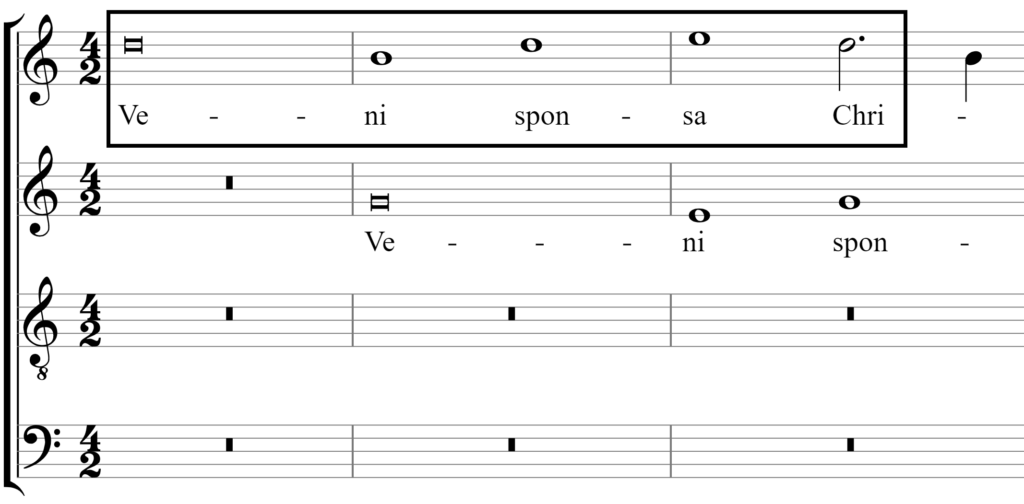
Example 1. Giovanni Pierluigi da Plestrina, Veni sponsa Christi, bb. 1–3, with box to show the relevant soggetto. Music examples from the motet Veni sponsa Christi and the Missa Veni sponsa Christi by Giovanni Pierluigi da Palestrina are taken from the CRIM project’s website (https://crimproject.org/pieces/CRIM_Model_0019; https://crimproject.org/masses/CRIM_Mass_0019).
“CombineUnisons”
Within any imitation Mass, the melodic material of the model undergoes re-textualization procedures, which sometimes include rhythmic adaptations. For the listener, the motive at the beginning of the motet (Example 1) and that, for example, at the beginning of the Credo of the Mass (Example 2) are in some way corresponding, whereas the machine considers them different. For the machine, the melodic n-gram at the beginning of the Credo (Figure 2) is “-3, 1, 3, 1, 2, -2” (where the number 1 indicates unison), which is different from the melodic n-gram of the motive shown in Figure 1 (“-3, 3, 2 -2”). To overcome this problem, we set the “combineUnisons” function to “True”, to make the machine read consecutive repetitions of the same pitch as a single note. With the combineUnisons function active, the pattern at the beginning of the Credo, which includes two repetitions of two different pitches, can be written as “-3, 3, 2, -2”, i. e. , in the same way as the motive at the beginning of the motet.
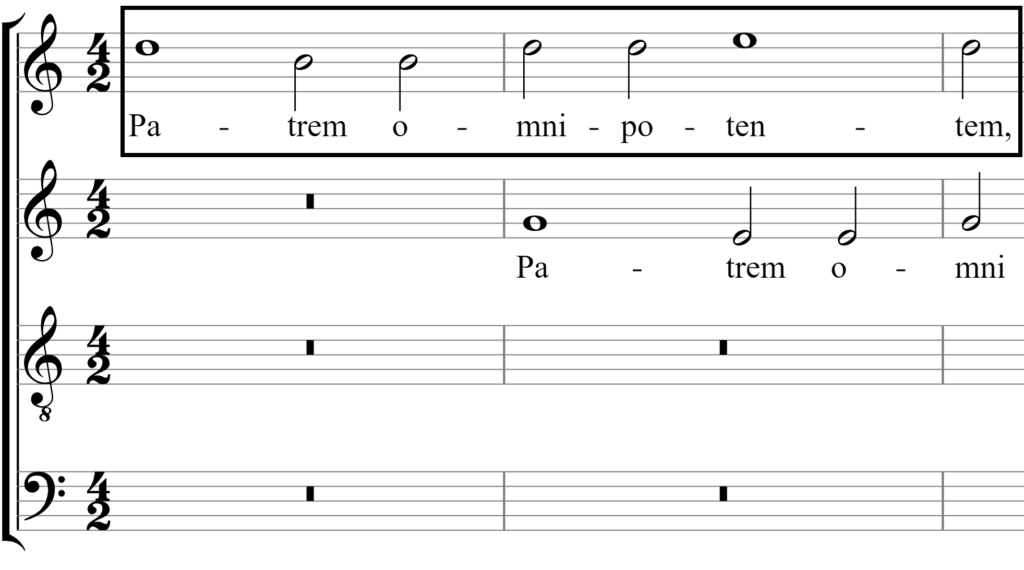
Example 2. Giovanni Pierluigi da Plestrina, Missa Veni sponsa Christi, Credo, bb. 1–3
“N-gram length”
The choice of n-gram length is conditioned by the fact that some of the tools discussed below can search multiple interval patterns simultaneously as long as they are the same length. Therefore, we sought a compromise to obtain the most significant number of relevant results when searching for all the soggetti/n-gramsThe first soggetto (“Veni sponsa Christi”), already shown in Example 1, can be translated in the 4-gram “-3, 3, 2, -2.” However, the 3-gram “-3, 3, 2” makes it possible to detect two additional occurrences within the Mass, one of which is irrelevant. The second soggetto (“accipe coronam”) is characterized by a leap of a fourth at the end (solid rectangle in Example 3), but in some occurrences the last interval is varied (dashed rectangle in Example 3). In order to search for both types, it is necessary to limit the n-gram to the fourth interval, resulting in the pattern “-3, 2, 2, -2.”
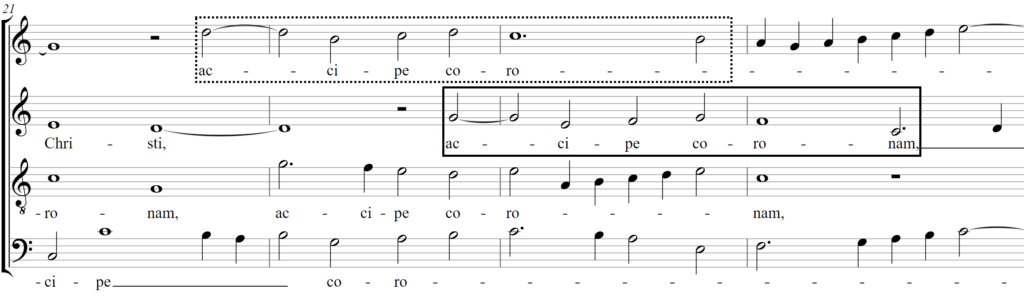
Example 3. Giovanni Pierluigi da Palestrina, Veni sponsa Christi, bb. 21–24
The third soggetto, which sets to music the words “Quam tibi Dominus”, is characterized by three repetitions of the same pitch at the beginning (Example 4). However, to include all possible variations due to possible rhythmic adaptations, we initially chose to activate the combineUnisons function, which makes the initial sequence of unisons no longer characterizing. In doing so, the motive can be described only by intervals other than unison, that is, for example, with the pattern “-3, 3, -2,”, which may be too generic. Alternatively, we can use the pattern “-3, 3, -2, -2,” if we add a further descending second, which appears in the vast majority of occurrences – but not all of them (e.g. Example 4, bb. 40–41, Cantus).
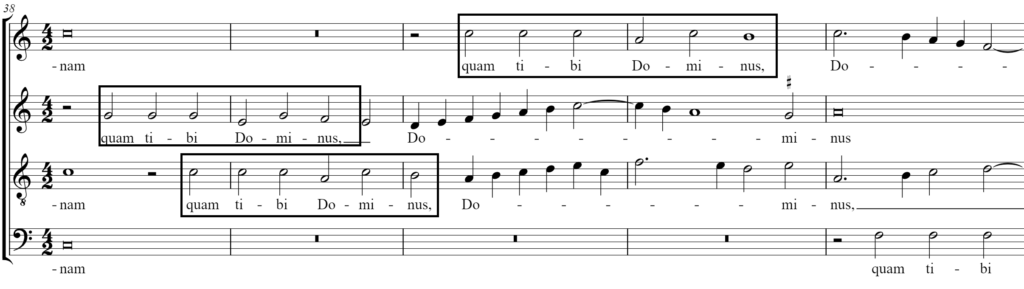
Example 4. Giovanni Pierluigi da Plestrina, Veni sponsa Christi, bb. 38–42
The last soggetto (“praeparavit in aeternum”) is also characterized by unisons, yet its outline is recognizable even without considering repetitions (Example 5). The motive can be described with n-grams of 4 or 5 intervals, sometimes even with 6.
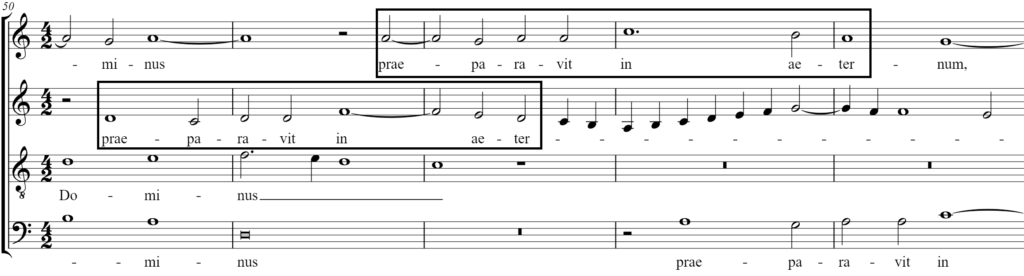
Example 5. Giovanni Pierluigi da Palestrina, Veni sponsa Christi, bb. 50–54
In light of these considerations, the best compromise is to adopt a length of 4 intervals for all subjects/n-grams, resulting in the patterns summarized in Table 1.
| Text | melodic n-gram |
| Veni sponsa Christi | -3, 3, 2, -2 |
| accipe coronam | -3, 2, 2, -2 |
| quam tibi Dominus | -3, 3, -2, -2 |
| praeparavit in aeternum | -2, 2, 3, -2 |
Table 1. The four soggetti of the motet expressed as melodic n-grams
Results and Data Validation [GT]
With the CRIM notebook “02b Melodic Harmonic Corpus” is possible to search for a melodic n-gram within the motet Veni sponsa Christi and the five parts of the Mass simultaneously. The rest of the article will refer to this group of six pieces as the corpus. The machine records all the occurrences of a given melodic n-gram in all the voices of the six pieces of the corpus. Ignoring unisons, as well as interval quality, reduces the level of specificity of the search. On the one hand, this allow us to find a more significant number of occurrences (with different rhythmic adaptations and in different hexachordal positions); on the other hand, there is the risk of obtaining irrelevant results, which we call ‘false positives’ here. The search result for the n-gram “-3, 3, 2, -2” (the “Veni sponsa” motive) is shown in the following Table 2 (see cells marked in with highlighted background). Columns 1 to 5 represent individual voices (columns 1-4: Cantus, Altus, Tenor, Bassus; in the Agnus Dei column 3 hosts the Quinta Pars, located between Altus and Tenor).
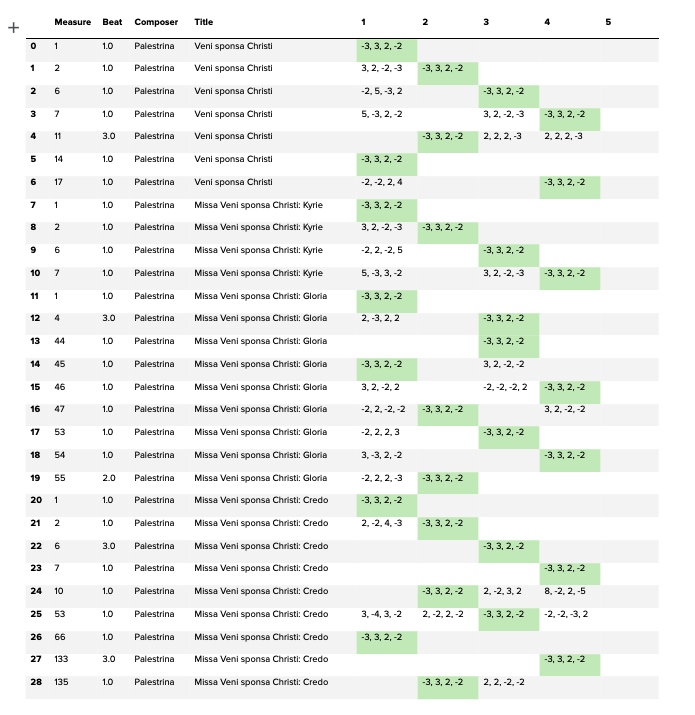
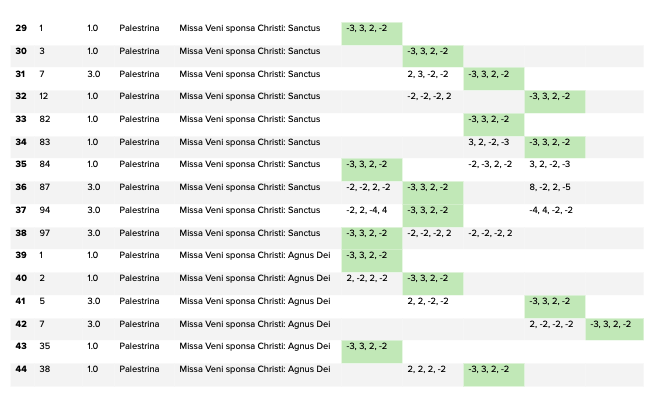
Table 2. Search of the melodic n-gram “-3, 3, 2, -2”, kind=‘d’ (diatonic), combineUnisons=True, length=4 in the corpus with CRIM notebook 02b Melodic Harmonic Corpus
The analyst must carefully check the results and decide whether or not a given occurrence of a melodic n-gram is a relevant result, that is, an actual occurrence of a given soggetto. In the case of the soggetto “Veni sponsa Christi”, the only false positive (i.e. non relevant result) is the 26th result of Table 2, which reports an occurrence of the melodic n-gram “-3, 3, 2, -2” at bar 66 of the Credo of the Mass in the Cantus. In this case, the machine detected the n-gram between the end of a section and the beginning of the next one (Example 6).
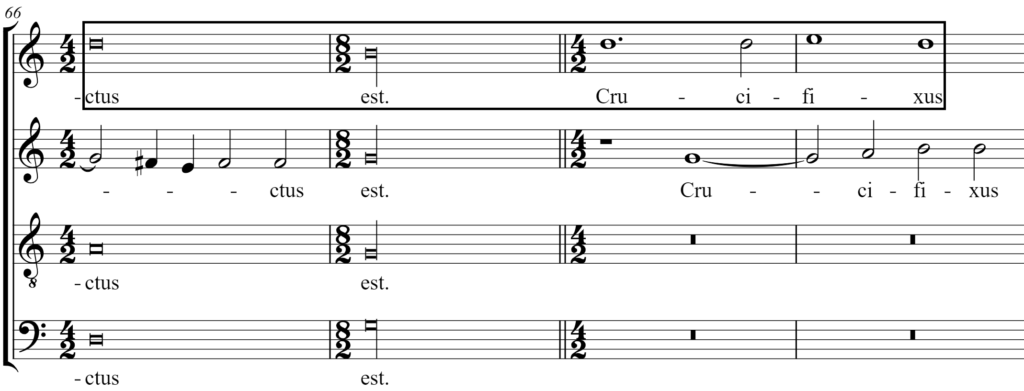
Example 6. Giovanni Pierluigi da Plestrina, Missa Veni sponsa Christi, Credo, bb. 66–69
After running the search for all four soggetti in the corpus and validating each result, we realize that the machine detected a considerable number of irrelevant occurrences of the soggetto “accipe coronam” (melodic n-gram “-3, 2, 2, -2”). This is probably because the motive includes three consecutive stepwise motions, thus being similar to a scalar movement. In contrast, the other n-grams have two distinctive jumps of third at the beginning (“Veni sponsa” and “quam tibi”) or one jump of third in the middle (“praeparavit”), which is probably why the percentage of relevant occurrences is higher.
| Text | melodic n-gram | occurrences | count of true positives | percentage of true positives | count of false positives | percentage of false positives |
| Veni sponsa Christi | -3, 3, 2, -2 | 45 | 44 | 97,78% | 1 | 2,22% |
| accipe coronam | -3, 2, 2, -2 | 84 | 42 | 50,00% | 42 | 50,00% |
| quam tibi Dominus | -3, 3, -2, -2 | 45 | 39 | 86,67% | 6 | 13,33% |
| praeparavit in aeternum | -2, 2, 3, -2 | 62 | 56 | 90,32% | 6 | 9,68% |
| total | 236 | 181 | 76,69% | 55 | 23,31% |
Table 3. Overview of the research results of the four melodic n-grams in the corpus
We should remember that this type of search doesn’t consider note durations. For this reason, the machine finds n-grams even within sequences of notes with short values, such as diminutions or series of semiminims or shorter values. For example, in the fourth bar of the motet the machine detects an occurrence of the n-gram “-3, 2, 2, -2” (the soggetto “accipe coronam”) in the Cantus within a melodic movement appearing right after the first occurrence of the main soggetto (“Veni sponsa Christi”) of the episode (Example 7). It should be mentioned, however, that during the preparation of this article, the CRIM team developed a research tool that considers both intervals and duration (more precisely, ‘durational ratios’). This new possibility will ensure even more targeted searches and is worth exploring further in the coming months.
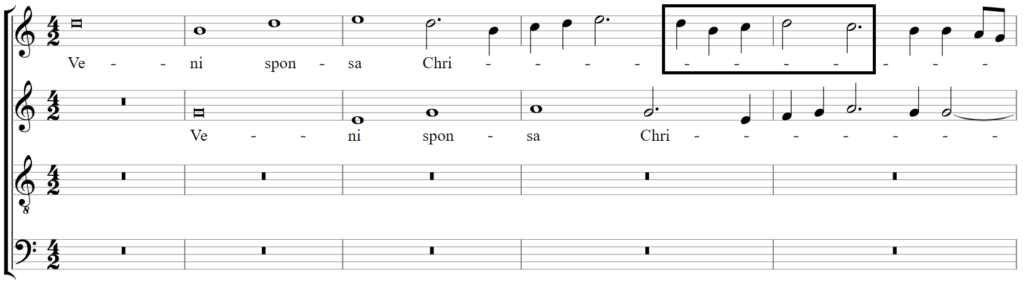
Example 7. Giovanni Pierluigi da Plestrina, Veni sponsa Christi, bb. 1–5
We can exploit at least two methods of CRIM Intervals to eliminate some of these false positives. The first is to exclude all weak semi-minims from the note count, that is, to consider only pitches that occur at the odd semi-minims of each bar, which can be achieved with the ‘regularize’ method. However, with this method the machine reads sequences of intervals that do not correspond to the real ones and may detect otherwise nonexistent occurrences of the n-grams. The second method consists of picking only those occurrences of the n-grams that happen after a rest or section break. Such occurrences are referred to as ‘entries’, as they begin a phrase. The only drawback of this method is that some relevant occurrences that do not only qualify as entries may be excluded.
We searched for the four n-grams with this second method, and the result is promising (Table 4). The total number of detected occurrences is much lower than in the previous search (170 instead of 236), but the number of correct results is quite close (158 instead of 181). Overall, it can be said that the search with the ‘entries’ filter guarantees a good approximation in our case: the machine excluded many false positives and only a handful of relevant results.
| Text | melodic n-gram | occurrences | count of true positives | percentage of true positives | count of false positives | percentage of false positives |
| Veni sponsa Christi | -3, 3, 2, -2 | 42 | 42 | 100% | 0 | 0% |
| accipe coronam | -3, 2, 2, -2 | 46 | 34 | 73,91% | 12 | 26,09% |
| quam tibi Dominus | -3, 3, -2, -2 | 31 | 31 | 100% | 0 | 0% |
| praeparavit in aeternum | -2, 2, 3, -2 | 51 | 51 | 100% | 0 | 0% |
| total | 170 | 158 | 92,94% | 12 | 7,06% |
Table 4. Overview of the research results of the four melodic n-grams as entries in the corpus
Visualizing the results [GT]
After checking the quality of the collected data, we can begin to analyze the Mass. For this purpose, we can employ a CRIM tool to visualize the search results graphically (the method is explained in the CRIM notebook “02d Melodic nGram Maps”). For each piece in the corpus, we searched for our four n-grams first by detecting all occurrences and then limiting the search to entries only, and generated a visualization of both searches. The resulting output is a series of heatmaps in which the y-axis represents the voices and the x-axis represents the horizontal development of the piece measured in semiminims. These heatmaps are populated by colored bricks, each color representing one of the n-grams (green-cyan=“Veni sponsa Christi”; orange=“accipe coronam”; red=“quam tibi Dominus”; blue=“praeparavit in aeternum”). Blank spaces indicate points where something other than the selected melodic patterns happens, including silence. This tool is particularly useful to ‘see’ the distribution of the soggetti. For example, by running this search and visualization on the model (Figures 1a and 1b), we get a relatively clear picture of the articulation of the piece. Thanks to the previous data check, we know that some of the orange bricks, representing occurrences of the n-gram “-3, 2, 2, -2”, are likely to be false positives. Also, we know that false positives should be fewer in the heatmap displaying only entries (Figure 1b).
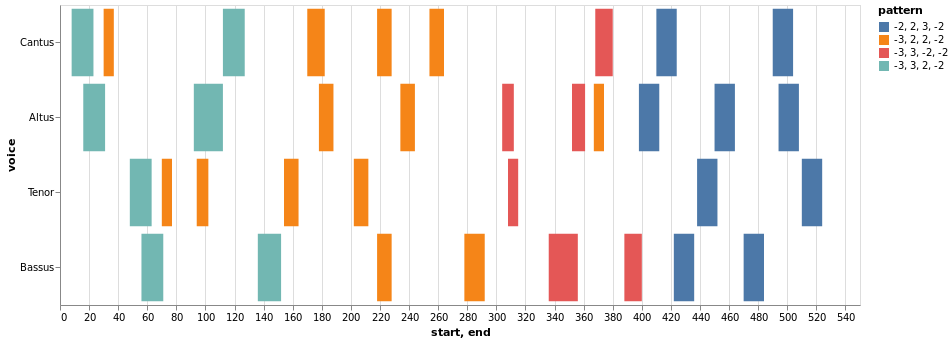
Figure 1a. Melodic nGram Map of the soggetti within the model (all occurrences)
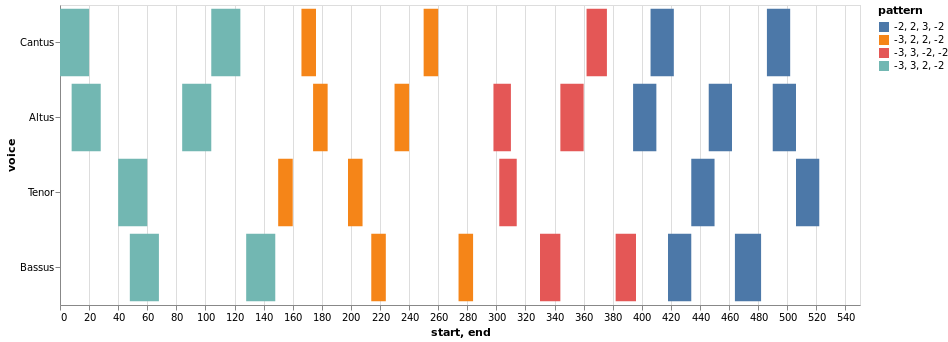
Figure 1b. Melodic nGram Map of the soggetti within the model (entries only)
These two heatmaps can communicate some elementary information about the structure of the motet and compositional strategies. As has already been mentioned, we can clearly see the articulation in subsequent episodes, with no overlapping of the different soggetti. Another piece of information, for example, is that the voices sing the first soggetto in pairs, a short distance apart and with some overlap: the two highest voices first and then the two lowest voices. We also note that the entry order of the voices varies with each episode. We should remember that we only see what we have searched for: the machine does not detect all slightly varied versions of the soggetti. For example, having translated the motive “praeparavit in aeternum” into the melodic n-gram “-2, 2, 3, -2,” we have left out the occurrence of bar 56 of the Cantus, where the motive is varied, presenting the interval sequence “-2, 2, 2, 2, -2” (Example 8).
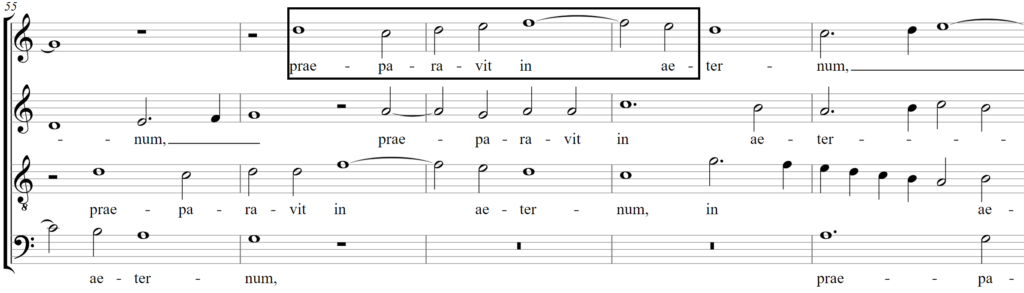
Example 8 . Giovanni Pierluigi da Palestrina, Veni sponsa Christi, bb. 55–59
If we run the same search in the Kyrie of the Mass, we obtain another couple of interesting heatmaps (Figures 2a and 2b).
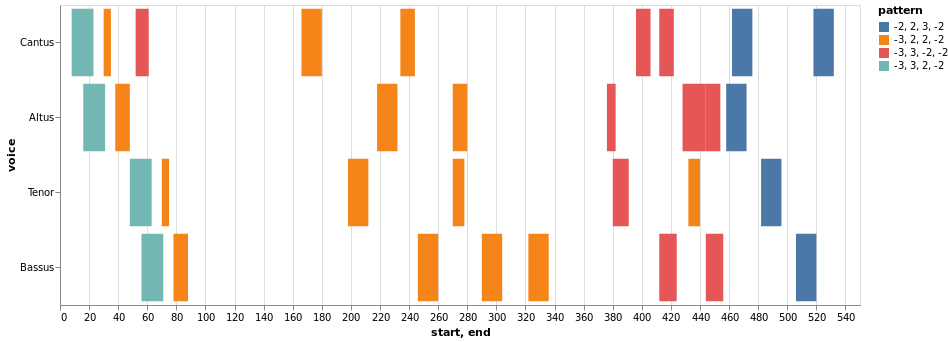
Figure 2a. Melodic nGram Map of the soggetti within the Kyrie (all occurrences)
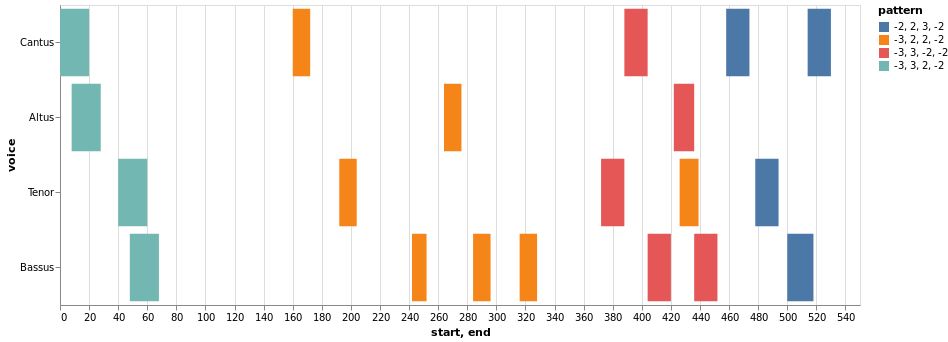
Figure 2b. Melodic nGram Map of the soggetti within the Kyrie (entries only)
In both cases, we notice that all the soggetti have been used, and they appear in the same order as in the motet. Again, as in the motet, the voices seem to enter in pairs in the first episode. This tells us something not only about the use of soggetti, but also about counterpoint and presentation types (Schubert 2007; CRIM Thesaurus of Musical Types). Blanks suggest the presence of new melodic material. The orange bricks and the red brick in the first part of Figure 2a are false positives that occur in the middle of a phrase – this can only be determined after checking the score – and, in fact, do not appear in Figure 2b. Figure 2b provides a cleaner view of the distribution of soggetti at the expense of losing some relevant occurrences that do not qualify as entries (i. e. are not preceded by a rest). In addition, Figure 2b shows an isolated orange brick within an area populated by red bricks. For the moment, the heatmap does not provide a convenient way to find the exact location of an occurrence within the score. Moving the cursor over the brick shows the offset number (i.e., the nth semiminim of the piece) at which the n-gram begins (Figure 2c).
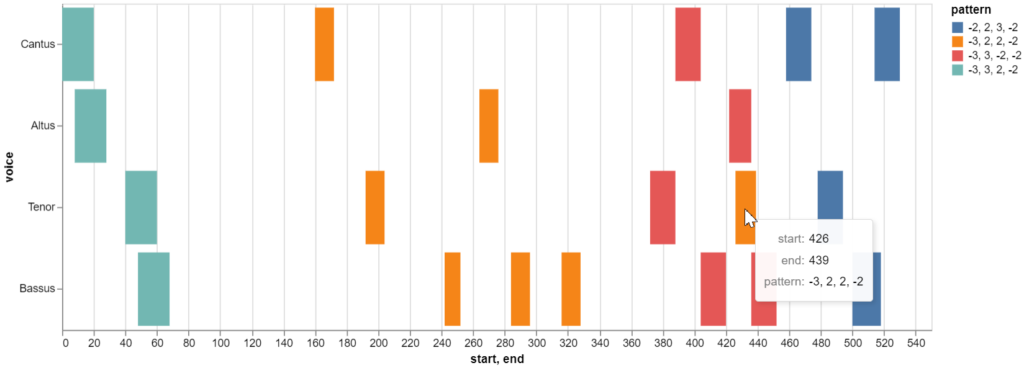
Figure 2c. Melodic nGram Map of the soggetti within the Kyrie (entries only) with the cursor over the last orange brick
To facilitate verification, we have prepared a command to draw the measure number from the offset number and automatically generate a music example. It is sufficient to enter the number of the piece of the corpus (0=model, 1-5=Mass movements) and the number appearing under ‘start’ when moving the cursor over the brick in the heatmap. It is also possible to determine the length of the example (i. e. the number of bars) and whether it should contain some bars preceding the occurrence, so as to see what happens before and after it (see the code used for this in Figure 3). In our case, loading the Kyrie (check_piece = 1) and indicating offset number 426 (start_offset = 426), we get the following message “offset 426 is in measure 52” and a musical example of measures 51-55 (see Example 9).
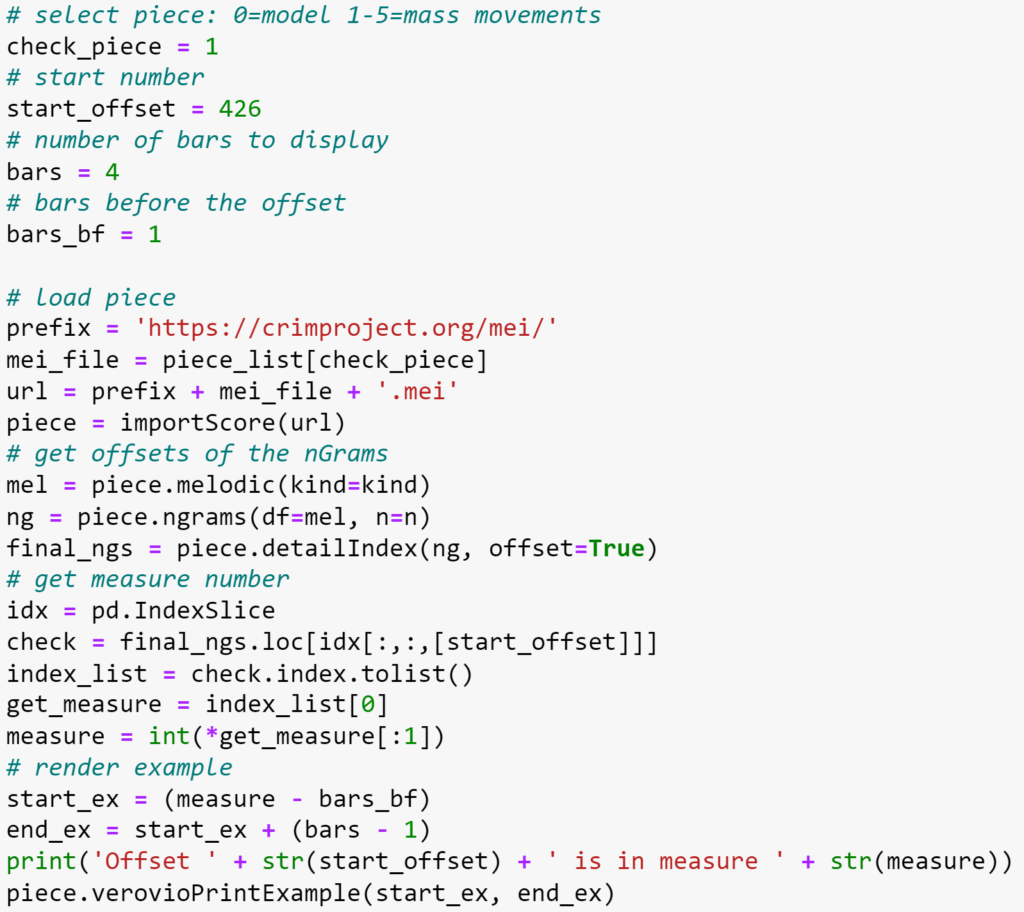
Figure 3. Python Code Used to Detect and Render Adjacent Instances of a Given n-gram
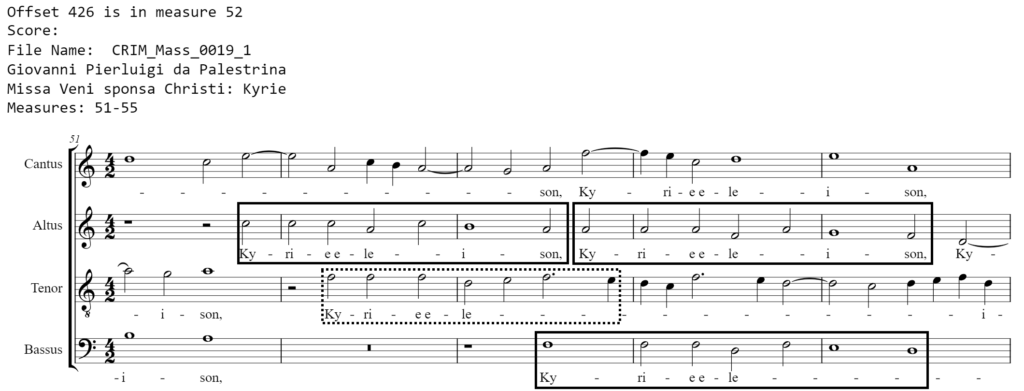
Example 9. Giovanni Pierluigi da Palestrina, Missa Veni sponsa Christi: Kyrie, bb. 51-55 (output of the previous block of code shown in Figure 3; rectangles added)
Example 9 shows that the orange brick in the Tenor voice at offset 426 (i. e. at bar 52) is a varied version of the soggetto “quam tibi Dominus” (-3, 3, -2, -2) sung by the other voices (solid rectangles). Due to its particular outline, the n-gram found in the Tenor (dashed rectangle in Example 9) has the same intervallic succession as the soggetto “accipe coronam” (-3, 2, 2, -2). So, that particular orange brick is to be considered a false positive, since it doesn’t represent an occurrence of the soggetto “accipe coronam”.
In the Gloria of the Mass, the picture is quite different. Both the heatmap with all occurrences (Figure 4a) and that with entries only (Figure 4b) show that the four soggetti do not appear in the same order as in the motet.
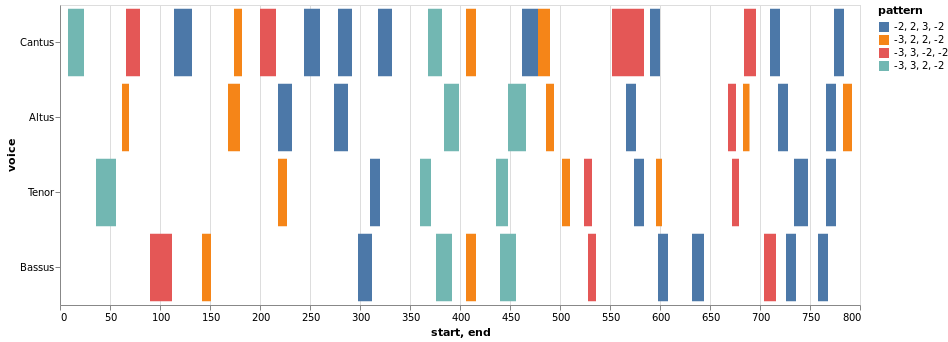
Figure 4a. Melodic nGram Map of the soggetti within the Gloria (all occurrences)
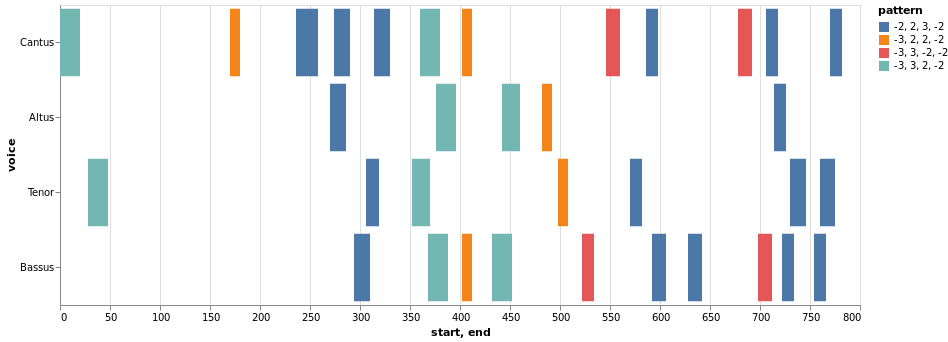
Figure 4b. Melodic nGram Map of the soggetti within the Gloria (entries only)
This piece, like the Kyrie, begins with the first soggetto of the motet. Nevertheless, both heatmaps show only two occurrences in two voices instead of the four green-cyan bricks we see in the motet and in the Kyrie. It’s not possible to tell from these images whether the other two voices are silent or singing new material. Indeed, here Palestrina once again employed a pair of duos. Still, this time he used non-imitative duos (i. e. the two voices of the duo sing different motives) instead of imitative duos (i. e. the two voices sing the same motive) (Example 10. The machine only highlighted the voice of the duo that sings one of the patterns (i. e. soggetti) we searched.
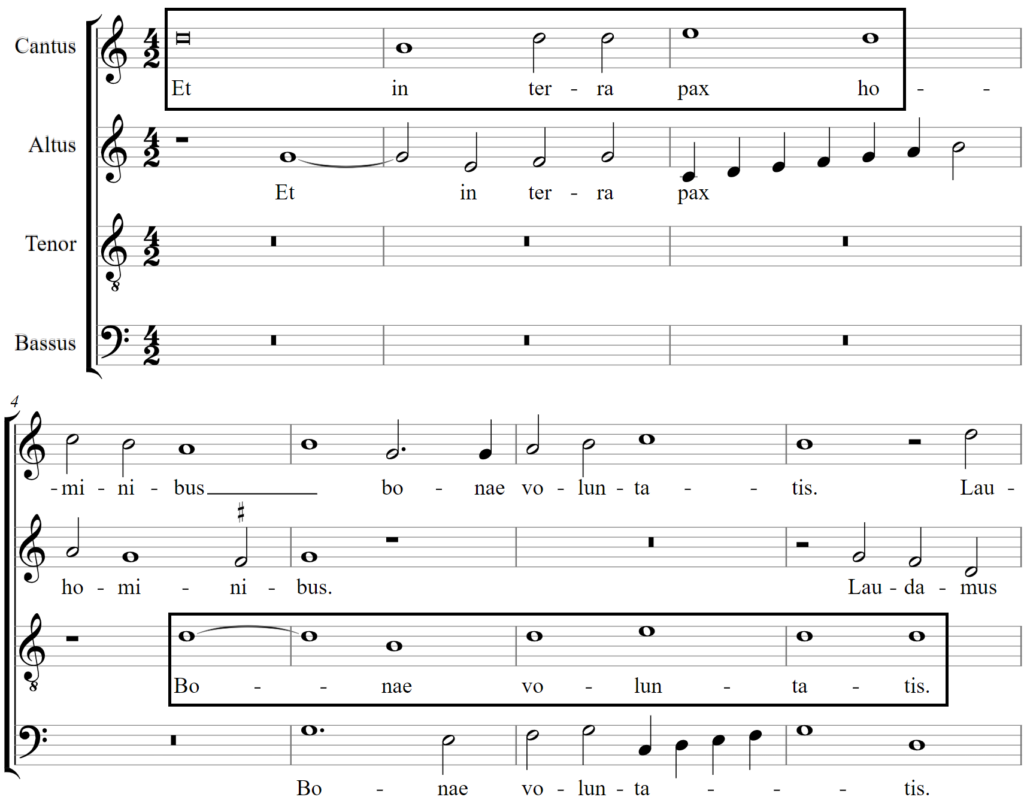
Example 10. Giovanni Pierluigi da Palestrina, Missa Veni sponsa Christi, Gloria, bb. 1–8
The heatmaps of the Gloria highlight some other details. About halfway through the piece, there are some occurrences of the last soggetto of the motet (“praeparavit in aeternum”, the blue bricks) followed by a group of occurrences of the first soggetto (“Veni sponsa Christi”, green bricks), which always appear at the beginning in the pieces examined so far. Looking at the score, we realize that the two groups of occurrences of the two soggetti are separated by a section break and that the position of the green bricks (Figures 4a and 4b, ca. offset 350) corresponds with the beginning of the section starting with “Qui tollis peccata mundi”.
The two heatmaps of the Credo show even more blanks, which likely indicates the presence of more new material (Figure 5a and Figure 5b). It should be noted that the Credo, often the longest movement of a Renaissance Mass, is heard after the Kyrie and the Gloria have already been sung.
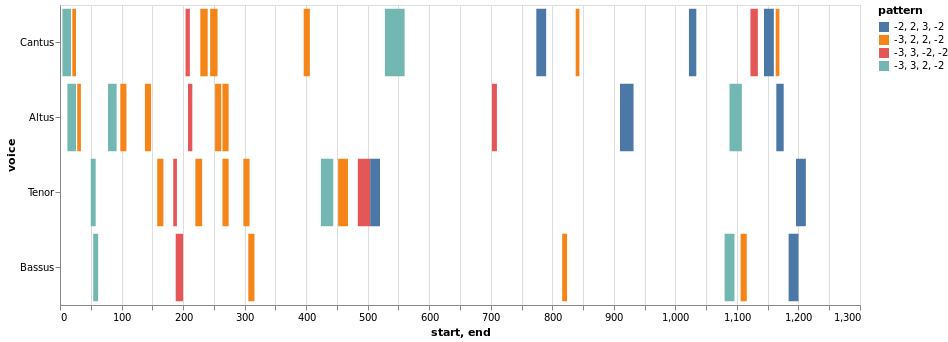
Figure 5a. Melodic nGram Map of the soggetti within the Credo (all occurrences)
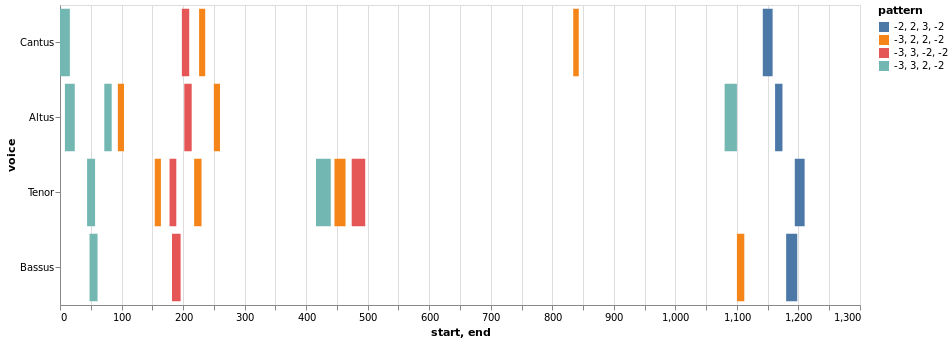
Figure 5b. Melodic nGram Map of the soggetti within the Credo (entries only)
This piece also seems to begin with the voices entering in pairs singing the soggetto “Veni sponsa Christi” and, apparently, ends with the last soggetto of the motet. Heatmaps report a peculiar behavior at offsets 450-550 on the x-axis. Figure 5a in particular shows the four n-grams in a row in the Tenor, where in the other voices show other activity (new material or rests). This is what takes place in the “Et incarnatus est”. Here Palestrina makes the Tenor sing all of the four soggetti, one after the other, in the same order they appear in the motet (Example 11 ). The other voices move in counterpoint, sometimes homorhythmically, sometimes in a more ornate fashion. This episode is a kind of small composition within the composition: not only is it preceded by a pause in all the voices and ends with a section break, but it includes all the melodic material on which the entire Mass is based, ideally replicating all at once the contour of the monodic antiphon. In this case, the heatmap suggested the presence of a peculiar compositional behavior.
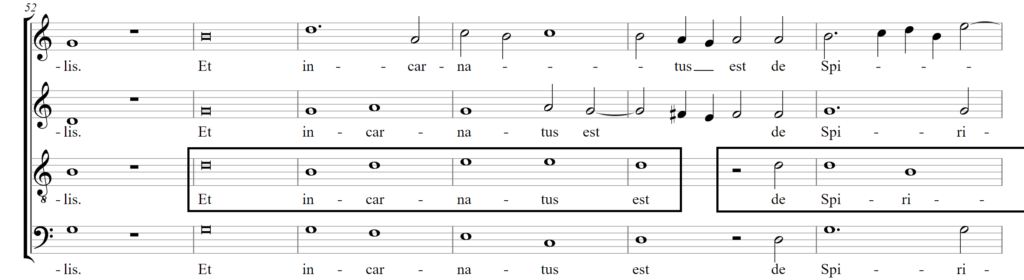
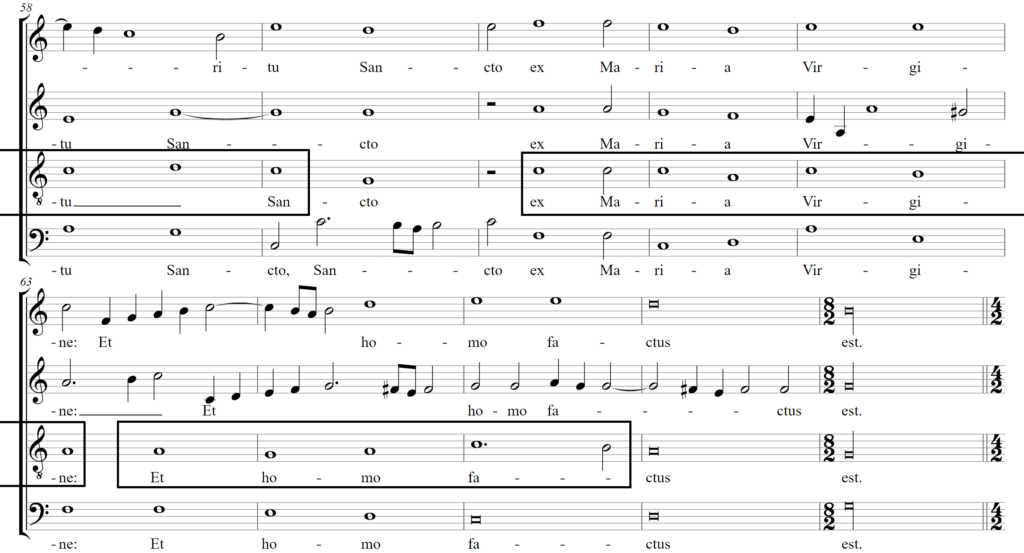
Example 11. Giovanni Pierluigi da Palestrina, Missa Veni sponsa Christi, Credo, bb. 52–67
The heatmaps of the distribution of the four n-grams within the Sanctus (all occurrences: Figure 6a; entries only: Figure 6b) are similar. Again, one can see the soggetto “Veni sponsa Christi” at the beginning of the piece, sung by all voices from the highest to the lowest. However, in this case, the time interval of entry seems irregular or at least different from the pieces observed so far.
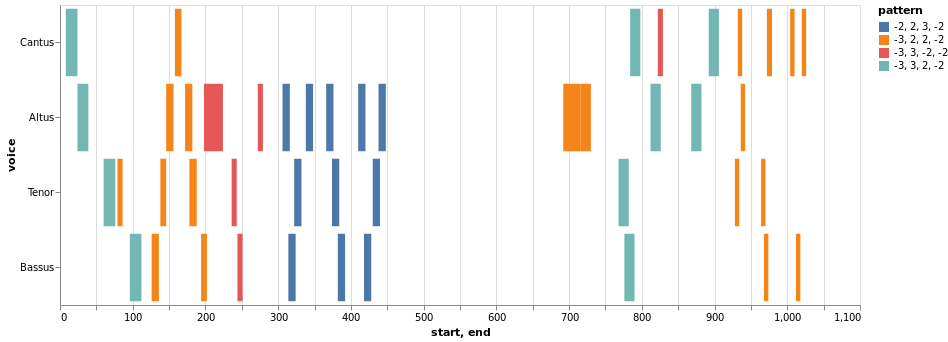
Figure 6a. Melodic nGram Map of the soggetti within the Sanctus (all occurrences)
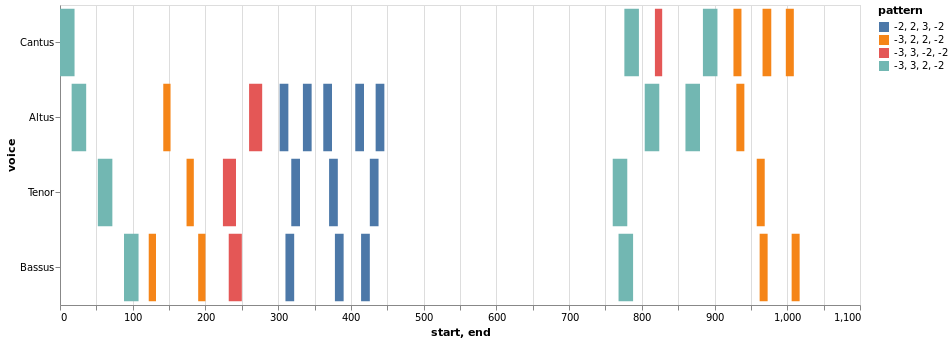
Figure 6b. Melodic nGram Map of the soggetti within the Sanctus (entries only)
The presence of blanks induces some reflections. From about offset 200, up to about offset 450, the machine detected several occurrences of the n-grams “-3, 3, -2, -2” (“quam tibi Dominus) and “-2, 2, 3, -2” (“praeparavit in aeternum”) in the three lower voices, whereas the upper voice does not take part in the imitative interplay. This is exactly what happens in the three-voice “Pleni sunt caeli” (Altus, Tenor, Bassus), based on the third and fourth soggetti of the motet. The next section is a “Hosanna” in triple time, involving all voices and based on a new subject not found in the motet. A few occurrences of the melodic n-gram of the first soggetto reappear at the beginning of the next section, the “Benedictus”. Subsequently, the piece ends with an episode based on the second soggetto of the motet (“accipe coronam”). It should be noted that this is the only part of the Mass that doesn’t end with the last soggetto of the motet.
The two heatmaps of the Agnus Dei are similar: the version displaying only entries (Figure 7b) has slightly fewer bricks than the one with all occurrences (Figure 7a). Here we find some of the features seen in the other pieces: the presence of four different colors (=four soggetti), the green bricks at the beginning, the blue bricks at the end, and, generally, groups of bricks of the same color. A score check reveals that the only apparent overlap of soggetti (the last red brick in the middle of blue bricks) is due to a false positive. We also note the presence of an additional “Quinta pars”, which doesn’t sing any of the soggetti until after halfway through the piece, when it shows a green brick: it is the beginning of the second Agnus, including an extra voice, in which all the soggetti of the motet are recapitulated, from first to last.
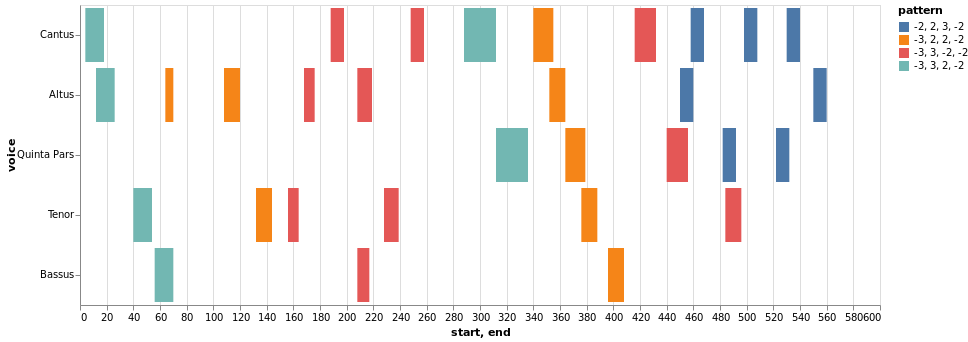
Figure 7a. Melodic nGram Map of the soggetti within the Agnus Dei (all occurrences)
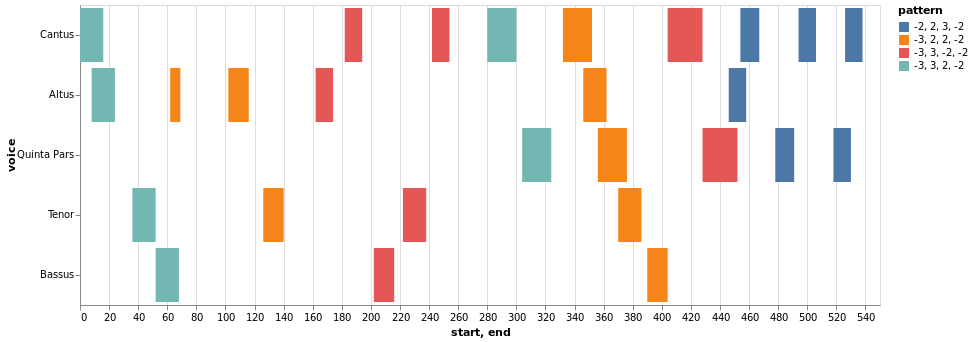
Figure 7b. Melodic nGram Map of the soggetti within the Agnus Dei (entries only)
At the end of this review, what are the basic elements made evident by the heatmaps generated with the CRIM tools? We have seen that this imitation Mass is extensively based on the soggetti of the motet, all appearing in each of the Mass movements. The first soggetto is found at the beginning of each movement and at the opening of some of the sections. This tells us, for example, that the initial episodes of movements and some internal sections tend to be similar. In turn, the last soggetto appears at the end of all movements, except in the Sanctus. The heatmaps also highlighted a reduction of texture in the “Pleni sunt caeli” of the Gloria and the entry of the added fifth voice in the second part of the Agnus Dei. In addition, heatmaps suggested peculiar behavior in the “Et incarnatus” of the Credo. In short, these visualizations say much about the strategies Palestrina employed to plan the distribution of soggetti throughout the Mass. The position of the colored bricks, however, does not allow us to infer meaningful information regarding the contrapuntal treatment: such an aspect would instead require different search parameters and visualization tools.
Evaluation of the Teaching Experience [MT, GT]
On the basis of these teaching experiences and what emerged in the students’ final reports, we can make a preliminary assessment:
The Technical Aspects [GT]
- The search for n-grams (such as Table 2), while requiring extensive manual checking, returned promising results, except for one soggetto (Table 3);
- heatmaps, quickly generated within the notebook, provided a reasonably good picture of the organization of this imitative Mass from the perspective of the use of soggetti.
Despite the presence of some ‘noise’ (e. g. a handful of false positives and the absence of some varied soggetti), in our opinion these visualizations communicate enough relevant information to trigger debate and arouse interest even among those who are less familiar with musical analysis. To the more experienced analyst, this tool acts effectively as a prospector, suggesting where potentially interesting activities are taking place. The tool, therefore, is suitable for different types of users.
Specific Learning Goals [MT]
Using CRIM tools in the classroom presented the following advantages:
- it contributes to bringing students – usually more familiar with technology than with Renaissance music – closer to a musical universe mainly unknown to them, thus determining a cultural enrichment that is undoubtedly useful within a curriculum such as that offered by the degree program in Performing Arts and Multimedia Production;
- it helps to reflect on how Renaissance music is constructed;
- it helps to visualize some characteristics of imitative polyphonic compositions (in particular, the formal structure and the internal articulation of each constitutive episode);
- it helps to analyze polyphonic music (to find the soggetti; to understand where they are located in the piece; to see how they are distributed among the voices) and speeds up the search for melodic patterns (whether they are soggetti or not);
- if the research conducted with the CRIM tools has not been fruitful, it stimulates reflections helpful in making it more fruitful (resulting in greater attention to the profile of the soggetti to be sought);
- if the research has given irrelevant results, it stimulates increasingly careful reflections to try to obtain more pertinent ones.
Cross-Curricular Learning Goals [MT]
There are other aspects, which we consider even more relevant, connected with using CRIM tools in an educational context. These are aspects that contribute to the achievement of more cross-cutting goals that we believe are fundamental to teaching (university and otherwise), including:
- develop a critical sense, the prerogative of every citizen and every free person;
- encourage the taste for experimentation, the engine of progress in every field of knowledge;
- and lastly, keep abreast of developments in new technologies, through which the processes of change in every subject area will pass.
It should also be considered that, among the students of this degree course, it is presumable that only few, if any, will devote themselves professionally to the analysis of Renaissance polyphonic music. On the other hand, everyone will be confronted with a reality in which information technology will gain increasing importance in analyzing the most diverse aspects of reality. In this regard, using CRIM notebooks for music analysis in the classroom is useful because:
- it helps to reflect on the man-machine relationship in the humanities;
- it helps to encourage a critical and aware use of technology in the analysis of artistic products, particularly musical;
- it makes students and teachers understand the advantages and limits (both practical and conceptual) of computer-assisted analysis;
- it makes students and teachers realize that computer programs improve primarily as they are used, that digital tools can be exploited better and better, and that their use and function can change over time: at first, perhaps, they can only contribute to saving time, but later they can make a significant contribution at the theoretical level as well;
- and finally makes us understand that the use of the digital tools stimulates reflections on aspects that perhaps, without their help, the analyst would have overlooked.
Using the CRIM tools for musical analysis allows to obtain always new, but not always relevant analytical results. This favors non-traditional teaching, characterized by an experimental approach based on a process of progressive development of increasingly effective and relevant computer-assisted research strategies. In this context, the teacher/tutor guides the students in critically using the instrument by exercising a maieutic function and encouraging an autonomous attitude and an approach as experimental as possible.
Conclusions [MT, GT]
In conclusion, the teaching experiences in Padua in recent years have shown that, using the CRIM tools in class, students willingly approach a musical repertoire very far from their listening habits thanks to a relatively familiar medium. At the same time, being asked to evaluate the results obtained using the PC for music analysis and compare them with those obtained from a traditional type of analysis, they learn to make critical use of the machine. In addition, analysis with CRIM tools stimulates the teacher (and tutors) and students to reflect on the music being analyzed and the tools used to analyze it. Moreover, these analysis exercises help trigger a circular reflection process that should enrich both the capacity of the music analyst and the expertise of those tasked with programming such tools.
Bibliography
Ackermann Peter (ed.). 2008. Giovanni Pierluigi da Palestrina. Motecta festorum totius anni […] quaternis vocibus […] liber primus: Venezia, Antonio Gardano, 1564. Roma: Comitato per l’Edizione nazionale delle opere di Giovanni Pierluigi da Palestrina–Istituto poligrafico e Zecca dello Stato, Libreria dello Stato (Edizione nazionale delle opere di Giovanni Pierluigi da Palestrina (1525-1594), 3).
Besseler, Heinrich. 1959. Das musikalische Hören der Neuzeit. Berlin: Akademie Verlag.
Bianchi, Lino (ed.). 1958. Giovanni Pierluigi da Palestrina. Il libro nono delle messe a 4, 5 e 6 voci secondo la stampa originale del 1599, la seconda edizione del 1608 e codici manoscritti. Roma: Fratelli Scalera, (Le opere complete di Giovanni Pierluigi da Palestrina, 25).
Cantus: A Database for Latin Ecclesiastical Chant – Inventories of Chant Sources
https://cantus.uwaterloo.ca/ (last access: 08/02/2023)
Caraci Vela, Maria. 2009. ‘Intertestualità e arte allusiva’, in La filologia musicale. Istituzioni, storia, strumenti critici. Volume II: 117-173. Lucca: LIM-Libreria Musicale Italiana.
Casimiri, Raffaele (ed.). 1939. Giovanni Pierluigi da Palestrina. Il libro primo dei mottetti a 4 voci. Secondo la ristampa del 1590. Roma: Fratelli Scalera, 1939 (Le opere complete di Giovanni Pierluigi da Palestrina, 3).
Espagne, Franz (ed.). [1875]. Pierluigi da Palestrina. Vierstimmige Motetten. Leipzig: Breitkopf & Härtel (Pierluigi da Palestrina’s Werke, 5).
Falck, Robert–Picker, Martin. 2001. ‘Contrafactum’ in New Grove 2, vol. 6: 367-370.
Filippi, Daniele V. (ed.). 2003. Giovanni Pierluigi da Palestrina. Motecta festorum totius anni cum communi sanctorum quaternis vocibus. Pisa: ETS (Diverse voci…, 2).
Filippi, Daniele V.. 2008. “Riscritture policorali e creatività sonora in Palestrina e Victoria” / “Polychoral rewritings and sonic creativity in Palestrina and Victoria”. Polifonie 8/2-3: 63-142; 143-182.
Freedman, Richard, Fiala, D. Russo-Batterham, D., Viglianti, R., Walter, M. 2014–. Citations: The Renaissance Imitation Mass, https://crimproject.org
Freedman, Richard, Morgan, A., Gould, F, Russo-Batterham, R, Dang, T. 2020–. CRIM Intervals.
Freedman, Richard, editor. CRIM Thesaurus of Musical Types. Version 4.0: January 2022. Online at https://sites.google.com/haverford.edu/crim-project/vocabularies/musical-types?authuser=1#h.hjzb38ktkd61 (accessed 31/01/2023)
Gurrieri, Marco (ed.). 2017. Veni sponsa Christi. Mass.
https://crimproject.org/masses/CRIM_Mass_0019/ (last access: 31/01/2023)
Gurrieri, Marco, Besson, V., Freedman, R. (eds.). 2017. Veni sponsa Christi. Motet
https://crimproject.org/pieces/CRIM_Model_0019/ (last access: 31/01/2023)
Haberl, Franz Xaver (ed.). 1886. Giovanni Pierluigi da Palestrina. Missarum Librum nonum curavit Franciscum Haberl. Leipzig: Breitkopf & Härtel (Opera Omnia Ioannis Petraloysii Praenestini, 18).
Palestrina, Giovanni Pierluigi. 1564. Motecta festorum totius anni cum communi sanctorum, Io: Petri Aloisii Praenestini chori Sanctae Mariae Maioris in Urbe magistri, quaternis vocibus, liber primus. Venice: Antonio Gardano [RISM A/I P 689].
Palestrina, Giovanni Pierluigi. 1599. Ioannis Petraloysii Praenestini Missarum cum quatuor, quinque, et sex vocibus. Liber nonus. Nunc primum in lucem editus. Venice: hei of Geronimo Scotto [RISM A/I P 683; digitised copy at https://loc.gov/item/ihas.200154766 (last access: 24/01/2023)].
Schubert, Peter N. 2007. “Hidden Forms in Palestrina’s First Book of Four-Voice Motets”. Journal of the American Musicological Society 60: 483–556. A corrected version of the appendix to this article is found on http://www.music.mcgill.ca/~schubert.