The Imitation Mass in Renaissance Spain: Pedro Fernández Buch listens to Francisco Guerrero
María Elena Cuenca Rodriguez (Universidad Autónoma de Madrid)
https://orcid.org/0000-0002-5419-2576
Abstract
Pedro Fernández Buch was a composer from La Rioja (Spain) in the late sixteenth and early seventeenth centuries who was of some importance in his time. In his corpus of sacred polyphony are his five imitation Masses, most of them based on motets by Francisco Guerrero. In this paper, I will analyze the contrapuntal style of Fernández Buch’s Masses and Guerrero’s motets to delve into their musical relationships using the CRIM tools. My aim is to find out the relationships between the borrowed melodic materials and their utilization and readaptation within Fernández Buch’s new polyphonic structures in four of his five complete imitation Masses. During this process, I will also be carried out a modular analysis to identify the rate of contrapuntal transformation that exists between Fernández Buch’s Masses and Guerrero’s previous models.
Introduction
Pedro Fernández Buch (1574-1648) was a composer of Flemish descent who was born in La Rioja (Spain). He was of some importance in his times yet remains unknown in current musicological literature. He had the recognition by some theorists such as Andrés de Lorente, who in El porqué de la música (Lorente 1672) compares him with other great composers of the Renaissance, including Morales, Guerrero, Palestrina, Victoria or Lobo. Fernández Buch was chapel master of the collegiate church of Toro and of the Santo Domingo de la Calzada (his hometown) and Sigüenza cathedrals. He remained in the latter cathedral for forty years until his death in 1648 (Jambou 1983; Suárez Pajares 1998).
Fernández Buch’s corpus of around 100 polyphonic compositions is still unpublished and is preserved mainly in manuscripts held at the ecclesiastical archives of the Segovia, Sigüenza, Zaragoza cathedrals and the collegiate church of Pastrana (Suárez-Pajares 1999, 53). Most of his work is liturgical, including six imitation Masses, a Requiem Mass and an Office for the Dead, forty-one motets, antiphons, a complete cycle of magnificats, and some hymns, antiphons, responsories and villancicos. Unfortunately, the lack of critical or interpretative editions on Fernández Buch makes it impossible to study and interpret them.
Four out of his five imitation Masses are based on motets by Francisco Guerrero and the remaining one, the 8-voice Missa de Batalla, is based on Janequin’s chanson La Guerre. This work is preserved in the manuscript E-Zac B-5/82 at the cathedral of Zaragoza—together with the Missa de Requiem—and has a polychoral conception typical of many choral compositions of the early 17th century. For this reason, and because of its stylistic differences with respect to the other imitation Masses, this work is not considered here. The Masses that are based on Guerrero’s homonymous motets are the five-voice Tota Pulchra, and the four-voice Virgines prudentes, Gloriose confessor Domini and Sancta Maria Succurre Masses, and are preserved in manuscript E-PAS 2 (Table 1). In this manuscript, an incomplete and unnamed imitation Mass is also preserved—only the end of the Credo, from “passus et sepultus est” to the end, the Sanctus and the Agnus Dei is found—. I managed to identify the model of this Mass which is again another motet by Guerrero: Prudentes Virgines (Cuenca Rodríguez, forthcoming). In the coming future, CRIM tools will be used to investigate the melodic relationships between the model and the Mass.
| Item | Work | Vv. | Scoring | Source |
| [1] | Missa [incomplete] | 5 | S-S-A-T-B | E-PAS 2, ff. 28r-33r |
| [2] | Missa Tota pulcra | 5 | S-S-A-T-B | E-PAS 2, ff. 34v-52r |
| [3] | Missa Virgines prudentes | 4 | S-A-T-B | E-PAS 2, ff. 52v-65r |
| [4] | Missa Gloriose confessor Domini | 4 | S-A-T-B | E-PAS 2, ff. 65v-77r |
| [5] | Missa Sancta Maria sucurre | 4 | S-A-T-B | E-PAS 2, ff. 77v-89r |
| [6] | Missa de Batalla | 8 | SS-AA-TT-BB | E-Zac [no foliation] |
| [7] | Missa de Requiem | 5 | S-S-A-T-B | E-Zac [no foliation] |
Table 1. List of the polyphonic Masses composed by Fernández Buch and their respective sources and scoring
In a recent project granted by the Instituto de Estudios Riojanos, I was able to make the complete edition of Fernández Buch’s imitation Masses—which will also be published in CRIM and by the Instituto very soon (Cuenca Rodríguez, forthcoming)—. For the following study, I have used this edition of the Masses by Fernández Buch to analyze only the complete imitative Masses based on Guerrero’s motets: the Tota Pulchra, the Virgines prudentes, the Gloriose confessor Domini and the Sancta Maria Succurre Masses. For the Guerrero motets, I have chosen the Llorens Cisteró and Karl H. Müller-Lancé edition (1978), re-edited it and exported it to XML, for analysis in Jupyter Notebooks. The aim is to find out the relationships between the borrowed melodic materials and their utilization and readaptation within Fernández Buch’s new polyphonic structures in four of his five complete imitation Masses. For that purpose, I will analyze the contrapuntal style of the Fernández Buch’s Masses and Guerrero’s motets to delve into their musical relationships using the CRIM tools. In order to achieve the objectives, I have used the CRIM methodology, which consists of an estimation—in which we use our expert knowledge to image the kinds of relationships that exist, or typical patterns—, investigation—in which we try to turn those expert opinions into some form that can be explored with machine tools—and evaluation/interpretation—in which we look back to see what we learned, or how our methods might be improved—.
When I approach the Fernández Buch’s Masses, the first thing I notice is that this composer integrated the contrapuntal rules of his time. However, he has a comparatively more vertical vision of the harmony more typical of the composers of the early seventeenth century rather than the style of Guerrero and his contemporaries, especially in the Missa Tota Pulchra and the polychoral Missa de Batalla. Unlike Guerrero, Fernandez Buch is not a composer concerned with the relationship between the music and the text prosody of his Masses. This is particularly manifest in their more syllabic movements, such as the Gloria or the Credo, where there are quite a few incongruities in the text underlay. For example, some tonic syllables in “genitum” or “consustantialem” do not coincide with the syncopations and strong beats of the phrase of Figure 1 (marked in red).
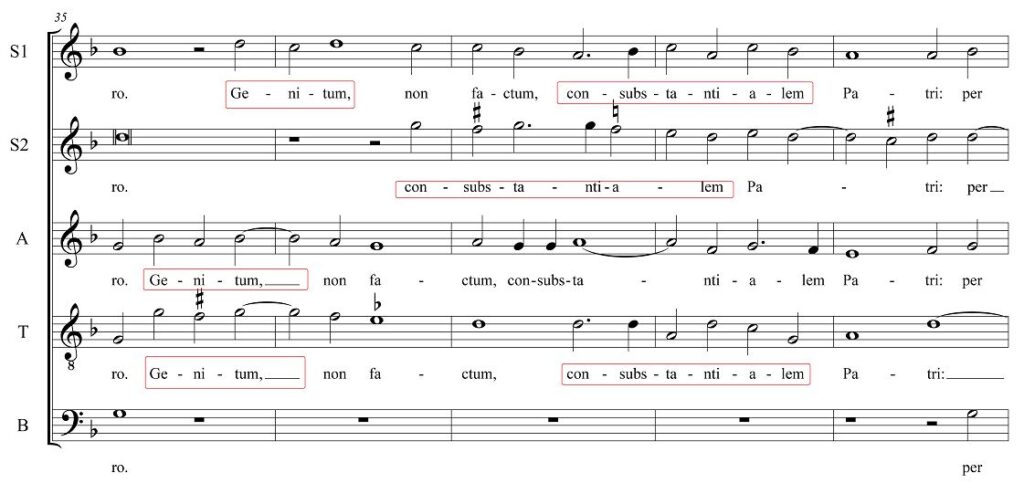
Figure 1. Text underlay not prosodic enough in Credo of the Fernández Buch’s Missa Tota pulchra (cc. 35-39). Source: created by the author (Cuenca, forthcoming).
The verticality of the polyphony and the less contrapuntal conception—in comparison with Guerrero’s motets—may be some of the reasons why Fernández Buch’s melodic elaboration and text prosody are not very outstanding. In all the masses the use of four-voice contrapuntal textures stands out, with movement by stepwise motion in the superius, altus and tenor and a melody with a greater number of leaps in the bassus. He also makes extensive use of unisons and his melodic elaboration and ambitus is quite reduced. In a recent study for the 50th Medieval and Renaissance Music Conference, Cory McKay and Cuenca Rodríguez (2022) selected a large number of masses and motets by Morales, Guerrero, Victoria and Fernández Buch—in order to make the sample statistically representative— and observed how Fernández Buch’s Masses were more similar to those by Victoria than to those by Morales and Guerrero through statistical analysis and machine learning techniques; also, we determined that they were more similar to those by Palestrina than to those by Orlando di Lasso, although Fernández Buch’s Masses have a distinctly Spanish style that differentiates him from the other composers. In both comparative experiments, the features that best statistically separate Fernandez Buch’s style from that of other composers were the importance of the high register and the histogram of vertical intervals. Future research will look at the differences in these features in detail in the work of these composers.
Macro level analysis of shared soggetti
Based on this information and considering that Fernández Buch’s is substantially different from Guerrero’s, I will focus on their melodic similarities, since the latter’s motets served as core material for Fernández Buch’s Masses. As for the methodology for the first experiment, concerning melodic relationships, I began with two different questions: how might CRIM vocabularies and methods help us understand the connections between Buch’s Masses and their models? And what might similarity based on compositional borrowing tell us about general stylistic similarity? To answer them, I have used the Jupyter Notebook No. 8 (Model_Finder_and_Comparisons) to build a table summarizing the percentage of “entries” shared among the pieces. As the Jupyter notebook describes:
These “entries” are soggetti (expressed as melodic n-grams) that begin after a rest or a section break. They are thus the most likely soggetti to be remembered and the most likely to be used in important presentation types. This method returns a “driving distance table” showing how likely each model was a source for each Mass. This is represented by a score 0-1 where 0 means that this relationship was highly unlikely and 1 means that the two are highly likely to be related in this way (or that a piece was compared to itself). Specifically, the value is the percentage of each piece’s thematic (i.e. recurring) melodies can be found as thematic melodies in all the other pieces in your corpus. The specific number of times each soggetto appears is not considered, but rather the percentage of unique entries that each pair of pieces shares (Freedman 2022).
I have used n-grams with a length of 4 for each experiment since it is the range in which the most similar repeated melodic structures are found between the Mass and model. In the following heatmaps, darker colors represent stronger relationships between the corresponding pairs of pieces on the grid.
In Figures 2a-d, I observe how the Sanctus and, to a lesser extent, the Credo and Gloria are the movements that melodically have the greatest similarity with Guerrero’s model, although the Gloria and Credo, as normally the longest movements, usually have fewer soggetti and thus fewer possible correspondences with the model compared to the Kyrie, Sanctus and Agnus Dei. In the Fernández Buch’s Missa Virgines prudentes, the Gloria and, secondly, the Credo are again movements that are melodically more similar to the Guerrero’s respective motet. Sanctus and Gloria are the closest to the previous model for the Missa Gloriose confessor, and Agnus Dei for the Missa Sancta Maria succurre. There does not seem to be, therefore, as much importance in the recurrence of melodic citation in the Kyrie, and—unlike the use made by many contemporary composers with the Gloria and Credo—they seem to be melodically similar movements in the Tota pulchra and Virgines prudentes masses—. Nevertheless, Fernández Buch chose Guerrero’s melodies in a particular way for each movement in each of his Masses. For example, Sanctus and Agnus Dei seem to be conceived in opposite ways: where there is melodic material quoted in one, the other lacks such material within the same mass.
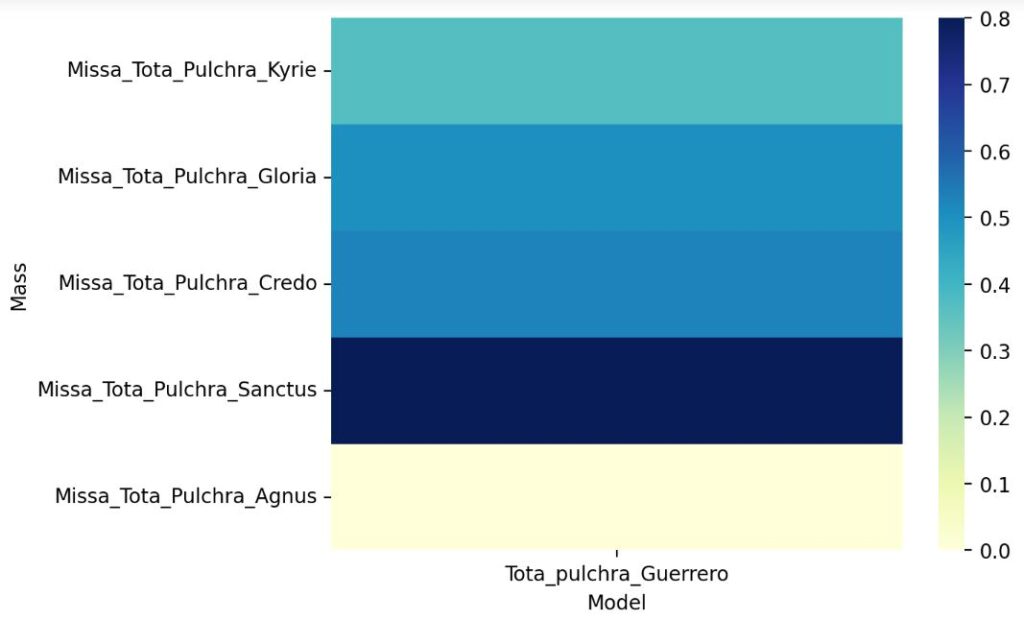
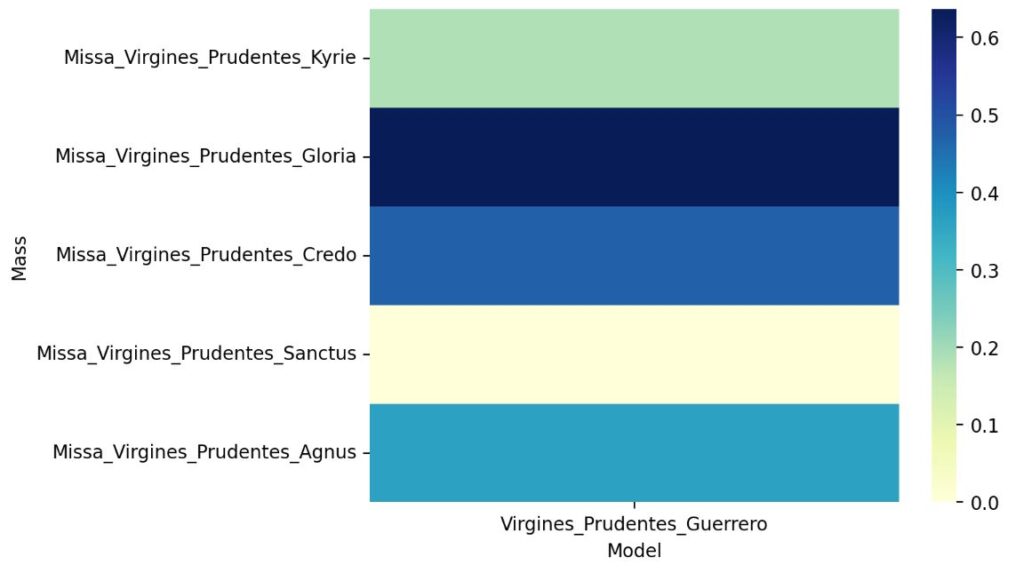
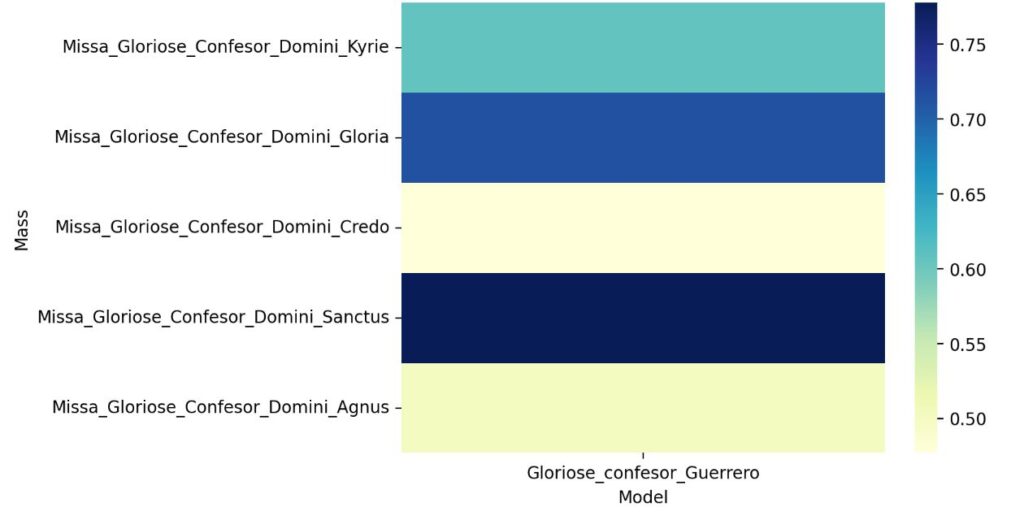
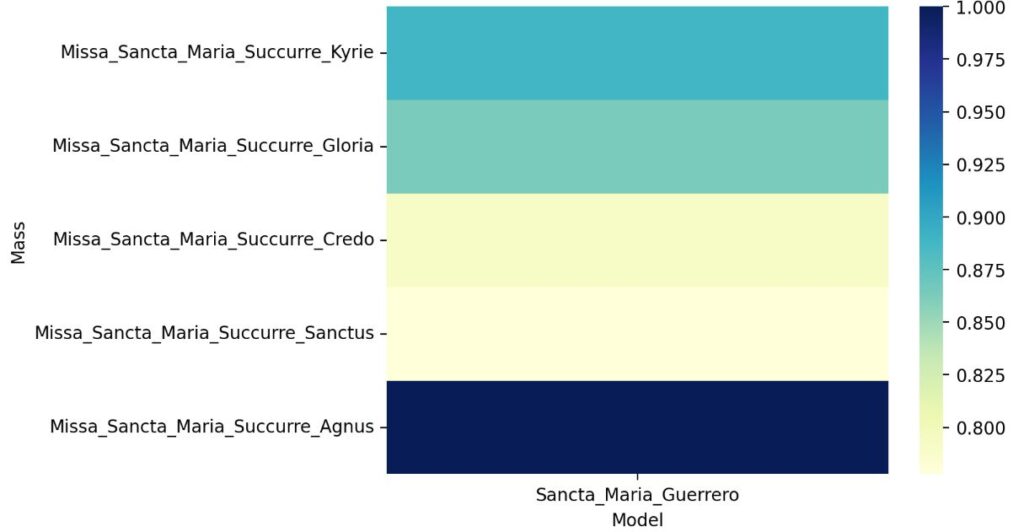
Figures 2a-d. Percentage of melodies from the Fernández Buch’s Mass movements (in each of his four Masses) that come from the Guerrero’s respective motets. Source: created using Jupyter Notebook 8 Model_Finder_and_Comparison. No 4 n-Gram is common between the Tota pulchra Mass and model; one 4 n-Grams soggetti is common between the Virgines prudentes Mass and model—(‘-2’, ‘3’, ‘-2’, ‘-2’)—; Two 4 n-Grams soggetti are common between the Gloriose confesor Mass and model—(‘-5’, ‘4’, ‘2’, ‘2’), (‘-3’, ‘2’, ‘-3’, ‘2’)—; Two 4 n-Grams soggetti are common between the Sancta María Mass and model—(‘3’, ‘-2’, ‘-2’, ‘2’), (‘-3’, ‘2’, ‘2’, ‘-2’)—.
Micro level analysis of shared soggetti
Also, I will look at the ways in which these common melodies between each individual Mass movement and its model are expressed throughout these works at a micro level. Despite the recurrence of melodies shown in the previous heatmaps for certain movements, I have checked those movements in which Fernández Buch had a greater interest in replicating the melodic and presentation types planning that can be derived directly from the Guerrero’s respective model. During the analytical process, I will also observe the different ways in which Fernández Buch presents the contrapuntal structures, or the different material selected, the overall order of the soggetti and the presentation types used in the movements that have more melodic similarities with the model itself. For this experiment, I try to find the shared entries of the 3-n-grams soggetti on a micro level, since Fernández Buch tends to change the melody of the soggetti from the fourth interval onwards. There are hardly any similar contrapuntal structures between them from the 4 n-Gram onwards. The following figures show HeatMaps with visual n-grams blocks to observe when each melody is quoted and what presentation type do these shared entries seem to be involved in. In these experiments, the data have been contrasted with the observation of the scores to verify the accuracy of the results.
Missa Tota pulchra
In the Missa Tota pulchra, the main soggetti of the beginning of part 1 (P1) and part 2 (P2) of Guerrero’s homonymous motet are quoted (see Figures 3a-b). I have combined unisons because of the prevalence to them in this work and to properly observe the movement of melodic intervals in it. These soggetti correspond to the following n-grams:
- P1A: -5, 3, -2 (in yellow); P1B: -4, 2, -2 (in green)
- P2A: 3, -3, 3 (in blue); P2B: -5, 5, -3 (in pink, the bassus melody)
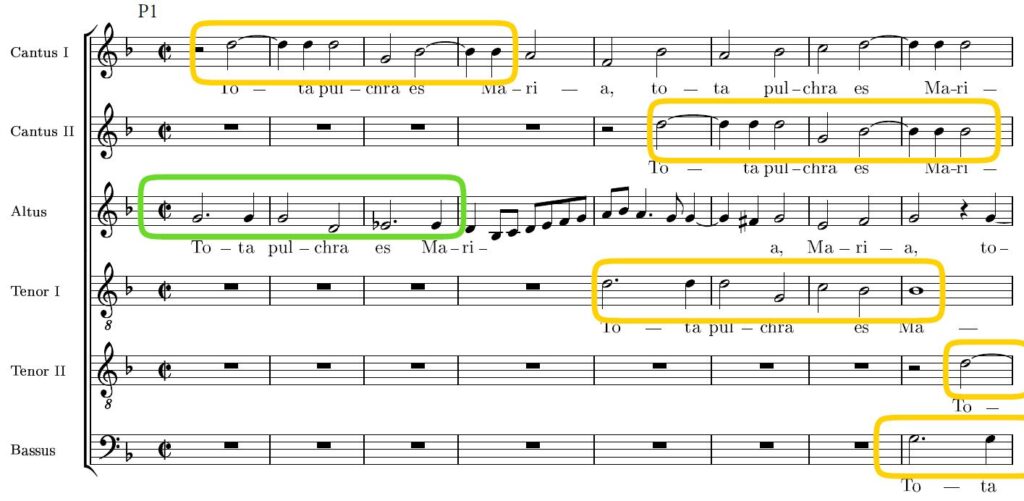
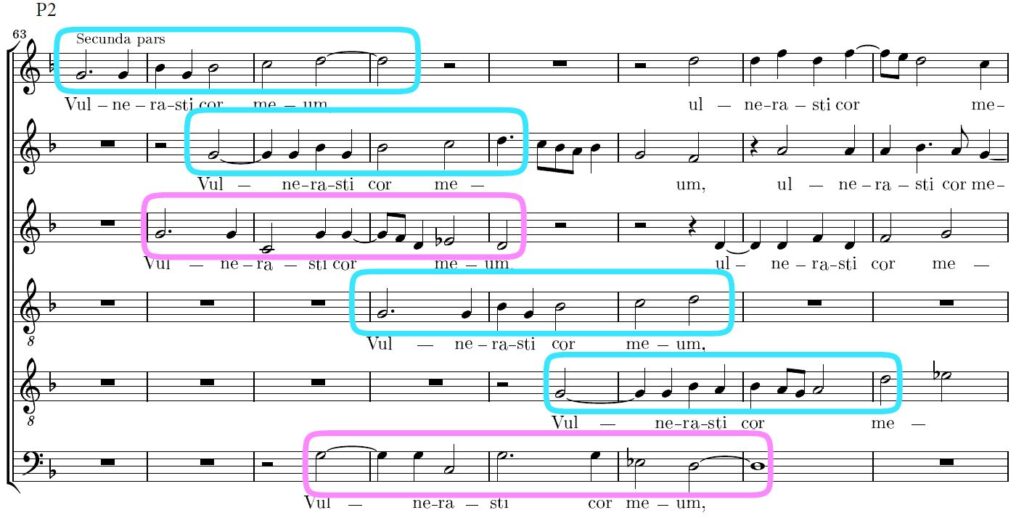
Figures 3a-b. Imitative soggetti in parts 1 (above, bb. 1-8) and 2 (below, bb. 63-70) of Guerrero’s motet Tota pulchra. Source: created by the author from Álvarez’s edition (2022).
Firstly, Guerrer’s P1 of the motet opens with a series of Imitative Duos (ID’s, onwards), and Non-Imitative Duos (NIm’s, onwards) in the six-voice texture. Secondly, Guerrero reuses similar intervals of P1B for P2B, developing his own material. The second part of the motet is created with a series of ID’s, NIm’s and Periodic Entries (PEn’s, onwards) that are already varied via flexing and changing melodic intervals of entry. He also re-uses the main soggetto of the motet as the lower soggetto of a new NIm, and then reuses the upper voice of that new NIm as the basis of a subsequent ID. As Freedman suggested to me, this is an interesting kind of developing variation, as the one (counter) soggetto becomes the basis of a new schemata. The chaining of this variety of contrapuntal procedures occurs practically throughout the motet at the beginning of a new verse, and usually ends the texture in tutti with a quasi-homophonic passage, while a new entrance overlaps.
One of the examples where a greater similarity and use of motet melodies is observed is in the Kyrie of the Missa Tota pulchra. Figures 4a-b show how Fernández Buch conceived the Kyrie in the same way as the repeated structure of Guerrero’s motet. He first quotes P1A (in orange) combined with another melody (4, -2, -3 n-grams in green) although in the Mass it is shown as a fuga, when Guerrero freely introduces these melodies repeated only once more. The Christe introduces variations of the P1A soggetti, while the Kyrie II takes up the melodic structures seen in part 2 of the motet, combining P2A (in turquoise blue) with a descending stepwise motion melody (in dark blue).
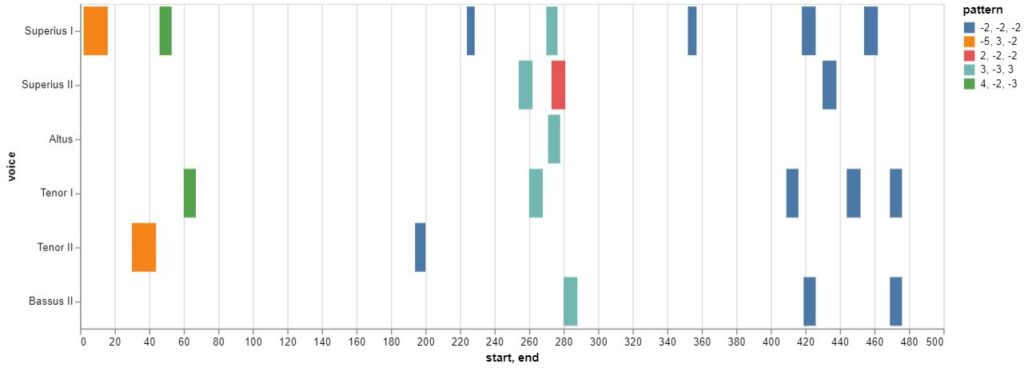
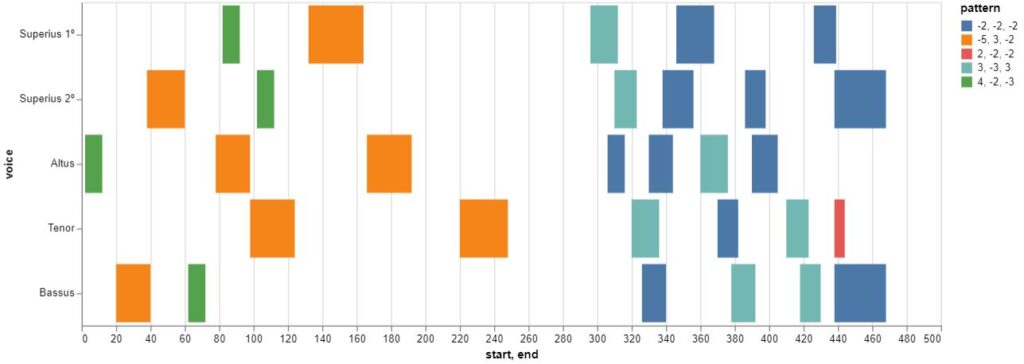
Figures 4a-b. Heatmaps of shared melodies between the Guerrero’s Tota pulchra (above) and the Kyrie of the Fernández Buch’s Missa Tota pulchra (below). Source: created using Jupyter Notebook 8 Model_Finder_and_Comparison. I should note in the heatmap of the motet that the altus countersoggetto is not represented here because of the many unisons, and that P2 starts at approximately offset 250 of the same upper heatmap. The colors betwwen the score (Fig. 3) and the heatmap (Fig. 4) are matched to improve visualization and identification of melodic soggetti
One of the differences noticed is that, while Guerrero uses periodic entries of P2A combined with P2B in the second part of the motet (see Figure 3), Fernández Buch uses P2A together with that stepwise motion melody as non-imitative duos, as shown in Figure 5 and previously in the Guerrero’s piece. This highlights Fernández Buch’s way of using the same melodic material as Guerrero, but through a different contrapuntal design.
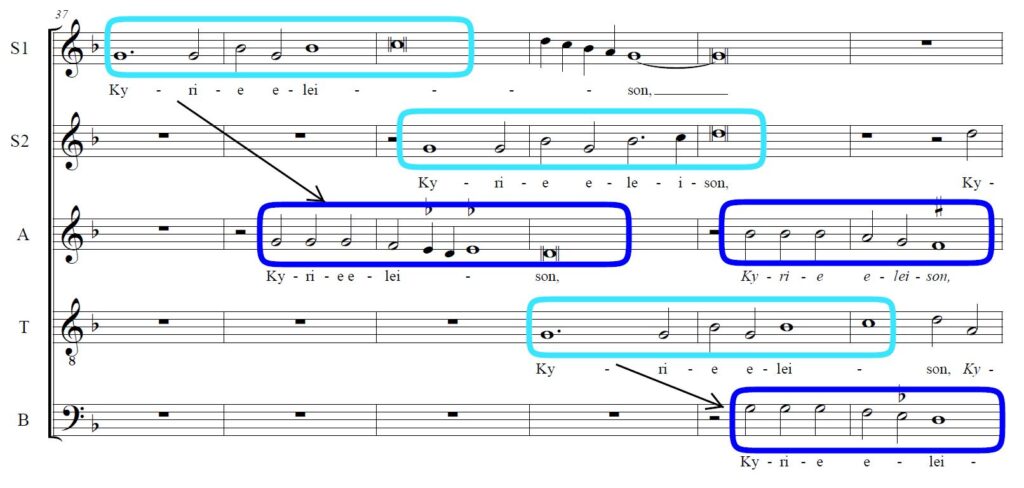
Figure 5. Non imitative duos in the Kyrie II (bb. 37-42) of the Fernández Buch’s Missa Tota pulchra. Source: created by the author (Cuenca, forthcoming). The last two dark blue soggetti in A and B are just parallel 10ths: a very common use in the imitative counterpoint of the time.
In the rest of the Mass, the Gloria and Credo are freer movements, which also employ material from the motet, but introduce a lot of newly created counterpoint in order to fit the liturgical text appropriately. However, as seen above in Figures 4a-b and below in Figures 6a-b, the Kyrie is conceived as an independent movement when imitating the main soggetti of the motet. Furthermore, the Sanctus and the Agnus Dei work as complementary movements. In Figure 7, Sanctus is based on material from P2A (right) that comes from the second part of the motet, while Agnus Dei (Figure 8) is based on P1A (left) that comes from the first part of the motet. Although the order of the soggetti is not always the same with respect to the model, this is a compositional characteristic of Fernández Buch’s Masses, since he melodically designs the Sanctus and Agnus Dei of his other Virgines prudentes, Gloriose confessor and Sancta Maria Masses using soggetti 1 and 2 of the two parts of the respective motet in a complementary movements. In this regard, it seems that Fernández Buch respects the rules set forth by Cerone, in the I Book of El melopeo y su maestro (1613), where he indicates this complementarity of motifs borrowed in the parts of the Kyrie and the Agnus Dei (Stunk 1965, 265-268).
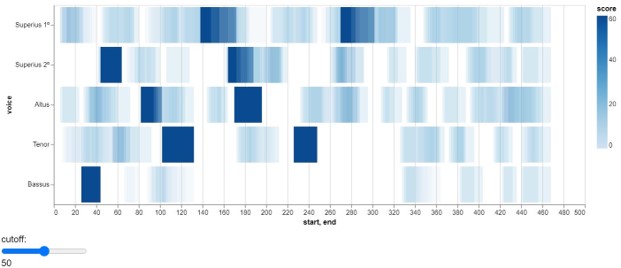
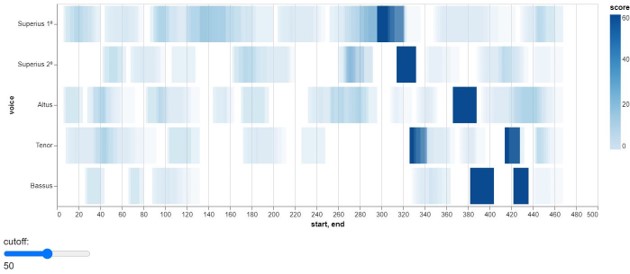
Figures 6a-b. Comparison of the use of soggetti P1A (left) and P2A (right) in the Kyrie of Fernandez Buch’s Missa Tota pulchra. Source: created using Jupyter Notebook 7a_Heatmaps_Notes_n-grams. Figures 6, 7 and 8 are heatmaps that show similarity based on edit distance to the previous P1A (-5, 3, -2) and P2A (3, -3, 3) n-grams
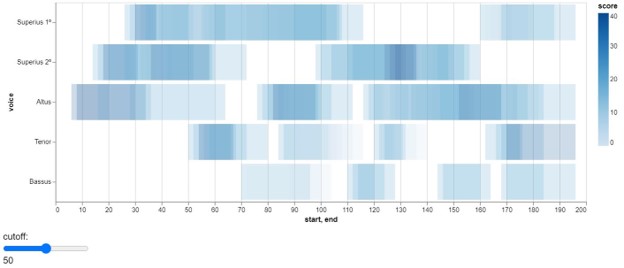
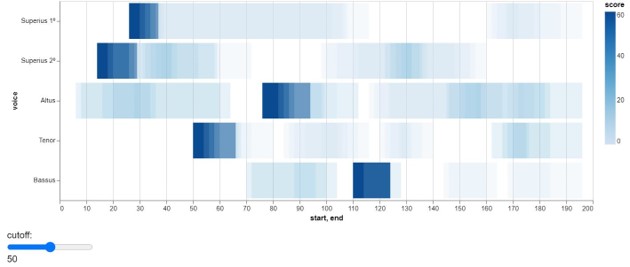
Figures 7a-b. Comparison of the use of soggetti P1A (left) and P2A (right) in the Sanctus of Fernandez Buch’s Missa Tota pulchra. Source: created using Jupyter Notebook 7a_Heatmaps_Notes_n-grams.
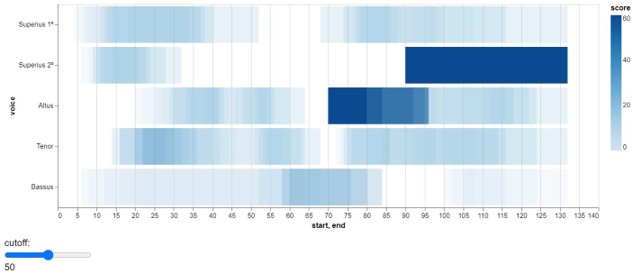
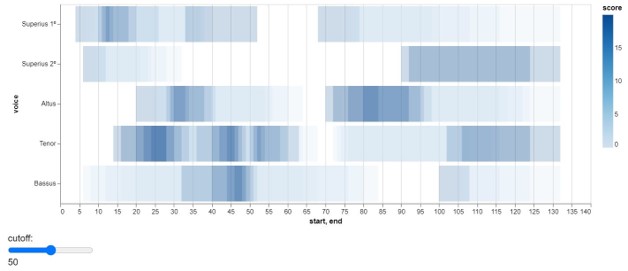
Figures 8a-b. Comparison of the use of soggetti P1A (left) and P2A (right) in the Agnus Dei of Fernandez Buch’s Missa Tota pulchra. Source: created using Jupyter Notebook 7a_Heatmaps_Notes_n-grams.
Missa Virgines prudentes
In the Missa Virgines prudentes, the case of the Gloria movement is different from the respective movement in Missa Tota pulchra, due to a greater use of the melodic material coming from Guerrero’s motet (see Figure 2). The Guerrero’s soggetti in his Virgines prudentes motet have the following n-grams: P1: -3, 3, -5; P2: -2, -2, 2. The soggetti P1 (in yellow) starts with imitative duos and the soggetti P2 (in blue) is developed in a fuga (Figure 7; The P2 soggetto is very declamatory, developed in unisons; however, when I change the parameter in CRIM Notebook 8 to combine unisons, the results are not remarkable and conclusive due to this declamatory character of the melodies in the motet and, therefore, in the Mass.). Unlike Guerrero’s other motets, Virgines prudentes does not have a structure that completely splits part 1 from part 2 of the motet, but rather the two would be connected in counterpoint, as can be seen in Figures 9a-b (below, first bar).
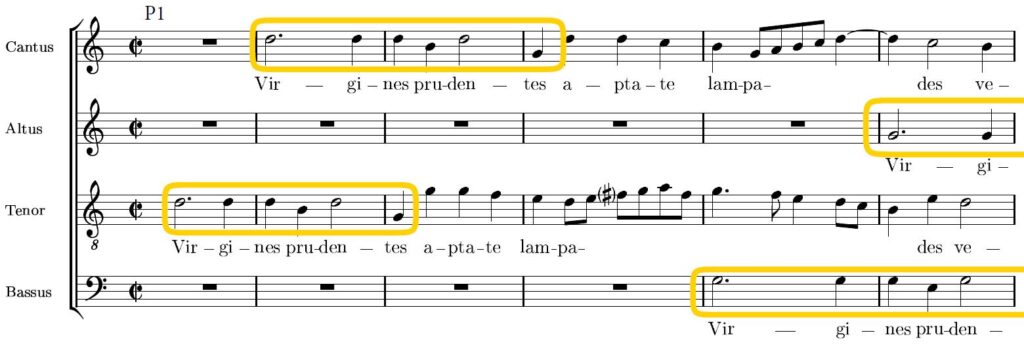
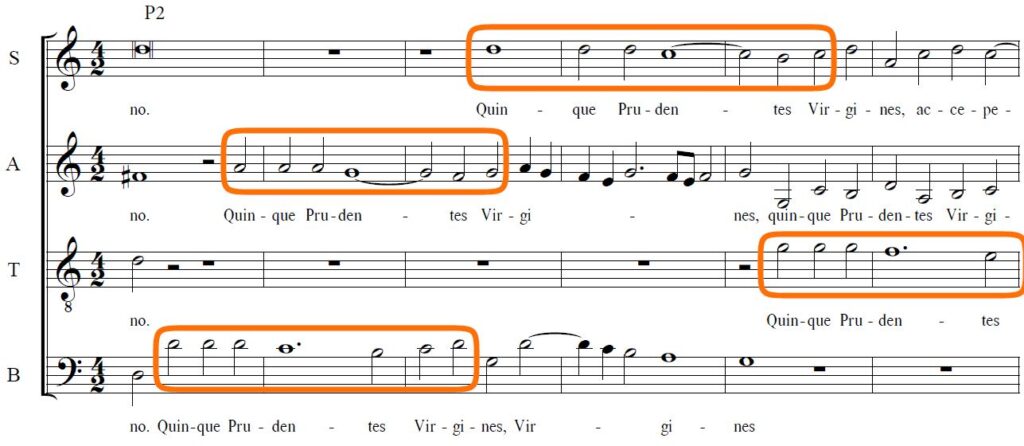
Figure 9a-b. Imitative soggetti in parts 1 (above, bb. 1-6) and 2 (below, bb. 33-38) of Guerrero’s motet Virgines prudentes. Source: created by the author from Álvarez’s edition (2022).
In Figure 10, the Gloria of the Fernández Buch’s Missa Virgines prudentes (below) tends to replicate the melodic structures that occur in its model more than in any other movement throughout the Mass. The soggetti P1 and P2 are clearly represented in yellow and orange respectively and are also used in Gloria (although P2 sparingly).
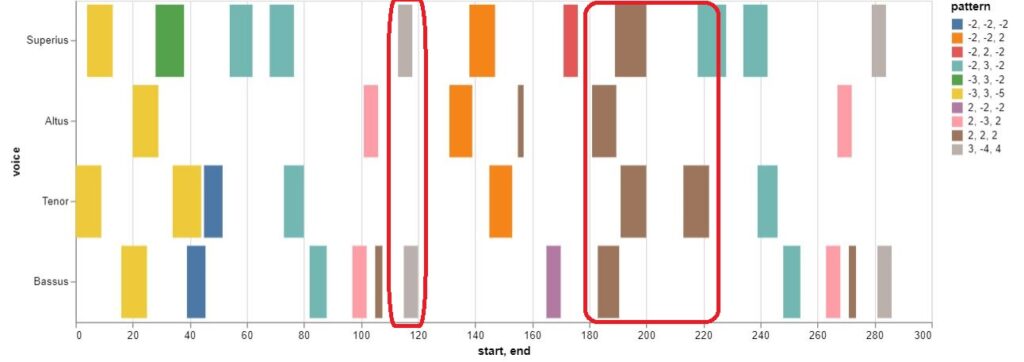
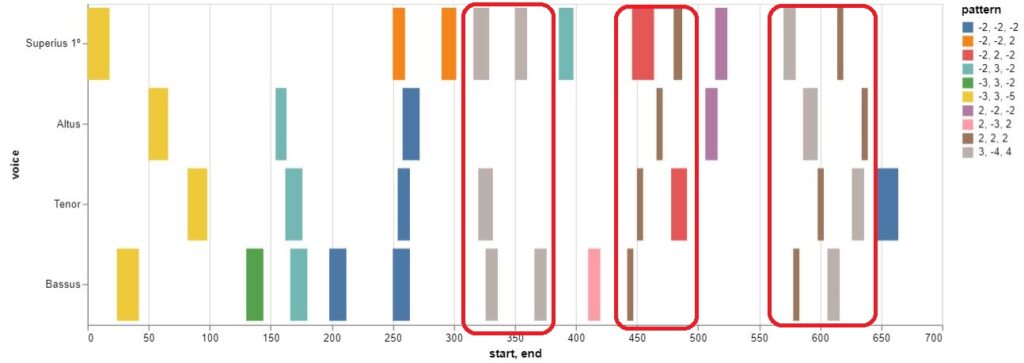
Figures 10a-b. Heatmap of repeated melodies between the Guerrero’s Virgines prudentes (above) and the Gloria of the Fernández Buch’s Missa Virgines prudentes (below). Source: created using Jupyter Notebook 8 Model_Finder_and_Comparison.
Firstly, the soggetti P1 begins in the same way as it does in Guerrero’s motet, although Fernández Buch prefers to use rhythmically varied entries by introducing a series of NIm’s with invertible counterpoint that completely reworks the polyphonic texture (compare Figs. 9 and 11). According to the CRIM vocabulary, it would involve of a type of transformation non-mechanical involving a contrapuntal variation: new counter subject.
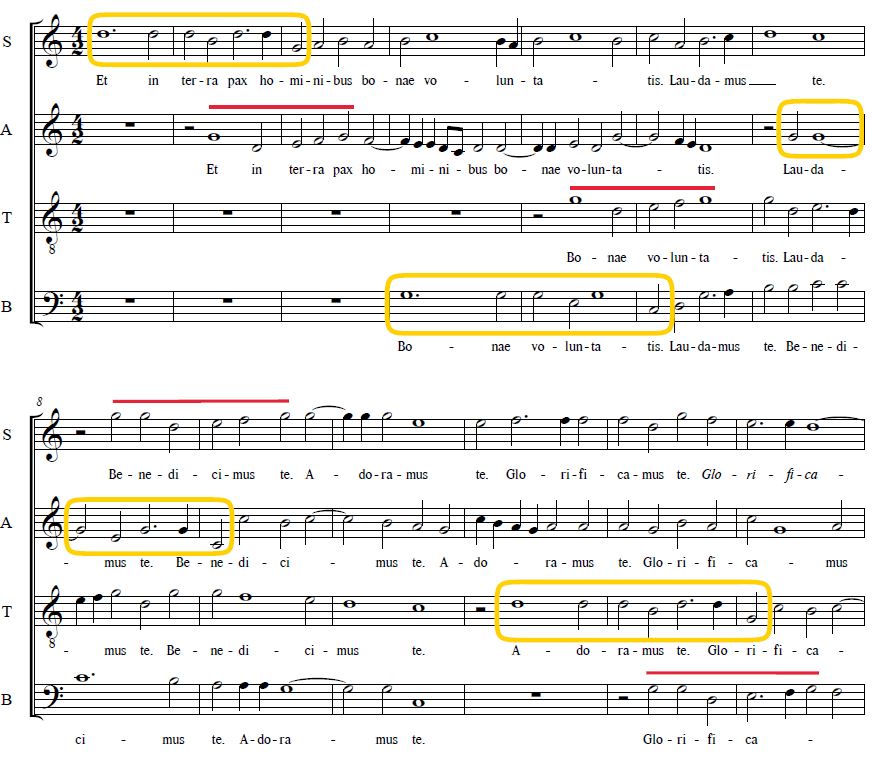
Figure 11. Series of NIm’s with invertible counterpoint in the Gloria (bb. 1-13) of the Fernández Buch’s Missa Virgines prudentes. Source: created by the author (Cuenca, forthcoming).
There are also other cases of transformation non-mechanical widely used in the motet, such as the one represented in turquoise blue in Figure 10 (-2, 3, -2 n-grams), which can be seen in the following Figure 12by Fernández Buch in the Gloria. Here I detect a whole passage metrically shifted and simplificated. After the “Gratias agimus tibi” in homophonic section, he did a succession of imitative duos with the soggetti marked in turquoise in Figure 10 and Figure 12 (the second picture), as Guerrero did. The heatmap has not detected the first entry in superius as I have performed an analysis limiting the entries in the Jupyter Notebook 8 (although it did help to detect more types of presentation that I later observed in the score). In this case—and unlike the example in Figure 11—Fernández Buch has preferred to remove the counter-subject introduced by Guerrero in order to give greater clarity to these imitative duos (almost like periodic entries) from the high to the low voice (Figures 12a-b below).
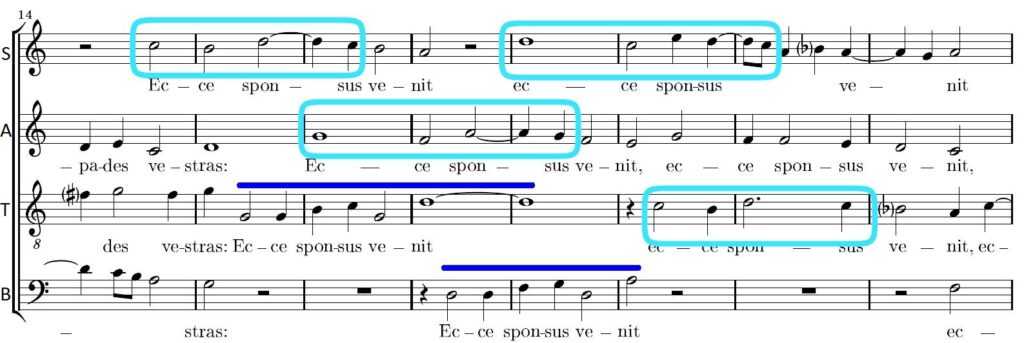
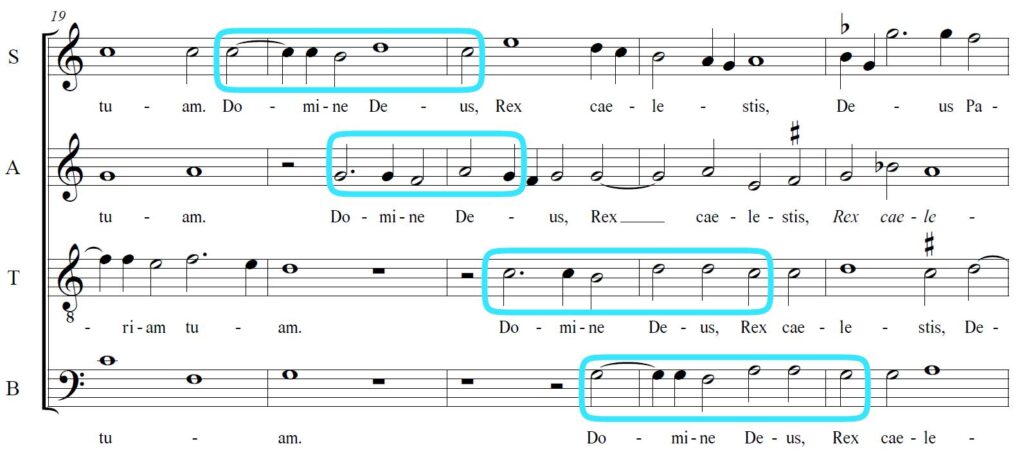
Figures 12a-b. Fuga with a counter-subject in the lower voices (two NIm’s) in the Guerrero’s Virgines prudentes (above, bb. 14-21) and imitative duos in the Gloria of the Fernández Buch’s Missa Virgines prudentes (below, bb. 19-23). Source: created by the author from Álvarez’s edition (2022) and from my own edition of Fernández Buch’s Masses (Cuenca, forthcoming).
In Figure 10, there are other examples of repeated melodic structures and combinations between the Gloria and the motet—such as those marked in gray and brown. It seems that Fernández Buch not only reworked this movement by quoting the melodic material, but also the different combinations shown throughout the model. This is quite rare for the rest of his Masses, as he usually performs it in the melismatic movements.
Gloriose confessor Domini and Sancta Maria Succurre Masses
As shown in Figure 2, the movements with the greatest melodic similarity to the model in the Gloriose confessor and Sancta Maria Masses were the Sanctus and Agnus Dei, respectively, although Fernández Buch conceives both pieces the two masses in a really short form—23 bars for the Sanctus and 19 bars for the Agnus Dei of the Missa Gloriose confessor; and 21 bars for the Sanctus and 19 bars for the Agnus Dei of the Missa Sancta María. Even so, these movements have a certain thematic dependence on Guerrero’s original material, as Cerone pointed out in his treatise. For this purpose, in the first instance of the Sanctus of the Missa Gloriose confessor, Fernández Buch selects the soggetti of part 1 of the Guerrero’s motet Gloriose confessor (see Figures 13 and 14) to develop a transformation (non-mechanical), modifying the rhythm of the previous melody and adding new counter-subjects (Fig. 13, below in green and blue). In the graphic representation of the counterpoint it can be seen how Fernández Buch replicates the fuga but with the accompaniment of material that appears later in the first and then in the second part of Guerrero’s motet (Figures 14a-b). In this way, he tries to synthesize part of the recurring melodies in a brief Sanctus. For the following experiments I have decided to combine unisons (as in the previous ones) but also to extract the heatmaps of 4 n-Grams, because the results were multiple and imprecise for 3 n-Grams.
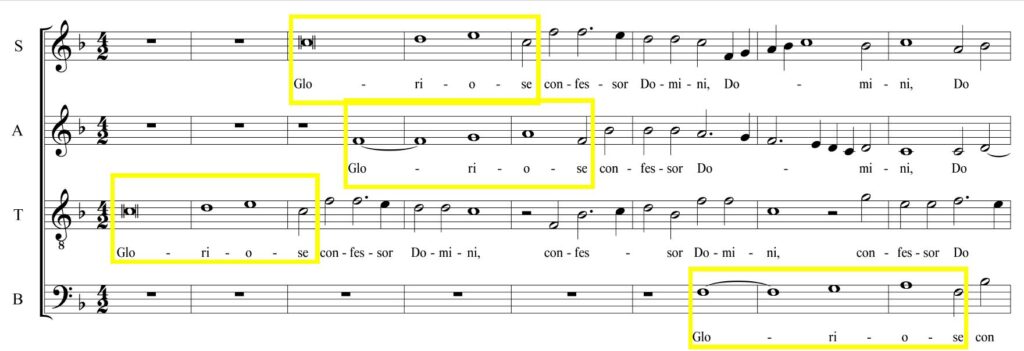
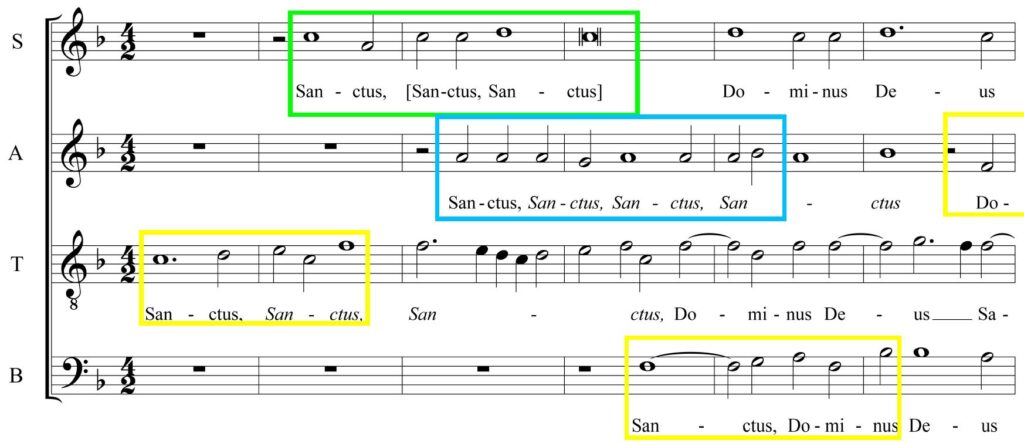
Figures 13a-b. Soggetti P1 in the Guerrero’s motet Gloriose confessor (above, bb. 1-8) and in the Sanctus of the Fernández Buch’s Missa Gloriose confessor (below, bb, 1-6). Source: created by the author from Álvarez’s edition (2022) and from my own edition of Fernández Buch’s Masses (Cuenca, forthcoming).
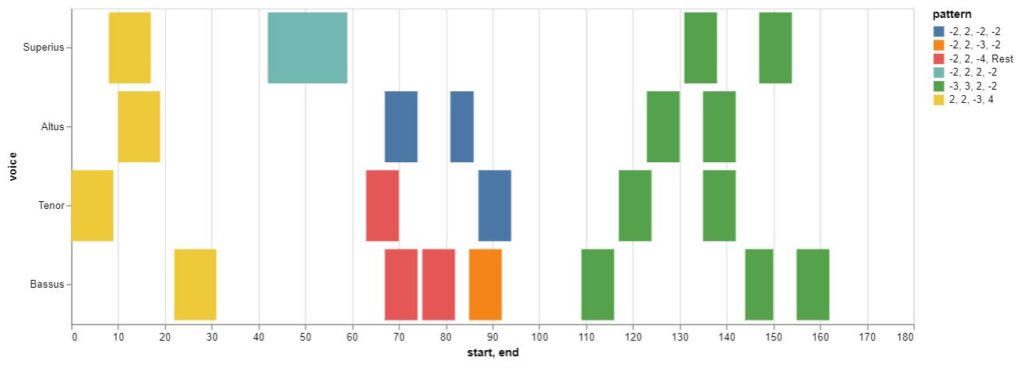
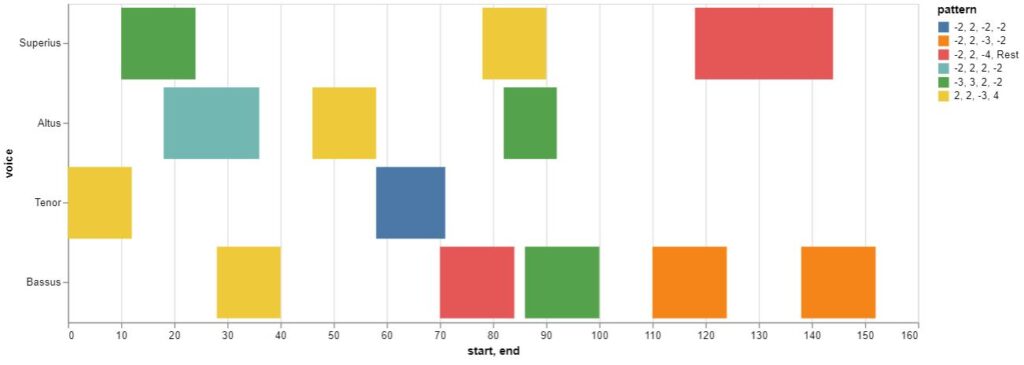
Figure 14. Heatmap of repeated melodies between the Guerrero’s Gloriose confessor (above) and the Sanctus of the Fernández Buch’s Missa Gloriose confessor (below). Source: created using Jupyter Notebook 8 Model_Finder_and_Comparison.
Another similar case in the form of a fugue can also be shown in the Agnus Dei of Fernández Buch’s Missa Sancta Maria, with respect to Guerrero’s previous melodic material from Guerrero’s homonymous motet. If we previously observe the heatmaps, it is shown that, in this case, the composer has preferred to use the main soggetto and counter-subject of the second part of the model (Figures 15a-b).
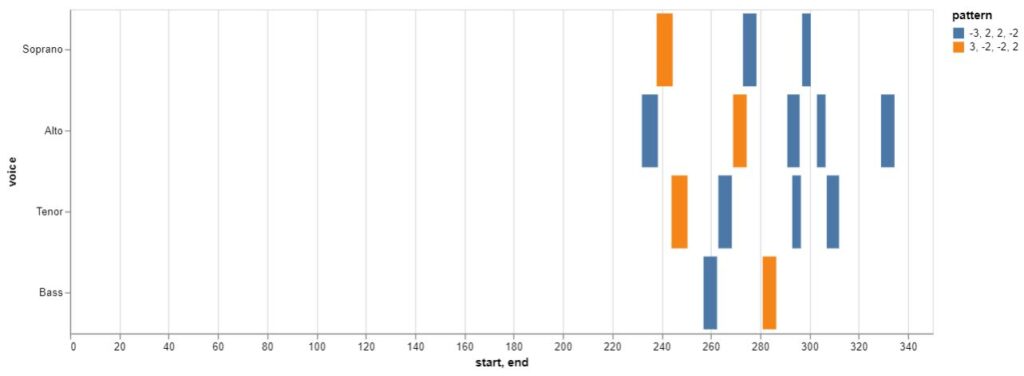
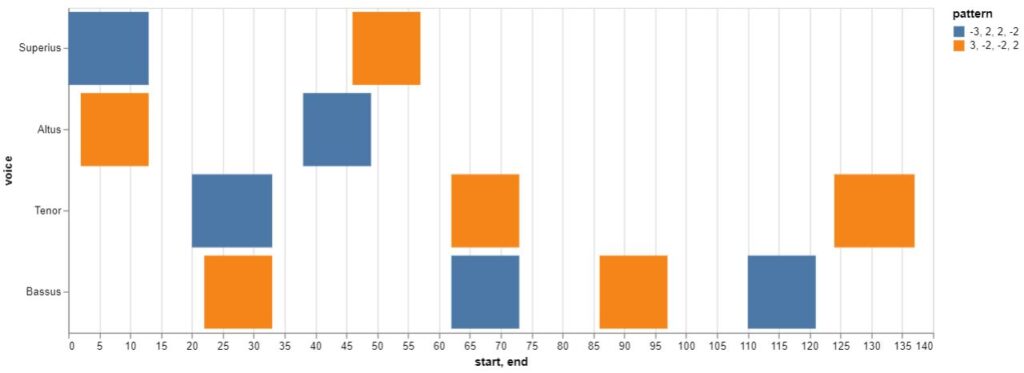
Figures 15a-b. Heatmap of repeated melodies between the Guerrero’s Sancta Maria (above) and the Sanctus of the Fernández Buch’s Missa Sancta Maria (below). Source: created using Jupyter Notebook 8 Model_Finder_and_Comparison.
As we do in CRIM, to contrast the evidence of the results of the tools, if we go to the score, I can observe how indeed Fernandez Buch replicates in some way the NIm’s presented in a different way by Guerrero: Fernandez Buch maintains a certain regularity in the intervallic distance of imitation and keeps it until the end of the movement (Figures 16a-b). He also performs non-mechanical transformation by modifying the rhythmic figures of the countersubject (marked in orange).
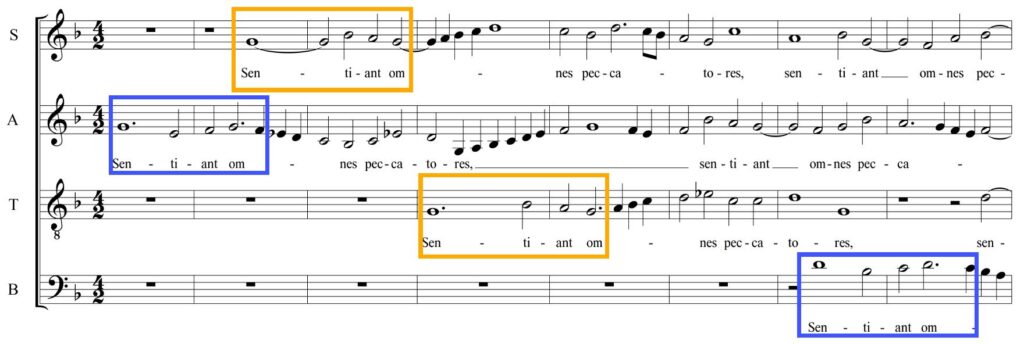
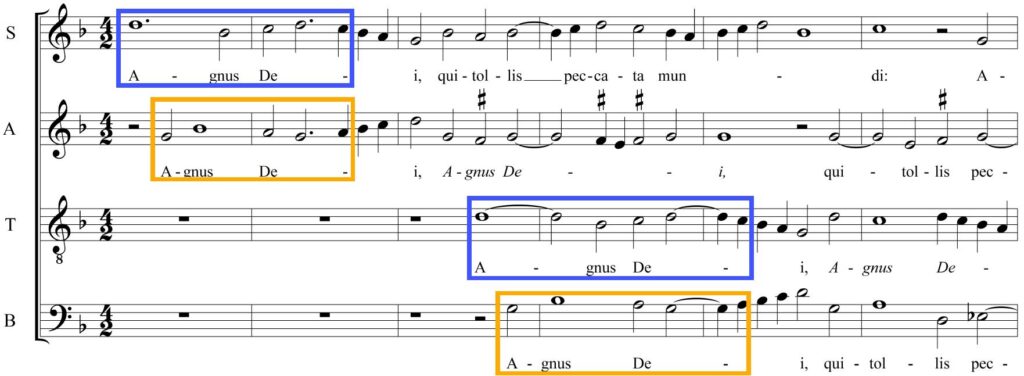
Figures 16a-b. Soggetti P2 in the Guerrero’s motet Sancta Maria (above, bb. 58-65) and in the Agnus Dei of the Fernández Buch’s Missa Sancta Maria (below, bb, 1-6). Source: created by the author from Álvarez’s edition (2022) and from my own edition of Fernández Buch’s Masses (Cuenca, forthcoming).
Modular analysis and index of transformation
Once all the melodic relationships between the Masses and their respective models have been observed and how Fernandez Buch transformed Guerrero’s material, usually adding new counter-subjects to create non-imitative duos, it is also important to know whether the modular counterpoint is the same and whether he has generated new vertical combinations. As I suggested in the introduction, and according to the MedRen experiment (2022), I propose to find out if Fernández Buch really differs from Guerrero in his more vertical vision of counterpoint.Firstly, I have performed a contrapuntal “modular” n-grams analysis as Similarity Matrix in the Jupyter Notebook No. 8 (Model_Finder_and_Comparisons). The concept of the “module” was developed in Jessie Ann Owens (1997: 251) and fully in Schubert (2007: 484) is “a contrapuntal relationship that can be repeated”. As it is expressed by Julie Cumming and Peter Schubert in the Jupyter Notebook No. 3: “it is a kind nGram that describes the movement of any two voices: a succession of harmonic intervals separated by the melodic motion of the lower voice”. In Figure 15, the percentages of repeated modules from the Fernández Buch’s Mass movements that come from the Guerrero’s respective motets can be seen. As in Figure 2, the darker the color, the greater the modular relationship between the Mass movement and its model. Also note that these maps focus on the moments when entries occur, so fewer shared entries means fewer modules to share, and a higher percentage of overlap.
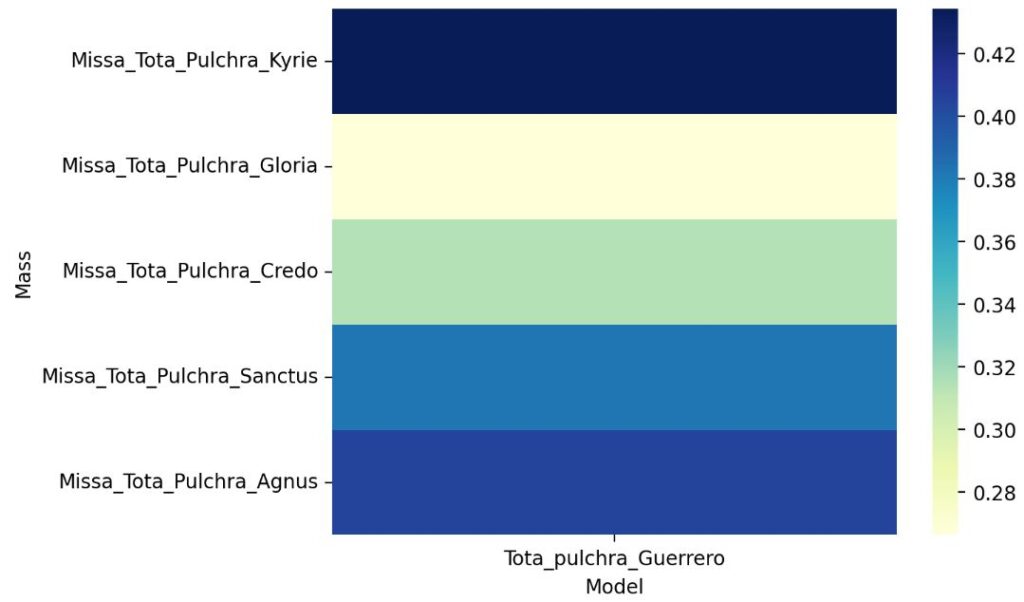
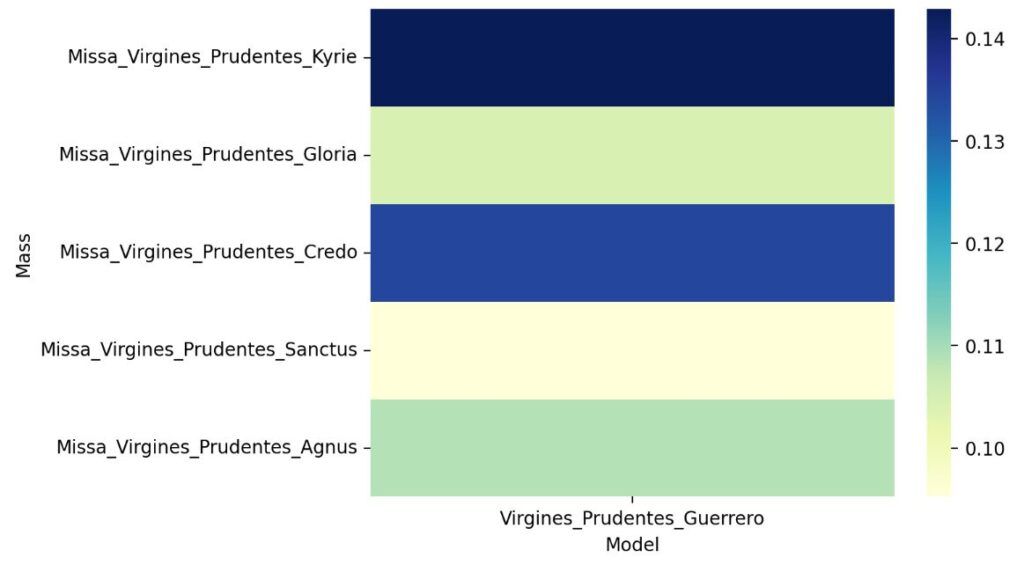
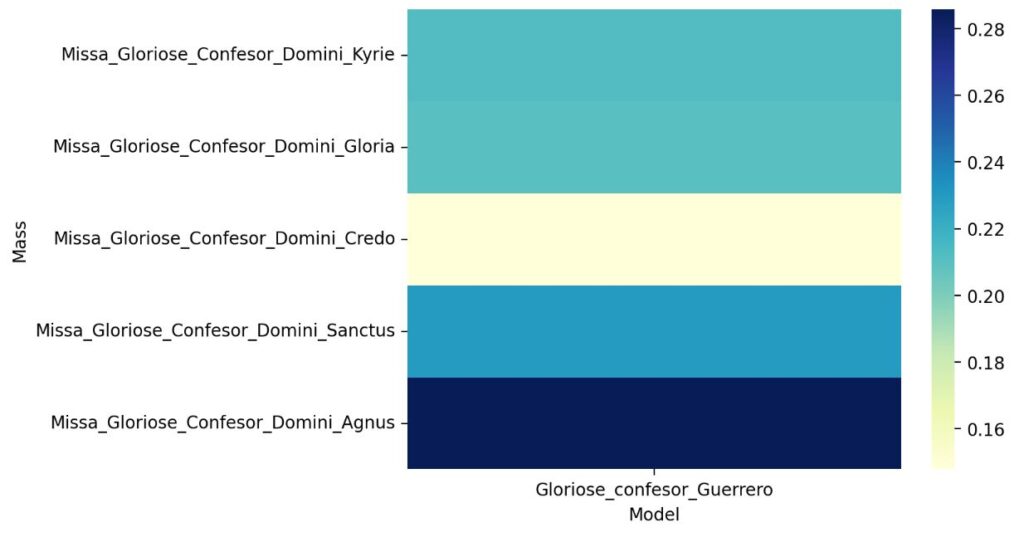
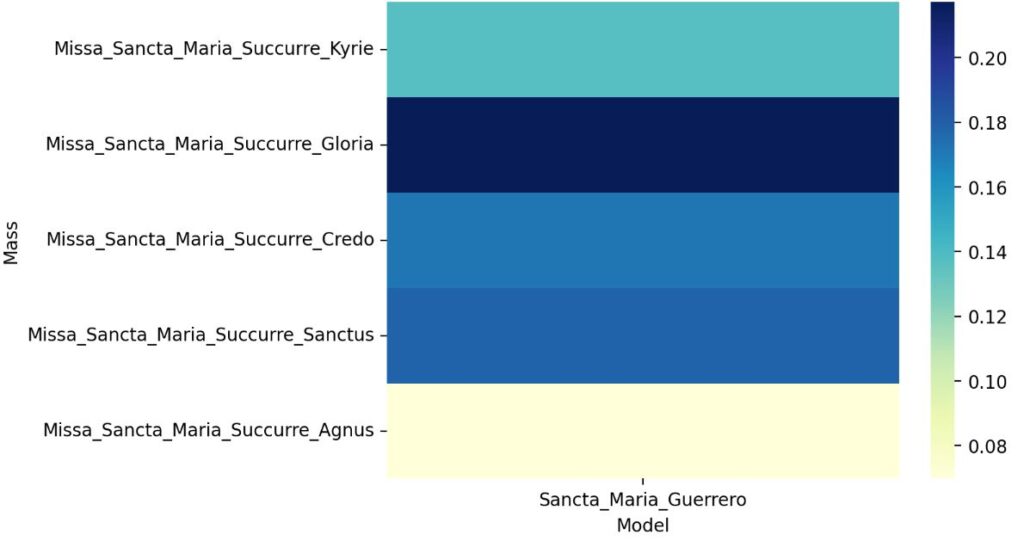
Figures 17a-d. Percentage of melodies from the Fernández Buch’s Mass movements (in each of his four Masses) that come from the Guerrero’s respective motets. Source: created using Jupyter Notebook 8 Model_Finder_and_Comparison.
In the case of modules, I note that the cases are very different depending on the Fernández Buch’s Mass. The movement that is most closely related to the original model at the contrapuntal level is clearly the Kyrie in the Tota pulchra (as I found before in Figure 6) and Virgines prudentes Masses. In general, it seems that the Gloria and Credo are not very similar movements on a contrapuntal level with the model, which indicates that Fernández Buch used them contrapuntally more freely and creatively. This is an exception in the Gloria and Credo of the Missa Sancta Maria succurre miseris and in the Credo of the Missa Virgines prudentes, in which they are based notably on contrapuntal modules of the Guerrero’s respective motets. The last movements—Sanctus and Agnus Dei—are very similar to their respective models in the Tota pulchra and Gloriose confessor Masses.
In the same Jupyter Notebook no. 8, there is a tool that allows you to compare the differences between the Model Finder and Module Finder outputs. This works as a transformation index, where there are two columns ‘self’ is the original table, and ‘other’ is the table to which I compared it to observe the degree of Fernández Buch’s contrapuntal manipulation on the original melodies from the model. The heatmaps with the results can be seen in Figure 16.
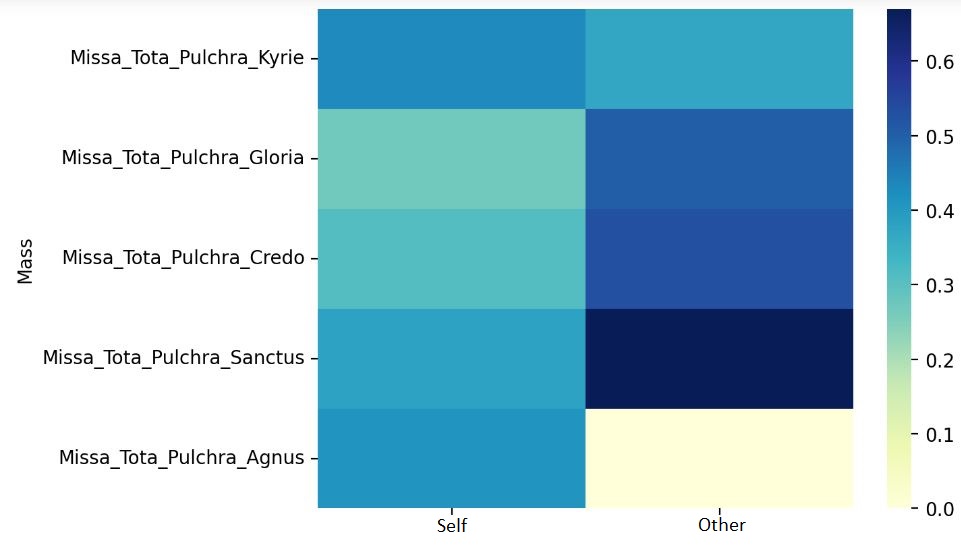
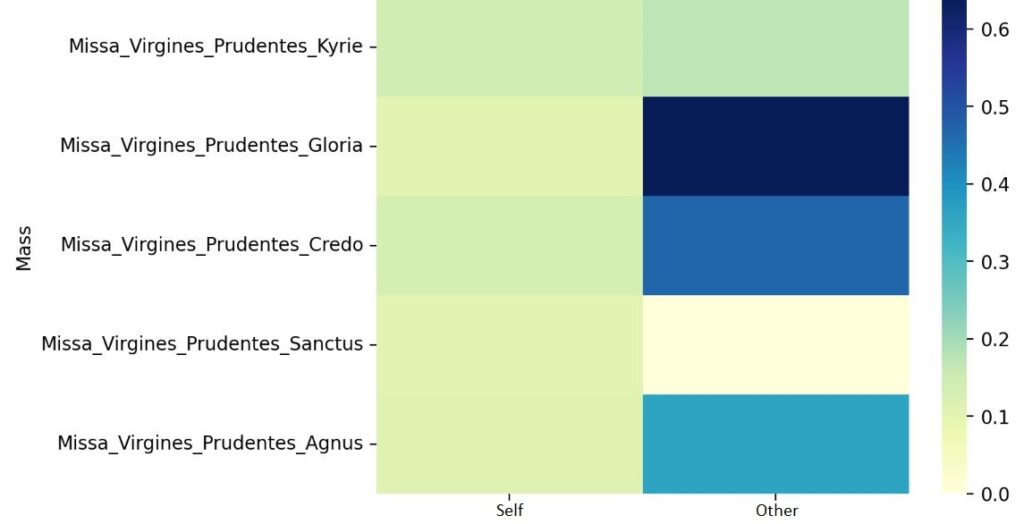
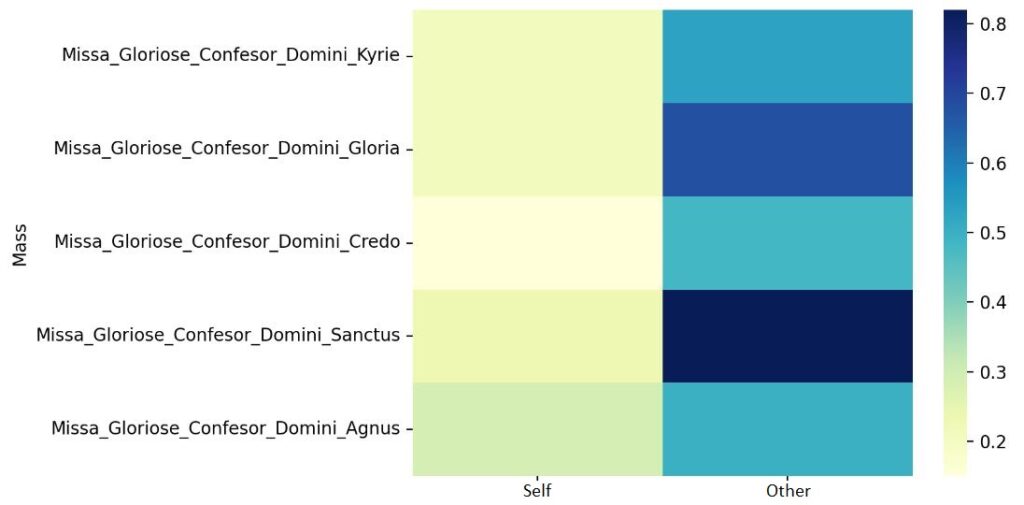
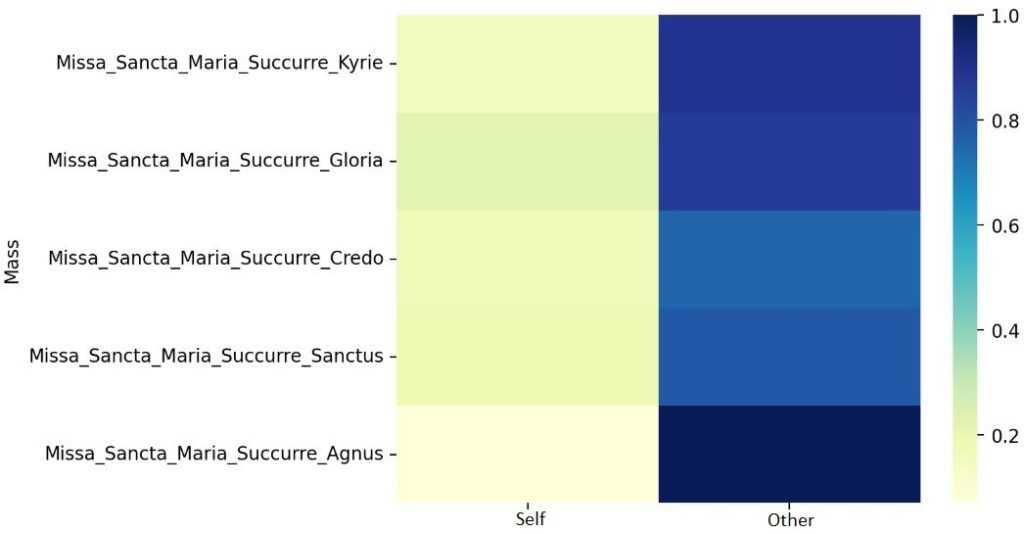
Figures 18a-d. Comparison of the percentage of the Model Finder and Module Finder outputs based on the Fernández Buch’s Mass movements. Source: created using Jupyter Notebook 8 Model_Finder_and_Comparison.
The Figure 16 shows the movements that Fernández Buch has reworked the most with respect to the original model. These differ from one Mass to another, but there is usually a high degree of manipulation, especially in the movements of the Gloria and, secondly, the Credo. In the Tota pulchra and Gloriose confessor Masses, the Sanctus is strongly reworked from the original melodies, while this happens for the Agnus Dei and quite a lot in the Kyrie of the Missa Sancta Maria. It seems, therefore, that Fernández Buch conceived each Mass differently and adopted different ways of transforming the melodic material as he pleased for each movement.
In conclusion, I have been able to note that Kyrie, Gloria and Credo are movements more varied in the different use of presentation types than the final movements of the Mass, although Fernández Buch has a predilection for fuga. It would be interesting to study the presentation types of all these works and to make an inventory of them to check the common or differentiated uses among these composers in a future study. He tends to give greater melodic similarity to the model in the Kyrie, Sanctus, and Agnus Dei; while the most common fuga patterns are shared in the syllabic movements of the Gloria and Credo. The Kyrie is usually treated independently at the melodic level, quoting almost all the soggetti in the three parts, while the Sanctus and Agnus Dei—very short movements in Fernández Buch’s Masses—usually act in a complementary way.
The level of contrapuntal transformation with respect to the original model is different for each movement depending on the Mass, although the Kyrie turns out to be the least modified movement with respect to Guerrero’s models. Buch lived and worked decades after his models were created. He created new compositions using the previous material to add contrapuntal phrases that were new or previously used by Guerrero at other points in the motet. In this way, he generated new modules and vertical relationships through a melodic design not as rich as that of his predecessor. This seems to tend towards a greater concern for vertical rather than horizontal intervals in this generation of Spanish composers. However, it is clear that he continued the norms of the imitation masses of his time, which Cerone specified in his treatise.
Bibliographic references
Álvarez, Nancho. 2022. Tomasluisdevictoria.org. https://www.uma.es/victoria/guerrero.html#motetes
Cuenca Rodríguez, María Elena and Cory McKay. 2022. “Musical influences on the Masses of Pedro Fernández Buch (c. 1574- 1648): A stylistic comparison using statistical analysis”. Presented at the 50th Medieval and Renaissance Music Conference. Uppsala University, July 4-7, 2022.
Cuenca Rodríguez, María Elena. Forthcoming. Las misas de Pedro Fernández Buch (1574-1648): estudio y edición crítica. La Rioja: Instituto de Estudios Riojanos.
Freedman, Richard. 2022. CRIM: the Renaissance Imitation Mass. Thesaurus of Musical Types. https://docs.google.com/presentation/d/1SADm0wRQMwHh4R0A-VZu__hSHVSsCMHS3OkugWenReQ/present?slide=id.g116204e485_1_43
Freedman, Richard, “Jupyter Notebook 8 Model_Finder_and_Comparison.”. CRIM Jupyter Notebooks. https://ds-crim.haverford.edu/user/m.cuenca-rodriguez/notebooks/CRIM_JHUB.git/CRIM_12_Model_Finder.ipynb (accessed on 14/12/2022)
Jambou, Louis. 1983. “La capilla de música de la catedral de Sigüenza en el siglo XVI. Ordenación del tiempo litúrgico: del Renacimiento al Barroco”. Revista de musicología 6 (1-2): 271-298.
Llorens Cisteró, José María and Karl H. Müller-Lancé. 1978. Francisco Guerrero (1528-1599). Opera Omnia. Volumen III. Motetes I – XXII. Barcelona: CSIC, Instituto Español de Musicología.
Lorente, Andrés. 1672. El Porque de la musica: en que se contiene los quatro artes de ella, canto llano, canto de organo, contrapunto y composicion y en cada uno de ellos nuevas reglas, razon abreviada […]. Facsimile edition of 2006. Alicante: Biblioteca Virtual Miguel de Cervantes. https://www.cervantesvirtual.com/obra/el-porque-de-la-musica-en-que-se-contiene-los-quatro-artes-de-ella-canto-llano-canto-de-organo-con-0/
Martínez Gil, Carlos. 2021. “Esplendor sonoro y ceremonia. El plan de mecenazgo musical de Fray Pedro González de Mendoza para la colegiata de Pastrana”. Congreso Internacional: La figura de Fray Pedro González de Mendoza (1571-1639) en el 450 aniversario de su nacimiento. Palacio Ducal of Pastrana, October 7-8, 2021.
Owens, Jessie Ann. 1997. Composers at Work: The Craft of Musical Composition 1450–1600. New York and Oxford: Oxford University Press.
Schubert, Peter N. 2007. “Hidden Forms in Palestrina’s First Book of Four-Voice Motets”. Journal of the American Musicological Society 60: 483–556. A corrected version of the appendix to this article is found on http://www.music.mcgill.ca/~schubert.
Strunk, William O. 1965. Source Readings in Music History: The Renaissance. W. W. Norton, 1965.
Suárez-Pajares, Javier. 1998. La música en la catedral de Sigüenza, 1600-1750, 2 vols. Madrid: ICCMU.
Suárez-Pajares, Javier. 1999. “Fernández Buch, Pedro”. In Diccionario de la música española e hispanoamericana, vol. V, 53. Madrid: Fundación Autor – Sociedad General de Autores y Editores.