Verdelot’s Ultimi miei sospiri and Padovano’s Mass: Exploring Contrapuntal Form without and with CRIM Intervals
Julie E. Cumming (McGill University)
Introduction
Studies of imitation Masses normally investigate the presence of tunes (or “soggetti”) from the model in the Mass. There are some standard questions:
- What are the principal soggetti in the model?
- Do all the soggetti appear in the Mass?
- Are they in the same order?
- Are the soggetti modified in the Mass?
- Are they all used in every movement of the Mass?
- Where in the Mass movements do the soggetti from the model appear?
Peter Schubert’s article “Hidden Forms in Palestrina’s First Book of Four-Voice Motets” (2007) taught us to look beyond the soggetti to the contrapuntal structures, or “presentation types” featuring the soggetti, which raises another series of questions.
- Does the composer of the Mass borrow the presentation types (as well as the soggetti)? Or to put it another way, do the soggetti appear in the same presentation types (or contrapuntal context) in the model and the Mass?
- Does the Mass have the same sequence of presentation types as in the model?
Schubert’s “Hidden Forms” also looks at formal structures, both within the points of imitation, and between them. He looks at “heightening” or increased intensification, and at relaxation, within and between points of imitation. His focus is mostly on local contrasts, not at the level of the piece, but he points out that long time intervals of imitation tend to appear at the beginning of the piece, and Non-Imitative modules (NIms) at the ends of motets (Schubert 2007, 529-30). His work, as well as the work of James MacKay (2002) and of our student Ian Lorenz’s dissertation work on Gombert Magnificats, have inspired me to think about contrapuntal form (Lorenz’s term) and formal functions (Caplin 1998) in Philippe Verdelot’s madrigal, Ultimi miei sospiri, and the Mass that Anibale Padovano based on it decades laters. This raises a few more questions.
- Do presentation types (with their soggetti) have formal functions in the model?
- Do they preserve those formal functions in the Mass?
- Do the formal functions persist across the five movements?
And finally, it is worth asking why the composer of the Mass chose to treat the music from the model in particular ways. We cannot know if our answers are correct, but this question helps us think about compositional process. Formal functions – beginnings, middles, and endings – provide productive way of thinking about the composer’s choices. Another important principle in the imitation Mass is variety (varietas) an important principle in rhetoric and music (Luko 2008). The composer of the imitation Mass has to balance the values of repeating material from the model and varying it in each movement.
The CRIM project has developed a variety of sophisticated tools for locating soggetti and modules in models and Masses. I have chosen to analyze the madrigal and the motet “by hand” before using the computer tools, in order to evaluate what the tool can do. The answers to the questions shown above are largely found in Table 2 (the model) and Tables 4-8 (the Mass movements), shown below. I then compare some of those findings to some the data found in CRIM’s “heatmap” tool.
The Madrigal and the Mass
Verdelot’s madrigal Ultimi miei sospiri is one of the earliest surviving six-voice madrigals. The text is a canzone stanza by Ludovico di Lorenzo Martelli (first published in his Rime of 1533), who was involved in the Italian language debate of the 1520s (Slim 1972, vol. 1, 86). The madrigal’s earliest source is the Florentine Newberry Partbooks, believed to have been copied c. 1527-29. It appears in five other manuscripts and in three six-voice madrigals prints: 154116,154619, and 156116 (see Slim 1972, vol. 1, 227). In the CRIM corpus it is Model 38, taken from the second print, 154619 (Venice, Gardano, 1546; see https://crimproject.org/pieces/CRIM_Model_0038).
Annibale Padovano’s five-voice imitation Mass on the madrigal was published in his first book of Masses (RISM A/I A 1248; Venice: Gardano, 1573). In the CRIM corpus it is Mass 45 (https://crimproject.org/masses/CRIM_Mass_0045). The model and the Mass are approximately 45 years apart. For convenience, in the text of this paper I identify the staves by number (rather than voice label), starting at the top. The madrigal has six voices; the Mass has five (except for the Agnus, which has six).
The Text and the Form of the Madrigal
The text of Ultimi miei sospiri is a one-stanza canzone (see Table 1), which begins with two piedi (in which lines 1 and 2 have the same rhymes and syllable count as lines 3 and 4) and ends with a sirima of six lines, the first of which (line 5) rhymes with the last line of the piedi. This connecting rhyme is called the unità. The last two lines of the sirima (9 and 10) are a rhyming couplet that shares its rhyme with line 6 (Harran 1969, 41-4). It has a mix of eleven-syllable lines (shown in Table 1 with the rhyme letter in upper case) and 7-syllable lines (shown in Table 1 with the rhyme letter in lower case).
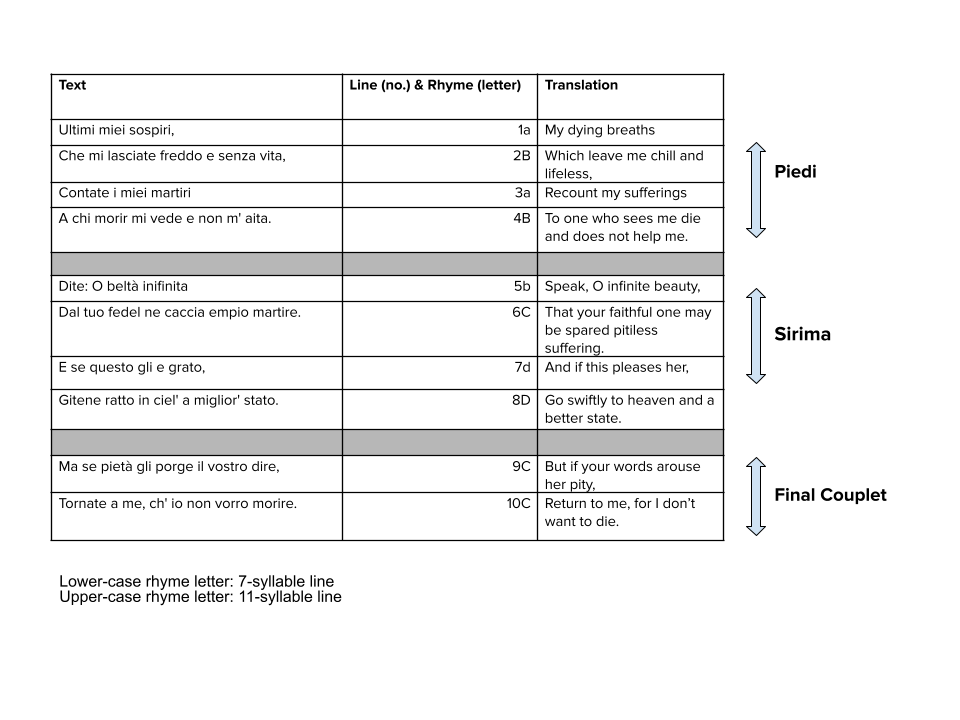
Table 1. The Text, Form and Musical Structure of Verdelot’s Madrigal
Verdelot’s approach to setting the poem was to create a point of imitation for each line of text. We can therefore identify the soggetti and the presentation types by line number and text incipit, e.g. “(1) Ultimi.” He chose to repeat the music for lines 1 and 2 for lines 3 and 4 (the text of lines 3 and 4 is shown in italics in Table 2, to indicate that there is no new music for these lines). The result is an “aab” form for the piece as a whole. Verdelot also divided the tenth and final line into two distinct points of imitation. Line 6, “Dal tuo fedel ne caccia,” is a single point of imitation in the madrigal, but Padovano often divides the soggetto into two parts in the Mass, so I have also labeled them separately (6.1 “Dal tuo fedel” and 6.2 “ne caccia empio martire”). This means that there are ten distinct soggetti (or clusters of soggetti in the case of NIms) in the madrigal, for lines 1, 2 (repeated for lines 3 and 4), 5, 6.1, 6.2, 7 , 8, 9, 10.1, and 10.2.
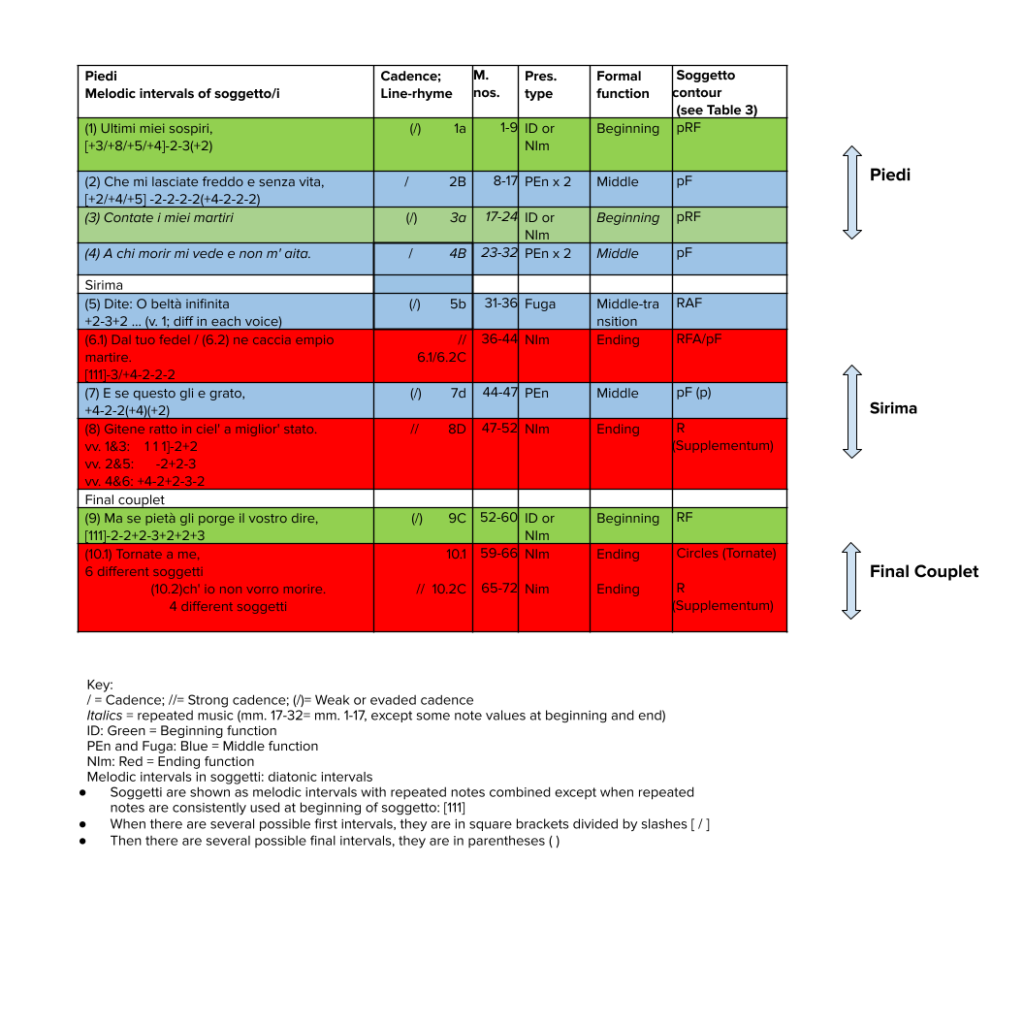
Table 2. The Melodic Intervals in the Soggetti of Verdelot’s Madrigal
In Table 2 I have shown the melodic intervals of the soggetti, to make it easier to identify the soggetti while looking for soggetti in the Mass (where the text is different), and while comparing my findings with those of CRIM’s heatmap tool. Many soggetti in the madrigal have repeated notes fitted to particular text rhythms. In the Mass, where the text is different (or almost non-existent in the more melismatic movements), the number of repeated notes is often different, or they are combined into one long note. I have therefore chosen to combine the repeated notes into one note for the melodic intervals of the soggetti in Table 2 in most cases.
Presentation Types and Formal Function in the Madrigal
In Table 2 the different presentation types are shown in different colors, to show their formal functions in the madrigal. See Schubert 2007 for a full explanation of the three primary presentation types (points of imitation that use a repeated contrapuntal combination, or module): Imitative Duos (ID); Periodic Entries (PEn); and Non-Imitative modules (NIm). These types are of course the foundation of the Musical Vocabularies used in the CRIM Project. In the same article Schubert coined the term “singleton”: a soggetto that appears in one voice that is not treated in imitation. “Fuga” is a term for imitation or canon in sixteenth-century music theory used by John Milsom to describe a repeated melodic motive or soggetto; here “fuga” indicates that there is no repeated contrapuntal combination (Milsom 2005).
Verdelot used Imitative Duos (IDs) at the beginning of each of the two piedi or “a” sections (lines 1 and 3), and at the beginning of the final couplet (line 9). This opening point of imitation can in fact be interpreted as an ID or a NIm; I will discuss this issue in more detail below. I have put IDs in green because they indicate a beginning function: green for “go.” These IDs also end with weak or evaded cadences shown as (/) where there is significant overlap between the end of one line of text and the beginning of the next, also indicating that this is a beginning function.
Verdelot used non-imitative modules (NIms) for an ending function, shown in red for “stop.” NIms only appear in the second half of the madrigal, and they end with strong cadences that come at the ends of sentences in the text. Verdelot divided the last line of the madrigal into two sections, providing two different NIms (10.1 and 10.2) to make the closing function even more powerful.
Verdelot used periodic entries (PEns) and fuga for middle or transitional music, marked in blue because they neither begin or end sections. They occur in the first half and the middle of the madrigal. They reinforce the transitional shared “B” rhyme or unità (“aita” and “infinita”) between the end of the piedi and the beginning of the sirima. They also tend to end with normal or weak cadences, rather than the strong cadences used at the ends of the NIms.
Presentation Types and Melodic Features of Soggetti
Many of the soggetti in this madrigal are similar to each other. We can describe the rough melodic contours with just four descriptive terms, shown in Table 3. These melodic contours for the soggetti that constitute the presentation types contribute to their formal functions.
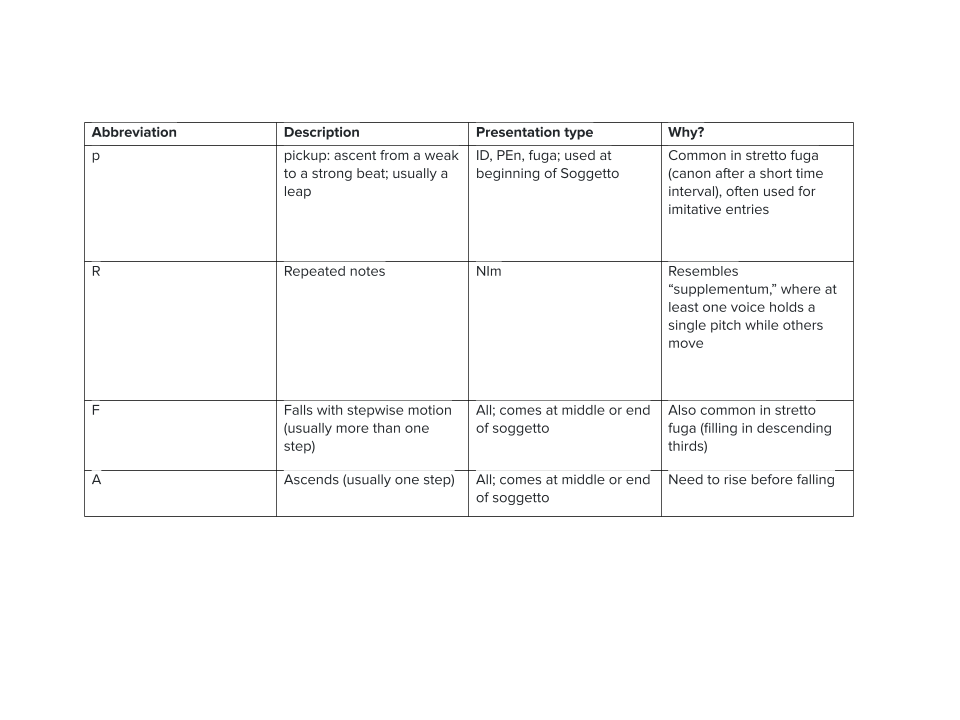
Table 3. The Presentation Types used in Verdelot’s Madrigal
When we look at the last column of Table 2, we see that in the piedi section of the madrigal every soggetto begins with a “pickup” – a leap up. The leap up of a fourth followed by a stepwise descent in smaller values is a standard feature in stretto fuga (imitation at a short time interval) at the fifth above, or in three- and four-voice invertible counterpoint at the twelfth, a standard way to begin points of imitation around 1500 (Cumming and Schubert 2015). The preference for falling soggetti in this madrigal may also correspond to the generally gloomy mood of the text.
As we move toward the end of the madrigal, we see that repeated notes dominate the red NIms, resulting in a relatively static structure that resembles the supplementum described by Burmeister: a held note in one or more parts while the other voices sing consonant harmonies, often with plagal sonorities (Burmeister 1987, 151). The only soggetto that does not fall into one of these patterns (10.1, ‘Tornate a me’) is a large six-voice NIm in which all the voices have melodies that ascend and descend by third or second, resulting in a circling or turning motion that illustrates the text (“Tornate a me”: return to me).
The First Point of Imitation in Ultimi miei sospiri
It is not easy to identify the presentation type at the beginning of the madrigal. There are six voices, each of which begins with the first four words of the madrigal text, and almost all of them have the same rhythm for the first five syllables (voice 5 starts with a semibreve instead of a breve). All voices leap up and then have the sequence of melodic intervals 1, -2, -3, +2. This is clearly imitative texture. There are four different opening melodic intervals: two voices begin with +3, two with +5; the other voices begin with +4 and +8. If we focus on the repeated opening melodic intervals, we see two pairs of voices (1 and 3, 4 and 6) entering with 2-voice fuga; see Example 1.
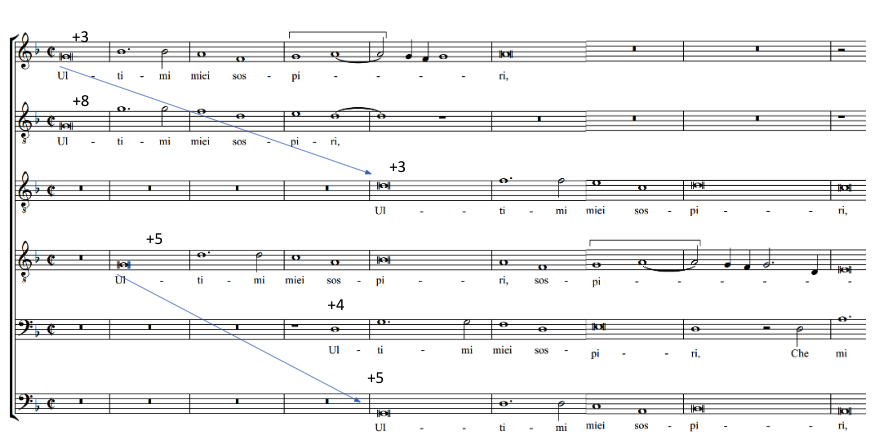
Example 1: Model, mm. 1-9. What is the soggetto? 4 different opening intervals: + 3, 8, 5, and 4. Is it 2-voice fuga?
Normally, however, there is a more constrained presentation type (i.e. with repeated modules) in the first point of imitation in an imitative sixteenth-century composition. If we omit the first pitch in each voice, we discover a repeated module in parallel thirds between two pairs of voices: 1 and 2, 4 and 5, and parallel 10ths (third plus an octave) between voices 3 and 6: this is a NIm, with three modules; see Example 2.
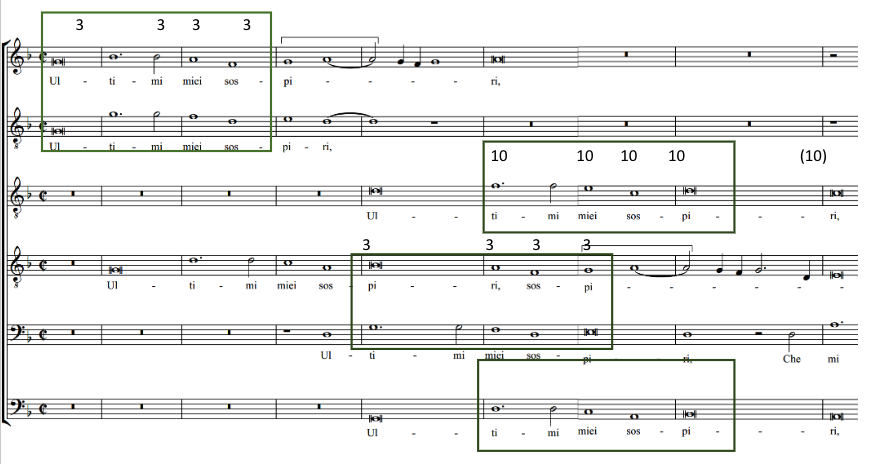
Example 2. Omit the first note and look for repeated counterpoint, or modules. There are 3 modules, resulting in a Nim.
However, If we look again (still omitting the first note; see example 3) we can see a different presentation type: a classic pair of imitative duos (ID), with the first imitative duo between staves 2 and 4, and the second imitative duo in staves 5 and 6, with time intervals (TIs) between the entries of the second note of the soggetto, of 2, 4, and 2 semibreves, shown with blue arrows. The repeated soggetto (starting on the second note) is shown with a thin rectangular box and the thick green boxes show the modules.
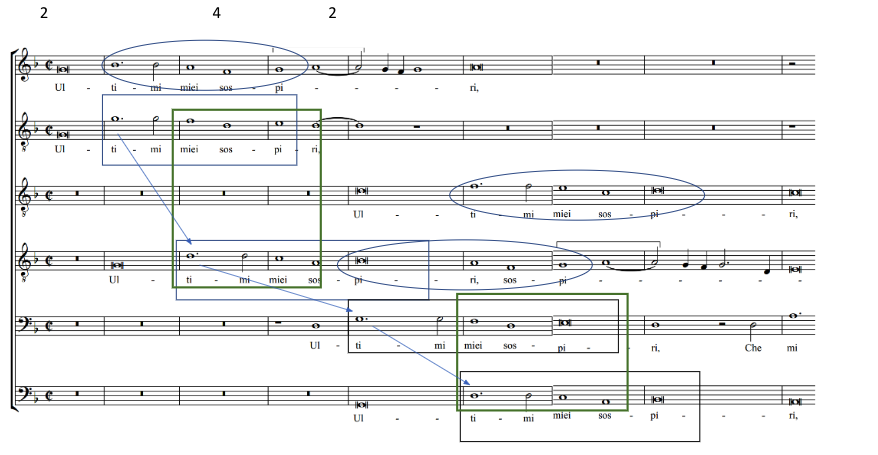
Example 3. Imitative Duos (ID). The soggetto overlaps with itself at two different Time Intervals (TIs): 2 and TI in Semibreves:
The first entry of the ID presentation type in staff 2 is doubled in thirds by staff 1 (shown with an oval box); the third entry in staff 5 is doubled in thirds by staff 4, and the fourth entry in staff 6 is doubled in tenths by staff 3. This interpretation reveals the maximum contrapuntal constraints: an ID with doubling in thirds and tenths. This is therefore the preferred interpretation of the point of imitation. Padovano, however, in his imitation Mass on this model, can select voices and modules from the madrigal to emphasize either the NIm or the ID presentation type in the Mass movements.
Use of Nims as Ending Function
Example 4 shows the NIm at the end of line 8, “–te-ne ratto in ciel,” just before the final couplet. The top voice of the three-voice module (repeated an octave lower by the other three voices) starts with a repeated Bb in the top voice, and an Eb in the bass (the local 4th degree used in plagal cadences), then leading to neighbour tone in the top voice providing the leading tone for a cadence to Bb without suspension. The whole section then ends with an emphatic cadence on G, marking the end of the section of the sirima before the final couplet.
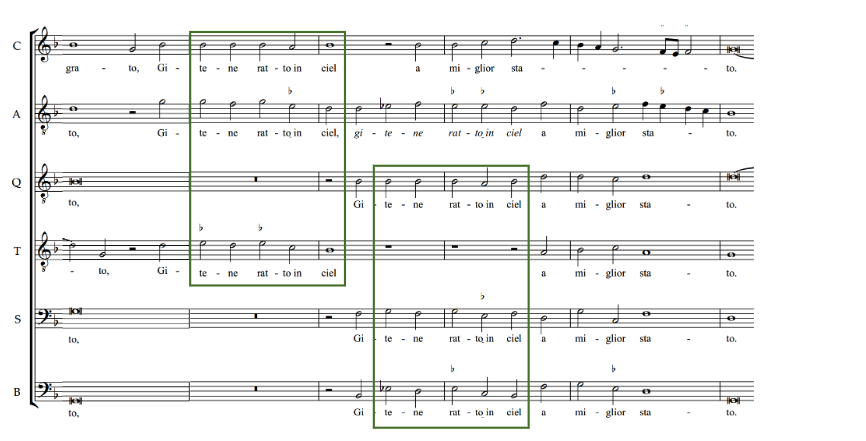
Example 4. Mm. 47-51. Line 8, “Gitene ratto in ciel”: NIm that resembles a Supplementum, followed by a strong cadence
The very end of the madrigal is shown in Example 5, which uses a much more complex NIm. The sustained Gs in the voices 1 an 4 make the very end a classic supplementum. The bass line starting at the end of m. 67 is repeated down a fifth in m. 70; examination of the other voices shows that there is a 4-voice NIm, though in the first module the sustained D is shared between voices 3 and 4, and the voices are substantially rearranged and elaborated in the second module.
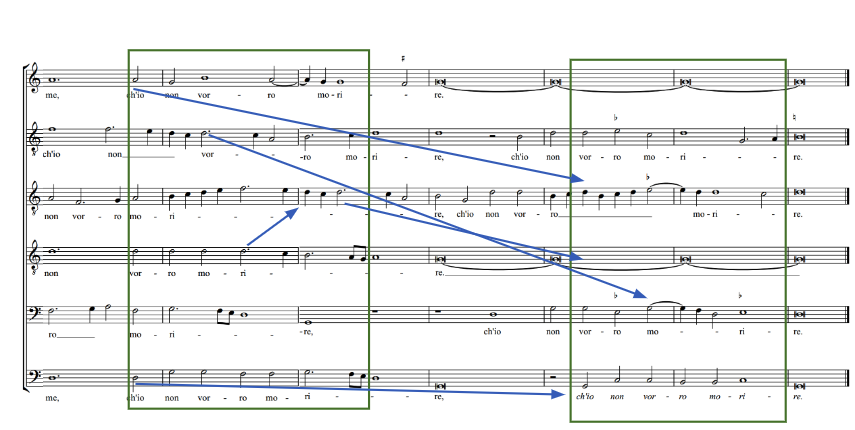
Example 5. Mm. 67-72: Final NIm/Supplementum (2nd module a 5th below). Ds in vv. 3&4 in module 1 = held Gs in mod. 2. Turquoise (); material not shared in the modules; blue arrows show where voices move from module 1 to 2.
Highly constrained presentation types begin and end the madrigal: the ID at the beginning sets up the complex imitative texture and the dominant opening motive for the soggetti: a leap up followed by stepwise descent. The NIms in lines 8 and 10 function as closing material through use of repeated notes.
Fuga is much less constrained, since it involves no modules. PEns do have modules where the voices overlap, but their common use of stretto fuga techniques makes them fairly easy to compose. These less constrained presentation types represent a “middle” function; these sections of the madrigal also end with normal or weak cadences, not the strong cadences that end the NIms.
I do not claim that the formal functions I ascribe to the presentation types in this madrigal are used consistently by other composers and in other genres (though I do hope to look into the possibility in future studies). A preliminary look at the appendix to Schubert 2007, where he lists all the presentation types in Palestrina’s First Book of Four-Voice Motets (RISM P689, 1564), indicates that eighteen of the thirty-five motets begin with an ID (the next most frequent presentation type is the PEn, with five examples). This suggests a strong preference for IDs at the beginning of a motet, at least by Palestrina. I also checked the final presentation types in the same collection: fourteen of the thirty-five motets use NIms, which also suggests a preference for NIms at the end (the next most frequent presentation type, however, is ID, with six examples).
The Madrigal and the Imitation Mass
When we compare an imitation Mass to its model there are some standard questions.
- Do all the soggetti appear in the Mass?
- Are they in the same order?
- Are the soggetti modified in the Mass?
- Are they all used in every movement of the Mass?
These are important questions, that teach us a lot about what happens in an imitation Mass. But we need to go further. It is not enough to identify melodies and counterpoint from the model in the Mass; we need to ask why the material from the model is used in the Mass in a particular way. We can break down these questions as follows.
- Where in the Mass do the soggetti from the model appear? Why there?
- Do presentation types (with their soggetti) from the model have formal functions in the Mass? Do they have the same formal functions as they had in the model?
CRIM tools allow scholars to search for the soggetti from the model in the Mass movements. One tool provides a “heatmap”: a visual representation of the soggetti found in the model, and of the soggetti shared between each Mass movement and the model. These representations provide a broad overview of the approach taken by Padovano in each of the movements; but because so many soggetti involve stepwise motion, it is hard to sort out what is “motivic” and what is just another scalar passage.
I have therefore begun with my own “manual” analysis of each movement in the Mass, identifying soggetti from the model and their use in the same or different presentation types in the Mass. I have used the green, blue, and red colors when I think the formal functions of the presentation types are used in the Mass.
Padovano’s Use of Verdelot’s Madrigal
Padovano’s Mass corresponds to one of Cerone’s instructions for composing an imitation Mass: “the musical theme at the beginning of the first Kyrie, the Gloria, the Credo, the Sanctus, and the Agnus Dei should be one and the same … but not the same treatment or accompaniment” (summarized in Lockwood 1978; Cerone 1613, translation in Strunk 1950). Tables 4-8, one for each Mass movement, show the location of the soggetti from the madrigal, and their treatment. Padovano begins every movement with the “(1) Ultimi” soggetto, but he takes advantage of the multiple possible presentation types provided in the opening of the madrigal to provide variety. The Kyrie quotes the madrigal’s ID exactly (combining two voices from the Mass into 1, since the Mass is for five voices; see Example 6).
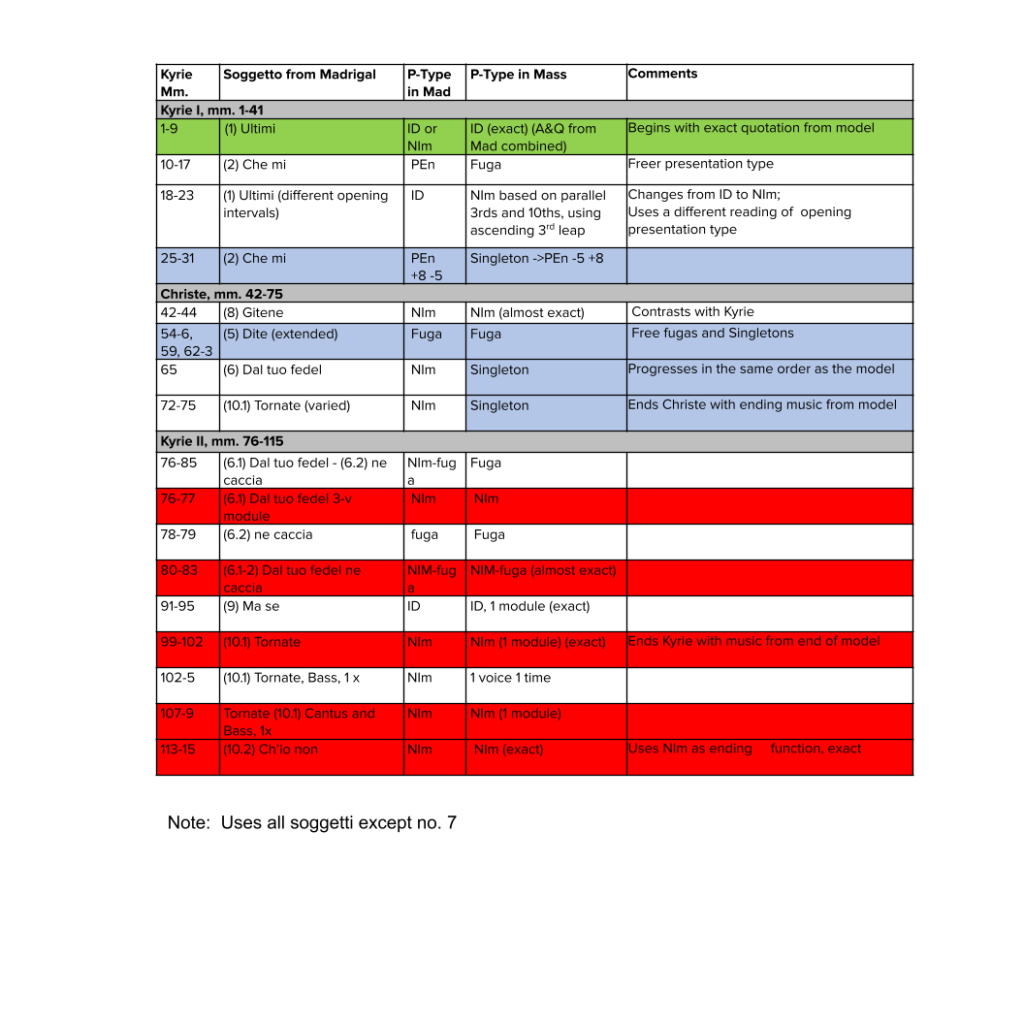
Table 4: The Kyrie of Padovano’s Mass in Relation to Verdelot’s Madrigal
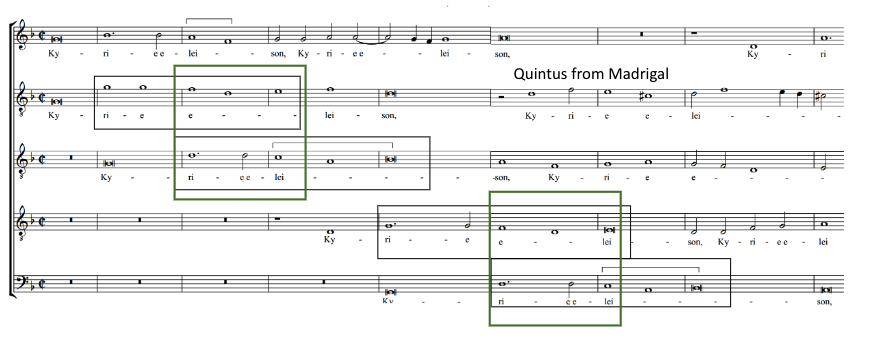
Example 6. Padovano Kyrie maintains the original material: Kyrie’s ID is almost exactly like the madrigal (Q moves to A in Mass)
At the beginning of the Gloria Padovano chooses Verdelot’s NIms with parallel thirds and sixths, rather than the ID used in the Kyrie (Examples 7 and 8). In the Credo Padovano also uses a NIm, but the soggetti are recombined and inverted for a new contrapuntal combination; free material is also inserted.
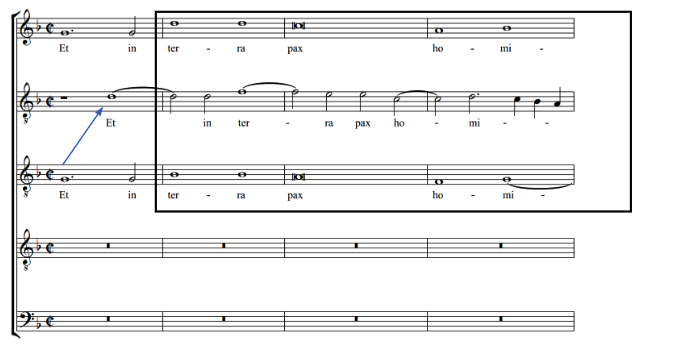
Example 7. Padovano Gloria: Very different approach. Focus is on Parallel 10ths in outer voices (and some very flexed fuga in the middle voice)
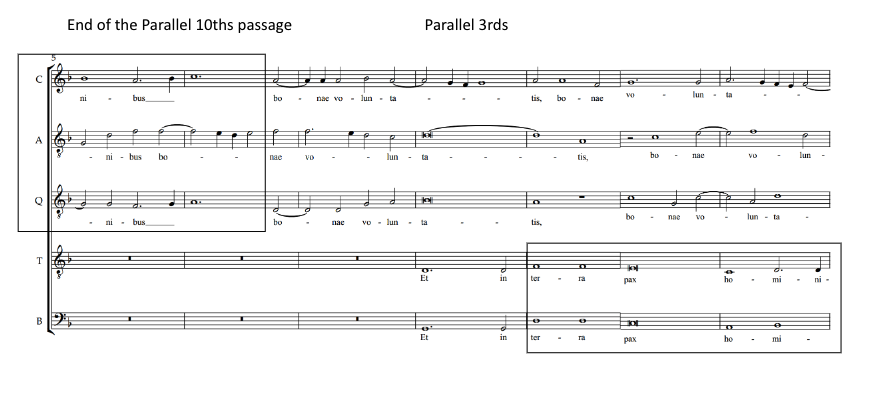
Example 8. Padovano Gloria: Parallel 10ths; then parallel 3rds in lower voices
In the Sanctus (Example 9) Padovano takes the top-voice soggetto from staff 1 of the madrigal (which begins with an ascending minor third), and then the soggetto from staff 5 (which begins with an ascending fourth) and applies rhythmic augmentation, making the soggetti into long-note cantus firmi. He uses the technique of contrapunto fugato (a repeated motive against a cantus firmus; see Schubert 2020) to compose repeated motives against these cantus firmi. There are three recurring motives used against the soggetto: a neighbour tone (shown with green ovals in Example 9), a suspension, and a turn in semiminims. In the Agnus Dei he takes two versions of the Ultimi soggetto, changes the rhythm, and combines them in a new way.
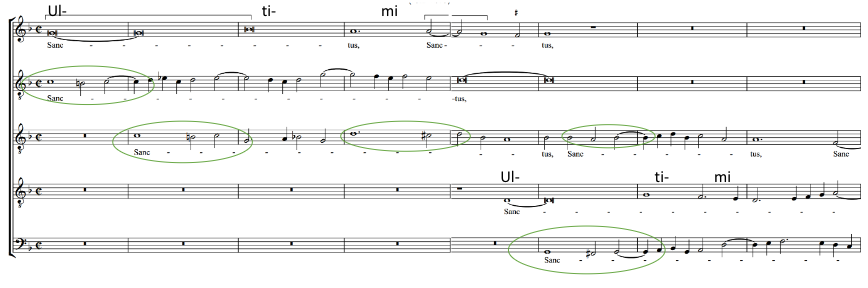
Example 9: Sanctus, with contrapunto fugato against soggetto (1) Ultimi.
Cerone also suggests that “the endings … [of all five movements] should all be made alike … yet varied in accompaniment and treatment.” Padovano uses material from the end of the madrigal in all movements except the Sanctus. The end of the Kyrie dwells on the two final soggetti (10.1, Tornate, and 10.2, ‘Ch’i non vorro’), with 3 NIms that come close to exact quotation of the madrigal. The Gloria also uses 10.1 and 10.2, with exact quotation and some variation. The Credo only uses 10.2, but stays close to the original counterpoint. The Sanctus does not use anything from the Mass in the final Hosanna, probably because the movement ends in a joyous triple meter, which makes it difficult to adapt the soggetti from the madrigal. The single Agnus Dei provides one of the paired modules from the final NIm of 10.2.
Cerone states that “the more use one makes … of motives from the middle or inside of the composition upon which the Mass is written, the better and more praiseworthy it will be.” Here Padovano’s Mass does not correspond to Cerone’s description. A survey of Tables 4-8 shows that the Mass moves from extensive borrowing of soggetti and contrapuntal structures in the Kyrie, to minimal borrowing in the Agnus, with each Mass movement using less and less material from the madrigal, both in terms of how many soggetti are used, and in terms of the number of measures that use no music from the model (passages of more than five measures with no material from the madrigal are shown as blank rows in the tables). The Kyrie and Gloria each use all but one of the soggetti from the model; the Credo omits four soggetti; the Sanctus uses only four of the eleven soggetti; and the Agnus uses only three.
Presentation Types and Formal Function in Padovano’s Mass
In tables 4-8 I have used green, blue, and red highlights when the presentation types and soggetti from the madrigal recall their use in the madrigal. The alternate interpretations of the opening point of imitation in the Madrigal are used to vary the openings of the individual Mass movements. In quite a few cases, a NIm (with two contrapuntal modules in the madrigal) returns with only one iteration in the module (this is shown with “one module” in Tables 4-8); strictly speaking, it is no longer a NIm, but the memory of the repeated module in the model makes it function in a similar way in the Mass. The repeated PEn (2, ‘Che mi’) also often returns only once.
The structure of Kyrie I is closely modeled on the piedi of the madrigal, with the soggetti for the first two lines repeated. The second use of the first “Ultimi” soggetto, however, is not an ID; Padovano choses to vary it and emphasizes the NIm interpretation of the opening point of imitation. The use of PEn, singletons, and fuga (highlighted in blue) dominate the Christe and connect to the end of Kyrie I. Kyrie 2 is dominated by NIms, with multiple uses of the soggetti from the final line of the madrigal. Here Padovano has largely taken over Verdelot’s use of presentation types for formal function.
In the Gloria (Table 5) Padovano varies the opening “Ultimi” section (Examples 7 and 8), as Cerone would suggest; he then moves into relatively free use of the middle soggetti from the madrigal (lines 6 and 5), for middle function. The second section of the Gloria (Beginning with the words “Domine Deus,” m. 80), does not begin with soggetti from the madrigal; instead there is a set of 3-voice NIms, resulting in reduced texture. When musical material from the madrigal (line 2, Che mi) returns in m. 103, Padovano changes the presentation type from the PEn in the madrigal to an ID. While there is some overlap between the preceding “qui tollis peccata mundi phrase,” the “miserere nobis,” set with descending lines as an ID, makes a striking new beginning for the second half of the Gloria. NIms from the madrigal (8, Gitene, and 10.2, ch’io non) dominate the end of the movement, for a strong closing function.
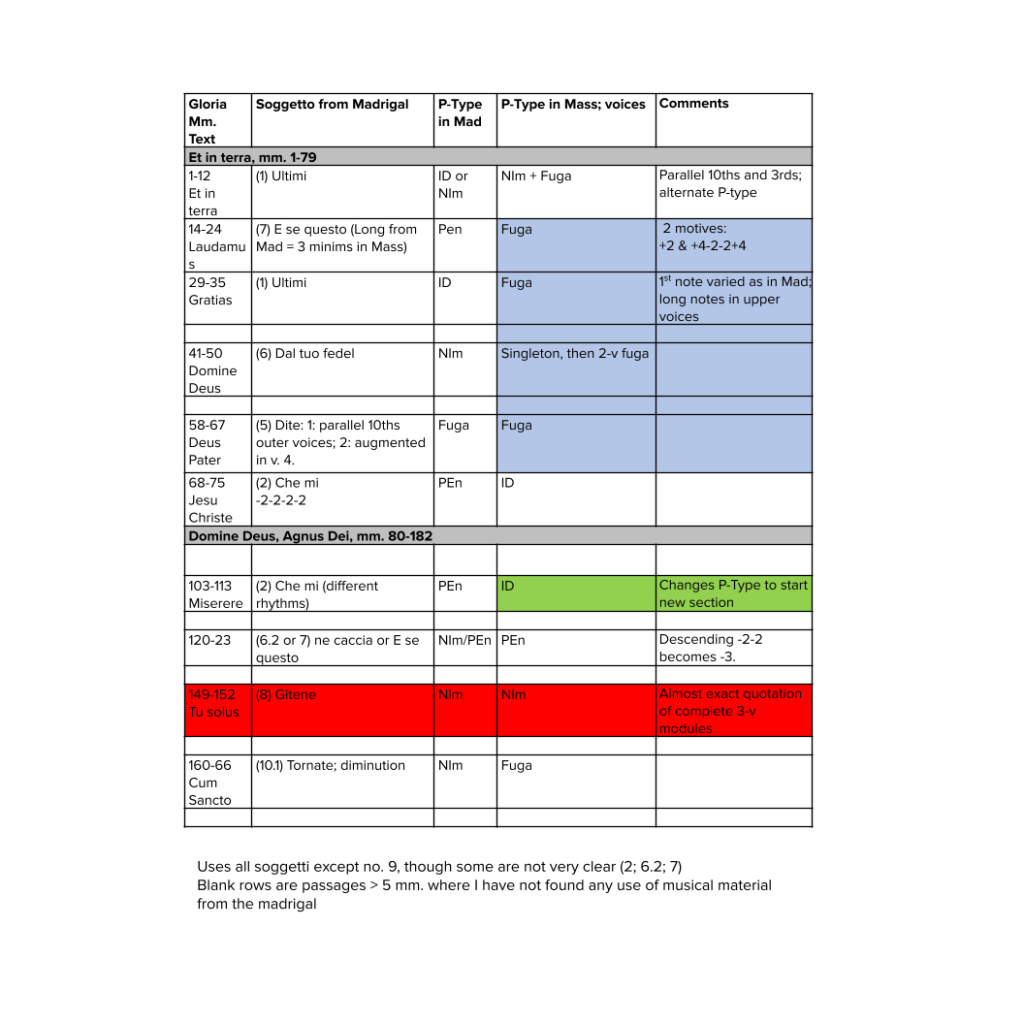
Table 5: The Gloria and Agnus of Padovano’s Mass in Relation to Verdelot’s Madrigal
In the Credo (Table 6) Padovano’s use of material from the madrigal is fairly limited; however, we do see the use of the formal functions quite strongly, both in the opening “Patrem” section, and in the final “Et iterum” with beginning, middle, and end functions (even though the “Ultimi” soggetto comes in the middle of the movement).
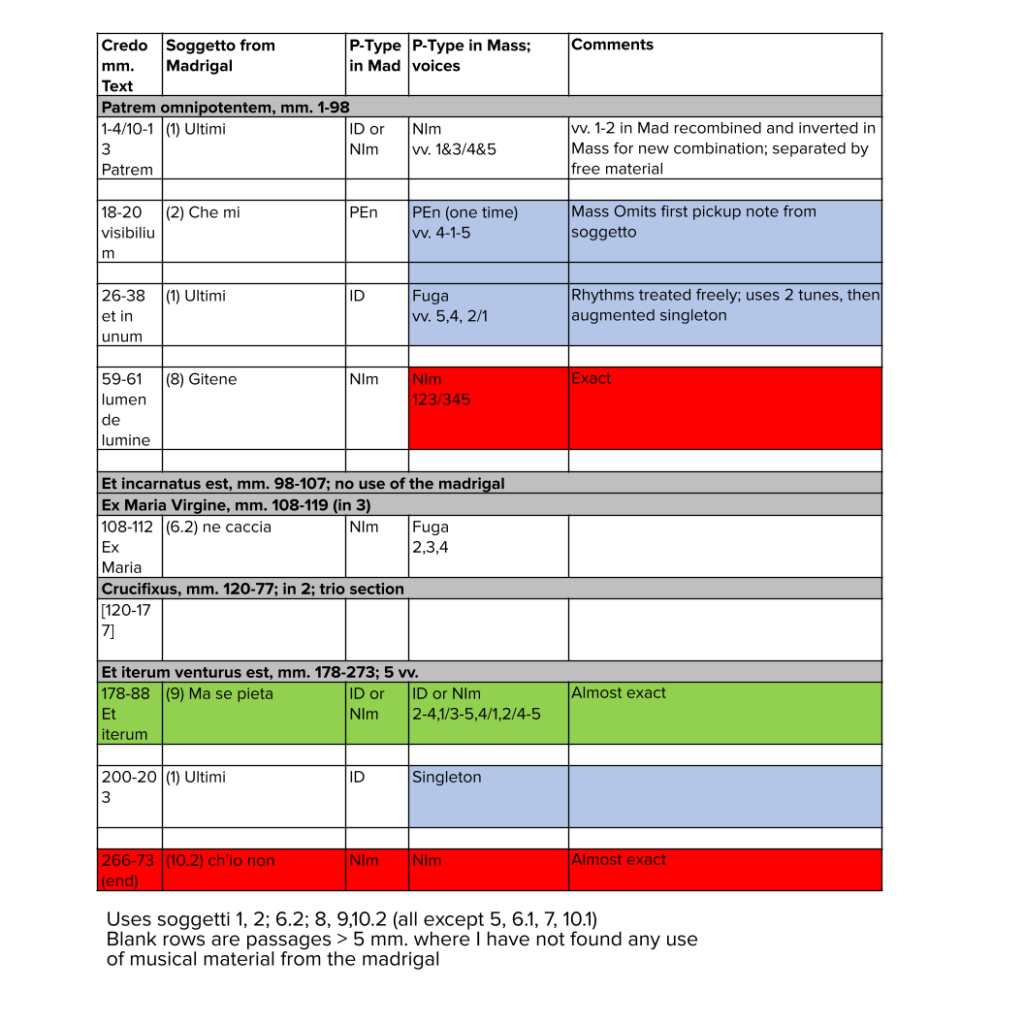
Table 6: The Credo of Padovano’s Mass in Relation to Verdelot’s Madrigal
The Sanctus (Table 7) seems to turn its back on the presentation types with modules, using mostly singletons and fuga. The first Hosanna does begin with the (8) “Gitene” NIm, signalling the end of the movement, and in the second Hosanna Padovano converts the (7) “E se questo” soggetto so that it works in triple meter.
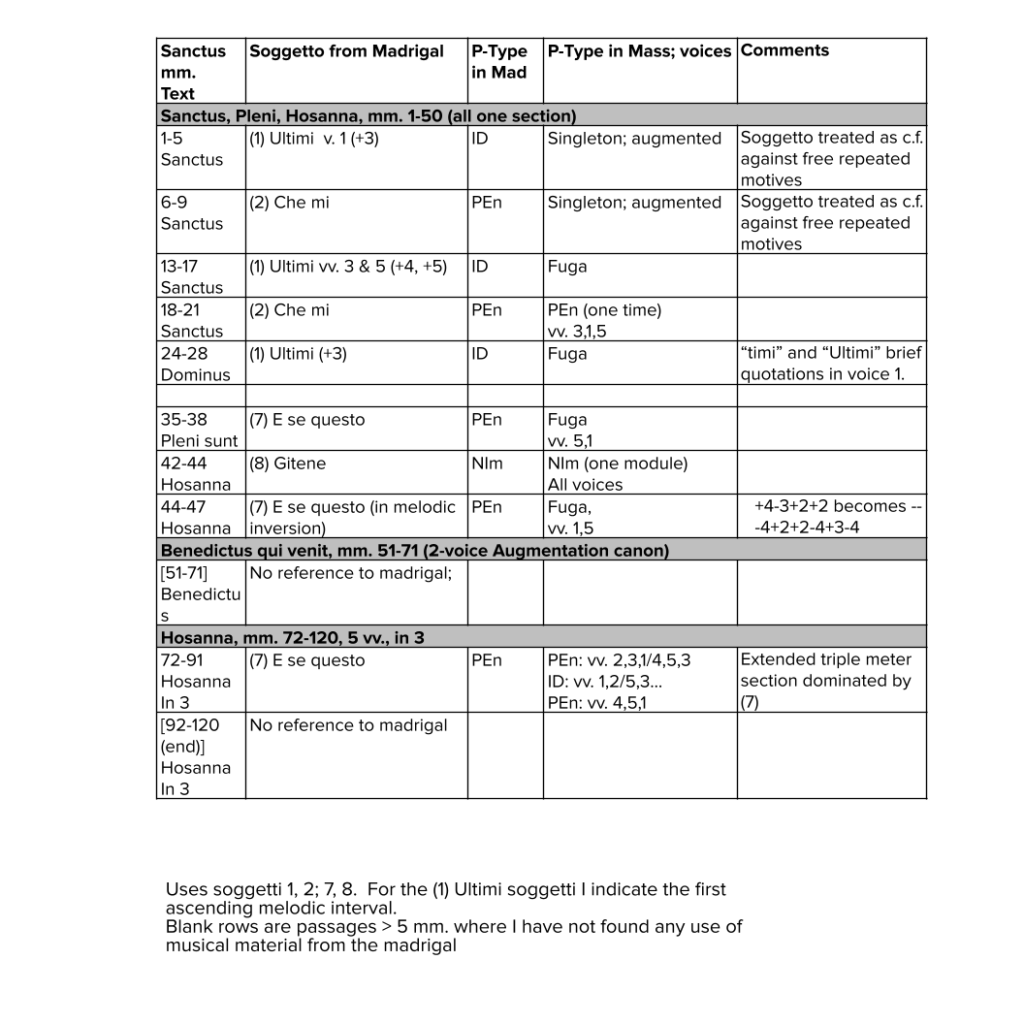
Table 7: The Credo of Padovano’s Mass in Relation to Verdelot’s Madrigal
The Agnus (Table 8) reminds us of the first and final soggetti at the beginning and end of the movement. Overall, the use of formal functions in the Mass builds upon the structure established in the madrigal. Even though the amount of material from the model diminishes sharply over the course of the Mass, both the order of the soggetti and the formal function of the presentation types work to articulate the form of the Mass movements.
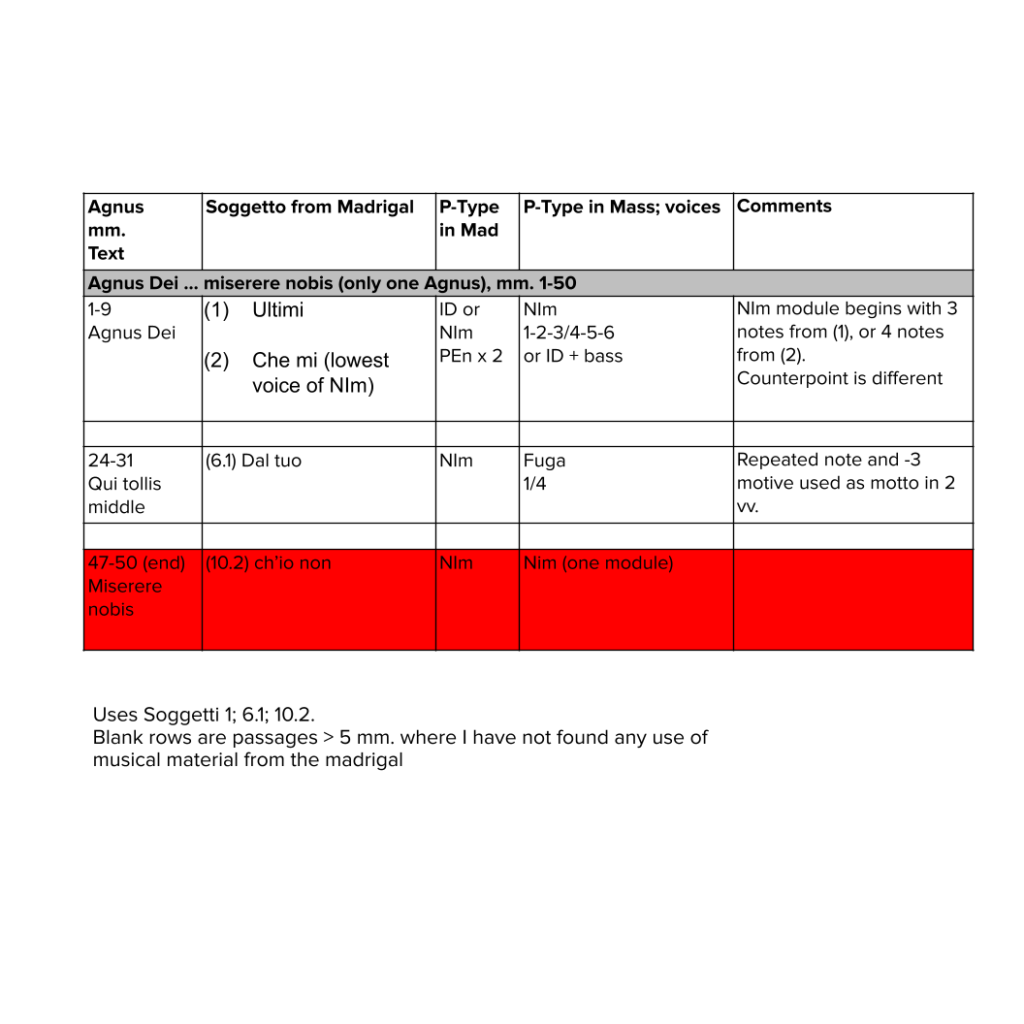
Table 8: The Soggetto of Verdelot’s Madrigal in Relation to Selected Movements of Padovano’s Mass
The CRIM “Heatmap” Data in Relation to “Manual” Analysis
In this CRIM tool, the computer extracts the four diatonic melodic intervals for five-note soggetti that happen more than once in the model and the Mass (rhythmic values are not considered). It identifies the soggetti found in both model and Mass for each Mass movement. It then shows the location of those soggetti in each voice on a timeline (measured in quarter notes); each soggetto has a different color, and we also see the melodic pattern and how many times each soggetto appears. (Thanks to Vlad Praskurnin, who generated the CRIM heatmaps in the Jupyter notebooks for my madrigal and Mass.)
The user can set the tool to include repeated notes as separate notes, or to combine the repeated notes into one note. I chose to focus on the version which combined unisons, to increase the number of different notes in the soggetti, and to minimize the differences between the soggetti in the madrigal and the Mass, given that different text in the Mass can change the number of repeated notes. I also found that the version with combined repeated notes generally found more different soggetti, and more instances of each soggetto, as shown in Table 9.

Table 9: The Distribution of Soggetti with Unisons in the Mass
When we look at the list of soggetti in the madrigal found by the CRIM tool (Figure 1), we find that there are far more soggetti (30) than in my analysis of the madrigal, where there were 10 soggetti (see Table 2). Nine of the soggetti listed in CRIM occur only twice, and another four occur only three times. Three of them occur significantly more frequently than the others. The most common is +4, -2, -2, -2, with 24 occurrences, shown in red. (I have added a “+” in the my text next to the ascending intervals for clarity; CRIM shows them as positive integers). The most common soggetto (+4, -2, -2, -2) shown in red is identifiable as soggetto (2) “Che mi,” which occurs at the end of each of the piedi, and (6.2), “ne caccia,” in the sirima. The tool brings out the connection between these soggetti (which belong to the pF group of soggetti melodies discussed earlier).
The next most common soggetto is Rest, Rest, +4, -2 (which leads into the beginning of the most common red soggetto), shown in grey; and third most common is -2, -2, -2, +2, shown in blue, which is rather generic stepwise motion.
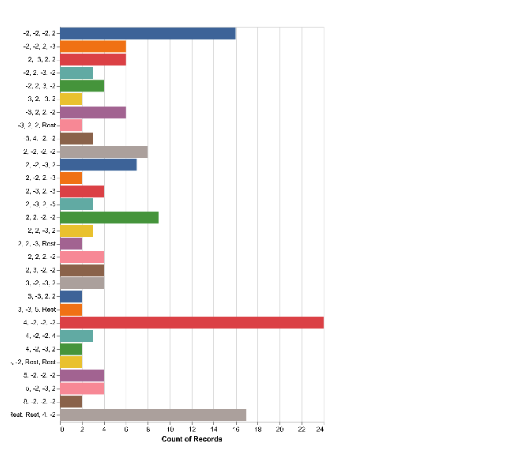
Figure 1. Soggetti found in the madrigal
Looking at the heatmap brings out some important features of the madrigal (Figure 2): the repeated A section is very evident (shown in boxes, Figure 2). The break just before quarter note 420 is the major cadence before the final couplet in m. 52-3, and the following orange entries show the ID for soggetto (9) “Ma se pieta,” which has a distinctive descending third. Imitation is quite evident, as blocks of the same color are passed from voice to voice (different widths have to do with different note values – longer note values produce wider blocks). NIms are much harder to detect, since the repeated melodies that constitute a module do not necessarily line up clearly; and in general it is hard to determine if there are repeated modules.
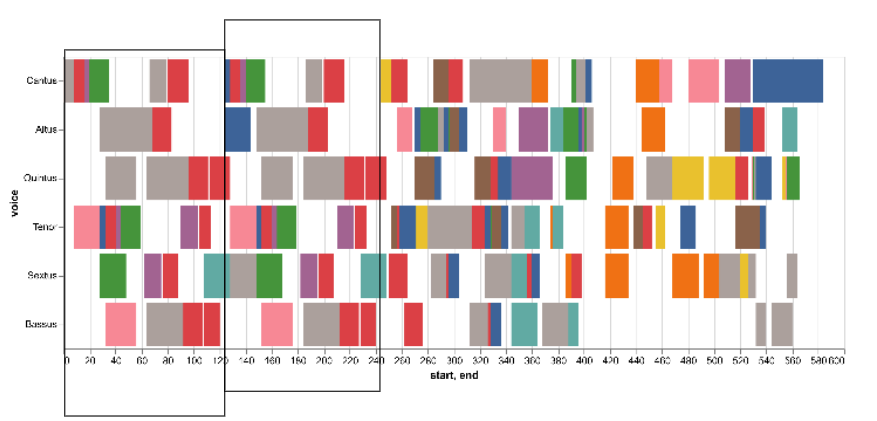
Figure 2. Heatmap, showing the soggetti in the madrigal
Looking at the heatmaps of the shared material between madrigal and the Mass movements, many of the shared soggetti are primarily stepwise motion, and I found many of the “quotations” corresponded to generic passages from the middles and ends of phrases, and therefore not really “motivic” in the madrigal. The most frequent soggetto in the madrigal (+4, -2, -2, -2) according to CRIM, is also the soggetto with the most pronounced profile in the heatmaps of shared soggetti in the Mass movements (all the soggetti in the heatmaps that have more instances than +4, -2, -2, -2, use only stepwise motion).
The heatmaps also provide a good overall view of the gradually decreasing use of soggetti from the madrigal over the course of the Mass. Table 9 (above) shows that there are more shared soggetti in the longer movements (Gloria and Credo); many soggetti occur less than four times; and the Sanctus and Agnus use very little music from the madrigal.
The Agnus Dei, according to CRIM, only shares two soggetti with the madrigal, in only three of the six voices (see Figure 3). This corresponds to my finding of relatively little material from the madrigal in this final movement, although I found four soggetti from the madrigal (see Table 8).
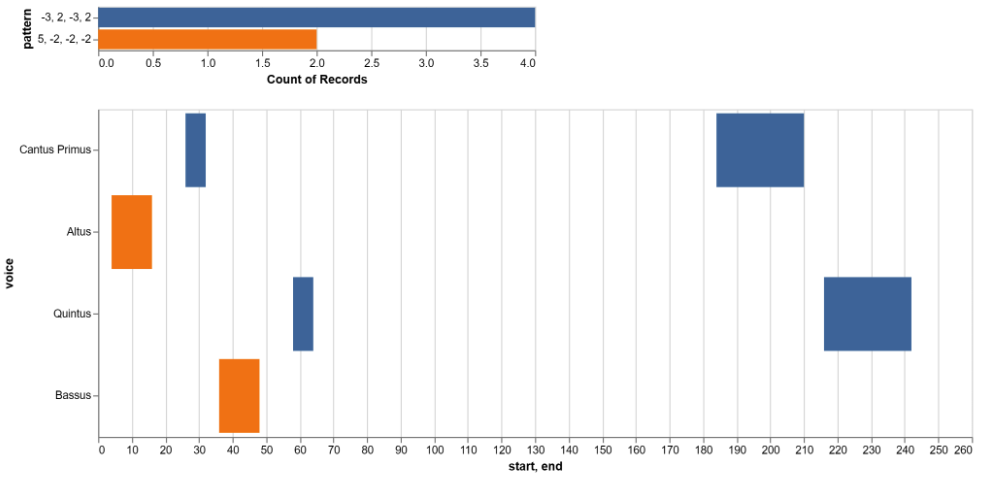
Figure 3. Heatmap for the Agnus Dei.
The NIm at the beginning of the Agnus seems to me to refer to the (1) “Ultimi” soggetto in the version with the ascending minor third found in the top voice of the madrigal, but it only has three notes (two intervals) in common with that soggetto, so it is not picked up by the CRIM heatmap, which has a minimum of four melodic intervals. The orange soggetto shown in the heatmap is a version of the (2) “Che mi” soggetto, beginning with an ascending fifth rather than the usual fourth. So the heatmap did bring out an interesting combination of two soggetti in the final movement of the Mass. The blue soggetto, with stepwise falling thirds (-3, +2, -3, +2) is found in the madrigal soggetto (5), “Dite,” beginning on the second note, a transitional moment between the piedi and sirima, where every voice has a slightly different version of the soggetto. I did not pick up on this soggetto in the Agnus when analyzing the piece “by hand.” There is definitely more to be learned using the CRIM tools going forward.
Conclusion
Verdelot responded to the highly structured canzona form with a highly structured musical form, in which presentation types take on formal functions of beginning, middle, and end. His points of imitation (especially (1) “Ultimi miei”) are also possible to interpret in different ways, because of the six-voice texture and the use of doubling voices in thirds and tenths.
Padovano begins the Kyrie with a note-for-note copy of the beginning of the Kyrie, and replicates the madrigal’s use of formal functions quite faithfully. He begins every movement with some version of soggetto (1) “Ultimi” and generally does them in order. Soggetto I10.2) “ch’io non” ends every movement except the Sanctus. These first and final soggetti take on beginning and ending functions in the Mass based on their locations in the model, even when the presentation type is changed.
After the Kyrie the borrowing becomes less dense, and less exact; the number of soggetti from the madrigal decreases sharply in the last two movements, and the soggetti are separated by more “white space” in the heat maps, and by empty rows in the tables. The principal of “varietas” takes over, and Padovano develops new ways to use old soggetti (especially striking is the contrapunto fugato in the Sanctus against an augmented and varied soggetti from the madrigal). Ultimately, juxtaposing these two works, and using multiple methodologies, allowed me to develop new approaches to the analysis of Renaissance music, and new ideas about compositional process.
Bibliography
Burmeister, Joachim. 1987. Musical Poetics. Edited by Claude P. Palisca. Translated by Benito V. Rivera. Yale University Press. https://doi.org/10.12987/9780300162110.
Caplin, William E. Classical Form: A Theory of Formal Functions for the Instrumental Music of Haydn, Mozart, and Beethoven. Oxford: Oxford University Press, 1998.
Cerone, Pietro. 1613. El Melopeo y Maestro.
———. 1950. “The Manner to Be Observed in Composing a Mass.” In Source Readings in Music History, edited by Oliver Strunk, 265–68. New York: W.W. Norton and Co. https://bac-lac.on.worldcat.org/oclc/421760031.
Cumming, Julie E., and Peter Schubert. 2015. “The Origins of Pervasive Imitation.” In The Cambridge History of Fifteenth-Century Music, edited by Anna Maria Busse Berger and Jesse Rodin, 200–228. Cambridge: Cambridge University Press. https://doi.org/10.1017/CHO9781139057813.018.
Harran, Don. 1969. “Verse Types in the Early Madrigal.” Journal of the American Musicological Society 22 (1): 27–53. https://doi.org/10.2307/830811.
Lockwood, Lewis. 1978. “On Parody as Term and Concept in 16th-Century Music.” In Aspects of Medieval and Renaissance Music: A Birthday Offering to Gustave Reese, edited by Jan LaRue, Martin Bernstein, Hans Lenneberg, and Victor Yellin, 2 (first edition 1966), 560–75. Series III, Festschriften, no. 2. New York: Pendragon Press, 1966.
Luko, Alexis. 2008. “Tinctoris on Varietas.” Early Music History 27:199-136.
MacKay, James. 2002. “Toward a Theory of Formal Function for Renaissance Music.” Indiana Theory Review 2: 99–131.
Milsom, John. 2005. “Crecquillon, Clemens, and Four-Voice Fuga.” In Beyond Contemporary Fame: Reassessing the Art of Clemens Non Papa and Thomas Crecquillon, edited by Eric Jas, 293–345. Epitome Musical. Turnhout: Brepols.
Schubert, Peter N. 2007. “Hidden Forms in Palestrina’s First Book of Four-Voice Motets.” Journal of the American Musicological Society 60 (3): 483–556. https://doi.org/10.1525/jams.2007.60.3.483.
———. 2020. “Contrapunto Fugato: A First Step Toward Composing in the Mind.” Music Theory Spectrum 42 (2): 260–79. https://doi.org/10.1093/mts/mtaa009.
Schubert, Peter N., and Marcelle Lessoil-Daelman. 2013. “What Modular Analysis Can Tell Us About Musical Modeling in the Renaissance.” Music Theory Online 19 (1). https://mtosmt.org/issues/mto.13.19.1/mto.13.19.1.schubert_lessoil-daelman.html.Slim, H. Colin, ed. 1972. A Gift of Madrigals and Motets. 2 vols. Chicago: University of Chicago Press. http://hdl.handle.net/2027/heb.05587.