The Rest is Silence: Thomas Morley’s Concept of the ‘Close’
Jessie Ann Owens (University of California, Davis) and Richard Freedman (Haverford College)
Setting the Problem: Cadences and ‘Closes’
The authors are grateful to John Milsom and Alexander Morgan for their contributions to this essay.
Supplementary materials, including transcriptions and encodings of the musical examples considered here at https://github.com/CRIM-Project/Essays_Explorations/tree/main/Owens%20and%20Freedman
The CRIM cadence tool identifies cadences by recognizing cadential voice functions (CVF) between pairs of voices. (Morgan et al. 2022; Morgan 2023). A suspension cadence is a kind of module, defined by Morgan as a “collection of one or more pairs of voices that accentuate a perfect interval through the expression of all four phases of a the formula: preparation, suspension, resolution, perfection.” (Morgan 2023) The tool is a distillation of principles derived from a careful analysis of the CRIM repertory, informed by the pedagogy offered by a select group of Renaissance music theorists. (Morgan 2016)
The goal of our investigation, in contrast, is to explore cadential structures that differ in important ways from the principles embodied in the current CRIM corpus of continental music. In so doing we will interrogate the concepts at work in the CRIM Intervals cadence tool, while also exploring some alternative algorithms. In particular, the focus here is on a subset of music found in Thomas Morley’s well-known treatise A plaine and easie introduction to practicall musicke (London, 1597), namely, compositions and pedagogical examples for three voices. (Jessie Ann Owens and John Milsom are currently preparing a four-volume modern edition of Morley’s book (to be published by DIAMM Publications), including a critical edition of the text, critical notes and commentary, essays by leading scholars and a full-color facsimile.) Not only do we have Morley’s own explanations of cadence—his term is ‘close’ (we place Morley’s terms in single quotation marks)—but we also have musical examples he included to illustrate ‘closes’ as well as three compositions: a brief composition (just six measures long) he included to show how to form chords), a textless Aria and the song O sleepe fond fancie ). Table 1 lists the corpus investigated (We have not included the three-voice Christes crosse in our corpus: it is a lengthy and notationally complex set of variations on a tune, the goal of which is to show differing ways of notating proportions).
| Page | Filenamenote a | Type |
| 68 | Morley_1597_068 | Untexted aria |
| 127 | Morley_1597_127_3 | Brief composition showing how to form chords |
| 127 | Morley_1597_127_4 | ‘Close’ (‘cadence’ in tenor) |
| 127 | Morley_1597_127_5 | ‘Close’ (‘cadence’ in tenor) |
| 127 | Morley_1597_127_6 | ‘Close’ (‘cadence’ in tenor) |
| 127 | Morley_1597_127_7 | ‘Close’ (‘cadence’ in tenor) |
| 127 | Morley_1597_127_8 | ‘Close’ (‘cadence’ in tenor)*note b |
| 128 | Morley_1597_128_01 | ‘Close’ (‘cadence’ in tenor) |
| 128 | Morley_1597_128_02 | ‘Close’ (‘cadence’ in tenor) |
| 128 | Morley_1597_128_03 | ‘Close’ (‘cadence’ in tenor) |
| 128 | Morley_1597_128_04 | ‘Close’ (‘cadence’ in tenor) |
| 128 | Morley_1597_128_05 | ‘Close’ (‘cadence’ in tenor)* |
| 128 | Morley_1597_128_06 | ‘Close’ (‘cadence’ in tenor)* |
| 128 | Morley_1597_128_07 | ‘Close’ (‘cadence’ in tenor) |
| 128 | Morley_1597_128_08 | ‘Close’ (‘cadence’ in bassus) |
| 128 | Morley_1597_128_09 | ‘Close’ (‘cadence’ in bassus) |
| 128 | Morley_1597_128_10 | ‘Close’ (‘cadence’ in bassus)* |
| 128 | Morley_1597_128_11 | ‘Close’ (‘cadence’ in bassus) |
| 129 | Morley_1597_129_1 | ‘Close’ (‘cadence’ in altus) |
| 129 | Morley_1597_129_2 | ‘Close’ (‘cadence’ in tenor) note c |
| 129 | Morley_1597_129_3 | ‘Close’ (‘cadence’ in tenor) |
| 129 | Morley_1597_129_4 | ‘Close’ (‘cadence’ in altus) |
| 129 | Morley_1597_129_5 | ‘Close’ (‘cadence’ in altus) |
| 129 | Morley_1597_129_6 | ‘Close’ (‘cadence’ in altus) |
| 194 | Morley_1597_194 | O sleepe fond fancie |
Table 1: Examples and Compositions for Three Voices Containing Closes, from A Plaine and Easie Introduction
Notes to Table 1
a) In this essay we identify Morley’s examples by the page number, using three digits. Morley_1597_194, for instance, refers to the example found on page 194 of the 1597 edition of his treatise. When more than one example appears on a page, we add a second set of digits. Thus Morley_1597_127_03 refers to the third example on page 127.
Modern editions were prepared in Sibelius by Holly Druckman, some of them based on diplomatic transcriptions created by Ross Duffin. These were in turn saved as MusicXML files for use with CRIM Intervals. Sibelius, MusicXML, and PDF files of all the passages are available at https://github.com/CRIM-Project/Essays_Explorations/tree/main/Owens%20and%20Freedman along with Verovio renderings of the XML files.
b) Morley calls some of his ‘closes’ ‘passing’ or ‘false’ (we would say evaded). These ‘passing closes’ are marked in his treatise (and this table) with *.
c) ‘Closes’ Morley_1597_129_3 and Morley_1597_129_4, which Morley included among the altus ‘closes’, in fact have the ‘cadence’ in the tenor, not the altus
Constraining the investigation in this way helps us to put Morley’s ideas about closure in conversation with other theorists of his day, and with our own analytic concepts. By putting his (and our) ideas to test against the unforgiving mechanisms of computational pattern finding, moreover, we hope to uncover where rules hold sway, and where art begins. But before we examine the inner workings (and limitations) of the computational methods, we should first pause to examine Morley’s surprising ideas on cadences, and the ways in which he puts them into practice.
Morley Explains ‘Cadence’ and ‘Close’
Morley considers what we call cadences in two key portions of his treatise. The first is in Part II, in the midst of a discussion of discords in two-voice counterpoint. His terminology is subtly different from ours. Here the term ‘cadence’ refers not to a contrapuntal combination, but instead simply to a single voice: “A Cadence wee call that, when comming to a close, two notes are bound togither, and the following note descendeth thus:” (Morley 1597, 73, see Figure 1). For Morley, ‘cadence’ can be the typical suspension formula that moves up stepwise to an octave or a unison, but it can also mean syncopation that does not involve a dissonant suspension: “Syncopation (which we abusively cal a Cadence).” (144). This distinction will prove significant.

Figure 1. Morley’s explanation of ‘what a cadence is’, from Morley 1597, 73.
The form most corresponds to what scholars of Renaissance polyphony call a cantizans, the melodic behavior commonly associated with the cantus voice in the two-voice clausula vera (where it pairs with the descending tenorizans), to use the CRIM definition (for an illustration and explanation, see Example 2, below).
Morley recognizes the two-voice contrapuntal pattern that is often associated with this melodic ‘cadence’. But he calls it a ‘close’, or, more accurately, one kind of ‘close’. In the passage that immediately precedes his explanation of ‘cadence’ he offers an example to illustrate ‘exquisite’ descant: it is a ‘close’ (the two-voice contrapuntal module) with a ‘cadence’ (the syncopated gesture found in a single voice, in this case the top voice; see Figure 2; Morley generally distinguishes ‘cadence’ from ‘close’, though once he does seem to equate the terms: “except at a Cadence or close where a discorde is taken” [(Morley 1597, 143. ]).
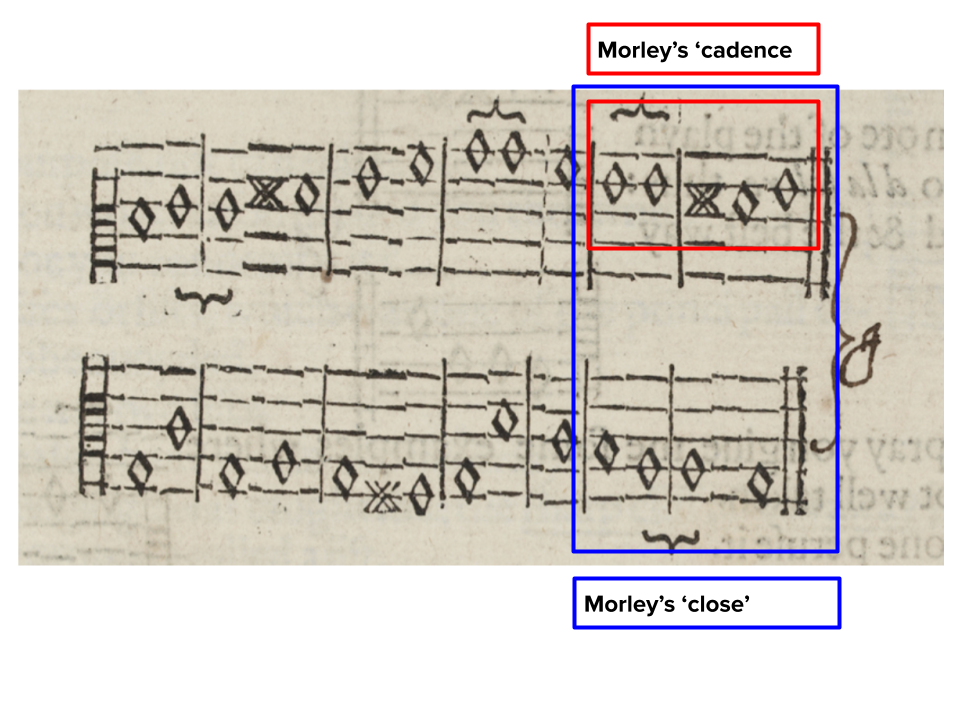
Figure 2. Morley’s example of good descant, from Morley 1597, 73
Morley was not the first writer in English to use the word ‘close’ to mean some kind of syntactic articulation in written or spoken expression. There does not seem to be any obvious equivalent in continental writings on music, unless we are to understand ‘close’ as an Anglicization of ‘clausula’. There is some sense to that, perhaps, once we remember that the two-voice suspension formula so long a part of European art music of the 14th through 16th centuries is the clausula vera. (From the extensive secondary literature on cadences, see especially Herissone 2000 for the discussion of English practice, Schwind 2009 for her discussion of fifteenth- and sixteenth-century continental theories, and Cohen 2001 for reflections on historical conceptions of directed motion. Bergwall 2023 can usefully be read alongside our essay.)
Morley’s main discussion of ‘close’ comes in Book III, where he teaches ‘setting’, that is, composition. In a passage about the proper handling of octaves (‘eight’), he explains the role of ‘cadence’ in a ‘close’:
the eight is in three parts seldome to be used, except in passing maner or at a close, and because of all other closes the Cadence is the most vsuall (for without a Cadence in some one of the parts, either with a discord or without it, it is unpossible formallie to close): (127)
This passage hints at the varieties of closure in Morley’s world. ‘Formal’, that is, correct, suggests the existence of ‘closes’ that are not formal but are nonetheless ‘closes’. Formal ‘closes’ should have a ‘cadence’. But in certain circumstances a ‘close’ apparently does not have to have a ‘cadence’. There are even options for the ‘cadence’; it always has a syncopation but not necessarily a suspension. This is important news to those of us accustomed to thinking of contrapuntal closure in terms of preparation, suspension, resolution, perfection. A subtle but important innovation is at work here, in terms of both compositional practice and the theoretical justification that explains it. And with it we are prompted to rethink some of our analytic assumptions, too.
But before we proceed we should consider the examples of ‘closes’ that Morley provides as illustrations. There are 22 ‘closes’ for three voices, organized by the position of the voice that has the ‘cadence’ (the syncopated gesture): first bassus, then tenor, and finally altus. (Morley 1597, 127-29; we follow Morley in identifying the three voices as altus, tenor and bassus, regardless of the clefs employed.) Here is one of the ‘closes’ that has the ‘cadence’ in the tenor (middle voice; see Example 1).
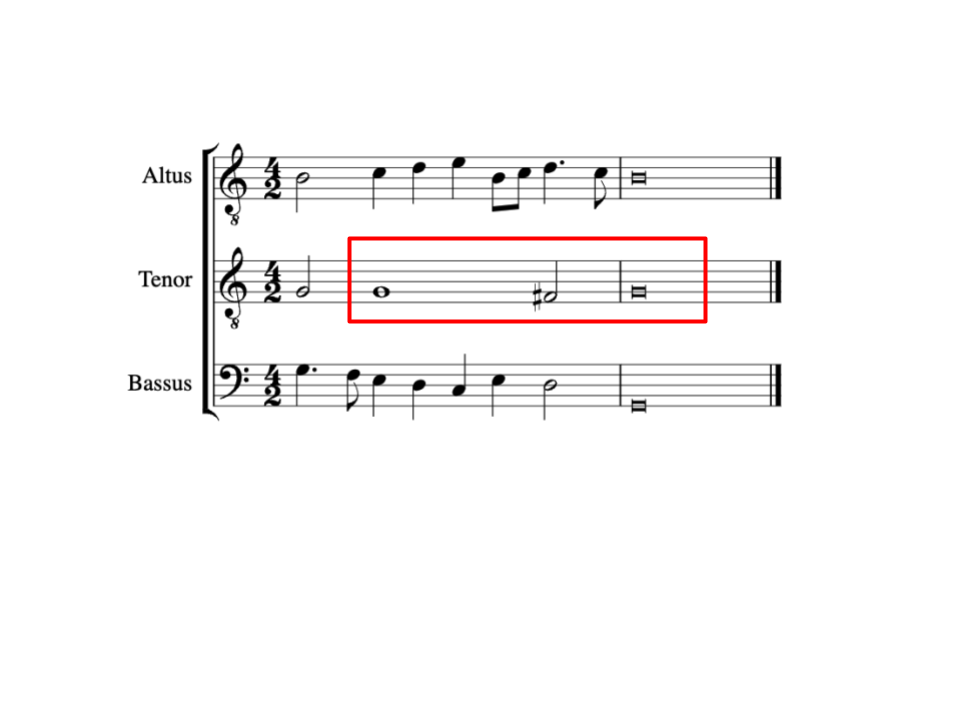
Example 1. A ‘cadence’ (in the tenor), within a ‘close’, from Morley_1597_127_5
There are two anomalies among these examples: two of the ‘closes’ included among the altus ‘closes’ (Morley_1597_129_2 and Morley_1597_129_3) actually have the ‘cadence’ in the tenor. We will consider them below because they shed light on Morley’s practices.
In addition to these explicit examples of ‘closes’ Morley provides three three-voice compositions, mentioned above and listed in Table 1: the six-measure illustration of chord formation, the textless Aria, and O sleepe fond fancie. We must presume that these pieces include ‘closes’ and ’cadences’, but Morley says nothing about where they are to be found, or how his readers should go about looking and listening for them.
Towards Automatic Analysis and Detection of ‘Closes’
As it happens, Morley’s ‘closes’ are surprisingly varied. The vast majority of them include the syncopated ‘cadence’ pattern described above. But a few do not. And while many of his ‘closes’ lack the customary preparation-suspension-resolution-perfection formula, others are entirely explicable from the standpoint of conventional descriptions of Renaissance counterpoint. They thus prove an interesting testing ground for the CRIM Intervals tools, through which we can rapidly inventory and categorize various kinds of melodic, harmonic, rhythmic, and contrapuntal patterns. Morley’s ‘cadences’ and ‘closes’ certainly appear in the CRIM Intervals tables. But can their rules be formalized in ways that allow us to detect them reliably even when they do not contain suspensions? What should we make of false positive and false negative results?
Our first step in this process was thus to analyze Morley’s examples with Alex Morgan’s cadence function. As he has explained (Morgan et al 2022 and Morgan 2023), this method is founded on the detection of what he calls Cadential Voice Functions (CVFs), which variously embodying contrapuntal roles that trace the four stages from preparation to perfection noted above. The tool is sophisticated, and quite reliably finds (and labels) both the voice roles in cadences, including not only cantizans, tenorizans, bassizans, but also irregular or even abandoned instances of these voices, plus altizans, quintizans and sextizans found in multivoice textures. The details of Morgan’s code do not need to detain us here, but in brief the method involves building a table of contrapuntal (modular) n-grams, then reasoning over various formulas to detect pairs of voices and the roles they imply. A two-voice clausula vera (involving only the cantizans and tenorizans functions, thus “CT” in Morgan’s method) can be detected with just a single modular n-gram (as we see in Example 2, below). A three-voice pattern, in contrast, would need two n-grams happening at the same time (so that we can detect the functions of cantizans-tenorizans and cantizans-bassizans, in all their variety. The unique combinations of these coinciding modules, in turn, allows the tool to predict dozens of specific types of cadences–not only clausula vera but also authentic (that is, involving a CB function, regardless of the behavior of the tenorizans part), and authentic evaded (CtB in Morgan’s system, for instance, represents regular cantizans and bassizans functions but a tenorizans that moves up a step instead of the expected downward step).
Morgan’s method makes good on its promise, accurately detecting the instances in Morley’s three-voice corpus of cadences that follow the preparation-suspension-resolution-perfection model. Example 2 shows a classic example of the clausula vera type identified by his method, with 7>6>8 pattern between the cantizans-tenorizans structural pair, along with the contrapuntal n-gram that can be used to describe the melodic and harmonic intervals made by the two parts over the suspension-resolution-perfection stages of the pattern.
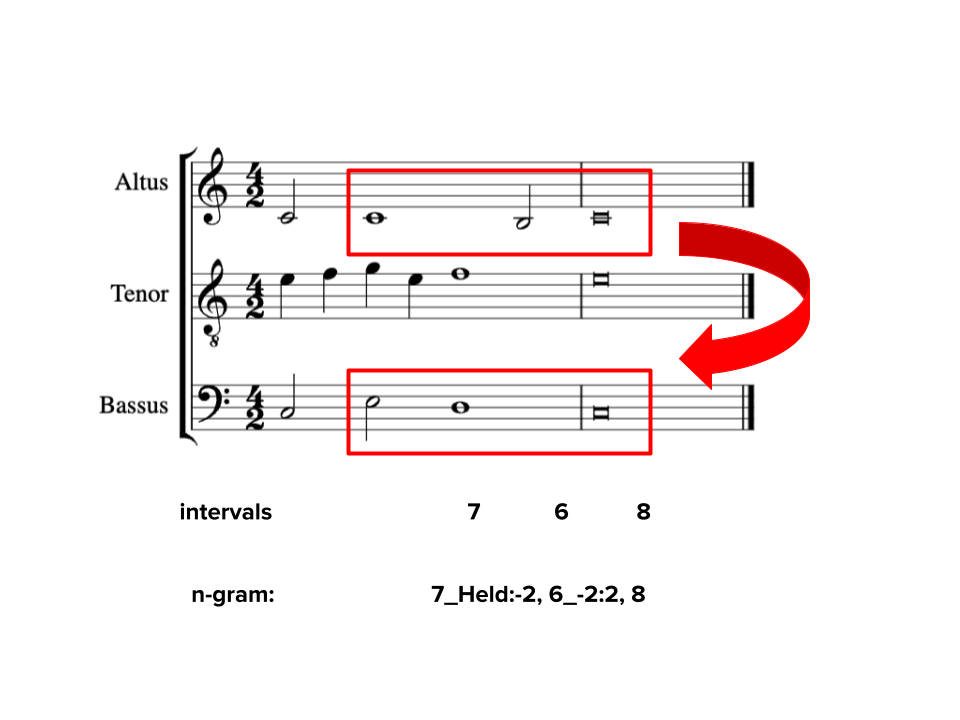
Example 2. from Morley_1597_129_5, showing a clausula vera, along with harmonic intervals and contrapuntal n-gram
Example 3, from O sleepe fond fancie, shows yet another instance of the classic type: a cantizans in the top voice, a tenorizans in the middle voice that moves up instead of down at the final perfection and a bassizans in the bottom voice. In Morgan’s parlance (and we agree), this is an evaded authentic cadence to F, with cadential voice functions of CtB.
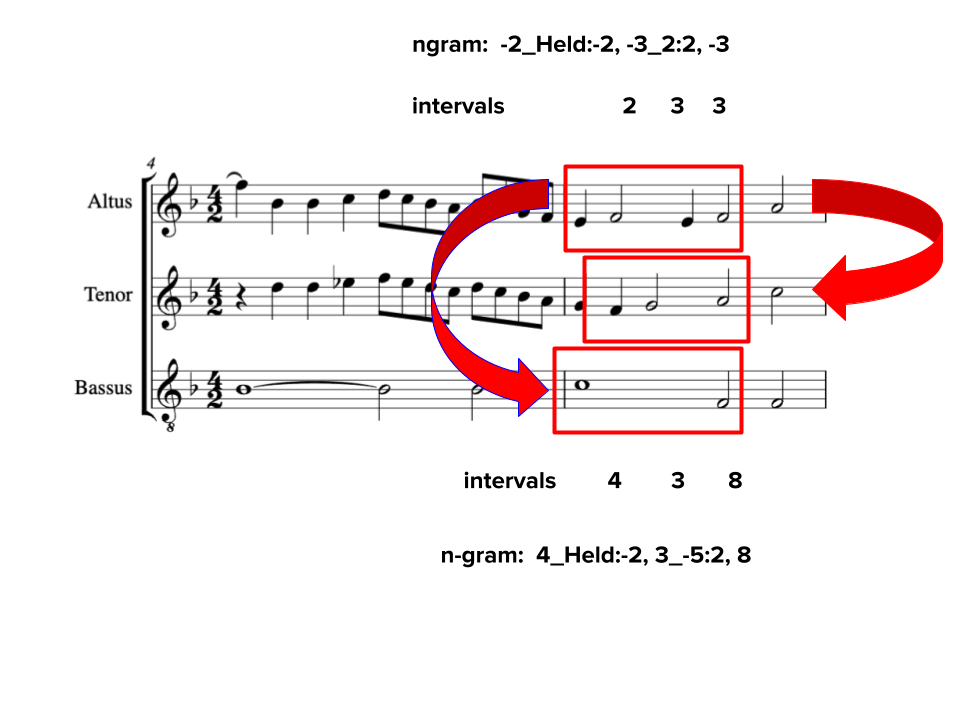
Example 3. Morley_1597_194, m. 5, with notation of harmonic intervals formed as the altus (Morley’s ‘cadence’) makes suspension formulas with the tenor and bassus. The basic harmonic intervals and the complete contrapuntal n-grams are shown for each pair.
But there are other ‘closes’—including ones that Morley explicitly cites as examples of ‘closes’—that cannot be found by the CRIM tool because they do not involve suspensions. The ‘close’ Morley_1597_127_5 (given above as Example 1 and repeated below with new annotations) was missed for a perfectly good reason: it is not a cadence as defined by the CRIM tool. The middle voice has a ‘cadence’ (it follows the same syncopated melodic pattern we observe in each of the previous examples) but the semibreve G never forms a dissonance with a voice below or above it. And without a suspension, Morgan’s cadence tool is deaf to the ‘close’ that then ensues. There is no suspension, but there is a ‘close’ with a ‘cadence’ (see Example 4).
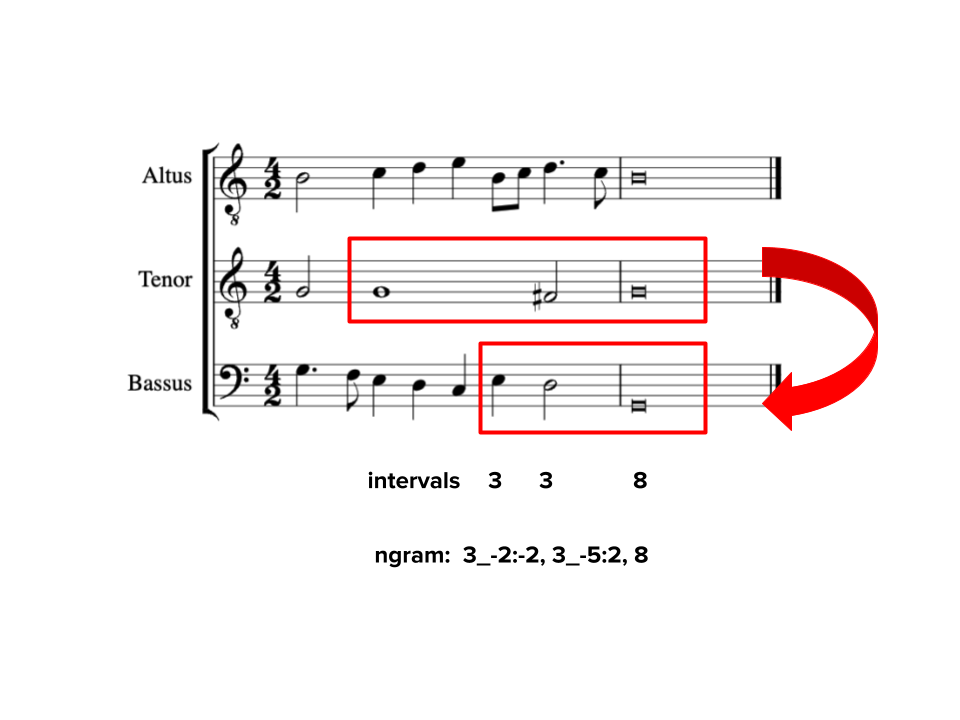
Example 4. Morley_1597_127_5, showing the ‘cadence’ (in the tenor) with annotation of intervals and n-grams for the tenor-bassus pair.
Finding Other Ways to Search for Morley’s Closes: The Freedman-Owens Cadence Tool
We realized, in brief, that we needed to find other ways to identify Morley’s ‘closes’ in all their variety. We began with the ‘closes’ that Morley explicitly identifies as such on pages 127-129 of his treatise, and with the three compositions (where we sometimes needed to make our own judgements about exactly where the ‘closes’ occurred). We produced a complete table of contrapuntal n-grams for each piece in turn, then located the structural pair for each close in each piece. Figure 3 shows the n-grams for Example 4 above, including the one between bassus and tenor that represents the ‘close’.
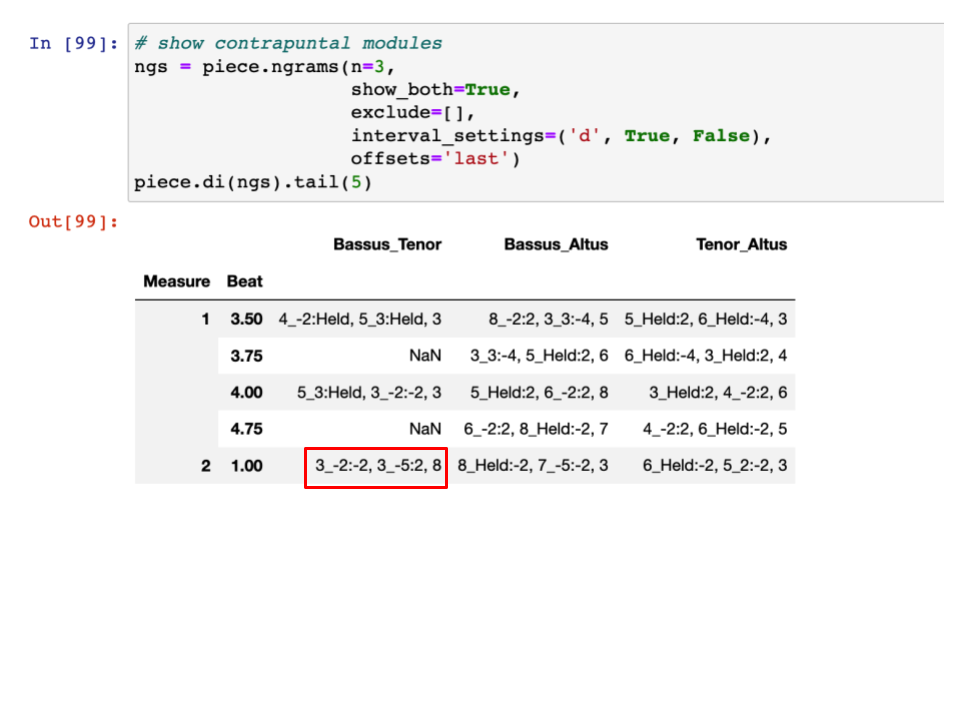
Figure 3. The contrapuntal n-grams for Example 4; with highlight indicating the n-gram that represents the ‘close’ between bassus and tenor.
Working through all of the ‘closes’ not found by Morgan’s method, we identified four main types, one of which we have already seen above (Morley 127_5 in Example 1 and 4).
Type 1 C’T’ no suspension (see Example 5)
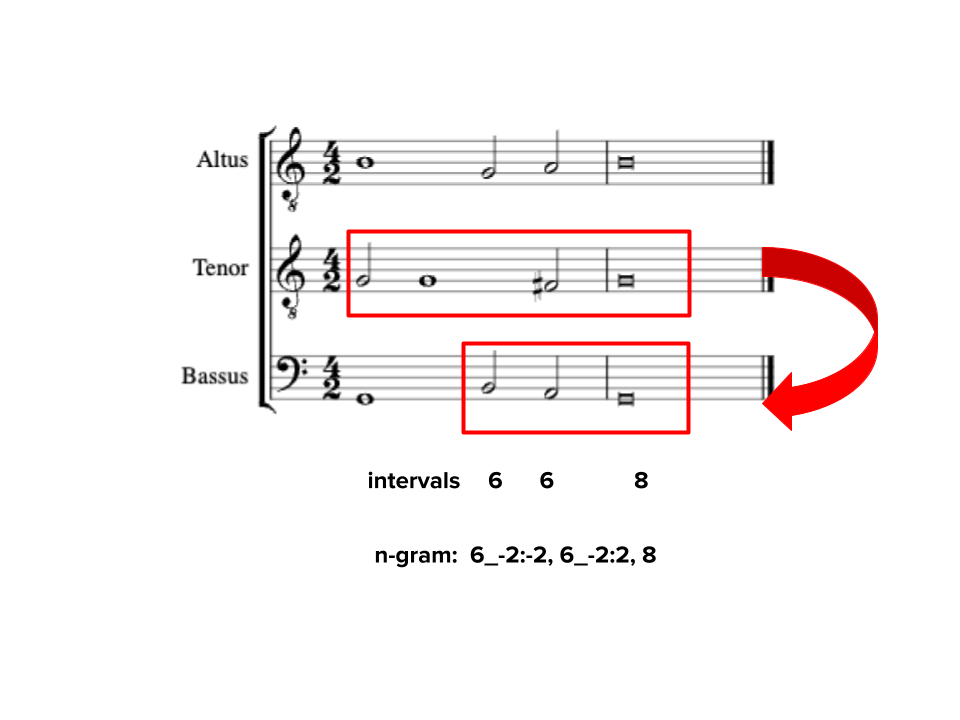
Example 5 Morley 128_04 ‘Close’ of the type C’T’, showing syncopated ‘cadence’ in tenor but no suspension in the bassus
This close has the ‘cadence’ in the middle voice but without a suspension. It is paired with the lowest voice that resembles a typical T in being a stepwise descent to the octave but without a suspension. The third (uppermost) voice is decorative. To avoid confusion between different kinds of voice functions, we use single quotation marks to differentiate ours from Morgan’s: our C’ is not the same as the usual C because there is no suspension and it would not have been identified as a C by Morgan’s cadence function in CRIM Intervals.
Type 2 C’B’ no suspension (see Example 6, also as Examples 1 and 4 above).
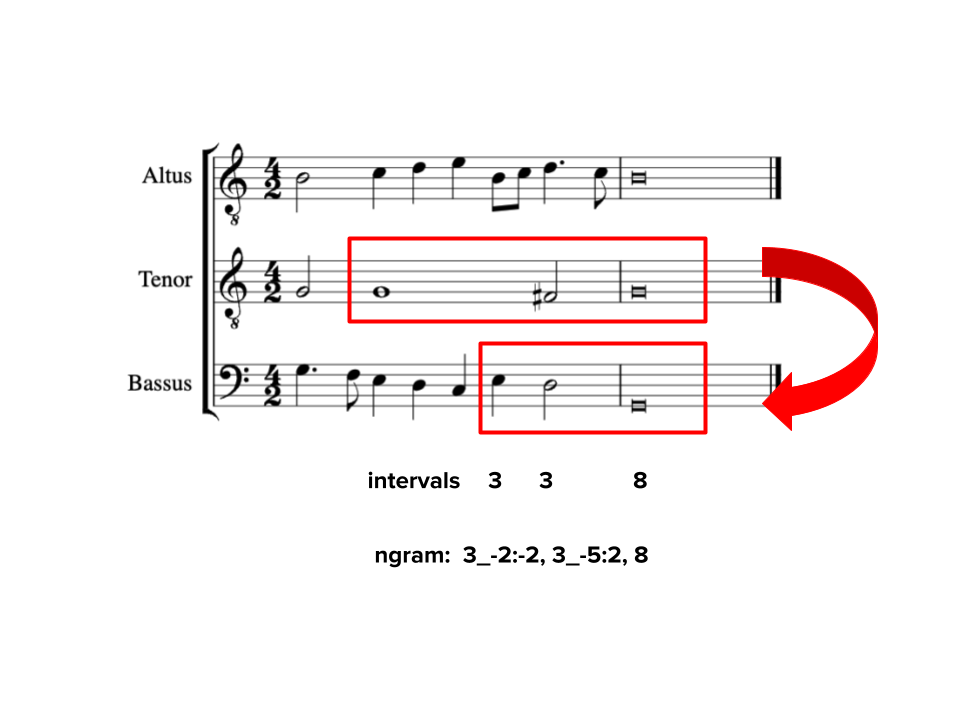
Example 6. Morley 1597 127_5, showing the ‘cadence’ (in the tenor) with annotation of intervals and n-grams for the tenor-bassus pair.
We label this ‘close’ “C’B’ no suspension.” The designation C’ (in the middle voice) indicates that it is not a traditional cantizans but rather the syncopated figure that Morley called essential for a ‘formal’ ‘close’. Similarly the designation B’ denotes a bassus that leaps down a fifth but without a suspension. It is perhaps redundant to add “with no suspension” given these definitions, but we are trying to draw attention to this essential feature. The top voice is decorative: there is no tenorizans. The structural elements in this kind of close are C’ and B’.
Type 3. C’B’ no suspension; B evades (see Example 7)
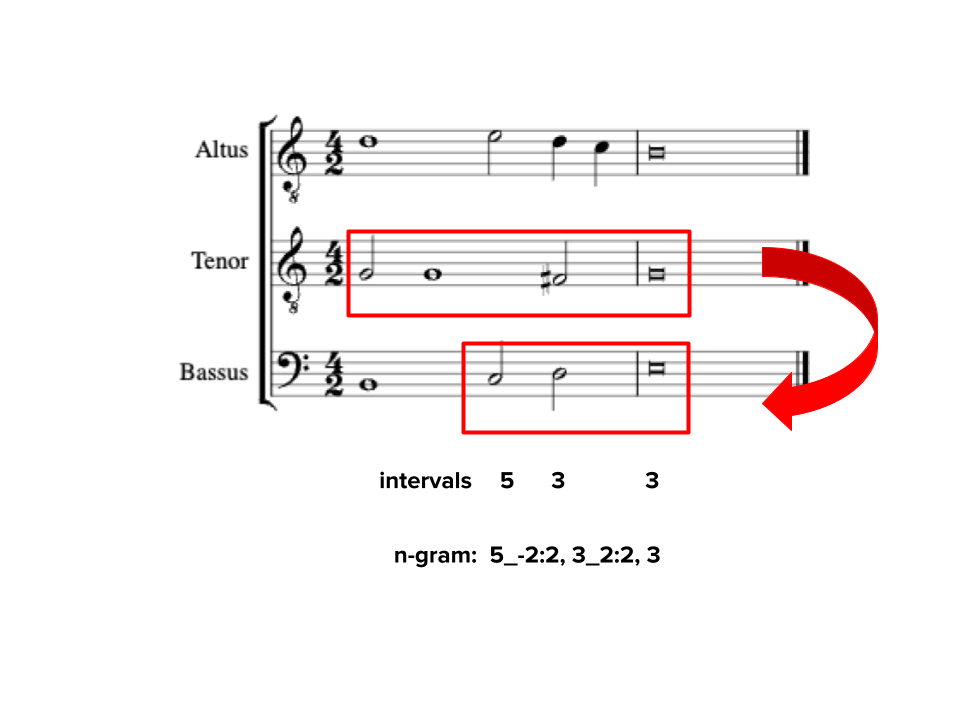
Example 7. Morley 1597 127_8, showing the ‘cadence’ (in the tenor) with annotation of intervals and n-grams for the tenor-bassus pair as the bassus forms what Morley would call a ‘passing’ or ‘false’ close’.
We call this type of ‘close’, “C’B’ with no suspension B evades.” It is a variant of “C’B’ with no suspension”: instead of leaping down a fifth, the B’ evades by moving stepwise to a pitch other than the expected cadence note, what we would call an evaded cadence. Morley explains ‘passing’ or ‘false close’, some of which he identified in the 1597 print with an asterisk (‘starre’). (We note that four of the three-voice ‘closes’ have asterisks: Morley_1597_127_8 [bassus stepwise up to the third below the final], Morley_1597_128_05 [bassus stepwise down to the sixth below the final], Morley_1597_128_06 [bassus stepwise up to the third], Morley_1597_128_10 [altus, in a decorative role, stepwise up to the sixth, discussed further below].
and as for those waies which here you see marked with a starre thus * they be passing closes, which we commonly cal false closes, being deuised to shun a final bend and go on with some other purpose (Morley 1597, 127)
He explains that there are two kinds of ‘passing closes’ in the bassus, ascending and descending; if descending, the bassus goes to the sixth, relative to the final tone of the close, if ascending to the tenth or third. (We are uncertain whether it is important to track the specific interval relative to the final or if simply designating these types of ‘close’ as evaded [‘passing’ or ‘false’] is sufficient.) They all proceed stepwise. In this instance (Example 7), with the ‘cadence’ in the middle voice, the bassus is moving stepwise up to the third below the cadence pitch (G) rather than by the expected leap down a fifth or up a fourth to make a perfect octave with the final note of the melodic ‘cadence’. For ‘closes’ that have the ‘cadence’ in the bassus, the altus or tenor makes a ‘passing close’ by ascending to the sixth or thirteenth and descending to the tenth or third, for example, in Morley_1597_128_10. (Morley 1597, 128)
Type 4. ‘Close’ without ‘cadence’ (with neither syncopation nor suspension; see Example 8)
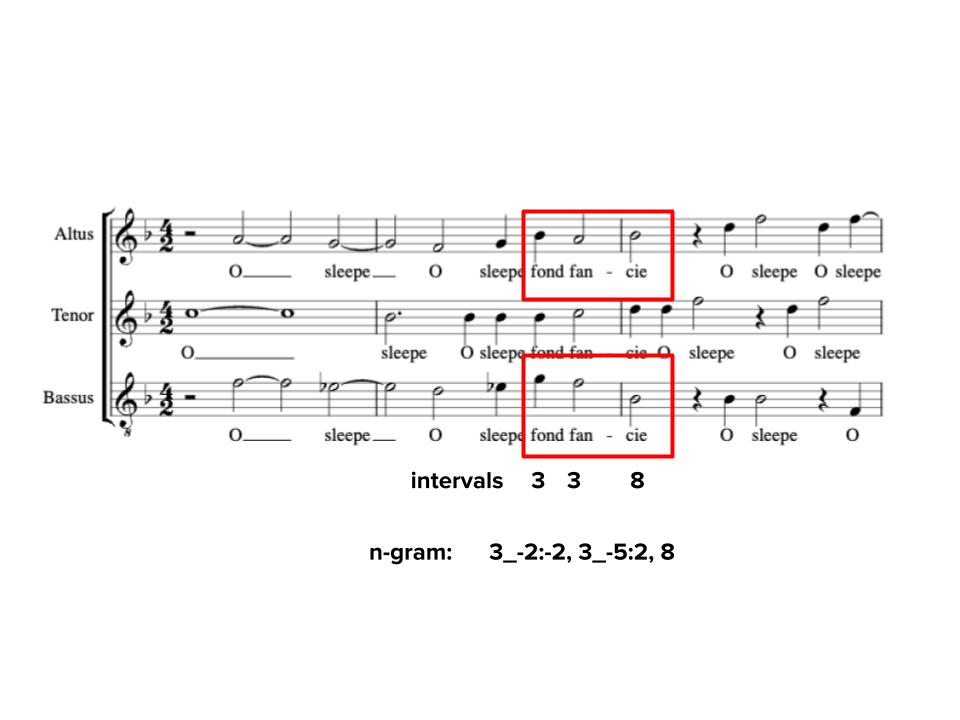
Example 8. A ‘close’ without a ‘cadence’, neither suspension nor syncopation, as seen in Morley 194, measure 3
Morley does allow a ‘close’ without a ‘cadence’ in some circumstances (he would consider it unformal, not formal). We call these “closes without a cadence.” Example 8, from O sleepe fond fancie, m. 3, achieves closure with the motion to the perfect octave in the altus and bassus, as chords on successive minims; the sense of closure is heightened by the arrival on an important beat (the beginning of m. 3), followed by a change in texture from chordal to imitative, and the beginning of a repeated textual unit. In our corpus this kind of ‘close’ occurs only three times (Morley_1597_194, m. 3 and m. 11; Morley_1597_068, m. 3), always in the compositions, and never in the examples of ‘closes’, all of which have a ‘cadence’ in one of the voices.
Evaluating Our Method for Detecting ‘Closes’
We next put these insights to work in CRIM Intervals. Each of our four types of ‘closes’ is characterized by a particular (or in some cases, more than one) contrapuntal n-gram, as seen in the examples above. We assembled these as a Python dictionary, with key and value pairs for each:
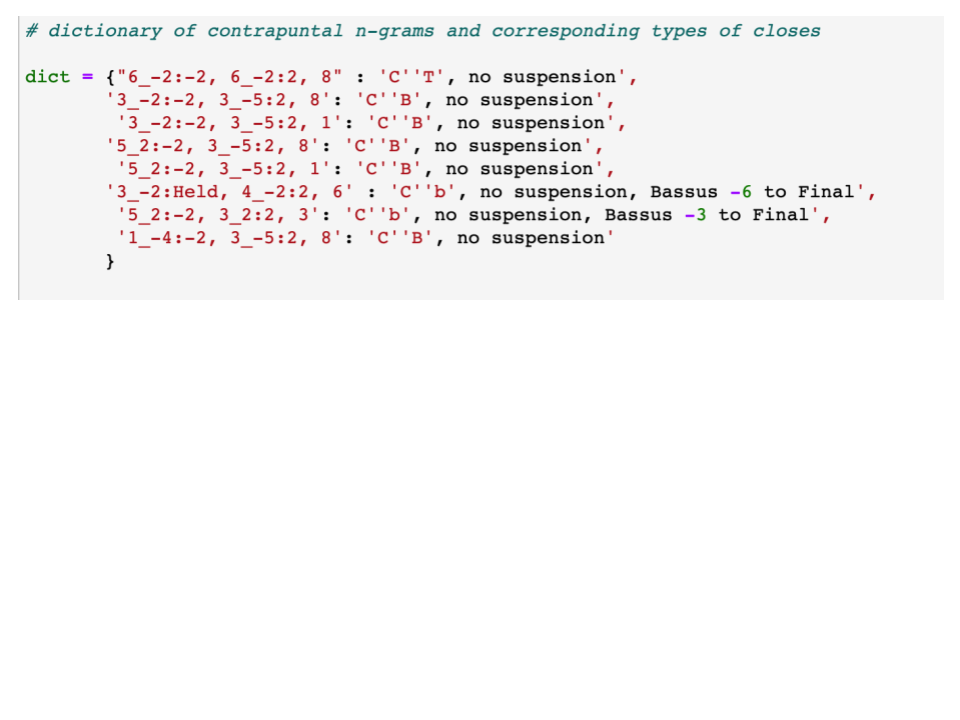
Figure 4 Key and value pairs of the ‘close’ classification in Freedman-Owens method.
For each piece in our corpus, we first create a dataframe of contrapuntal n-grams (diatonic intervals, with a length of “3”). These represent the n-grams for all the combinations of voice parts in the given piece (bassus-tenor, bassus-altus, and tenor-altus). The results are then masked according to the keys noted above. A new dataframe in turn represents each offset in each piece where one of these ‘closes’ is detected, along with the given value listed as the type. Figure 5 shows the results for one of the three-voice compositions, Morley_1597_068.
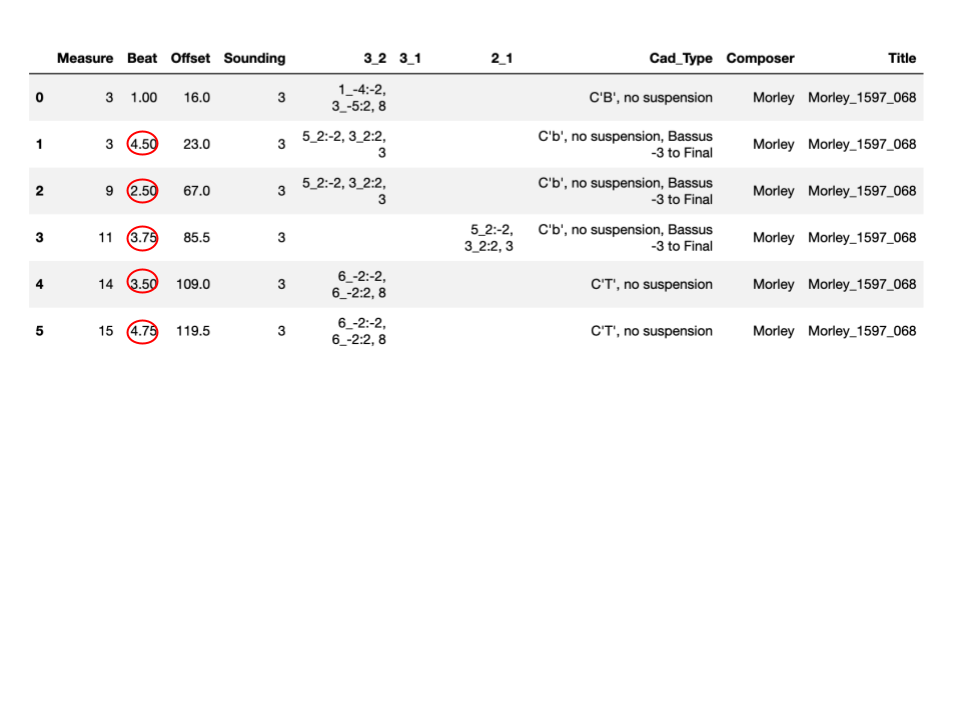
Figure 5 Sample results of ‘closes’ detected and labeled in a single piece (Morley_1597_068), according to the Freedman-Owens method. ‘Close’s in weak metrical positions are marked in red.
This was promising, since the patterns detected in almost every instance also found the ‘closes’ that we observed with human eyes (and ears). But there are also a considerable number of false positive results in these tables. ‘Closes’ (like cadences) have a strong metrical component to them, with the final perfection almost always coming at a strong beat (such as beat 1.0 or 3.0 in a 4/2 measure). One solution would be to filter out ‘closes’ that seem to arrive at beats other than these, or fractional beats, which were very unlikely to have been considered valid by Morley and his contemporaries, no matter that the underlying n-grams match those found in valid ‘closes’, either formal or otherwise. Filtering out cadences on weak beats might seem arbitrary, but it reminds us of the fundamental role of meter and accent in the entire process of closure. Morley’s ‘closes’ often lack suspension formulas, and so it makes sense that we might encounter the same n-grams in various contexts.
In any case, CRIM Intervals provides a ready way of testing this hypothesis. The piece.beatStrength() method created some time ago by Alex Morgan applies a rating already part of Music21 to rate each beat (or fraction of one) on a scale of 0 to 1. A downbeat is 1.0; the third beat of a measure is 0.5. Filtering the original results for events with a beat strength of 0.5 or higher easily eliminates ‘closes’ falsely detected at fractional beats, no matter where they occur in the measure (see Figure 6). This is by no means a perfect solution to the problem of the false positives, but seems reasonable for the three-voice repertory under consideration here.
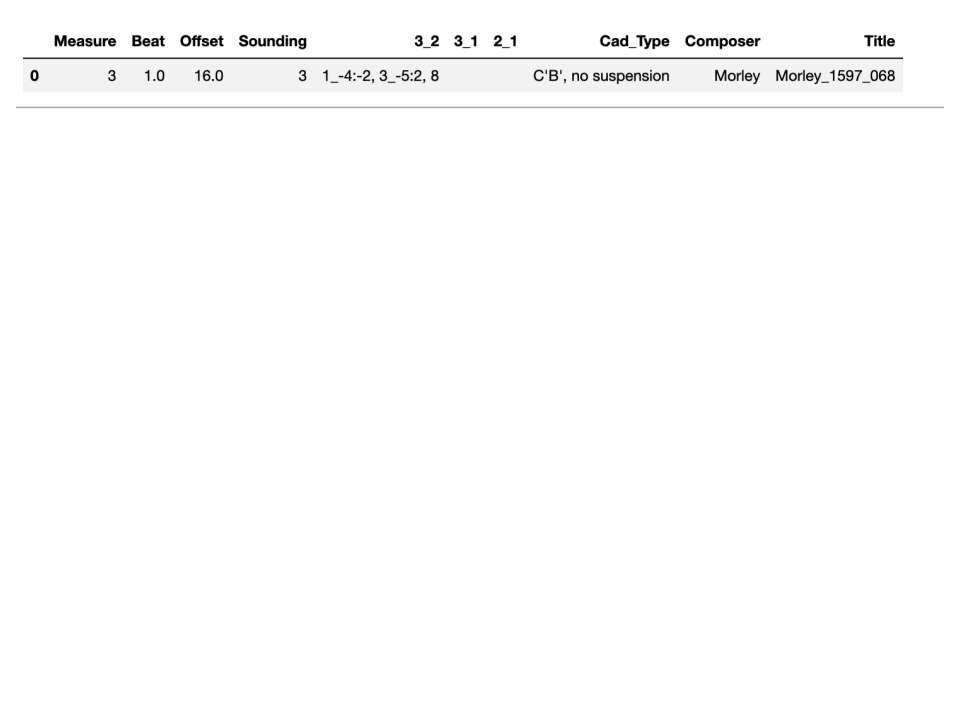
Figure 6 The results of Figure 6 for Morley_1597_068 now filtered to show only ‘closes’ with beat strength of 0.5 or greater.
Our next step was to analyze each piece with Morgan’s method, which might tell us where the two approaches complement, overlap or contradict each other. The results for the same piece considered in Figures 5 and 6 include no duplications (see Figure 7). Morgan’s method, as we have noted, is highly reliable in predicting and classifying suspension-type cadences. There are no false positives.
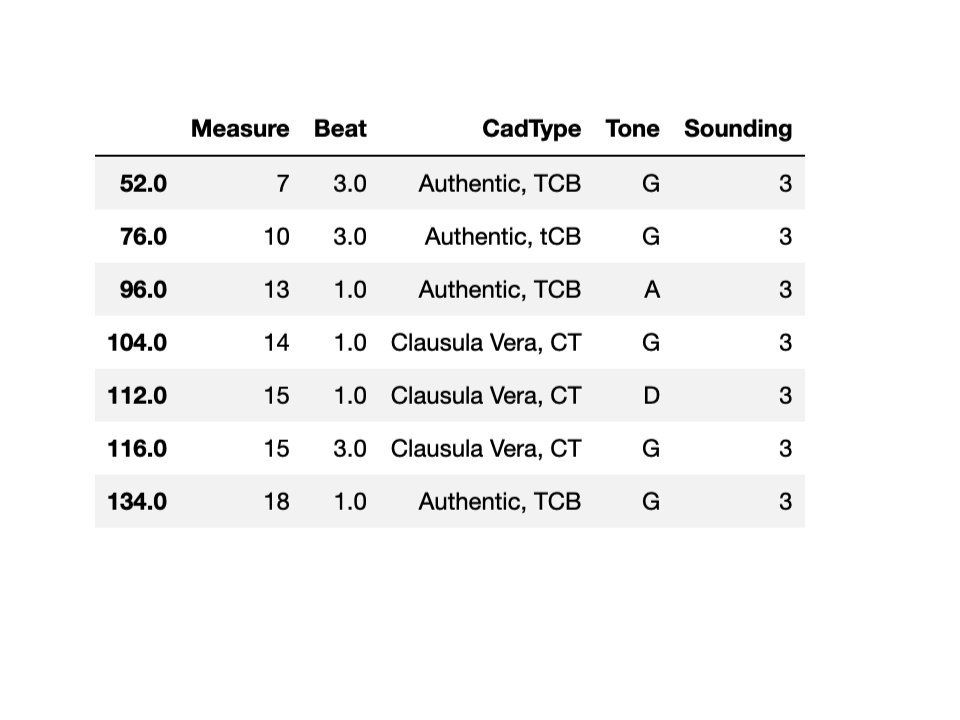
Figure 7. Cadences found with Morgan tool for the same piece shown in Figures 5 and 6. There are no overlaps between the cadences found with each method for this piece, Morley_1597_068.
Now prepared with these two complementary but different ways of classifying cadences and ‘closes’, we at last turn to the corpus as a whole. Roughly 25% of the 46 events found by the combined methods are Morley ‘closes’ (see the complete dataset in Table 2, and the graphical representation of the relative proportion of the identified types in Figure 8) That might seem a small proportion, given what we have noted about Morley’s views on these passages. But there is more to the story, for if we consider the top four types found by the combined methods (representing about 60% of the whole), we note that only one of these involves a regular suspension formula between cantizans and tenorizans (the type marked as Clausula Vera, CT in the chart, itself 17% of the whole). The remainder of these ‘top four’ are the Morley ‘closes’ in the strictest sense (C’B’, no suspension), and two sets of suspension cadences in which the tenorizans is the evading voice, leaving the work of closure to the syncopated ‘cadence’ and the bassus part. And if we add two other types of patterns that clearly fall within Morley’s model of a ‘close’ (the C’T’, no suspension, and the two C’b’ evaded forms without suspension), we find that about 50% of the 46 patterns that our combined methods found in the entire corpus favor pairings of the bassizans and a voice with the ‘cadence’, very often without suspension. Clearly Morley’s examples demonstrate that something important is afoot.
| Title | Measure | Beat | JAO_RF_CadType | Morgan Type | Tone | Sounding | Truth Status | Comments |
| Morley_1597_068 | 3 | 1 | C’B’, no suspension | G | 3 | True Positive | ||
| Morley_1597_068 | 7 | 3 | Authentic, TCB | G | 3 | True Positive | ||
| Morley_1597_068 | 10 | 3 | Authentic, tCB | G | 3 | True Positive | ||
| Morley_1597_068 | 13 | 1 | Authentic, TCB | A | 3 | True Positive | ||
| Morley_1597_068 | 14 | 1 | Clausula Vera, CT | G | 3 | True Positive | ||
| Morley_1597_068 | 15 | 1 | Clausula Vera, CT | D | 3 | True Positive | ||
| Morley_1597_068 | 15 | 3 | Clausula Vera, CT | G | 3 | True Positive | ||
| Morley_1597_068 | 18 | 1 | Authentic, TCB | G | 3 | True Positive | ||
| Morley_1597_127_3 | 4 | 1 | Authentic, tCB | G | 3 | True Positive | ||
| Morley_1597_127_3 | 6 | 3 | Clausula Vera, CT | C | 3 | True Positive | ||
| Morley_1597_127_3 | 8 | 1 | Authentic, CtB | C | 3 | True Positive | ||
| Morley_1597_127_4 | 2 | 1 | C’B’, no suspension | G | 3 | True Positive | Rival claims | |
| Morley_1597_127_4 | 2 | 1 | Evaded Clausula Vera, tC | G | 3 | True Positive | Rival claims | |
| Morley_1597_127_5 | 2 | 1 | C’B’, no suspension | G | 3 | True Positive | ||
| Morley_1597_127_6 | 2 | 1 | C’B’, no suspension | G | 3 | True Positive | ||
| Morley_1597_127_7 | 3 | 1 | Authentic, tCB | G | 3 | True Positive | ||
| Morley_1597_127_8 | 2 | 1 | C’b’, no suspension, Bassus -3 to Final | E | 3 | True Positive | ||
| Morley_1597_128_01 | 3 | 3 | Authentic, tCB | G | 3 | False Negative | ||
| Morley_1597_128_02 | 3 | 3 | C’b, no suspension, Bassus -6 to Final | A | 3 | True Positive | ||
| Morley_1597_128_02 | 4 | 3 | Clausula Vera, CT | G | 3 | True Positive | ||
| Morley_1597_128_03 | 2 | 1 | Authentic, CB | G | 3 | True Positive | ||
| Morley_1597_128_04 | 2 | 1 | C’T’, no suspension | G | 3 | True Positive | ||
| Morley_1597_128_05 | 2 | 1 | C’b, no suspension, Bassus -6 to Final | B | 3 | True Positive | Rival claims | |
| Morley_1597_128_05 | 2 | 1 | unknown, Cu | G | 3 | True Positive | Rival claims | |
| Morley_1597_128_06 | 2 | 1 | unknown, cz | unknown | 2 | True Positive | ||
| Morley_1597_128_06 | 4 | 1 | Authentic, tCB | G | 3 | True Positive | ||
| Morley_1597_128_07 | 2 | 1 | Authentic, tCB | G | 3 | True Positive | ||
| Morley_1597_128_08 | 1 | 2.33 | Evaded Clausula Vera, tC | G | 3 | True Positive | ||
| Morley_1597_128_09 | 1 | 2.33 | Quince, QC | G | 3 | True Positive | ||
| Morley_1597_128_10 | 1 | 2.33 | Evaded Clausula Vera, tC | G | 3 | True Positive | ||
| Morley_1597_128_11 | 1 | 2.33 | Abandoned Clausula Vera, zC | G | 2 | True Positive | ||
| Morley_1597_128_11 | 2 | 3 | Quince, QC | G | 3 | True Positive | ||
| Morley_1597_128_11 | 3 | 3 | Evaded Clausula Vera, tC | G | 3 | True Positive | ||
| Morley_1597_129_1 | 2 | 3 | Clausula Vera, CT | C | 3 | True Positive | ||
| Morley_1597_129_2 | 2 | 1 | Clausula Vera, CT | C | 3 | True Positive | ||
| Morley_1597_129_3 | 2 | 3 | C’B’, no suspension | C | 3 | True Positive | Rival claims | |
| Morley_1597_129_3 | 2 | 3 | Evaded Clausula Vera, tC | C | 3 | True Positive | Rival claims | |
| Morley_1597_129_4 | 2 | 3 | Authentic, CtB | C | 3 | True Positive | ||
| Morley_1597_129_5 | 2 | 1 | Clausula Vera, CT | C | 3 | True Positive | ||
| Morley_1597_129_6 | 3 | 1 | Authentic, CtB | G | 3 | True Positive | ||
| Morley_1597_194 | 3 | 1 | C’B’, no suspension | B- | 3 | True Positive | ||
| Morley_1597_194 | 5 | 3 | Authentic, CtB | F | 3 | True Positive | ||
| Morley_1597_194 | 9 | 1 | Authentic, CtB | F | 3 | True Positive | ||
| Morley_1597_194 | 11 | 3 | C’B’, no suspension | B- | 3 | True Positive | ||
| Morley_1597_194 | 15 | 1 | Authentic, tCB | F | 3 | True Positive | ||
| Morley_1597_194 | 18 | 1 | Authentic, CtB | F | 3 | True Positive | ||
| Morley_1597_194 | 20 | 1 | Authentic, tCB | F | 3 | True Positive |
Table 2. Summary of Cadences and Closes in Morley’s 3-voice examples and pieces. The instance in Morley_128_01 is a False Negative–missed by both the Morgan and Freedman-Owens methods
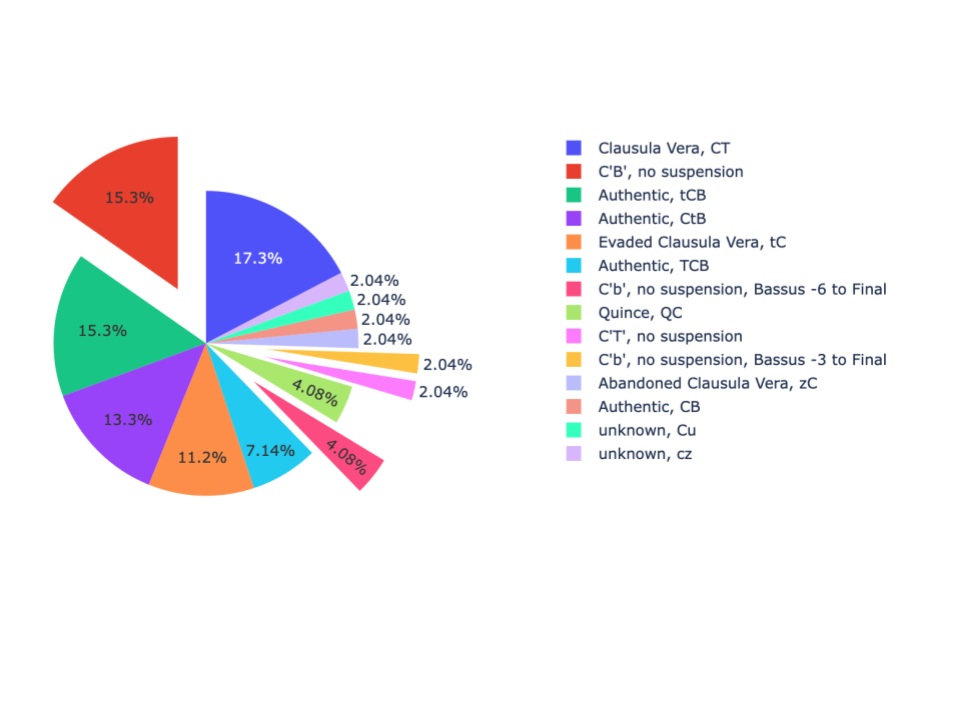
Figure 8. Pie chart showing relative proportion of cadences and ‘closes’ identified by the two methods. The ‘closes’ found by the Freedman-Owens method are pulled out from the rest of the diagram, which shows the cadences found by Morgan’s method. The False Negative identified in Table 2 above is not included in this diagram.
“You say cadence, I say … ‘close’”
The two methods complement each other well: only three of the 46 passages were tagged by both approaches (see highlights in Table 2, above). These rival claims are nevertheless important in the ways they illuminate alternative explanations for the same contrapuntal structures. Put another way, the CVFs identified by Morgan and the roles that we discern through our Morley-centric approach represent two ways of explaining the same sounds. Let us begin by considering the three examples identified by both methods: Morley_1597_127_4, Morley_1597_129_3 and Morley_1597_128_05.
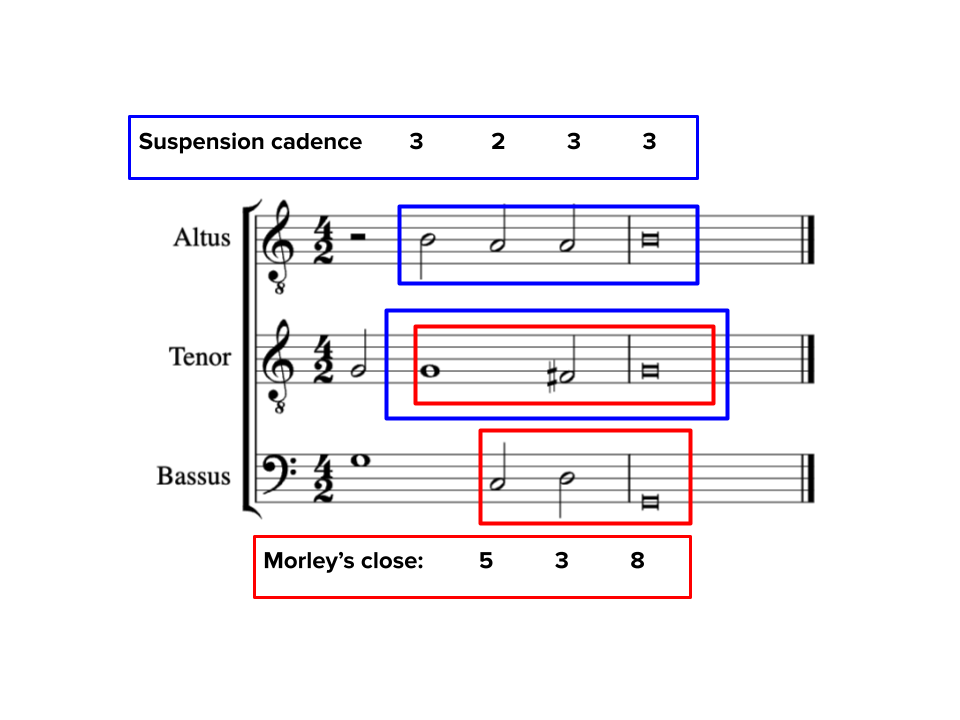
Example 9. Morley_1597_124_4, showing two ways of understanding the same passage.
The Morgan cadence tool identifies Example 9 as “tC”: a tenorizans in the top voice evading to the upper third and a cantizans in the middle voice; the bassus plays no structural role. The Freedman-Owens tool identifies it as “C’B’ no suspension.” The tenor (C’) has the ‘cadence’, which is syncopated but not suspended in relation to the bassus. The Morgan tool sees the altus as an evaded tenorizans, while the Freedman-Owens tool imagines that the altus is decorative, supplying the third in the final sonority, and the bassus (B’), ignored by Morgan, as a structural voice.
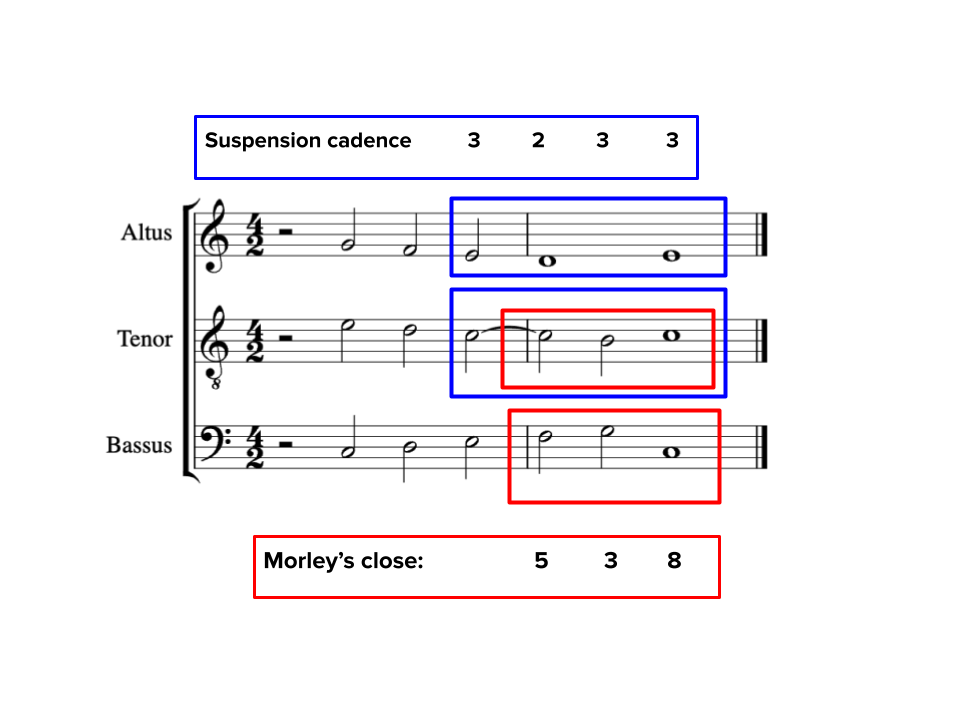
Example 10. Morley_1597_129_3, showing two ways of understanding the same passage.
The Morgan cadence tool identifies Example 10 as “tCB”: a tenorizans in the top voice evading to the upper third, a cantizans in the middle voice, and a bassizans in the bassus. The Freedman-Owens tool identifies it as “C’B’ no suspension.” The tenor (C’) has the ‘cadence’, which is syncopated but not suspended, that is, from the perspective of the tenor-bassus pair. The difference between the two approaches is the role of the altus: in the Morgan tool, it is an evaded tenorizans, in the Freedman-Owens, it is decorative, supplying the third in the final sonority.
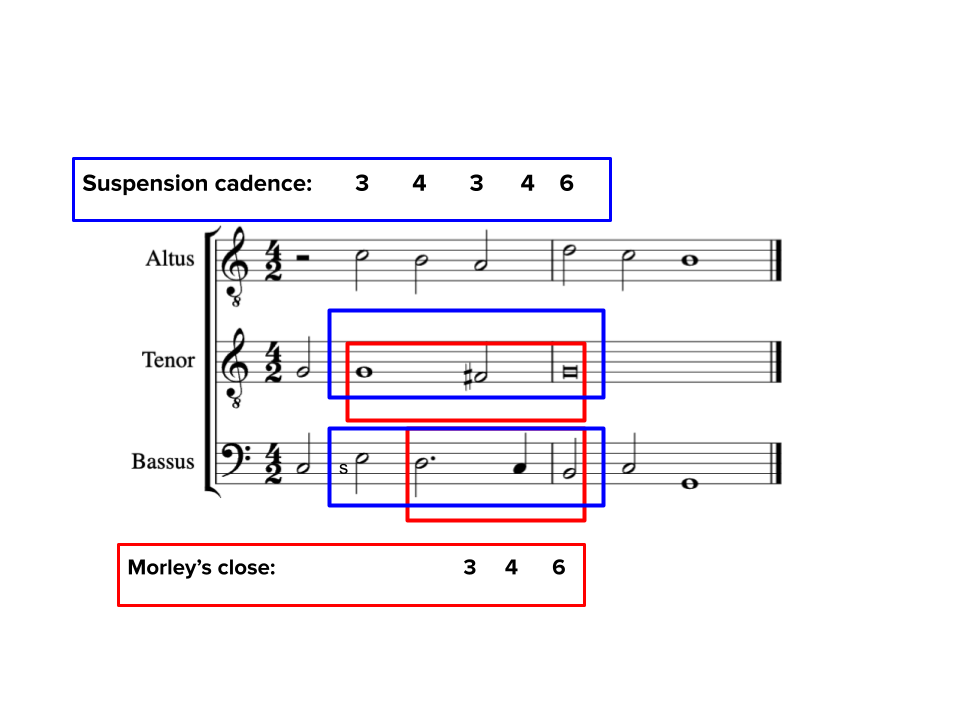
Example 11. Morley_1597_128_5, showing two ways of understanding the same passage.
The Morgan cadence tool identifies this example as “Cu”: a cantizans in the middle voice and a bassus that evades by moving down a third, forming a sixth below the final tone in the tenor at the start of the second measure. The Freedman-Owens tool identifies it as “C’B’ no suspension, B evades.” The tenor (C’) has the ‘cadence’, which is syncopated but not suspended. The bassus evades by moving stepwise to the sixth below the final note of the ‘close’; the altus, which might have supplied the third that is now sounded by the bassus, instead leaps to the upper fifth; both altus and bassus then move into their expected places for the final sonority. In this case, the two methods yield identical results though with different conventions of naming.
Two other examples offer further insights into the different ways of understanding cadences/’closes’. Both are identified by Morgan but not by Freedman-Owens: Morley_1597_194, m. 5 and Morley_1597_128_10.
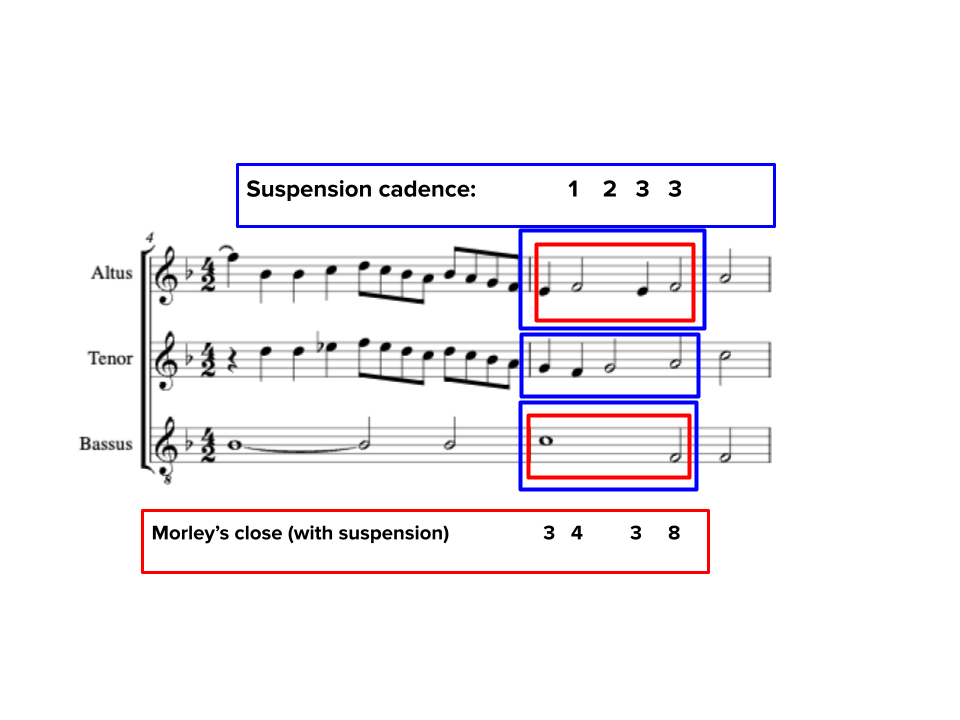
Example 12. Morley_1597_194, m. 5, showing two ways of understanding the passage
Morgan labels the cadence from O sleepe fond fancie given in Example 12 with the functions CtB, which seems entirely correct from the standpoint of the suspension model. We suspect that for Morley the focus was on the ‘cadence’ in the altus and its structural partner the bassus, hence a “CB with suspension.” in this example, as in others we have just considered, the tenor, in Morley’s bass-centric world, is not a true tenorizans but is decorative, supplying the third.
Morley includes Example 13 among the ‘closes’ that have the ‘cadence’ in the bassus. How should we explain his thinking?
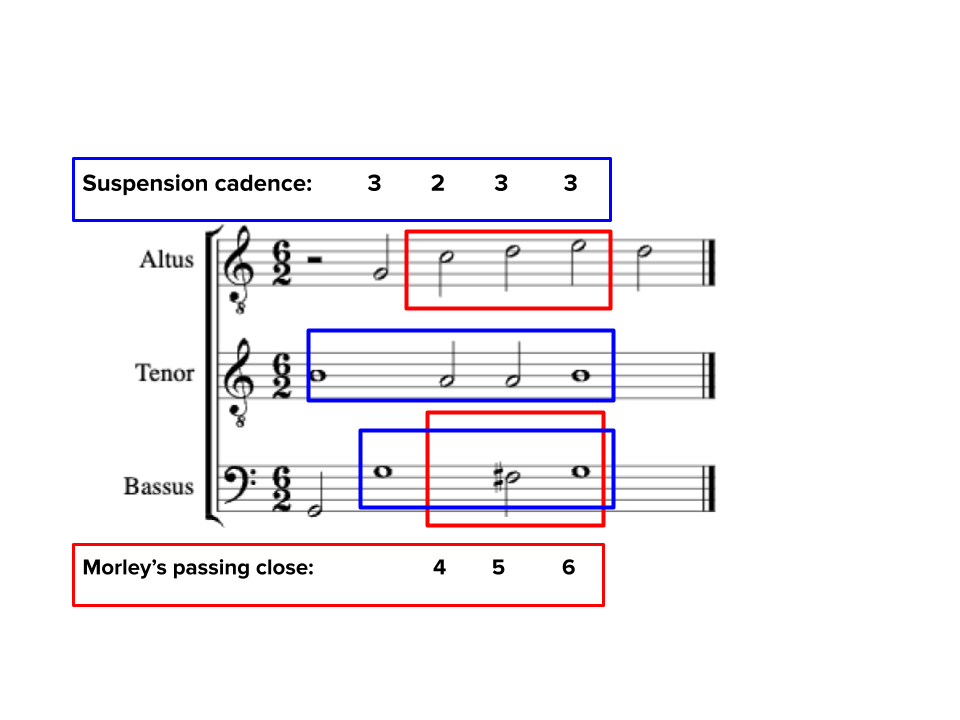
Example 13. Morley_1597_128_10, showing two ways of understanding the same tones.
Because it has a suspension it is readily discovered by the Morgan cadence tool: the tenor (tenorizans) evades the cadence by moving to a B rather than to the unison G, hence the designation “tC.” (The Freedman-Owens method does not currently identify this pattern.) Morley also hears it as an evaded ‘close’, adding an asterisk to denote that it is a ‘passing’ or ‘false’ ‘close’, explained above. For Morley, however, it is the altus voice that is evading, moving stepwise up to the E rather than by leap down to G. His focus is on the interval above the final of the ‘close’, a sixth, as well as on the passing or stepwise motion. Heard from the standpoint of the suspension-based cadences classified in Morgan’s method, the evading voice is not fulfilling the expectation of its role (in this case, tenorizans) but nonetheless making a kind of cadence. Heard from Morley’s vantage point, in contrast, the ‘close’ has a ‘cadence’ in the bassus and in this case a voice that should be acting like a bassus (the altus) instead “shun[s] a final bend.”
As a group these examples underscore the distinctive ways in which Morley both explains and exemplifies ‘closes’. In his world, the ‘cadence’ (the syncopated figure with or without a suspension) is both a signal of and a necessity for a ‘close’, certainly for a formal ‘close’. His decision to call the syncopated gesture ‘cadence’, however, means that he has no names for the characteristic gestures of the other structural voices, those behaving like either a tenor or a bassus. It is clear that the ‘cadence’ can join with either a bassus (moving by leap) or a tenor (moving stepwise).
In sum our analysis of the frequency of the types identified by the Freedman-Owens method shows a striking preponderance of ‘closes’ that combine a voice that has the ‘cadence’ and a voice that takes on the role of the bassus (10): only once does the second structural voice behave like a tenor. The Morgan method also shows a preference for authentic (i.e., with bassizans), 18, over clausula vera, 13. These numbers no doubt partly reflect the exigencies of three-voice texture (the third has to be supplied, hence the large numbers of ‘t’ in the Morgan CVF) but they also signal a genuine move away from a clausula vera, contrapuntal conception to one that hears the pairing of the syncopated ‘cadence’ and bass.
Morley Reads Tigrini
Every reader of Morley’s treatise must contend with the reality that he drew on many different sources, often interpolating entire passages,more often than not with little or no acknowledgment. (Owens forthcoming) This is also true of many of his examples of ‘closes’. As early as the time of Charles Burney (Burney 1789, vol. 3, p. 100)) Morley’s readers recognized that he had taken (Burney’s word was “pillaged”) many of his ‘closes’ from Orazio Tigrini’s 1588 counterpoint treatise, Il compendio della musica, and he has been roundly criticized for these unacknowledged “borrowings.” Recently even more ‘closes’ have been identified, as being drawn from compositions by Marenzio and other composers. (Blackburn forthcoming) In addition Megan Long has considered the five-voice Morley-Tigrini cadences as part of her investigation of plagal cadences (Long 2022). While there are clear points of agreement, her methods are quite different from ours.
Figure 9 shows the six ‘closes’ that conclude Morley’s discussion of three-voice ‘closes’.
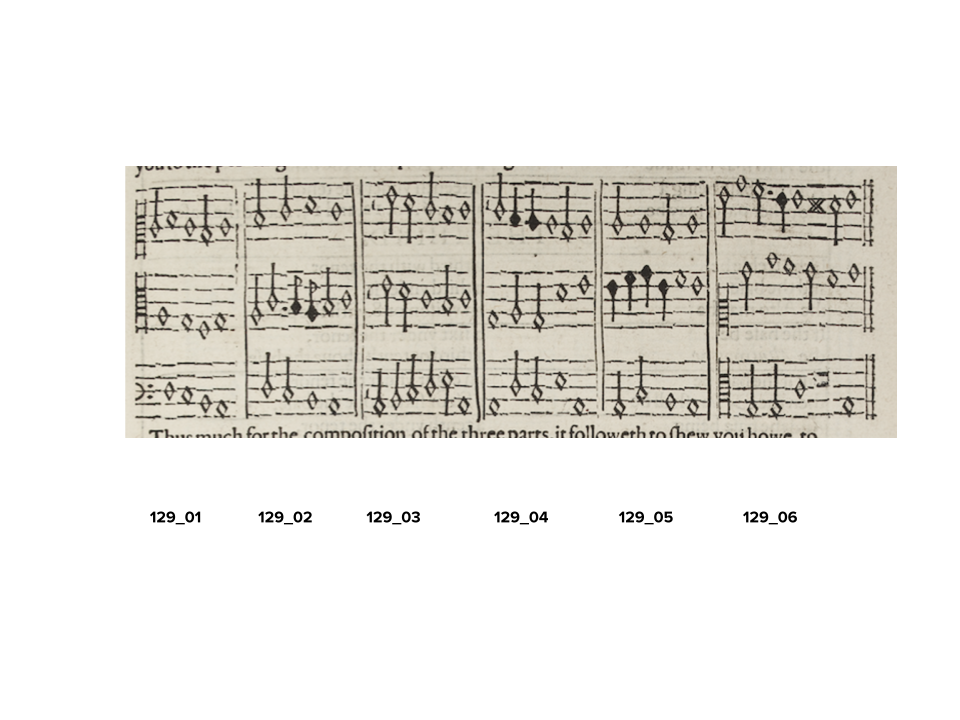
Figure 9. Morley 1597, 129, Six three-voice ‘closes’
The first five come directly from Tigrini; a source for the last one, 129_06, has not been identified. Morley turned three cadences given by Tigrini into five ‘closes’ (see Figure 10). The boxes show notes that he omitted, the circles notes that he repeated. These truncations and expansions do not alter Tigrini’s counterpoint: Morley simply sees an opportunity in Tigrini’s long examples to create two extra ‘closes’.
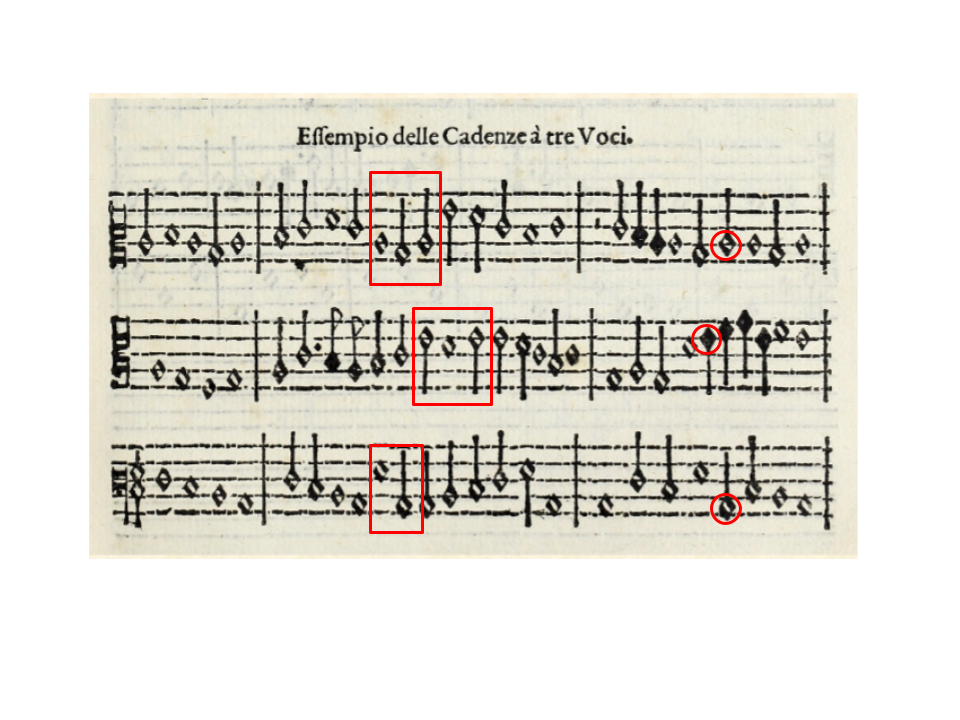
Figure 10 Tigrini 1588, “96” [recte 79], three cadences, with passages reworked by Morley (see Figure 9) marked in red.
Morley intended all six of these ‘closes’ to illustrate the ‘cadence’ in the altus. However, as mentioned above, two of them (Morley_1597_129_2 and Morley_129_3) have the ‘cadence’ in the tenor instead of the altus. Was Morley simply grabbing something in haste without noticing the discrepancy between his explanation and the ‘closes’ he provided?
We can’t be sure that the other ‘closes’ in our corpus–the ones not by Tigrini–were composed by Morley, given his magpie-like tendencies. And yet there is clearly visible in these examples a distinctive way of making ‘closes’ that Morgan’s cadence tool sometimes can’t find. The ‘closes’ identified only through the Freedman-Owens method–let’s call them Morley ‘closes’–may represent English practice. It is surely significant that all of the ‘closes’ taken from Tigrini are readily identified by the Morgan tool. (One of the Tigrini examples, Morley’s 1597_129_3, is found by both cadence methods.) From this analysis we learn to be cautious about seeing every t or T as a tenorizans and to pay attention to the prominent role of the voice behaving like a bass whether or not it is involved in a suspension.
We deliberately restricted ourselves to a small and idiosyncratic corpus (three-voice examples or compositions in Morley’s 1597 treatise) in order to test both our methods for identifying ‘closes’ without suspensions and our assumptions about the roles of voices. Clearly, a number of possibilities for further work remain. It would be interesting to know, for instance, how the ‘closes’ explored in this essay figure in the four-, five-, and six-voice passages found elsewhere in Morley’s treatise. And it would also be interesting to know whether collections like his Canzonets to Three Voices of 1593 use ‘closes’ no less than conventional suspension cadences in anything like the proportion we have found here.
While we await those studies, however, it seems worth noting how the changes underway in Morley’s treatise are more than just stylistic. Yes, the ‘closes’ and the traditional cadences represent different contrapuntal structures. But from the standpoint of Morley’s treatise they are not just a new way of making closure, but a new way of explaining how closure comes about. And in that sense his views are part of what Thomas S. Kuhn famously called a shift in paradigm: how the same phenomena could be explained in different ways. Kuhn’s argument, of course, centered on issues of cosmic scale: the rival views of the geocentric and heliocentric solar systems that raged in the years around 1600. Musicians, too, as Gary Tomlinson demonstrated, were caught up in debates about rival ways of explaining their medium, as we witness in the Monteverdi-Artusi controversy about the status of music in relation to number and text.
Morley’s rethinking of Tigrini seems of miniscule importance by comparison with such concerns. But the parallel seems apt: the sound of these passages was not in question; how to explain them was. Similarly, the stages of estimation, investigation and evaluation we traversed in creating digital rules to find Morley’s ‘closes’ (even when they intersected with patterns that Alex Morgan’s cadence classifier) reminded us that our assumptions often shape how we explain the evidence before us. The digital tools, in short, have helped us to listen. But they have also forced us to reflect on how we know what we know in the first place.
Bibliography
Bergwall, E. 2023. “Cadential structures in English sixteenth-century instrumental music: using CRIM Intervals to analyze an In Nomine corpus.” CRIM Essays and Explorations, ed. Richard Freedman. Haverford College and CRIM Project.
Blackburn, B. J. (forthcoming) “Morley and Italian Theory.” In Thomas Morley, A plaine and easie introduction to practicall musicke (London, 1597), ed. J. Milsom and J.A. Owens. DIAMM Publications.
Burney, C. 1789. A General History of Music from the Earliest Ages to the Present Period, vol. 3.London.
Cohen, D. E. 2001. “‘The Imperfect Seeks Its Perfection’: Harmonic Progression, Directed Motion, and Aristotelian Physics.” Music Theory Spectrum 23: 139-169.
Herissone, R. 2000. Music Theory in Seventeenth-Century England. Oxford University Press.
Kuhn, T. S. 1962. The Structure of Scientific Revolutions. University of Chicago Press.
Long, M. K.. 2022. “Reassessing the Plagal Cadence in Byrd and Morley.” MTO 28. Reassessing the Plagal Cadence in Byrd and Morley
Morgan, A.; Russo-Batterham, D.; Freedman, R. 2022. “Musicologists and Data Scientists Pull out all the Stops: Defining Renaissance Cadences Systematically.” Paper presented at the Music Encoding Conference, 18-22 May, 2022, Halifax, Canada, and CRIM Essays and Explorations, ed. Richard Freedman. Haverford College and CRIM Project.
Morgan, A. 2023. “Automated Detection of Renaissance Cadential Voice Functions and Cadences.” CRIM Essays and Explorations, ed. Richard Freedman. Haverford College and CRIM Project.
Morgan, A. 2016. Renaissance Interval-Succession Theory: Treatises and Analysis. Ph.D. diss., McGill University.
Morley, Thomas. (forthcoming). A plaine and easie introduction to practicall musicke. Edited by J. Milsom and J. A. Owens. DIAMM Publications.
Morley, Thomas. 1597. A plaine and easie introduction to practicall musicke. London: Peter Short. Digital images from DIAMM https://www.diamm.ac.uk/sources/4039/#/
Owens, J. A. 2022. “Thinking about Cadences: Vicentino, Tigrini, Morley.” Nicola Vicentinos ‘Musica pratticabile’, Musik-Academie Basel, 24–26 November 2022.
Owens, J. A. (forthcoming). “Morley and his Sources.” In Thomas Morley, A plaine and easie introduction to practicall musicke (London, 1597), ed. J. Milsom and J.A. Owens. DIAMM Publications.
Schwind, E. 2009. Kadenz und Kontrapunkt. Zur Kompositionslehre der Klassischen Vokalpolyphonie. Olms.
Tigrini, Orazio. 1588. Il compendio della musica. Venice: Ricciardo Amandino. Digital image: Gallica http://catalogue.bnf.fr/ark:/12148/cb31469712j; edition: TMIweb https://tmiweb.science.uu.nl/text/reading-edition/tigcom.html
Tomlinson, G. 1990. Monteverdi and the End of the Renaissance. University of California Press.