The Curious Case of Tomás Luis de Victoria: A Window into His Self-Borrowing in His Missas O quam gloriosum and O magnum mysterium
Maura Sugg (Case Western Reserve University)
Introduction
Among the many composers who wrote imitation Masses in the sixteenth century, Tomás Luis de Victoria (1548-1611) presents a peculiar case. An iteration in the centuries-long tradition of using familiar music in new settings, the imitation Mass involves the reworking of polyphonic compositions, such as motets and chansons, into the five movements of the Catholic Mass Ordinary (Kyrie, Gloria, Credo, Sanctus/Benedictus, and Agnus Dei). Because these Ordinary texts remain constant from day to day, the imitation Mass can be a way to inject the service with additional levels of variety, interest, and intertextual meaning. Although composers approached this practice in different ways, there were common elements that composers like Giovanni Pierluigi da Palestrina championed and theorists like Pietro Cerone later codified. But unlike Palestrina and other mid- to late-sixteenth-century figures, Victoria stands out for his relatively limited output, his use of almost exclusively sacred models, and the high percentage of Masses he based on his own models. With the tools that the CRIM Project has developed, I am using this essay as a start to my exploration of the patterns and techniques in Victoria’s self-borrowed imitation Masses, which I hope will ultimately unlock a deeper understanding of the interpretive dimension of these works. By comparing some aspects of his Missas O quam gloriosum and O magnum mysterium, two four-voice Masses based on models from the same book of motets, I have begun to identify idiosyncrasies that point to the need for further investigation beyond the present essay. CRIM is and will continue to be an essential part of this investigation because of its capacity for systematic macro- and micro-level analyses.
Victoria’s Self-Borrowing: Why Does It Matter, and What Do We Already Know?
Victoria’s biography and the nature of his compositional output suggest a thoughtful, inventive approach to the imitation Mass. Born in Ávila, Spain, in 1548, Victoria spent much of his childhood as a choirboy at the Ávila Cathedral before moving to Rome in 1565 to join the Jesuit Collegium Germanicum. There, he undertook ecclesiastical, theological, and musical studies, and his involvement with the institution shifted over time from student to teacher (Cramer 2001: 234-5). While in Rome, Victoria also developed connections with churches associated with Spanish communities within the city, Jesuit confraternities, and even became an ordained priest (O’Regan 1994, 2000). In 1587, he returned to Spain, where he served as private chaplain to the Habsburg Empress María of Austria, organist for the Descalzas Reales convent, and chapelmaster for the convent’s adjoining priests’ and boys’ choir (Cramer 2001: 264). Over the course of his musical and ecclesiastical careers, Victoria composed works in a variety of sacred genres, including Masses, motets, antiphons, Magnificats, hymns, lamentations, psalms, and Requiems, which would have covered occasions throughout the liturgical calendar (Huff 2015: 196-218).
Three noteworthy things about Victoria’s publications stick out: he only wrote sacred music, he self-published his music, sending prints out in mass mailings and expecting payment in return, and he reprinted many of his works multiple times (Huff 2015: 177-218). In the context of Victoria’s biography, what these signal to me is that he was both a devout Catholic and a strategic businessman, both of which the project of self-borrowed imitation Masses support. On a practical level, publishing Masses based on his own models that he reprinted several times was a marketing tool to reinforce his reputation and guarantee financial success. On a deeper level, Victoria could have also encoded theological messages in his musical borrowing. Because he rearranges his models’ materials in his Masses by taking sections out of order and recombining motives in interesting ways, Victoria opens up the potential for intertextual interpretation on the part of his singer-listeners, who would have been familiar with the models and could make connections between their theological ideas and those of the Mass depending on where in the Mass the borrowed material appears. If this was the case, it carries cultural weight in the context of the Counter-Reformation, and we could consider Victoria as playing a part in the larger initiative of reinforcing Catholic doctrine during the last quarter of the sixteenth century.
Other scholars have noted the pervasiveness of Victoria’s self-borrowing, which occurs not only in his imitation Masses but also among other works, lending credence to the need for a thorough examination of his borrowing techniques. Eugene Cramer has found connections between the Masses in the 1592 Missae … Liber secundus (Cramer 2001: 22-60), looking at the relationships between the Masses and their models as well as those between the different Masses themselves. Further, he has also highlighted polyphonic material shared among parts of Victoria’s Lamentations and motets (Cramer 2001: 61-118). Rather than suggesting explicit intertextual resonances that may arise from these borrowings, he instead uses his analysis to argue that frequent self-borrowing is a hallmark of Victoria’s style. Owen Rees takes this a step further in his recent study of Victoria’s Officium defunctorum for Empress María, finding specific contrapuntal modules, cadential gestures, and melodic contours that recur and even hold special significance for celebrating María’s legacy (REES 2018: 117-208). One thing that stands out about both Cramer’s and Rees’s analyses is that they deal with short snippets of harmonic and melodic materials. In many cases, Victoria does not borrow entire passages wholesale and transplant them into new contexts, but instead chooses concise yet recognizable fragments to reuse multiple times. Perhaps this is why the study by Patrick Brill, a dissertation dealing with all of Victoria’s imitation Masses, falls short of adequately capturing the nuances of Victoria’s borrowing techniques (Brill 1995). In an attempt to see how Victoria’s approach adheres to Cerone’s rules (which were not even published until after Victoria’s last works) and to root it in melodic borrowing, Brill identifies melodic themes and their variations in each of the models and searches for where they appear in the Masses. But, because these themes are typically long phrases and because Brill only focuses on melodic rather than polyphonic borrowing, he misses many instances of borrowing that do not fit his parameters.
Where CRIM Comes In
Given the insights, shortcomings, and gaps that the current research provides, I believe that the CRIM Project can be a helpful tool for reassessing the relationship between Victoria’s imitation Masses and their respective models. CRIM’s various Jupyter notebooks offer tools to isolate multiple different types of similarity, and they allow customizable searches for the length and characteristics of the kind of similarity at hand. CRIM has also been instrumental in developing precise, consistent vocabulary to describe Renaissance counterpoint and musical relationships—something that is lacking in Victoria scholarship and in the literature on Renaissance musical borrowing in general. In applying CRIM’s resources to Victoria’s self-borrowing in his imitation Masses, I am seeking to eventually investigate a number of questions: Does his approach to borrowing change over time, and if so, how? Is there a pattern to where in the Mass Victoria includes music from the model, and do these places have theological significance or textual similarities? Are some kinds of similarity easier to detect than others, and what is the experience like for the singers and listeners who might recognize those similarities? The present essay is only a small start at addressing these questions; my larger goal is to incorporate CRIM’s tools and vocabularies into my dissertation, which will involve much more thorough, extensive, and contextualized analyses of Victoria’s imitation Masses based on his own models.
For this essay, I chose to look at two Masses and their models that I thought had potential for fruitful comparison. Both models, the O quam gloriosum est regnum and O magnum mysterium (henceforth O quam and O magnum, respectively, for short), first appeared in the same 1572 Motecta publication and were reprinted several times in subsequent publications, which suggests a high likelihood that the people and institutions that owned Victoria’s music would have been familiar with them. Both models also have short texts (the O quam for the Feast of All Saints and the O magnum for the Feast of the Circumcision), four voices, and finals on G, albeit in different modes. Victoria first published the Missa O quam in his 1583a Motecta, meaning the mass began to circulate just over a decade after the model. The Missa O magnum hails from the 1592 Missae … Liber secundus, nearly another decade after the Missa O quam and twenty years after the model. These Mass-model pairs can therefore give us a sense of how Victoria takes two pieces from the same publication and transforms them into Masses at different points in his compositional career. In experimenting with CRIM’s tools, I quickly discovered that there was much to discuss by applying only a few Jupyter notebooks to the models and even just one or two movements from the derived Masses. Because of this, I am presenting slivers of analysis to give a taste of what CRIM can help us find in Victoria’s Mass-model pairs.
I ran both Mass-model parts through a number of CRIM notebooks to try to understand how Victoria’s borrowing works in these pairs. Some of the tools were helpful on a macro level, while others shed light on the pieces’ finer details. My process of inquiry involved trial and error, requiring me to become more fluent with CRIM’s tools and vocabulary by exploring an array of options for analysis. At first, I tried out notebooks to find presentation types, cadences and cadential progress, melodic and contrapuntal nGrams, and homorhythm. The more the CRIM team updated and improved the notebooks, the more options there were to play with. Presenting all the results at once can be overwhelming, especially when not all of them seem to have immediate significance. Except for occasional gestures to other notebooks, I am therefore focusing on three tools that include digestible data visualizations: both the Melodic and Module Similarity Matrices (in the CRIM_Combined_Reports_12_2022 notebook), and the Melodic nGram Maps (in the CRIM_02d_Melodic_nGrams_Map notebook). I applied the matrix tools to both Mass-model pairs and the melodic nGram maps to the Missa O quam’s Kyrie, Gloria, and model and the Missa O magnum’s Kyrie and model. Although I am not looking closely at all of the Mass movements or doing interpretive work here, I believe that my findings reveal some of the nuances of Victoria’s writing and support the need for further work.
O quam gloriosum est regnum and Its Mass
To get a basic macro-level overview of the relationship between the Missa O quam and its model, I used the Melodic and Module Similarity Matrix tools. These can show the degree of similarity between the model and each movement of the Mass that arise from shared soggetti and contrapuntal modules that occur at entries (i.e., after a rest or section break). A caveat to using this tool is that it does not capture the full scope of shared material in Victoria’s music, or at least in this Mass-model pair. As CRIM’s Presentation Types notebooks attests, Victoria has a penchant for long fugas in this piece. Many of the fugas entries do not occur after a rest, meaning that any search limited to entries will not detect every voice in the fuga. Further, the high degree of body flexing that Victoria uses makes it more difficult to pick up the nuances of his melodic borrowing. While these facets of Victoria’s style mean that the Similarity Matrix tools will not detect every instance of a shared soggetto or contrapuntal module, the tools still provide a handy overview of the general strength of the connection between the Mass and its model.
As the description for the Melodic Matrix states:
This method returns a “driving distance table” showing how likely each model was a source for each mass. This is represented by a score 0-1 where 0 means that this relationship was highly unlikely and 1 means that the the two are highly likely to be related in this way (or that a piece was compared to itself). Specifically, the value is the percentage of each piece’s thematic (i.e. recurring) melodies can be found as thematic melodies in all the other pieces in your corpus. The specific number of times they appear in the model is not considered, provided that it is at least two. (emphasis in original)
For O quam and the Mass, there is a definitive ranking of similarity between the model and each of the Mass movements in terms of shared melodic nGrams (Figure 1). The nGrams in the Kyrie are derived exclusively from the model, with a correspondence score of 1. This is not much of a surprise, given that the Kyrie is the first movement in the Mass and thus helps to clearly announce the model near the top of the liturgy. It is also the shortest movement with the fewest words, which reduces the potential redundancy of borrowing from a relatively short model for each section. The order of similarity proceeds as follows: Kyrie, Agnus Dei, Gloria, Credo, Sanctus. Although it made sense to see that the Agnus Dei was the second-closest related to the model, it was surprising to find that the percentage of nGrams derived from the model was only 62%. Considering that the Agnus Dei is also a short tripartite movement like the Kyrie, I thought there might be more symmetry in terms of how much was derived from the model, and perhaps how similar the Kyrie and the Agnus Dei are to each other. The other short movement, the Sanctus, is the one least-related to the model when it comes to nGrams—yet another surprising result. Although beyond the scope of this essay, it would be worth investigating if there are other measures of similarity besides nGrams that we can use to describe the relationship between the Sanctus (or any of the Mass movements) and the model.
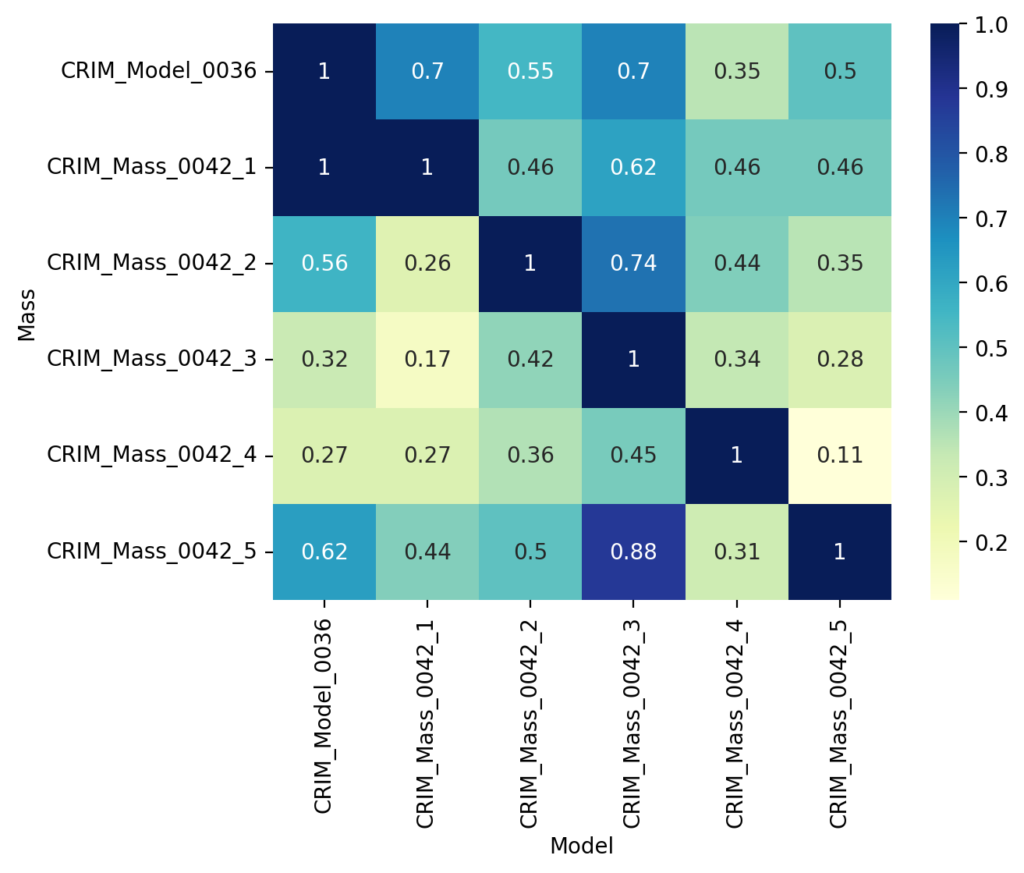
Figure 1. Melodic Matrix showing the percentage of melodic material at entries in the Missa O quam movements (CRIM_Mass_0042_1-5) derived from the O quam model (CRIM_Model_0036) and from each other. Reading across each row gives the percentage derived from the corresponding column.
Another curious feature that this matrix draws attention to is how much the material in the Credo is related to the other Mass movements. The Agnus Dei has the closest similarity to the Credo, but this is followed closely by the Gloria. Further, the Credo is also the movement to which the Sanctus has the greatest correlation. Yet, only about one third of the nGrams in the Credo are drawn from the model, which suggests that Victoria is not only using the O quam gloriosum est motet as a model, but is creating a cohesive whole by reusing newly introduced material within parts of the Mass itself.
The Module Matrix works similarly to the Melodic Matrix, looking instead for the contrapuntal patterns between two voices. Applying this tool to O quam and its Mass, the connection between the model and the Mass movements does not appear to be as strong as it was when considering shared melodic entries (Figure 2). As with the melodic nGram analysis, the Kyrie has the highest correlation, with about half of the Kyrie’s modules at entries matching those of the model, and the Sanctus has the lowest with only 18%. Otherwise, the other movements relate to the model and to each other with less than 30% correlation in most cases. This suggests that even when there is similarity between nGram entries from a purely melodic standpoint, Victoria alters the counterpoint enough to create new modules. Closer hand or computer-assisted analysis would help determine what kinds of changes these are (duration between entries? order of voices in entries? different presentation types? flexed nGrams? etc.).
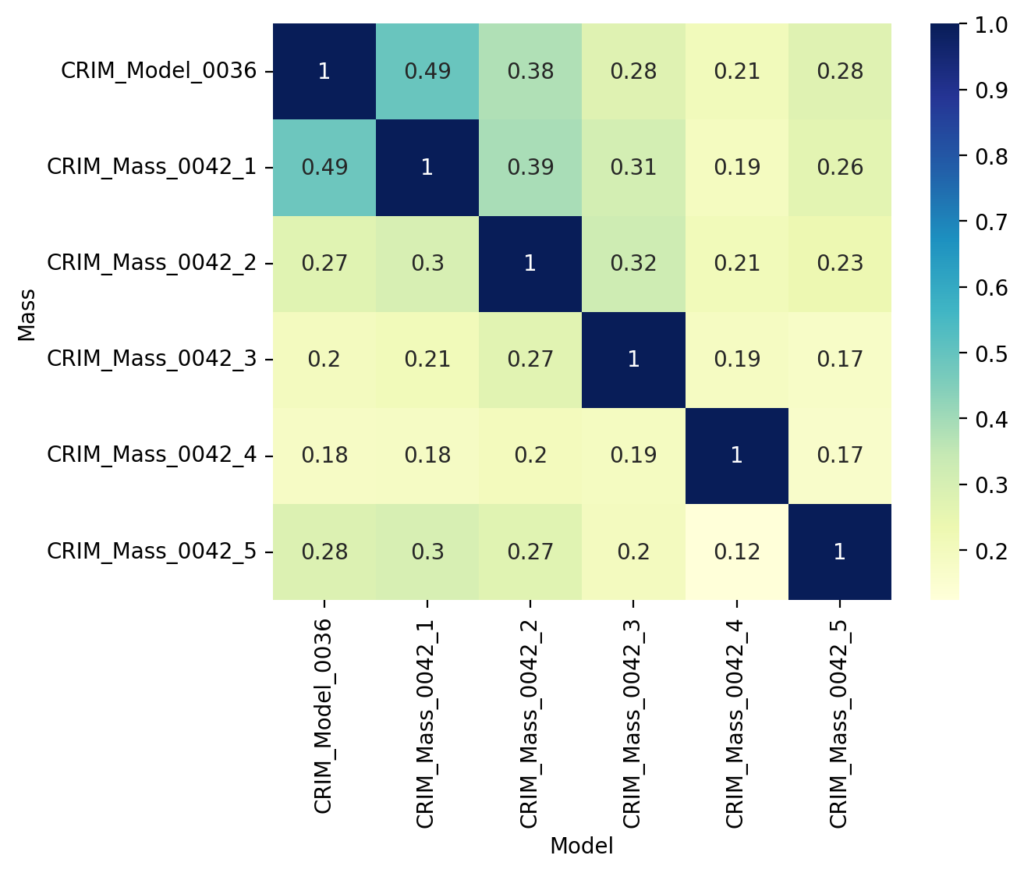
Figure 2. Module Matrix showing the percentage of shared contrapuntal material at entries in the Missa O quam movements derived from the model and the other Mass movements (read the same way as the Melodic Matrix in Figure 1).
Other the nGram mapping tools can further illuminate the nature of this these measures of similarity on a more detailed level. The original nGram Heatmap tool (in the Heatmaps_Notes_Ngrams notebook) is a helpful first step because it is interactive and easy to manipulate. However, it has the same drawback as the Matrix tools for looking at Victoria’s music; limiting to entries misses fuga voices, and not limiting to entries outputs visualizations that are difficult to parse because of the saturation of results (Figure 3). A happy medium is the tool in the updated Melodic nGram Maps tool, which does not limit to entries but looks for thematic soggetti (the first of which still must enter after a rest) and can directly compare the model with each individual Mass movement. This eliminates some of the visual clutter in the data and makes it easier to see more precisely where and how melodic nGrams appear.
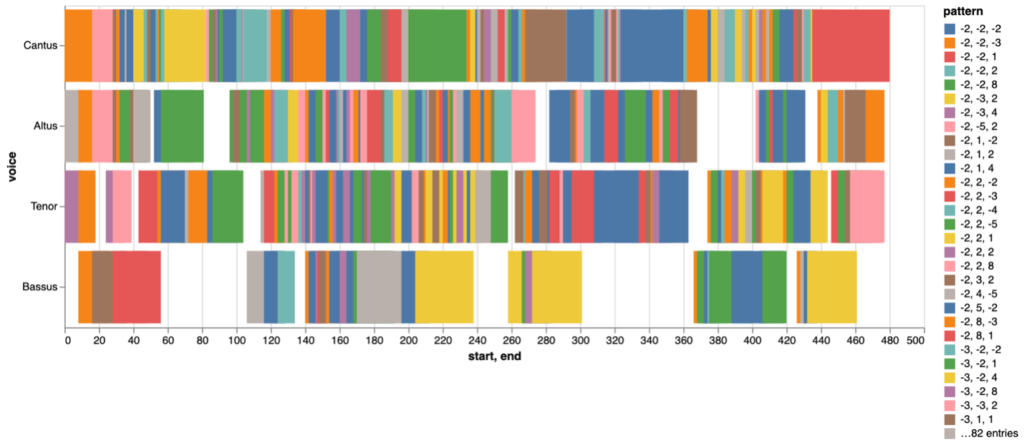
Figure 3. Map of melodic nGrams in O quam (using the Melodic nGram Heatmap tool without thematic finder, where n=3, unisons are combined, and results are not limited to entries).
With n=3, the updated tool with the thematic finder identified a few main soggetti in O quam (Figure 4) Not all of these are necessarily significant in every instance; stepwise motion (‘2, 2, 2’ and ‘-2, -2, -2’), for instance, is a feature of Renaissance compositional style. When we compare the model to the Mass movements, we can start to see which sets of nGrams Victoria chooses to borrow. In the Kyrie, for instance, which we know from the matrix has a very strong correlation to the model, we find that Victoria takes the double fuga complex of ‘4, 2, 2’ and ‘4, -2, 2’ from close to the beginning of the model (offsets 70-130), the ‘-2, -2, -2’ fuga from the middle (offsets 275-370), and the ‘-3, 2, 2’ fuga from the end (offsets 370-end) as the three main parts of O quam to incorporate into this Mass movement (Figure 5). Although there is some variation, the general order of entries in these fugas remains the same, making the connection between the Kyrie and model particularly strong. Two observations stick out: Victoria does not seem to use the striking opening complex of the model in the Kyrie, and he rearranges the main section of the model, placing the material from the end of O quam in the Christe and the middle of the model in the second Kyrie. Already, this signals that Victoria is taking some liberties with transforming the model into the Mass, and the rest of the movements are a testament to this.
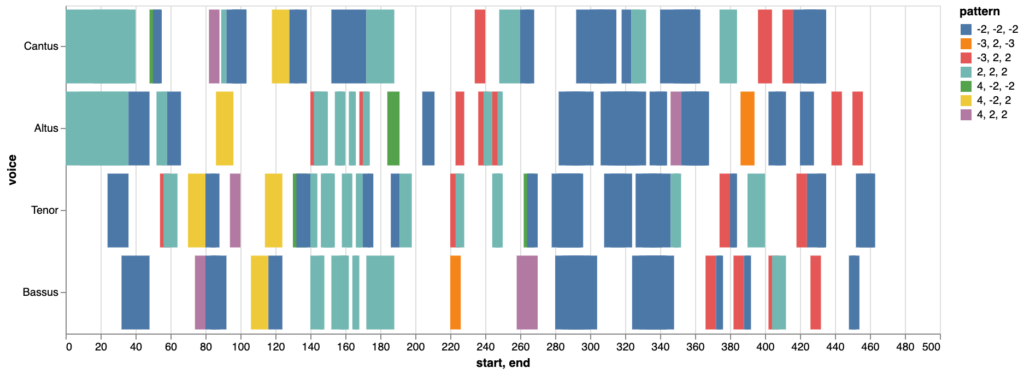
Figure 4. Map of melodic nGrams in O quam (using the Melodic nGram Maps tool with thematic finder, where n=3 and unisons are combined).
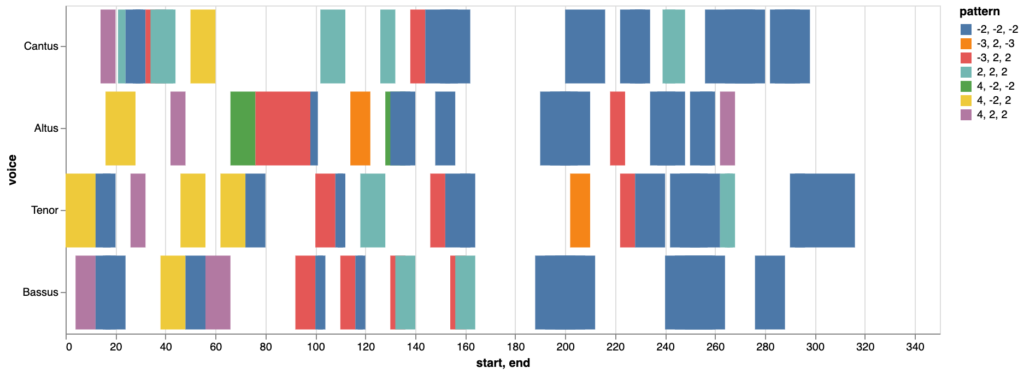
Figure 5. Map of melodic nGrams in the Missa O quam Kyrie derived from the O quam model (using the Melodic nGram Maps tool with thematic finder, where n=3 and unisons are combined).
These liberties are even more apparent in the Gloria, in which Victoria takes the short, recognizable soggetti from the model and sprinkles them throughout the movement, rather than preserving full polyphonic complexes (Figures 6 and 7). Ascending stepwise motion opens the movement in a contrapuntal duo between the tenor and bassus, both a transformation of melodic lines from within the model’s opening homorhythmic material and a nod to the scalar motion that appears frequently throughout the piece. The soggetti that CRIM’s tool detected, ‘4, -2, 2,’ ‘-2, -2, -2,’ and ‘-3, 2, 2’ are the same ones that appeared in the Kyrie, but here they do not remain in the context of the original fuga structures. Instead, Victoria reorders and recombines them, creating a series of phrases that are simultaneously familiar and novel. In a few key places, however, the fugas from the model appear mostly intact. This first occurs between offsets 300-350, which closely matches the end of O quam and signals the end of the first part of the Gloria at the words “Fililus Patris.” The second is around offsets 550-625, which corresponds to the middle of O quam and creates emphasis on the text “Tu solus Altissimus, Jesu Christe.” Finally, the end of the Gloria draws from the double fuga near the beginning of the model, with particular emphasis on the ‘4, -2, 2’ nGram.
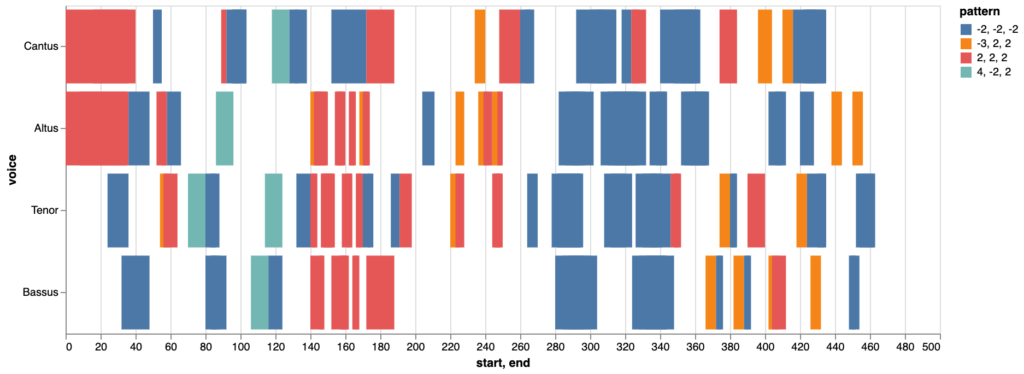
Figure 6. Map of melodic nGrams in O quam shared by the Missa O quam Gloria using the Melodic nGram Maps tool with thematic finder, where n=3 and unisons are combined.
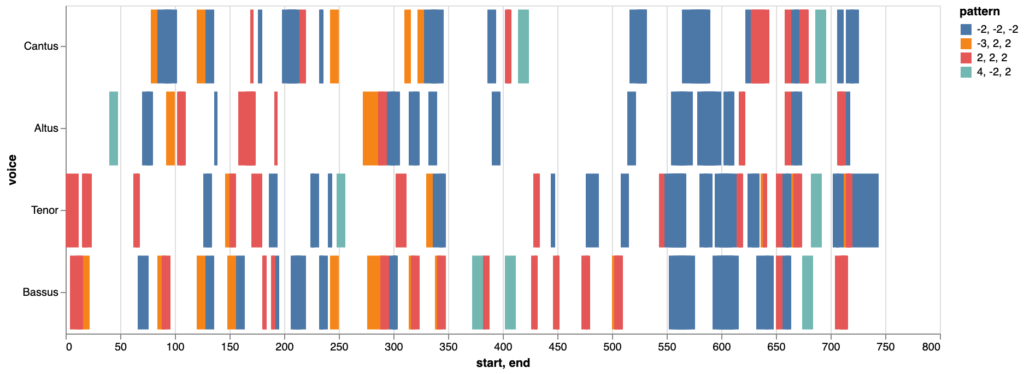
Figure 7. Map of melodic nGrams in the Missa O quam Gloria derived from the O quam model (using the Melodic nGram Maps tool with thematic finder, where n=3 and unisons are combined).
Although a more complete melodic (and contrapuntal) nGram analysis is something I am continuing to work on and plan to finish in the future, even just a look at the melodic nGrams in the Kyrie and Gloria of the Missa O quam can give us a sense of Victoria’s approach to borrowing. Lining up with the results of the Melodic and Module Matrix tools, the Kyrie’s melodic material comes exclusively from the model, and its counterpoint is also closely related, though with some variation within the fugas that lowers the modular similarity score. Even with this explicit resemblance to the model, the Kyrie presents the sections of borrowed material out of order and does not include the model’s opening gambit, signaling that Victoria is being inventive even in the Mass movement most closely related to the model. Analysis of the Gloria shows that Victoria’s borrowing involves not only the full polyphonic textures of the model’s fugas, which he saves for a few particular (and textually related) moments in this movement, but also the extraction of individual soggetti that he then inserts, sometimes recombined with each other, throughout. This helps to account for the lower degree of similarity in the Module Matrix despite a still relatively high correlation in the Melodic Matrix, since the counterpoint at entries is not necessarily preserved from the model even when the soggetti themselves are similar.
O magnum mysterium and Its Mass
What happens when we apply the same analytical methods to O magnum mysterium and its imitation Mass? How much does Victoria’s approach seem to have changed from in the nine years between the Masses’ first publications? Compared to the O quam Mass-model pair, there is significantly less correlation between this pair according to CRIM’s tools. If we apply the Melodic Matrix tool, we find a clear difference in terms of melodic borrowing (Figure 8). Unlike the Missa O quam, the Missa O Magnum only has one movement—the Kyrie—with more than 50% similarity to its model. Even the Kyrie only bears 67% resemblance to the model, which is not nearly as much as the nearly identical melodic entries in the Missa O quam’s Kyrie and model. Both the Gloria and the Credo of the Missa O magnum are only about 25% related to the model in terms of the given parameter, and yet there is a clear relationship between these two movements. This suggests that Victoria is being inventive with his self-borrowing, creating connections between the Mass movements in an even stronger way than his did in the Missa O quam. Further analysis of Victoria’s other imitation Masses would shed light on this as a potential mark of stylistic development over time.
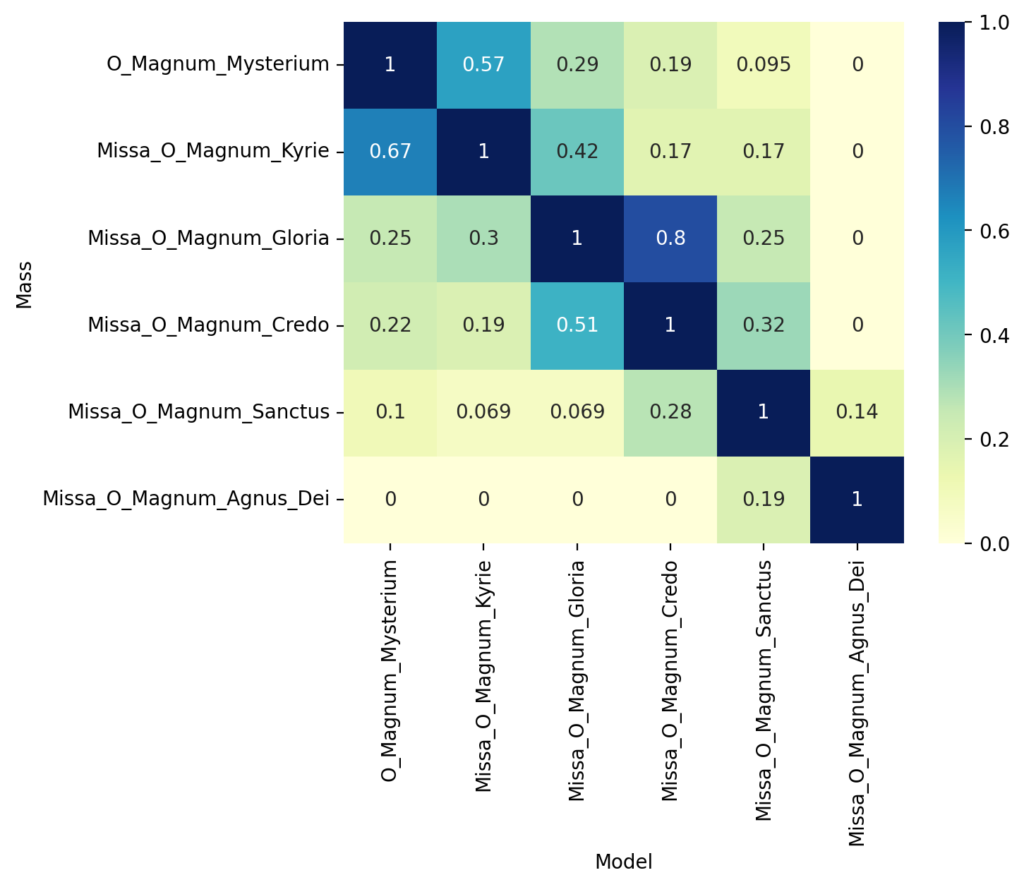
Figure 8. Melodic Matrix showing the percentage of melodic material at entries in each movement of the Missa O magnum derived from the O magnum model and from the other movements (read the same way as Figure 1).
The most surprising result from using this tool is the lack of resemblance between the Agnus Dei of the Missa O magnum and the model when it comes to melodic entries. Other than the 19% similarity between the Agnus Dei and the Sanctus, which is itself only 10% related to the model, it does not even appear connected to the rest of the Mass. Indeed, running the Missa O magnum and its model through CRIM’s cadence tools reveals that the Sanctus and Agnus Dei are the only movements with cadences on F and C, with the other movements cadencing almost exclusively on G and D. Using other tools, however, paints a bit of a different picture about forms of similarity between these Mass movements and the model (Figure 9). With the Module Matrix tool, the results show that the Sanctus and Agnus Dei have a stronger contrapuntal resemblance to O magnum (19% and 25%, respectively) than either the Gloria or Credo do (both at 12%). Looking at the other Mass movements in this matrix further complicates the picture. Even though the Kyrie is still the movement most closely related to the model, its counterpoint at entries is noticeably less similar than the melodies at those entries are. Further, the strong similarity between the Gloria and Credo appears to be a melodic rather than contrapuntal one.
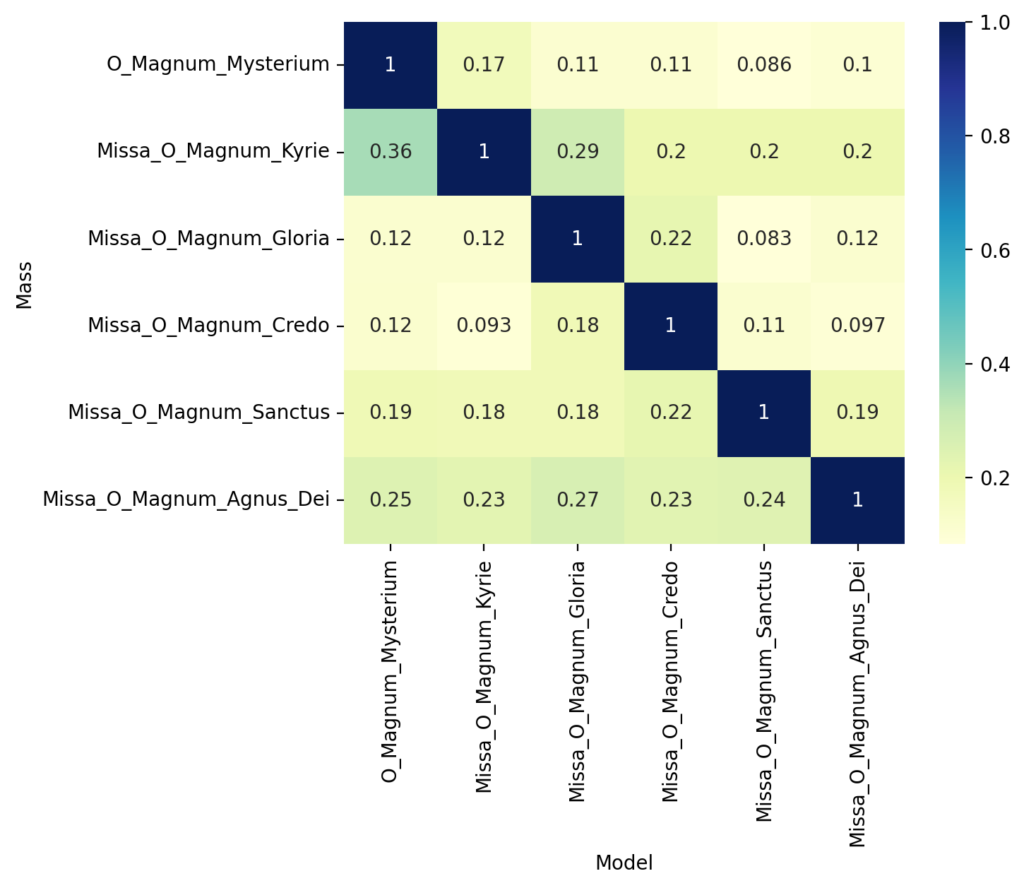
Figure 9. Module Matrix showing the percentage of contrapuntal material at entries in each movement of the Missa O magnum derived from the O magnum model and the other Mass movements (read the same was as Figure 1).
The model itself also appears to be more complicated than O quam, with a greater variety of presentation types, more head and body flexing, and overlapping melodies within a single horizontal line that serve as soggetti for the Mass and reveal similarity among multiple parts of the model. If we use the Melodic nGram Maps tool with the thematic finder, what seems like a relatively straightforward piece looks suddenly dense and complicated (Figure 10). Again, we do need to ask ourselves how many of these nGrams are significant as individual soggetti, as opposed to just features of the common style. One way to do this is to increase the length of the nGram to n=4, which helps to clarify this slightly by eliminating some of the melismatic material without stripping down the visualization to a level that does not display meaningful data. This does sacrifice the visual similarity of soggetti with body flexing after the fourth pitch, but it does more explicitly show us voices that appear to be part of presentation types (Figure 11).
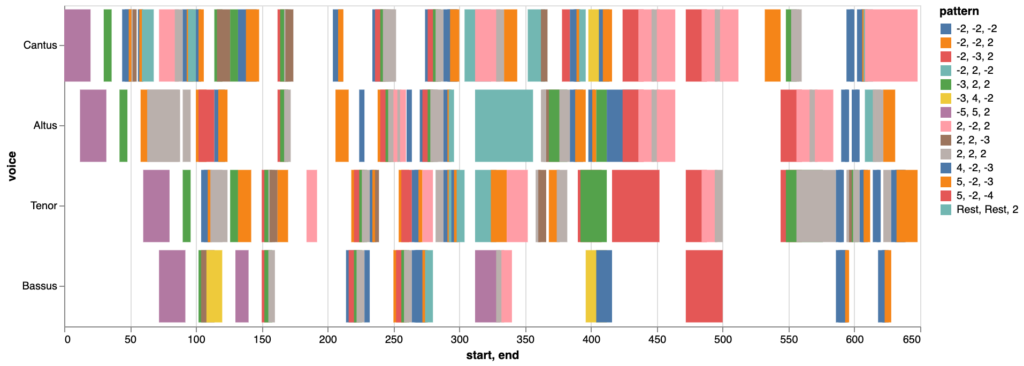
Figure 10. Map of melodic nGrams in O magnum using the Melodic nGram Maps tool with thematic finder (where n=3 and unisons are combined).
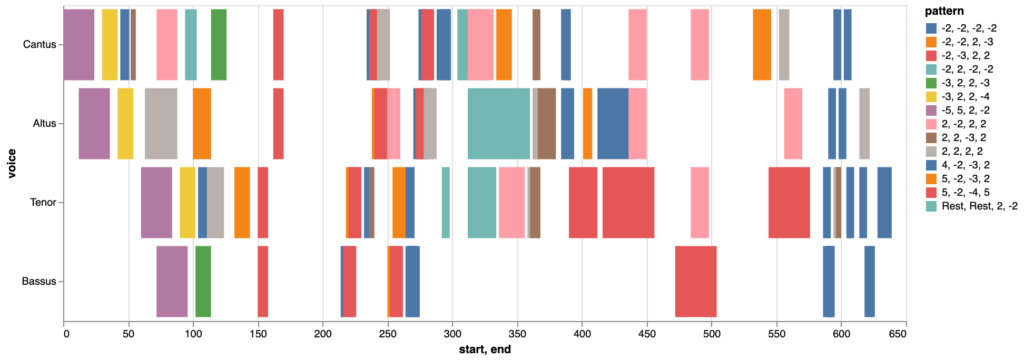
Figure 11. Map of melodic nGrams in O magnum using the Melodic nGram Maps tool with thematic finder (where n=4 and unisons are combined).
Another way is to keep n=3, but to interact with the visualization in the notebook to isolate particular nGrams. What becomes apparent through this method is that the second soggetto that is part of the opening imitative duo, ‘-3, 2, 2’ reappears in different guises by becoming embedded in longer nGrams throughout the piece, including the soggetto that begins ‘-2, -3, 2’ in the tenor-bassus and cantus-altus duets around offset 150 and the long fuga with flexed entries beginning ‘4, -2, -3’ and ‘5, -2, -3’ between offsets 200 and 300 (Figure 12). Further, the ‘-2, -3, 2’ soggetto then becomes the beginning of a repeated material in the homorhythm starting around offset 425, which corresponds to the piece’s triple-mensuration “Alleluia” section (Figure 13). Many of these nGrams entries are then also connected to ascending scalar motion, which is ubiquitous throughout the piece and thus not always meaningful for an assessment of similarity between the model and the Mass. One possible method for streamlining this analysis would be the Levenshtein Distance Calculator, which could help account for the high degree of flexing in longer nGrams and reduce the need to look at small nGrams that make up longer soggetti, but this is a tool I have yet to explore.
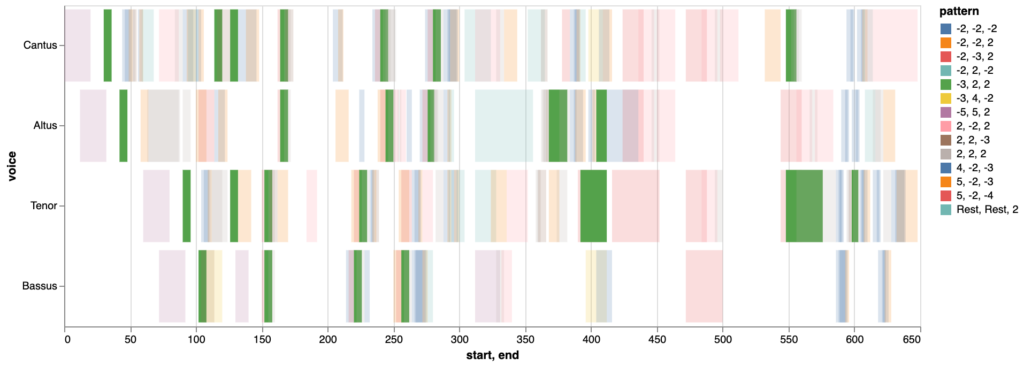
Figure 12. Map of melodic nGrams in O magnum using the Melodic nGram Maps tool with thematic finder, filtered to highlight the ‘-3, 2, 2,’ soggetto (where n=3 and unisons are combined).
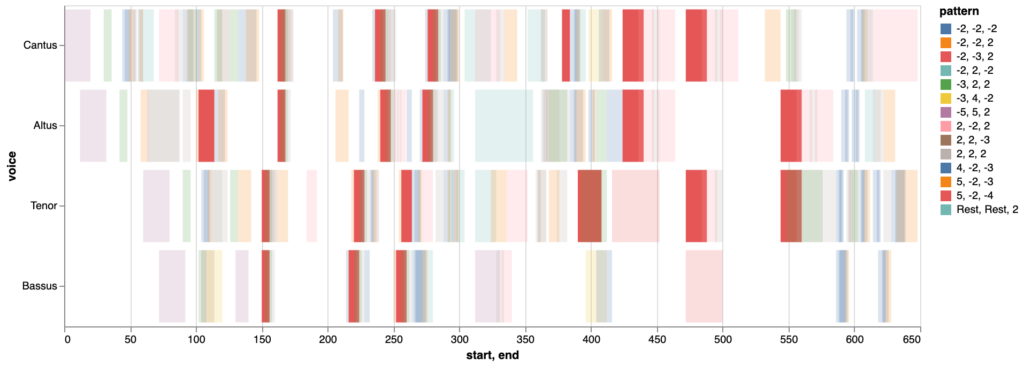
Figure 13. Map of melodic nGrams in O magnum using the Melodic nGram Maps tool with thematic finger, filtered to highlight the ‘-2, 3, 2’ soggetto (where n=3 and unisons are combined).
With such a surprisingly nuanced model, it is perhaps then not a surprise that its imitation Mass is also complicated, and so for the sake of this essay, I will only address the Kyrie. If we run a melodic nGram analysis on the Kyrie alone, we find that Victoria immediately flexes the cantus and tenor entries in the imitative duo from the model (Figure 14), something that the tool does not detect in comparison with the model because the flexed ‘-5, 3, 2’ is not an nGram that the Kyrie and the model technically share (Figures 15 and 16). This move on Victoria’s part is striking and seems to announce from the start that he is taking even more liberties with this Mass than he had with the Missa O quam.
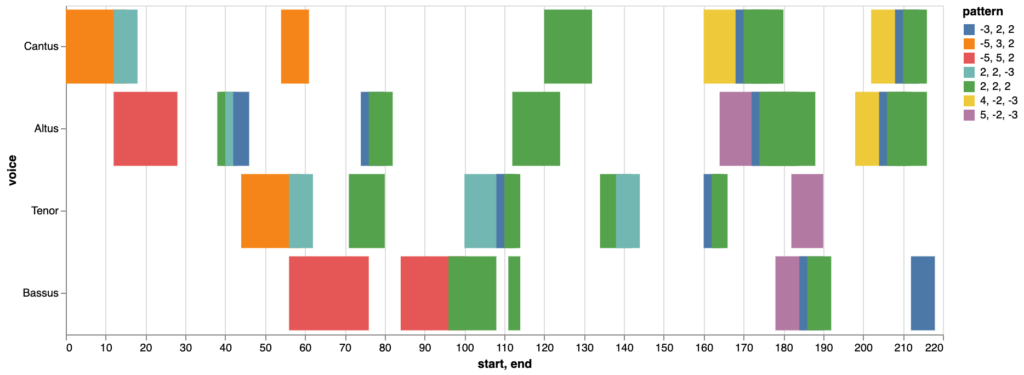
Figure 14. Map of melodic nGrams in the Missa O magnum Kyrie using the Melodic nGram Maps tool with thematic finder (where n=3 and unisons are combined).
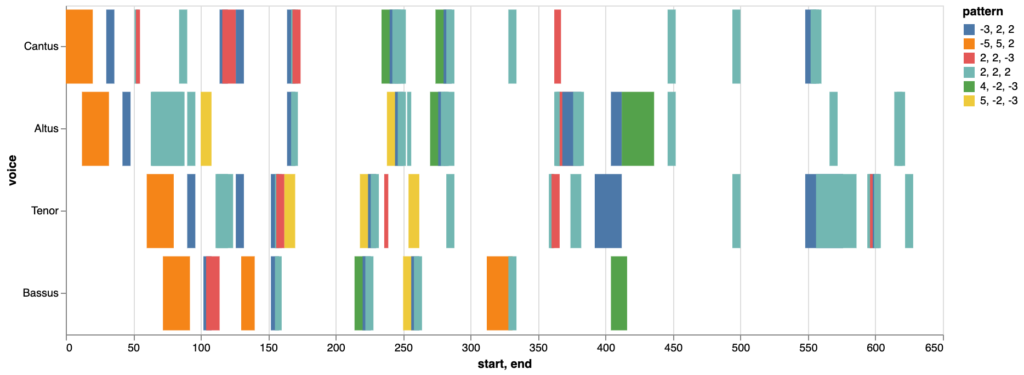
Figure 15. Map of melodic nGrams in O magnum that also appear in the Missa O magnum Kyrie using the Melodic nGram Maps tool with thematic finder (where n=3 and unisons are combined).
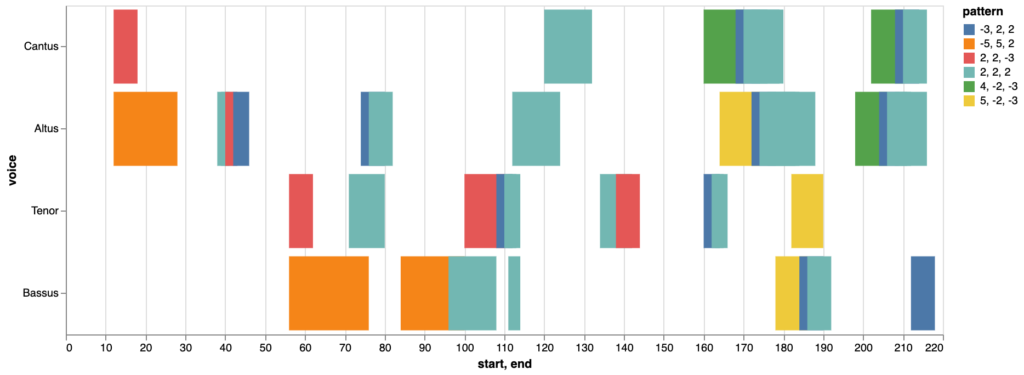
Figure 16. Map of melodic nGrams in the Missa O magnum Kyrie shared with the O magnum model using the Melodic nGram Maps tool with thematic finder (where n=3 and unisons are combined).
The melodic nGram comparison visualizations reveal more of these liberties. We can see that the second nGram in the imitative duo of O magnum is not part of Victoria’s treatment of that duo in the Kyrie, marking an economic condensation of the model’s opening material. Victoria also appears to take the ‘2, 2, 2’ ascending stepwise motion that appears embedded in longer soggetti in the model as the main material for a fuga in the Christe (offsets 95-145). Although it is difficult to know which exact place, if any, in the model this comes from without another method of analysis like a contrapuntal module tool, it would be worth investigating this technique further to find out if it is something Victoria does throughout the rest of the Mass. One clear Mass-model correlation that the visualizations in Figures 14 and 15 do show is a straightforward relationship between the second Kyrie, beginning at offset 160, and the long, dense fuga between offsets 200 and 300. Although this fuga is in the middle of the model and not the end, it does culminate in a cadence that functions as a section break before the subsequent homorhythmic material, and thus fits nicely at the end of the Mass movement.
This overall structure still corresponds well with the Missa O quam Kyrie, in which Victoria reordered parts of the model and did not use the end of O quam at the end of the movement. Further, we could perhaps see the fact that Victoria uses one of the embedded nGrams as the soggetto for the Christe fuga as an extension of his practice we saw in the Missa O quam Gloria of dissecting his model for usable soggetti and transforming them in subtle, creative ways in the Mass. We can clearly see that Victoria borrows the model less literally in this Kyrie (as the similarity matrices already suggested), however, and future analysis of the other Missa O magnum movements may confirm this freer approach to self-borrowing throughout the Mass as a whole.
Conclusions and Next Steps
Applying CRIM’s tools to these two Mass-model pairs by Victoria has been an enlightening process that is still ongoing. Even just focusing primarily on the macro-level similarity matrices and the shared melodic nGrams between the models and one or two of the respective the Mass movements, I have begun to better understand Victoria’s style. What the results reveal to me is that Victoria likes dense fuga textures with flexed soggetti, and that he can pick apart and recombine those soggetti in different ways to create new fugas and counterpoint out of borrowed material. Although he incorporates fugas and homorhythm in both models, he does not borrow the homorhythm wholesale fore the Masses, instead opting for the fugas or for making fugas out of melodic material from a voice within the homorhythmic structures. The results also plainly show that Victoria reorders parts of the models in the Masses, which is something to continue exploring for its intertextually interpretive potential. Another conclusion that stands out is how much more compact and nuanced Victoria’s borrowing is in the Missa O magnum compared to the Missa O quam, something that the similarity matrices make apparent. Although it is not possible to say with certainty that this is a trend in his writing without investigating his other imitation Masses, it at least reflects that Victoria took multiple approaches to adapting four-voice models throughout his compositional career.
There is, of course, still much left to say. What happens in the rest of these two Mass’s movements? What measures of similarity could other CRIM tools find? How, if at all, might the borrowed material resonate on intertextual levels with the parts of the Mass in which it appears, does it reflect Victoria’s personal theology, and what impact would it have had on Victoria’s intended singer-listeners? How do we situate these two pieces among Victoria’s other imitation Masses, self-borrowed or not, the rest of his compositions, and the works of his contemporaries? Using CRIM to start addressing these questions has generated further ones about the intricacies of Victoria’s style, forcing me to refine my own lines of inquiry and be creative in what I am asking and how I interpret what I find. Even just picking apart specific, focused facets of these two Mass-model pairs has been fruitful, and this process gives me hope that, with more time, I can continue this exploration and shed new light on Victoria’s participation in the imitation Mass tradition.
Bibliography
Brill, Patrick John. 1995. “The Parody Masses of Tomás Luis de Victoria.” Ph.D. Diss., University of Kansas.
Cramer, Eugene Casjen. 2001. Studies in the Music of Tomás Luis de Victoria. Burlington: Ashgate.
Filippi, Daniele V. 2008. Tomás Luis de Victoria. Palermo: L’Epos.
Freedman, R., Fiala, D. Russo-Batterham, D., Viglianti, R., Walter, M. 2014. Citations: The Renaissance Imitation Mass, https://crimproject.org.
Huff, Kelly. 2015. “Demystifying the Life and Madrid Works of Tomás Luis de Victoria.” Ph.D. Diss., University of Kansas.
Mangani, Marco and Daniele Sabaino. 2018. “Modality as Orthodoxy and Exegesis: Strategies of Tonal Organisation in Victoria’s Motets.” In Mapping the Motet in the Post-Tridentine Era, edited by Esperanza Rodríguez-García and Daniele V. Filippi, 123-53. London: Routledge.
O’Regan, Noel. 2000. “Tomás Luis de Victoria’s Roman Churches Revisited.” Early Music 28, no. 3: 403-18.
O’Regan, Noel. 1994. “Victoria, Soto, and the Spanish Archconfraternity of the Resurrection in Rome.” Early Music 22, no. 2: 279-95.
Rees, Owen. 2019. The Requiem of Tomás Luis de Victoria (1603). Cambridge: Cambridge University Press.
Stevenson, Robert. 1991. “Tomás Luis de Victoria: Unique Spanish Genius.” Inter-American Music Review 12, no. 1: 1-100.