What CRIM can teach us about the Music of the Eton Choirbook (and vice-versa)
Michael Winter
Introduction
In using the CRIM tools for a repertory for which it was not specifically intended to analyze, there have inevitably been some challenges and learning opportunities. When using the CRIM tools, we are often examining presentation types (see Schubert 2007) and any kind of relationships between works. However, in the Eton Choirbook (GB-WRec MS 178; hereafter Eton) repertory, there is an absence of pervasive imitation or fuga, and there is not the same tradition of borrowing across different works. Nevertheless, the CRIM tools are still extremely valuable for the study of the Eton repertory, and there is significant potential. This paper will explore how the CRIM tools can be utilized in the ‘Estimation phase’ of my work to study the repertory from Eton and how we might be able to confirm, inform, or challenge scholarly perceptions on an ‘Eton Style’. It will also explore how these tools can be used to inform approaches to the study and reconstruction of fragmentary material from Eton and how the editor might justify, rationalize, or explain their decision-making; we will measure the possible against the probable, and thus bring us closer to the range of choices available to a given composer, and therefore inform our own interventions.
The Eton Choirbook
The Eton Choirbook is perhaps the most significant source of pre-Reformation English polyphony. It is relatively well preserved for a manuscript of its age, and it has no rival in terms of scale, splendor, and musical significance. Despite the loss of about half the original gatherings, and about a third of the pieces, the Eton Choirbook is the only substantial source of this incredibly virtuosic melismatic music from fifteenth-century England.
The manuscript was copied between 1500-1504, for use at Eton College (Williamson 1997: 15). Uniquely for a manuscript of this era, it is intricately linked to the institution which gives it its name. There are nine compositions by Robert Wylkynson, the college’s informator choristarum between 1500-1515, as well as numerous works by former scholars of Eton. The College was founded in 1440 by King Henry VI, initially as an ecclesiastical college and would later become twinned with King’s College, Cambridge (also founded by Henry VI) to allow for the progression of scholars from Eton to King’s, and of choristers from King’s College to Eton. With this transfer of students and musicians, there was also a great transfer of musical materials. An inventory from King’s College in 1529 lists numerous ‘bokys off parcemente’ that contain concordant works found in the Eton Choirbook. There are also works by composers not known to have had any formal connection to the twin institutions such as William Horwood, Gilbert Banaster, and a now lost work attributed to John Dunstaple (the only five-voice work ascribed to this composer).
Despite the loss of so much of the original repertory, this manuscript gives an extremely valuable impression of around fifty years of English choral music (1450-1500); a period from which comparatively little survives.
CRIM and Eton
At first sound and sight, it appears that there are considerable differences between the music of the Eton Choirbook and that studied by CRIM. The Eton music is highly florid, there is little use of imitation or fuga, a broader vocal compass is utilized, and there is a greater interplay of vocal forces and textures. Overall, this has not caused problems for the CRIM tools themselves, but rather the way in which the tools can be used to examine the Eton repertory. Tools that have been developed to highlight one aspect of the CRIM repertory, can be used differently, and tools searching for compositional features which are not as prevalent in the Eton corpus requires the careful adjustment of settings to ensure that the number of false positives and false negatives is reduced. The most significant challenge that has been presented is how to approach places in which voice parts are split (known as ‘gymels’) for extended sections or for final chords of cadences. In the first case, this is also tied into considerations of how we transcribe the music. Music21 (on which CRIM Intervals is based) can deal with harmonic intervals on one staff, but CRIM Intervals only recognizes one note for each voice-part at a time.
Additionally, whereas the primary focus of CRIM is to look for similarity and difference between works (and in particular Mass settings), there is little borrowing of material between different polyphonic compositions in Eton. That is not to say that there is none; the Magnificat settings of Horwood and Nesbett share some similarities, and Fayrfax’s Mass O Bone Jesu (though not found in Eton) is based on an antiphon of the same name (regrettably only the mean part survives). The CRIM Project considers where borrowing leaves off and stylistic similarity starts and in the Eton repertory, while there might be the absence of obvious quotation, there are certainly stylistic norms and similarities across the repertory (See Fitch 2008, and idem. 2009).
From what survives in Eton and this period of English music in general, there does not seem to be the same tradition of borrowing between polyphonic constructions compared to continental practices. In analyzing the Eton repertory using CRIM Intervals, I have not been searching for compositional similarities between pieces, in part due to the lack of editions of sufficient quality in a format that can be read by CRIM Intervals. This paucity of digital editions is something I hope to reduce through the completion my of PhD.
In search of an ‘Eton Style’: What CRIM can teach us about Eton
Despite its aural and visual beauty, and the rich recording history of its repertory, there is a lack in scholarship of any extensive study of an ‘Eton Style’. Fabrice Fitch (2009: 37) attributes this lacuna, in part, to the difficulty in charting the development of polyphony in England in the mid-fifteenth century owing to the scarcity of polyphonic sources from this period. Indeed, there is a stylistic chasm in what survives between the music of John Dunstaple (d. 1453) and the Eton repertory (c. 1470-1500). Fitch (2009: 38) further laments the difficulty in attempting to place the music of Eton within broader English practice. Even the works by the earliest composers in Eton such as William Horwood (d. 1484) and Gilbert Banaster (d. 1487) seem to have far more in common with the younger generation of composers in Eton than John Dunstaple (d. 1453), John Plummer (c. 1410 – 1483), or Walter Frye (d. c.1474). Rather than presenting a cross-section of polyphony at the start of the fifteenth-century, it is more likely that Eton offers a ‘slice’ of one institution at a particular time (Williamson 1997: 192) which also represents the very finest music of that institution and quite possibly of the country at the end of the fifteenth century.
This section will explore ways in which the tools developed for CRIM can be used to search for stylistic features of the Eton repertory. The absence of digital files of sufficient quality to be used with the CRIM tools has limited the scope of this study and therefore this section does not claim to have fully developed conclusions. The pieces from Eton used in this study can be found after the bibliography.
William Horwood’s Salve Regina is likely the oldest work in Eton, and it was probably the first to be copied (Williamson 2010: 28). As such, it is a useful work to examine in trying to bridge the gap between the music of the mid-fifteenth century and the rest of the Eton repertory. CRIM Intervals can be used to support assertions and observations made by other scholars on this work. Hugh Benham has noted the equal range used in the lowest two voices; an ‘old-fashioned’ feature more redolent of the five-voice works in the Old Hall Manuscript (GB-Lbl Add. MS 57950) than in the rest of the Eton repertory (Benham 1977: 75). Similarly, Roger Bowers (1995) has described these changes in performing forces as a ‘performance revolution’.
Figure 1a has used the first CRIM notebook to count and plot the pitches used by each voice-part, therefore creating a ‘note count’ graph. This graph produced by the CRIM tools clearly illustrates the overlap of the lowest two-voices that Benham describes, not just as having identical ranges, but also having the same peak notes in their respective ranges.
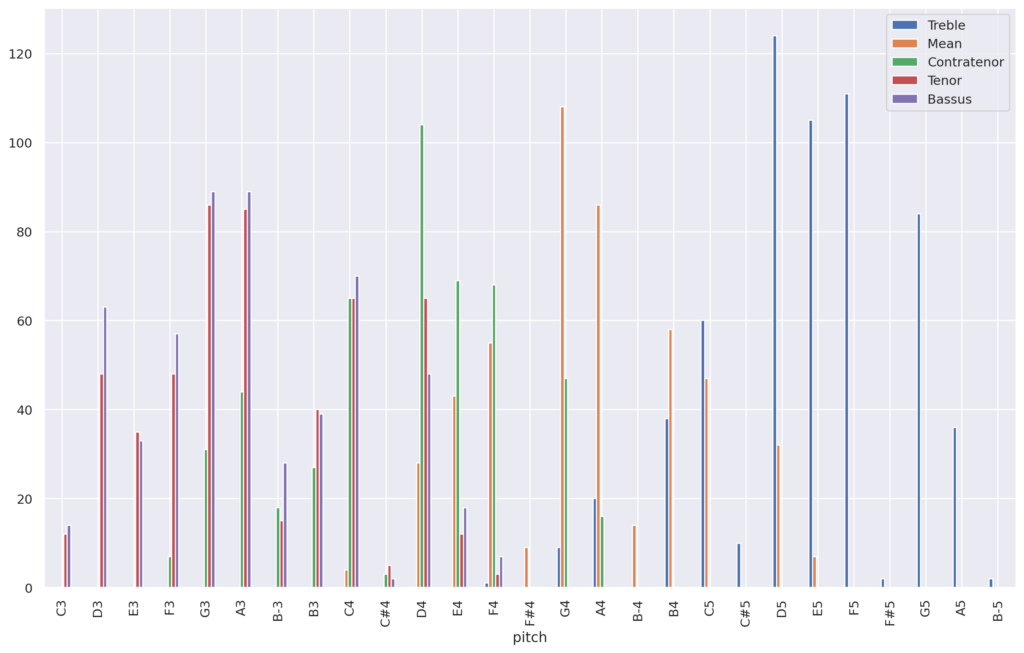
Figure 1a: Note count graph for William Horwood, Salve Regina
This contrasts to the later five-voice works in Eton where the contratenor and tenor overlap rather than the two lowest voices. Figure 1b below shows the note count graph for Robert Fayrfax’s (d. 1521) setting of Salve Regina.
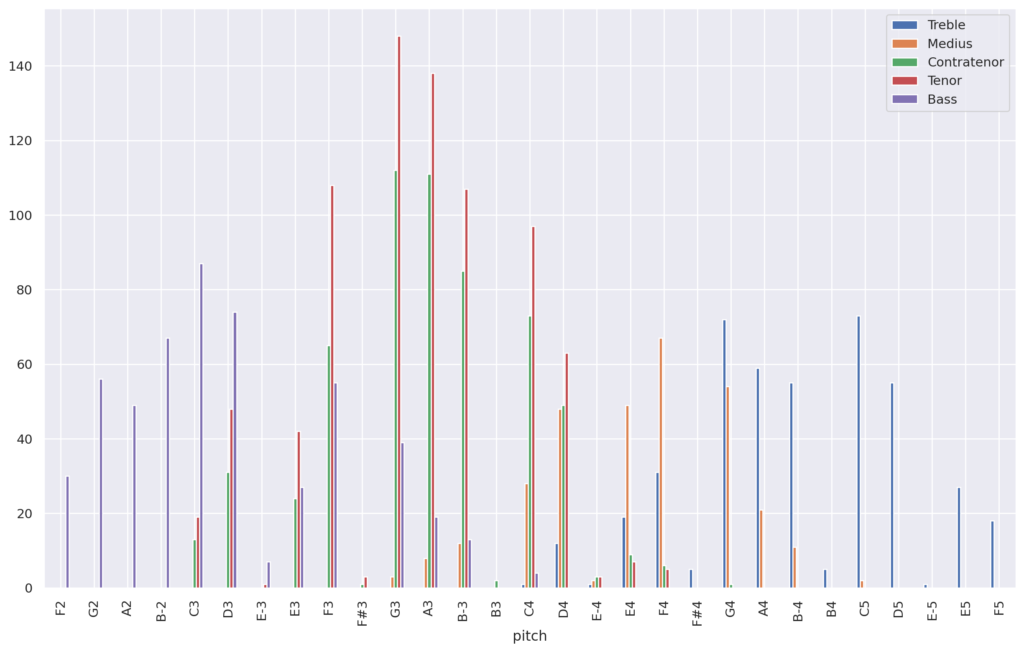
Figure 1b: Note count graph for Robert Fayrfax, Salve Regina
The simplest of the CRIM tools are able to demonstrate with great clarity this ‘Performance Revolution’ that Roger Bowers discusses. CRIM intervals can certainly produce and graph these observations far more quickly than counting manually and does not require extensive specialist training compared to tools such as MidiToolbox which uses the MatLab computing environment.
Other CRIM Intervals tools can demonstrate the highly florid nature of the Eton repertory. The CRIM_02_Melodic_Harmonic notebook can be used to search for both melodic ngrams and for melodic intervals within the corpus of Eton pieces that I have been able to transcribe so far. These initial datasets reveal that intervals of a unison or second (both ascending and descending) occur over two-thirds of the time (see Table 1 below). The same tools can be used to analyze the different intervals by voice part to discover whether the common conjecture that the contratenor is more angular than, for example, the treble, and what this might reveal about compositional process.

Table 1: Interval Count in selected Eton works
The same notebook can show us strings of melodic ngrams. Table 2 shows the ten most common melodic ngrams in my Eton corpus for a length of five notes (from 1073 unique values). The results reveal that most of the music moves by step, but where there are intervals a third or more, these intervals are almost always followed by stepwise movement. Again, these values could be sorted by voice part to support assertions that some voices might be more angular than others.

Table 2: 10 most common melodic ngram count for selected Eton works
CRIM intervals can also help us identify examples of what Fabrice Fitch describes as the ‘Eton Sixth’ (Fitch 2009). The Eton Sixth is a harmonic and melodic variation on the consonant step (the 6-5 step). It is often heard in a cadential context, although it also appears independently of cadences. The interval of a sixth appears usually between the highest voice and the tenor and it usually then descends after a minim from the sixth to the fifth. When the interval in question is not a suspension it is usually approached from below. It can be a minor or major sixth. An example of an Eton Sixth given by Fitch can be found in Example 1 below (the 6-5 movement, in this instance, is heard between the Contratenor I and the Bass). Using the CRIM_03_Modules notebook, we can search for contrapuntal modules and search for the specific pattern that would make up the Eton Sixth. Currently, I have been searching for 6-5 suspensions (‘6_Held, 5’ in the language of the notebook), and then manually filtering through the output looking at examples between the tenor and the highest voice. Due to the flexibility in the initial terminology, this search has produced numerous false positives; this is not a fault of CRIM Intervals, but rather with the search parameters I have formulated. This process could be optimized using EMA Selection on known examples of an Eton Sixth (as defined and given by Fitch, 2009). The EMA could be passed back into the notebook, and the notebook can identify the modules at that place. This is a particularly useful way of searching for modules which might be hard to define. This may not identify all examples of an Eton Sixth, but it would certainly streamline the process.
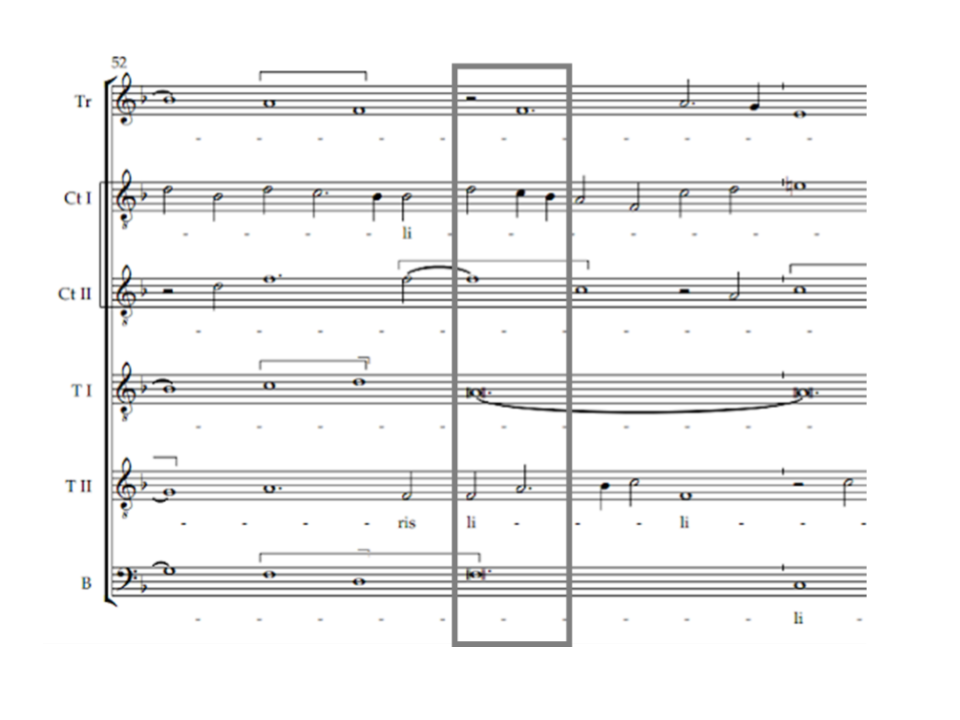
Example 1: An example of an ‘Eton Sixth’ in Sturton, Gaude Virgo Mater Cristi
While they might not reveal anything we do not already know about music from the Eton Choirbook, the ‘heatmapping’ tools in CRIM are an excellent way to visualize activity throughout a piece. Figures 2a and 2b, show the different textures at play in works from the Eton Choirbook. One can quite clearly see the interplay of different textures and vocal forces in the Eton Repertory. We can see devices such as the ‘gapped duo’ (see Fitch 2008), that is a pair of registrally non-adjacent voices (such as a treble and bass). Often the more voices a work has (and the larger the range) the more interplay there is between different textures. The Eton work in Figure 4a is Hugh Kellyk’s Gaude Flore Virginali, an example deliberately chosen to illustrate the heatmapping tools found in notebooks 7a and 7b. In Figure 4a, an excellent example of a gapped duo is found between the Quatruplex and the Bassus, and in 4b between the Treble and Tenor.
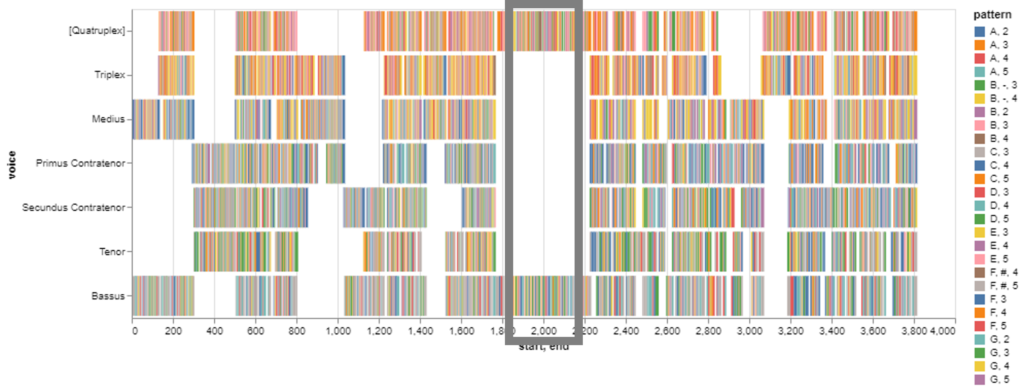
Figure 2a: Activity map of Hugh Kellyk, Gaude Flore Virginali showing a gapped duo between the Quatruplex and Bassus (as marked)
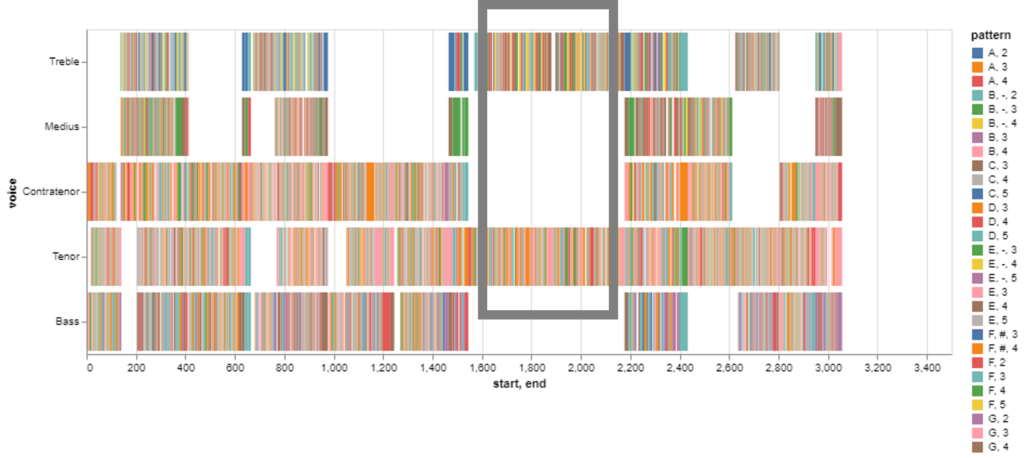
Figure 2b, Activity map of Robert Fayrfax, Salve Regina showing a gapped duo between the Treble and Tenor (as marked)
I have not yet used CRIM Intervals to reveal anything that has not already been discussed in previous scholarship, but the tools are nevertheless able to support prior observations. More significantly, I have been able to use CRIM Intervals to support and challenge my attempts at reconstructing the fragmentary works from Eton. The CRIM tools have revealed that note count for different pitches follows a fairly smooth bell curve pattern in the inner and upper voices (see Figures 1a and 1b), and therefore any reconstructed parts should also reflect this. Similarly, CRIM Intervals has highlighted the prevalence of stepwise movement and movement of major and minor thirds; over the course of my PhD, my reconstructions of the Eton repertory will seek to emulate these features more closely in the way in which it applies to each voice-part.
What can Eton teach us about CRIM?
Unsurprisingly, for the analysis of the Eton repertory, the CRIM tools need small adjustments to handle the unique patterns that appear in both older repertories and music from England. There are places where the tools have already been refined and other areas where we need to be careful in the conclusions we draw from the tools. In particular, there have been problems around false positives and negatives when looking at both cadences and presentation types.
Cadences
Looking at cadences, there were numerous false positives and negatives that were usually a result of patterns unique to Eton that tend not to appear in the CRIM corpus, especially due to ornamentation of the cantizans. Example 2a shows a representative problem found in the analysis of William Horwood’s Salve Regina. In this instance, the computer was not searching for the 7_Held, 5_Held, 6_-2 cadential pattern. This ngram (which is common at cadences in the Eton repertory) had not yet been added to the tool.
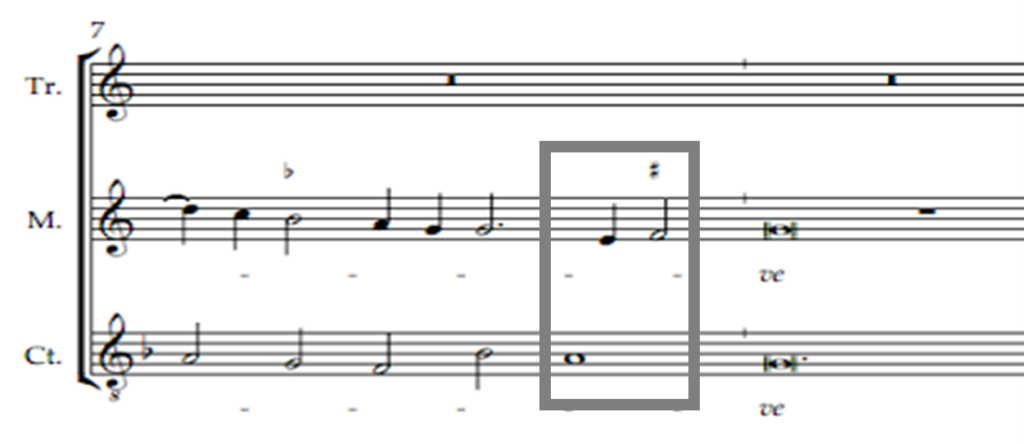
Example 2a: William Horwood, Salve Regina, bb. 7-8. A representative example of a cadential figure that CRIM Intervals was previously not spotting.
A different pattern that is very common in Eton, but the cadence finder doesn’t currently recognize is the cadential 6-6-7-6 pattern (see Example 2b). The cadence classifier only finds suspension-based cadences, which is a problem for this and similar cadences in Eton. But, of course, this is unquestionably a cadential passage and this particular pattern, as far as I can tell, is unique to cadences. Furthermore, at one of the breakout sessions in CRIM@Haverford, we suggested that it may be a pattern that is unique to English music from this period (certainly, we were not able to find this pattern in the works from CRIM that we tested). There are nevertheless ways to find these sorts of cadences by inputting these patterns manually. The tools can only be improved by submitting problems and patterns to the development team. The difficulties that the cadence classifier has with cadences from Eton are not a fault of the cadence tool itself, but rather the fact that I have been using it for a repertory for which it was not intended to study, and that I have not submitted representative examples from Eton to the developers of the cadence classifier to resolve these issues.
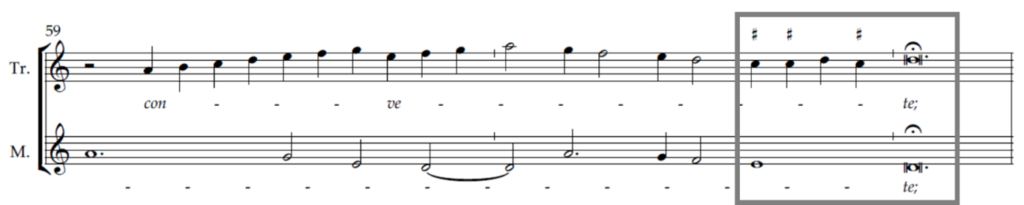
Example 2b: William Horwood, Salve Regina, bb. 59-60. A representative example of a cadential figure that CRIM Intervals was previously not spotting and one that appears to be unique to English repertory of this era.
Presentation Types
Imitation and Fuga play a far less significant role in the Eton repertory than it does in that of CRIM. Nevertheless the ‘presentation types’ notebook has still been useful in analyzing the Eton repertory and in looking at how CRIM Intervals might be improved. Aware that there is little use of presentation types in Eton, I have deliberately chosen a setting of the Magnificat which, due to the greater number of verses (and therefore more polyphonic entries), there is increased potential for presentation types to be found. Below there are two representative examples of the problems found when trying to use CRIM Intervals to search for presentation types in Eton.
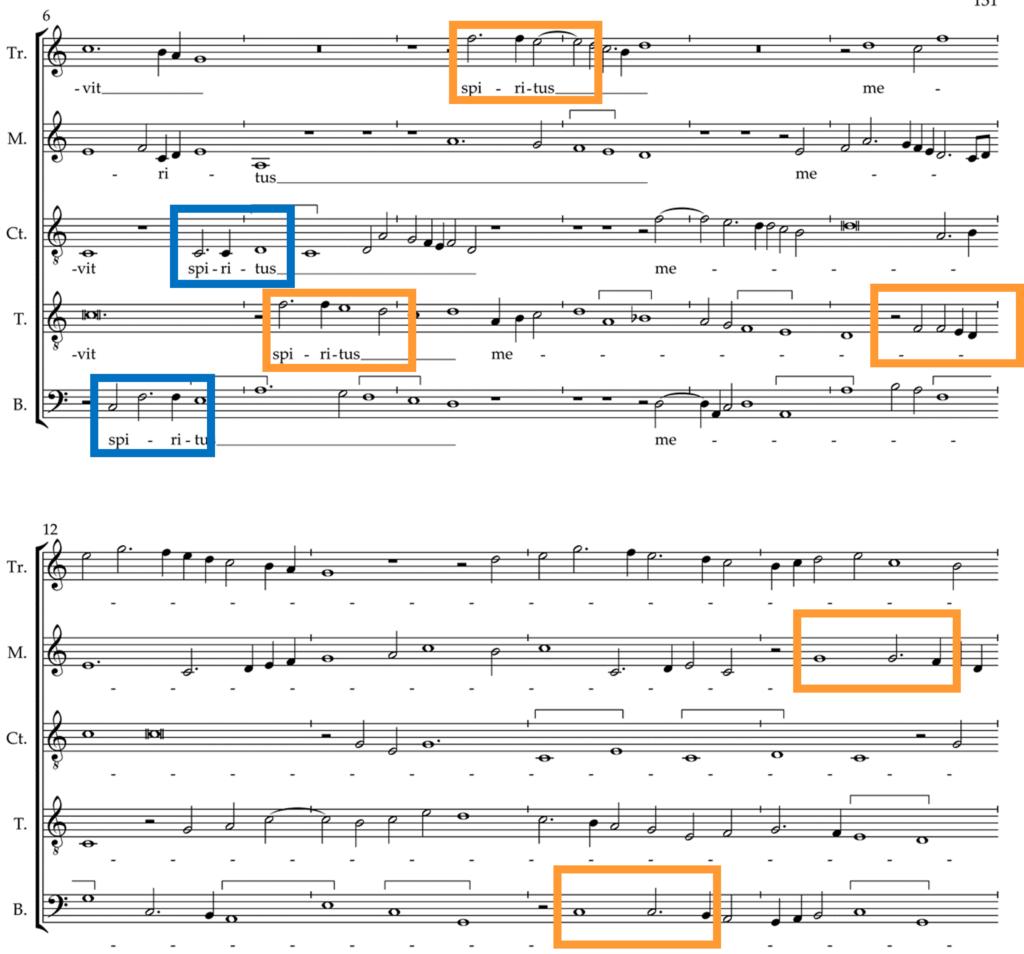
Example 3a: William Horwood, Magnificat, bb. 6-15. Contrapuntal entries that share a soggetto found by the CRIM Intervals are in Orange, those missed are in Blue.
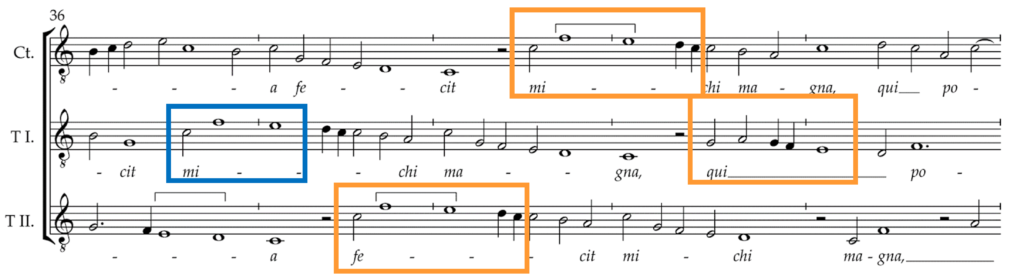
Example 3b: William Horwood, Magnificat, bb. 36-40. Contrapuntal entries that share a soggetto found by the CRIM Intervals are in Orange, those missed are in Blue.
Key for Figures 6a and 6b:

In Example 3a, on the default settings, CRIM Intervals incorrectly found a five voice fuga (including two entries that took place in the middle of a word). Indeed, only the first two entries that the computer found were correct. Given that the presentation types finder does not currently consider rhythm, it was unable to spot that the third, fourth, and fifth entries (which share the same melodic profile as the first two) were not melodically imitative of the first two. Furthermore, the computer had missed two entries before the first it had identified on the word ‘spiritus’. This was owing to the extra note in the bass entry and the contratenor entry rising rather than descending. Despite these differences in the contrapuntal entries, I would nevertheless argue that these entries are part of the same polyphonic motif informed by the prosody of the word ‘spiritus’. This is not a feature that CRIM Intervals can identify which causes problems for a repertory in which there is not the same systematic modularity of imitation. Despite the fact the presentations types finder currently consider rhythm, the potential is nevertheless there; the CRIM tools can find duration and durational ratios, so we could produce durational ngrams and combine these with melodic n-grams to make a representation of melodic and durational ‘intervals’. Richard Freedman currently has a version of this working.
Example 3b illustrates a different problem, one which is caused by using certain search parameters. The presentation types finder found a three voice PEN on the default settings, but in the wrong place. Again, the finder was run on the default search parameters. In order to find the correct three-voice PEN, limit_entries should have been set to ‘False’ so that entries that do not take place after rests are accounted for. The mistaken second entry is caused by the incorporation of ‘head flexing’ in the search parameters. Had this value been set to ‘0’, the incorrect entry would not have been given. CRIM has developed a ‘thematic feature’ which solves the problem found in the former case. Limit_entries would not need to be turned to ‘False’ provided that at least one of the entries using this material took place after a rest. Nevertheless, running the presentation types finder on the Eton repertory has highlighted the limited use of strict imitation in Eton.
Conclusion
The CRIM analytical tools have handled the Eton repertory reasonably successfully and are of significant value to the analysis of this music. The CRIM tools can reinforce observations made by previous scholars on both the changes in performance forces used by English composers in the fifteenth century, and in looking for common contrapuntal modules.
Thinking in terms of reconstruction, CRIM Intervals can easily show us what is common and what is rare; this is particularly useful in explaining and informing my decision-making process in the reconstruction of the Eton fragments. My preliminary work with CRIM Intervals has quantified the prevalence of stepwise movement and has produced visualizations for the ways in which the pitches of the inner voice-parts follow a bell curve. Alternatively, following different paths of logic in the reconstruction process, I have often found myself making decisions that seem unstylistic of the ‘Eton-Style’, especially around certain melodic patterns; CRIM can easily find these melodic patterns, and can confirm whether any reconstructed melodic lines that seem conceited might be justified or found in other places in the Eton repertory.
Finally, in using the CRIM tools in the analysis of the Eton repertory, we have spotted problems and been able to improve the cadence classifier, in particular by adding patterns that were uncommon in the CRIM repertory but ubiquitous in Eton. In searching for presentation types in Eton, the lesson has been that often it is sensible to run multiple searches using different parameters, with both large and little amounts of flexing. This method will produce a large quantity of false positives, but nevertheless, this seems to be the only way to tease out the true positives.
Bibliography
Benham, Hugh. 1977. Latin Church Music in England 1460-1575. London: Barrie and Jenkins.
Bowers, Rogers. 1995. ‘To chorus from quartet: the performing resource for English church polyphony, c. 1390–1559’, John Morehen (ed.), English Choral Practice 1400–1650. Cambridge: Cambridge University Press.
Fitch, Fabrice. 2008. “Hearing John Browne’s Motets: Registral Space in the Music of the Eton Choirbook.” Early Music 36: 19–40.
Fitch, Fabrice. 2009. “Towards a taxonomy of the ‘Eton Style’”, in M. Jennifer Bloxam, Gioia Filocamo & Leofranc Holford-Strevens (eds), Uno Gentile et Subtile Ingenio: Studies in Renaissance Music in Honour of Bonnie J. Blackburn. Turnhout: Brepols.
Schubert, Peter N. 2007. “Hidden Forms in Palestrina’s ‘First Book of Four-Voice Motets’” Journal of the American Musicological Society 60: 483-556.
Williamson, Magnus. 1997. “The Eton Choirbook: its Institutional and Historical Background.” DPhil thesis, Oxford University.
Williamson, Magnus. 2010. The Eton Choirbook: Facsimile with Introductory Study, DIAMM Facsimiles 1. Oxford: DIAMM.
Appendix
Pieces from Eton used in this study:
- E2, Hugh Kellyk, Gaude Flore Virginali
- E10, Sturton, Gaude Virgo Mater Cristi
- E17, William Horwood, Salve Regina
- E26, Robert Fayrfax, Salve Regina
- E35, Gilbert Banaster, O Maria et Elizabeth
- E36, William Horwood, Gaude Flore Virginali
- E65, William Cornysh, Ave Maria Mater Dei,
- E71 William Horwood, Magnificat
These works can be found at: https://github.com/Michael-Winter/Eton-Choirbook