With Baccusi in the Jacuzzi; or, How I Learned to Stop Worrying and Love Numbers
Sylvain Margot and Peter Schubert
Introduction
We’re always in hot water when we analyze old music. As Philippe Vendrix stated: “…music history has dealt with music that can only be imagined now, with music that cannot be heard. Renaissance music is at the heart of this paradox, as it will surely remain for a long time to come.” (Vendrix 2004: 9) We don’t have much idea of what people in the past did for analysis, and we probably don’t even have the same agenda. We might be approaching it all wrong because of our education in other types of music. There are two ways to deal with this uncertainty: we could try to read more historical treatises more carefully, or we could try to be more “objective,” that is to find a way not to let our biases interfere, or at least to make them more explicit. In the following pages we take the latter view, interrogating the role the computer might have in the conventional analysis of individual pieces of Renaissance music (as opposed to corpus study). As we will show, it not only makes it easier to answer certain questions, it causes us to reimagine the role of the analyst.
We begin with a review of the theories of Jean-Jacques Nattiez regarding the “neutral level” (an imaginary removal of the analyst’s biases), and then show how CRIM Intervals can be used to make queries of two pieces of Renaissance music (a madrigal by Cipriano de Rore and the Mass based on that madrigal by Ippolito Baccusi). We conclude by showing some surprising insights that the computer enabled us to bring, and we suggest reimagining the role of the analyst.
Methodological Worries
During the examination of any object, each question an observer asks yields some piece of information about the object. But each question asked reveals just as much about the analyst. The role that an observer plays in the analysis of music is at the very core of Jean-Jacques Nattiez’s concept of tripartition. According to this concept, when examining a work of music, three main methodological positions are available to the analyst, as illustrated in Figure 1. (Nattiez 1990: 135–36)
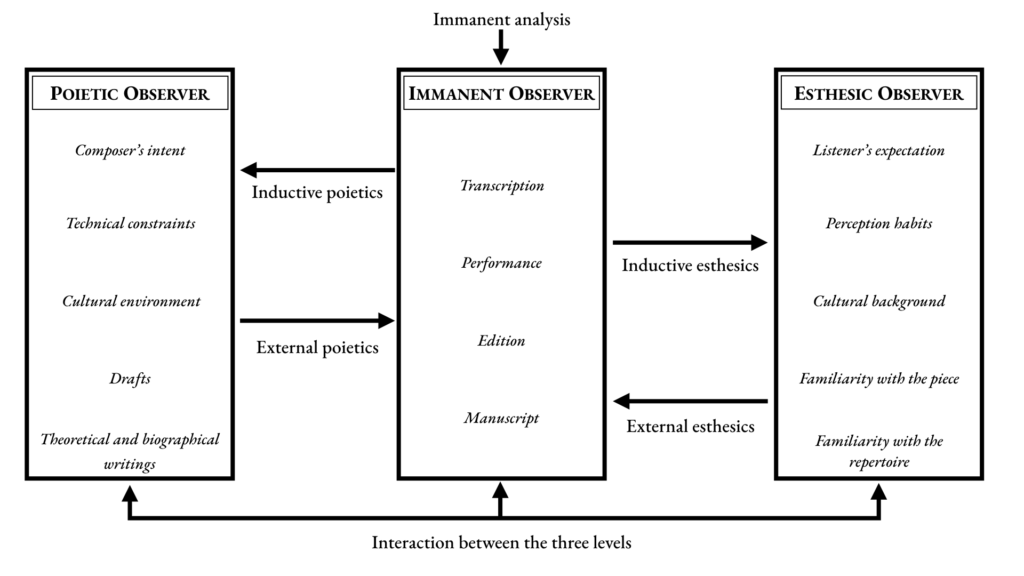
Figure 1. The tripartition of the analytical observer
A first position is that of the esthesic observer, whose intent is to put a work of music in relation with their own context (i.e., their expectations, their perception habits, their cultural background, or their familiarity with the piece and the repertoire). Although the musical culture of such an observer can be very different from that in which the work was created, it is nevertheless a valid standpoint. For example, the means by which a nearly 500-year-old madrigal can move us, or inductive esthesics, is indeed a meaningful object of study. Similarly, the influence of one’s socio-cultural background, analytical habits, and expectations on their reception of a work, or external esthesics, is also a field of research on its own. (Nattiez 1990: 141–42) Since an esthesic approach is inseparable from the context in which it occurs, the analyst must thus distinguish the means of reception (why a specific musical feature moves us) from the causes of reception (the specific musical feature itself).
An opposite position is that of the poietic observer, whose approach is to understand as precisely as possible the cultural environment, the technical constraints, and the intentions of the composer who created the work of music. Despite the possible lack of “period respondents” to answer our questions, analysts can often rely on treatises, drafts, letters from which it is possible to glimpse this context (external poietics). It is also possible to comprehend the craft, the compositional habits, or the style of a composer from one or several other musical works (inductive poietics). (Nattiez 1990: 140–41) This undertaking, however, is particularly delicate not only because we might comprehend these sources wrongly, the sources may disagree, and their real influence on the actual compositional process is unknown. (Schubert 1994: 3–4)
The last position is that of the immanent observer, whose method consists of examining the intrinsic characteristics of a work of music, free of any cultural biases. Although it could be objected that a cultural object has no meaning when it is isolated from an interlocutor, (Griswold 1987: 1–2) if such a neutral standpoint is even possible, this is what we aim to achieve. In principle, music analysis can reveal musical structures with no a priori meaning imposed by a human eye. However, there will undoubtedly be some characteristics that will not be included in the analysis, and the analyst must make explicit the reasons for discarding some musical elements in their observation. As LaRue stated: “If analysis at best can accomplish only part of the task of understanding music, obviously we must attempt to compensate by constructing a plan of exceptional completeness to ensure our observation of every nook and cranny of a piece, studying each of its musical elements in turn at various magnifications to fit all dimensions.” (LaRue 2011: 2) This is also very demanding, for even the most basic features must be weighted with great care. (Nattiez 1990: 140) Furthermore, not all immanent features may seem interesting to the analyst nor can be easily used for manual analysis.
Although Nattiez’s tripartition model does not presume that these positions must overlap, the analyst may want to examine where they do. Their task is, then, to find the most neutral basis to conduct such a study. In that case, Nattiez recommends beginning from the immanent level, arguably the position in which the observer is the most “neutral,” and proceed from there towards both the poietic and the esthesic levels. (Nattiez 1990: 140) Unfortunately, even in the case of an immanent analysis, there is no “neutral” observer because there is no “neutral” theory of observation. A theory must always hierarchize elements (intervals, pitches, durations, meter, timbre, dynamics, etc.) in one way or another. As Mario Baroni et al. have argued, it is only from the ascendancy of some elements over others that the construction of an analytical structure can emerge. (Baroni, Dalmonte, and Jacoboni 1995: 325–34) Since such a hierarchy is a matter of professional habits, aesthetic choices, even socio-political culture, and since they determine the way in which the observer will examine a work of music, any analytic process should first discuss them explicitly. Only then would the interaction of the three levels provide a more comprehensive view of the object. In other word, the analyst must remain aware at all times of the position they occupy as an observer and on what the assumptions of their theory of observation are.
One of the main objectives of our project was to stay as close as possible to the position of the ideal immanent observer, with as few assumptions as possible to avoid confusing objectivity with our own subjective biases. In particular, we wanted to identify hidden biases towards features that we have been taught to think of as meaningful. Working with computers can be a useful tool, as they can help us to see relationships that we are not used to noticing or hearing. Furthermore, due to the mathematical nature of our interactions with them, computers force us to be cultural “outsiders,” which offers many advantages in terms of diversity and inclusion of analytical views. (Nettl 2005: 149–60) But, despite its purely mathematical approach, software is far from being “neutral.” Examples of this are the constant use of the measure as a structural framework for music encoding, or the often-convoluted ways to integrate musica ficta. This poses several problems for the automatic analysis of genres such as early polyphony or Gregorian chant. Fortunately, the project Citations: The Renaissance Imitation Mass (CRIM), directed by Richard Freedman, is dedicated to Renaissance music and offers a Python library for the analysis of encoded of such scores, CRIM Intervals. (CRIM 2015) In particular, researchers can work on a series of customizable Jupyter NoteBooks in which each parameter is explained and described (for example, real/regularized approaches to durations, diatonic/chromatic/zero-based intervals, merged/unmerged unisons, durational ratios, etc; for more details, see: https://guides.tricolib.brynmawr.edu/c.php?g=1277440&p=9376199). Consequently, there are very few “hidden” concepts that would bias an immanent level analysis.
Imitation Masses: Methodological Hot-Water
When it comes to imitation masses, most analysts incorporate the models into their approach. This constitutes an interesting but complex methodological case, as many observational positions intersect within this “Model-Mass” ensemble. An imitation Mass is both a reading of its model and a testimony to its author’s techniques. This means that its composer was in both positions of esthesic observer (they “received” the mass’ model) and poietic observer (they “created” a mass from the model). In the same way, a modern analyst also has two roles and two individual but interacting objects to look at. As shown in Figure 2, all this creates an entanglement of positions that is extremely difficult to unravel. Not only can each piece be analyzed individually (solid arrows) but they can also be analyzed comparatively (hyphenated arrows). This is an especially delicate problem, as it blurs the border between poietics and esthesics (white box). Prior to any esthesic and/or poietic analysis of a “Model-Mass” ensemble, one necessarily has to conduct an analysis of this connection, preferably as neutrally as possible.
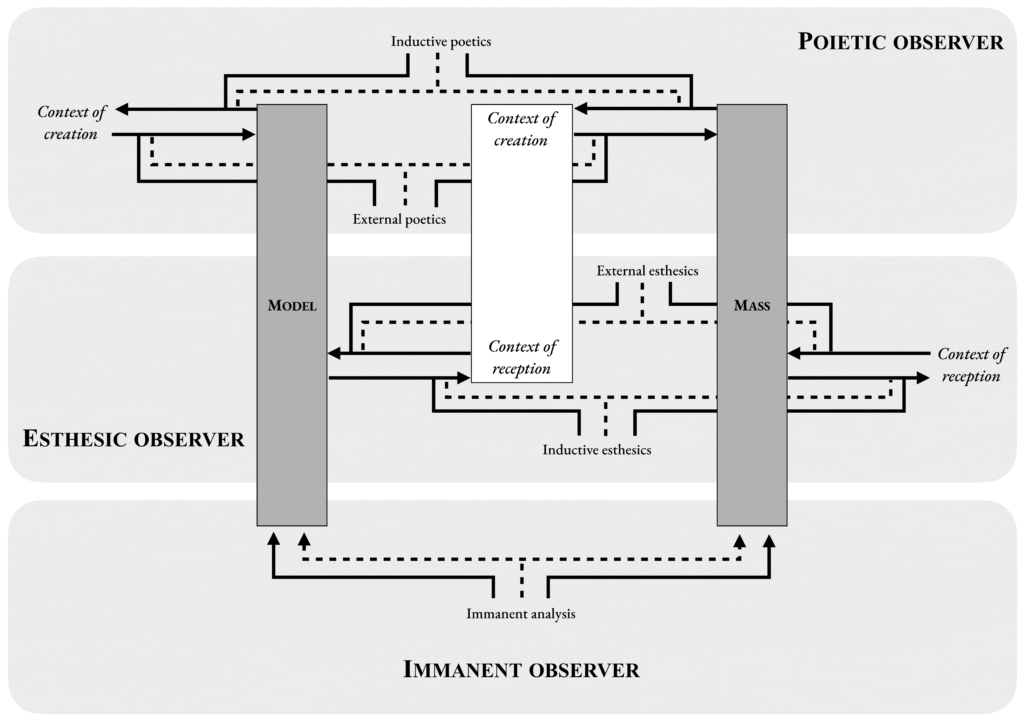
Figure 2. Intersection of observational positions in the Model-Mass ensemble
The most common approach consists of identifying meaningful motives in the model before looking for them in the mass. Although justifiable, this approach is, in fact, incorrect. By doing so, the analyst’s reception of the model is taken as the composer’s starting point in the creation of the mass. But it is not at all certain that what we find meaningful within the model alone was also meaningful for the composer of the Mass. As we will see, some seemingly trivial or meaningless motives can be of great importance in how the mass is composed. To observe both musical works on the same “neutral” level requires a balanced position. The examination of their commonalities and discrepancies (in other words what features they share and how their treatments differ), constitutes the right entry door to a more thorough analysis of the “Model-Mass” ensemble.
Baccusi’s Jacuzzi: Towards immanence
When we started this project, we expected to find that repetitions in melodic intervals carry important information on compositional techniques that may have eluded us, for the reasons stated above. Our first decision was to free ourselves from many habitual definitions of what a meaningful melody is, while still remaining in the world of Renaissance polyphony. For example, we’re used to thinking that a soggetto must have more “character” than a mere “generic” scale or neighbor motion; it should happen after a rest, be associated with text; its rhythm should only slightly altered, etc. Even the decision to begin with strings of melodic intervals is not truly “neutral” – a Martian would probably not approach Renaissance music this way. Nevertheless, for our project, the highest elements in our analytical hierarchy are melodic intervals, in both their diatonic and interval-quality description. The reason of our choice is partly based on a few clues we get from Renaissance theorists (Cerone 1613: 687–88, Pontio 1638: 153–61), and partly on what our teachers have told us (that counterpoint is combinations of nice lines). Pitch, rhythm, and text came next in this order. Thus, we allowed “meaningful” strings of intervals
- not to be preceded by a rest. Although this is a commonplace of the style (composers often set off a soggetto with a rest, perhaps to allow the singers to breathe and/or to make the beginning of the melody easier to hear), we have seen many cases where the soggetto is not preceded by a rest.
- not to be rhythmicized the same way, and not to have the same text syllables. These both result from the commonplace association of a text phrase, with its long and short syllables, with a unique melody. We want to be open to the possibility that the composer may use the same soggetto in different contexts. This is especially true when a soggetto from a madrigal is used with the new Mass text.
- not to be affected by repeated notes. This means that repeated notes, as well as anticipations in cadential suspensions, are considered unimportant embellishments. These are also introduced sometimes to accommodate text syllables (especially when a tune from the model is adapted to the Mass text).
- to have different “head” intervals. This is based on observation: we often find a first interval altered (especially a fourth replaced by a fifth). There might be reason to believe that intervals can be changed later on in the melody, after the head (e.g., various inganni), but we draw the line at the first interval.
Our next decision was based on the conventional idea that repetition is what gives form to music. Therefore, we asked CRIM Intervals to find all the occurrences of given strings of intervals that are shared by both the model and the mass. This means that if the Mass composer did not reuse a given melodic string from the model, it will not concern us at all (although it might be of interest to some analysts). In the rest of this article, we will therefore use the following definitions to discuss and describe our results:
- a soggetto is a melodic motive that is found in both the model and the mass;
- a core is a soggetto that is exactly repeated; CRIM Intervals can find flexed intervals, and that can be useful for counting the number of times, say, that X = a minor third;
- an initial melodic interval can be varied (such a variant is notated “head+core” with the varied interval labeled “X”).
Some Like it Hot: Double-Blind Analysts
To avoid the computer’s results being unconsciously tainted by familiarity with the music, we have opted for a “double-blind” workflow, as shown in Figure 3: a “blind” analyst was in charge of software requests and their outputs, and a “sighted” analyst annotated the scores from these outputs and analyzed the music works. The former could not look at or listen to the music while the latter could not deviate from the outputs. We used spreadsheets as a common document to discuss our process in order “to cut” each analyst even further from the other’s work material.
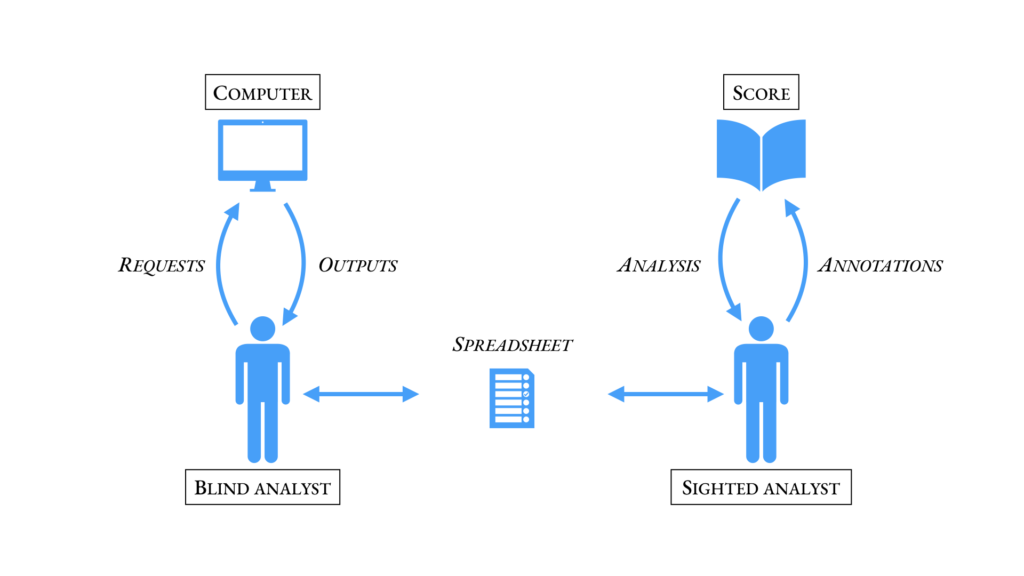
Figure 3. Blind-Sighted analysis workflow
First, we retrieved all the 4-interval long motives (i.e., motives that are 5 notes long) in both Rore’s Quando lieta sperai and Baccusi’s corresponding Kyrie. We opted for four types of melodic intervals: generic diatonic intervals, intervals with quality, diatonic intervals with merged unisons, and intervals with quality and merged unisons. Raw outputs are exported in .csv format—Figure 4 shows such outputs for diatonic intervals and merged unisons.
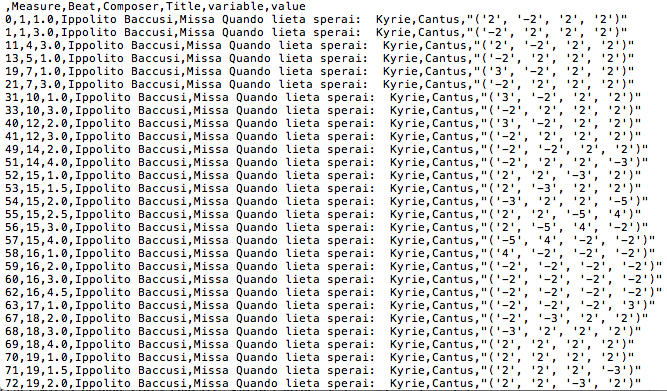
Figure 4. Raw results from CRIM Intervals in .csv format
From these raw results, using Excel-type spreadsheet to sort the data, we then listed the most common soggetti shared between both works. Figure 5 shows an excerpt of one such spreadsheet for soggetti A and B as they appear in the madrigal and the Kyrie, ordered by voices then by soggetti, in their diatonic form and with melodic unisons merged (Pandas Groupby operations can easily do these tasks within CRIM Intervals directly).
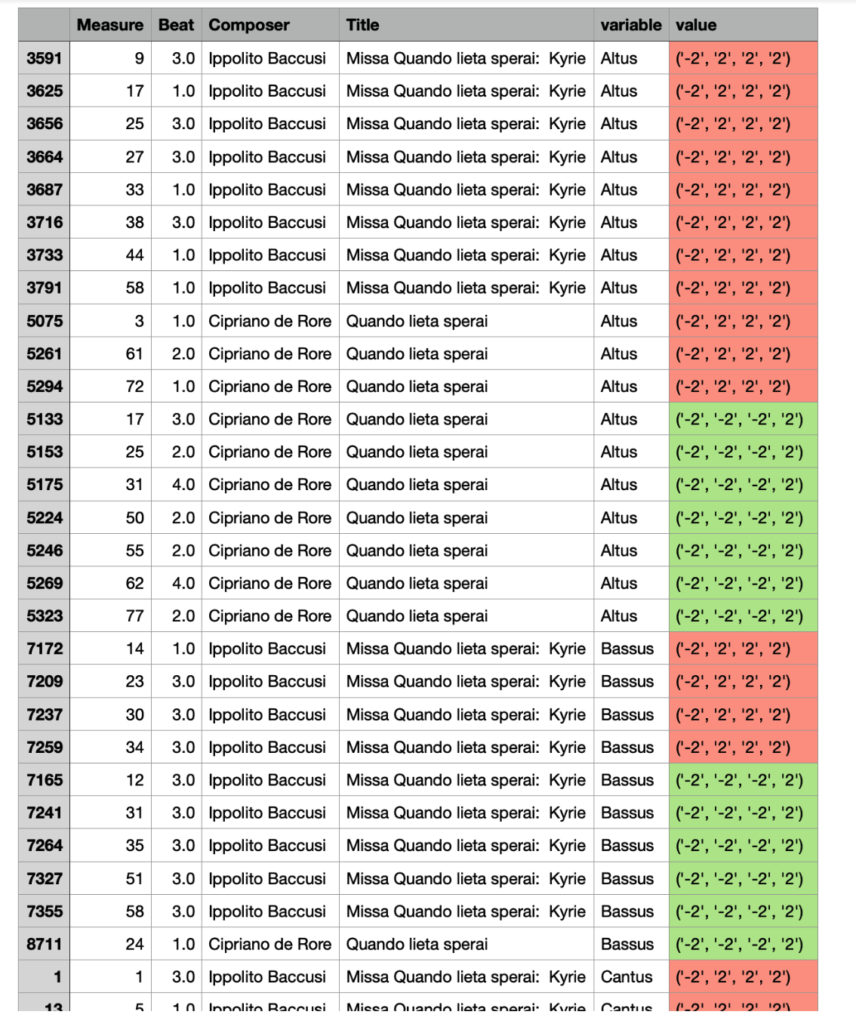
Figure 5. First lines of a spreadsheet showing soggetti A (in red) and B (in green) in Rore’s Quando lieta sperai and Baccusi’s derived Kyrie, ordered by voices then by soggetti, in their diatonic form and with melodic unisons merged
Soggetto A [-2, 2, 2, 2] appears the most frequently with 41 occurrences in the Kyrie (43 when unisons are merged) and 7 in the madrigal. Soggetto B [-2, -2, -2, 2] is only the fourth most common soggetto but the most common 4-interval long motive in the madrigal with 22 occurrences (29 when unisons are merged) and 12 in the Kyrie (14 when unisons are merged). It seemed interesting to examine them since we, as modern listeners, tend to consider step-motions less “meaningful” than leap motions. They are, however, the most used motives in both works (see Example 1.

Example 1. Most common soggetti shared by Rore’s Quando lieta sperai and Baccusi’s derived Kyrie
The examples are purposely clef-less to illustrate diatonic intervals.
The next step was to compare the treatment of A and B by considering their solmization. To do so, we looked at outputs of intervals with quality. Soggetto A comes in five forms based on interval quality, two of which, A3 and A3f, are related through the use of ficta (see Example 2):
- A1 as fa–mi–fa–sol–la [-m2, m2, M2, M2] occurs 36 times in the Kyrie and 3 in the madrigal;
- A2 as mi–re–mi–fa–sol [-M2, M2, m2, M2] occurs 3 times in the Kyrie and 2 in the madrigal;
- A3 as re–ut–re–mi–fa [-M2, M2, M2, m2] occurs 2 times (only if unisons are merged) in the Kyrie and once in the madrigal;
- A3f as re–#ut–re–mi–fa [-m2, m2, M2, m2] occurs 2 times in the Kyrie and none in the madrigal;
- and A4 as sol–fa–ut–re–mi [-M2, M2, M2, M2] does not occur in the Kyrie but once in the madrigal.
Soggetto B comes also in five forms, two of which, B3 and B3f, are related through the use of ficta:
- B1 as la–sol–fa–mi–fa [-M2, -M2, -m2, m2] occurs 6 times in the madrigal (8 with unisons merged) and 4 times in the model (6 with unisons merged);
- B2 as sol–fa–mi–re–mi [-M2, -m2, -M2, M2] occurs 9 times in the madrigal and twice in the Kyrie;
- B3 as fa–mi–re–ut–re [-m2, -M2, -M2, M2] occurs 3 times in the madrigal and twice in the model;
- B3f as fa–mi–re–#ut–re [-m2, -M2, -m2, m2] occurs twice in the madrigal (7 with unisons merged) and 4 times in the model;
- B4 as mi–re–ut–fa–sol [-M2, -M2, -M2, M2] occurs twice in the madrigal and none in the Kyrie.
Contrary to soggetto A, which shows a very strong modal focus through the almost exclusive use of A1, soggetto B does not display a specific inclination for one form or another.
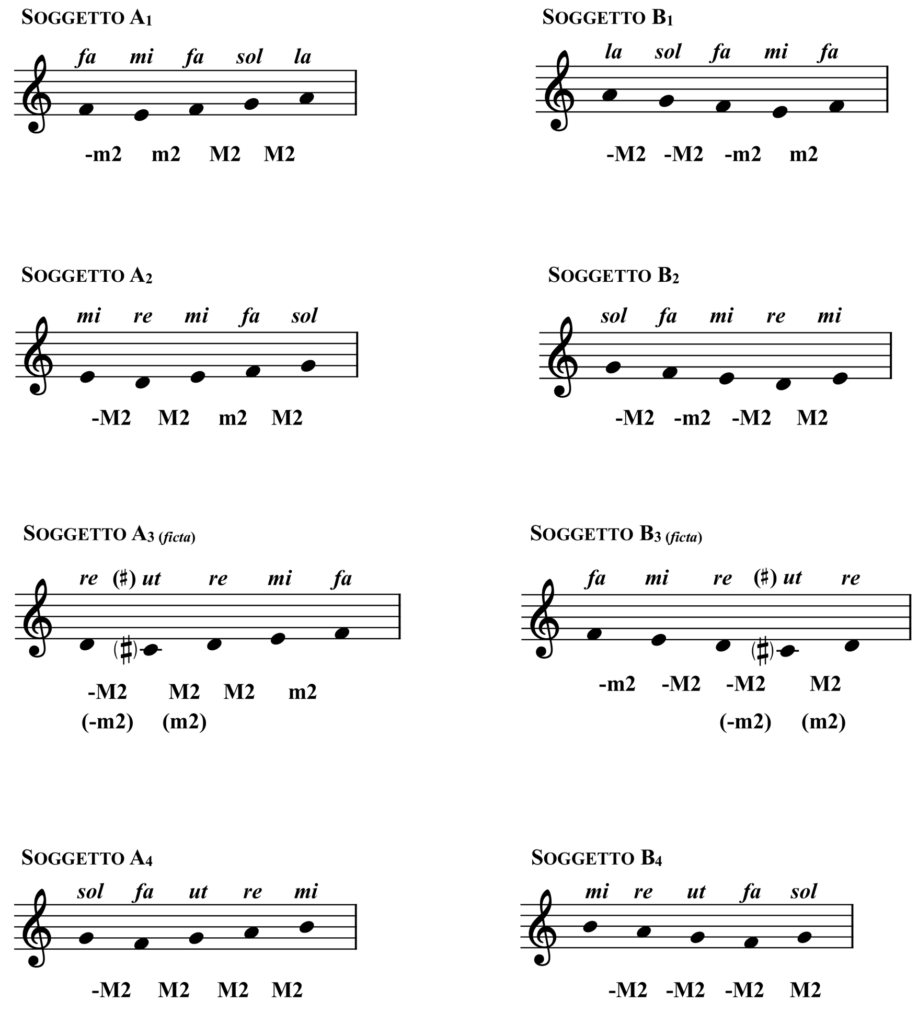
Example 2. Solmization of the most common soggetti shared by Rore’s Quando lieta sperai and Baccusi’s derived Kyrie
Variations on Variants: Melodic strings in the Madrigal
For the purpose of this study, we compared the variants based on cores A (i.e., [-2, 2, 2, 2]) and B (i.e., [-2, -2, -2, 2]) and examined if and how the treatment of variants X+A and X+B differs in both pieces, with X the head of the variant. The analyst wants to know whether there are patterns that one is not likely to find on one’s own with conventional score study—which usually focusses on entries. After the blind analyst has conveyed this data, the sighted analyst marked them in the score excerpt shown in Example 3 in the same colors. What would normally be assigned the label of soggetto would be the core in red and the head (the first interval). The green motive, however, would probably not be labeled at all! It would probably be considered a cadential cliché (note that the semiminim A anticipation in m. 4 was merged with the next note in the computer output).
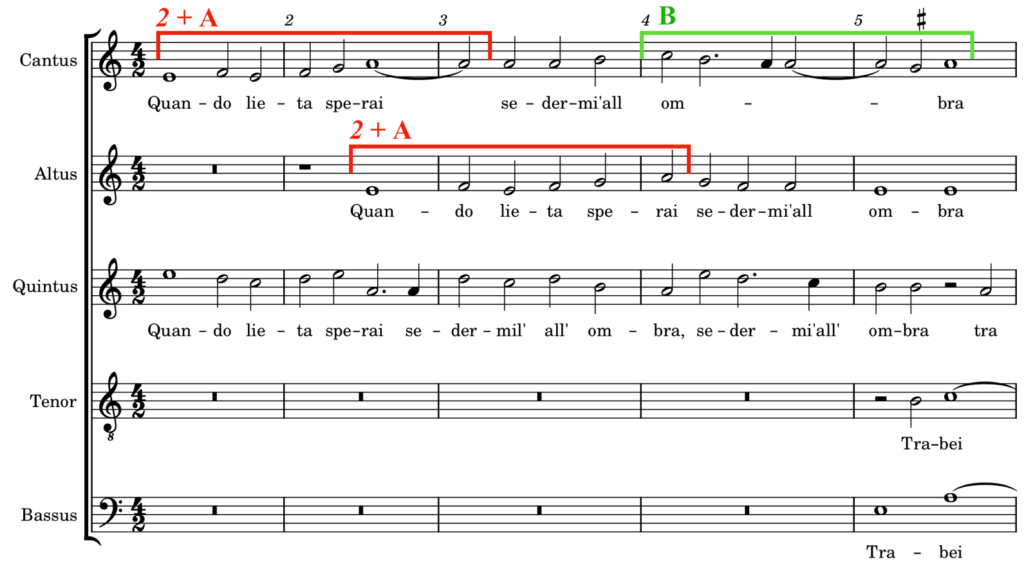
Example 3. First measures of Quando lieta sperai, mm. 1–5
The red string only appears seven times in the 84-breve madrigal. Because the lower voices enter with new text, it appears as an obvious soggetto only those two times shown in Example 3. The other five occurrences are found much later in the madrigal and each of those is rhythmicized differently. For such a “generic” melody, that might be surprising: wouldn’t you expect to find a lower neighbor and an ascending four-note scale sort of everywhere, in “just counterpoint”? One of the questions this provokes is whether the composer might have avoided using, elsewhere in the madrigal, what appears to be a significant tune.
The green core melody seems as “generic” as the red one—it is, in fact, the retrograde of the red one. One can only be amazed by the fact that the most frequent motive in the Kyrie and the most frequent motive in the Mass are actually related to each other in such a way. Furthermore, because it has all the “correct” notes to be a cantizans motion, it is often used by Rore at cadences, as it appears in Example 3. As mentioned above, this form of the melody, B3f or fa–mi–re–#ut–re [-m2, -M2, -m2, m2], occurs seven times in the madrigal but can be found in different rhythmic and melodic shapes another twenty-two times. As shown in Example 4, the Cantus line at mm. 39–40 sounds the green string without any “head.” Do we think Rore wanted to reference the cadence figure? Is the resemblance an accident?
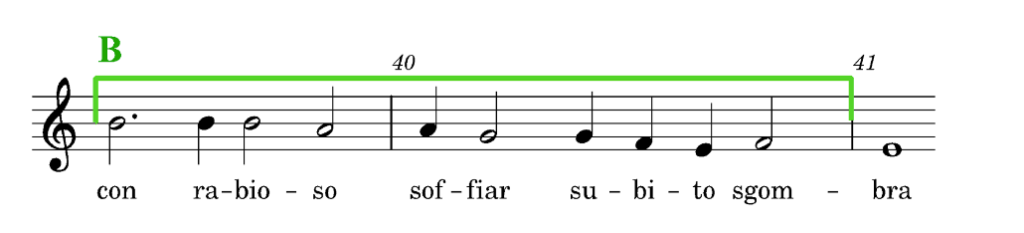
Example 4. Soggetto B at the Cantus, Quando lieta sperai, mm. 40–41
How about the one in Example 5, mm. 54–56, part of a stretto fuga? Are we meant to hear all these green melodies as related? Is the resemblance a coincidence? Is the similarity irrelevant? What defines relevance is our purpose as analysts. Once again, we can’t escape our prejudices; we’re in hot water when it comes to deciding what’s meaningful. Fortunately, the machine helps us notice thins we missed, which, in turn, exposes our assumptions.
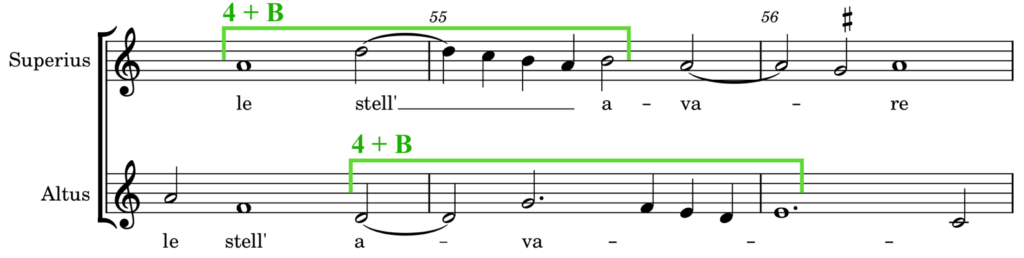
Example 5. Similarity between Cantus and Altus, Quando lieta sperai, mm. 54–56
The blind analyst reports a cluster of ten green strings in mm. 23–34, shown in Example 6. The sighted analyst cannot resist thinking that clustering might be the result of an intention of the composer: perhaps these are all soggetti, defining a section of the piece. The first one, in the bass, has a rising fifth for a head (X = 5); the pair in the two upper voices has no head (the unisons are merged); the second one in the Cantus has the same text and rhythm as the one in the bass, so we might be tempted to see a meaningful correspondence; the fifth one, in the Tenor, has an entirely different rhythm; the next four have the same syncopation as the cadential figure from Example 5, and all have a head of a rising third (X = 3). Except for the pair in parallel motion, these last four set different text phrases and appear in the middles of longer phrases. It is unlikely the sighted analyst would have noticed these similar melodic motions, due to the bias for expecting soggetti to set the same text and to be set off by rests. Rore has hidden these structural elements by preceding them with variable heads that act as as “red herrings.”
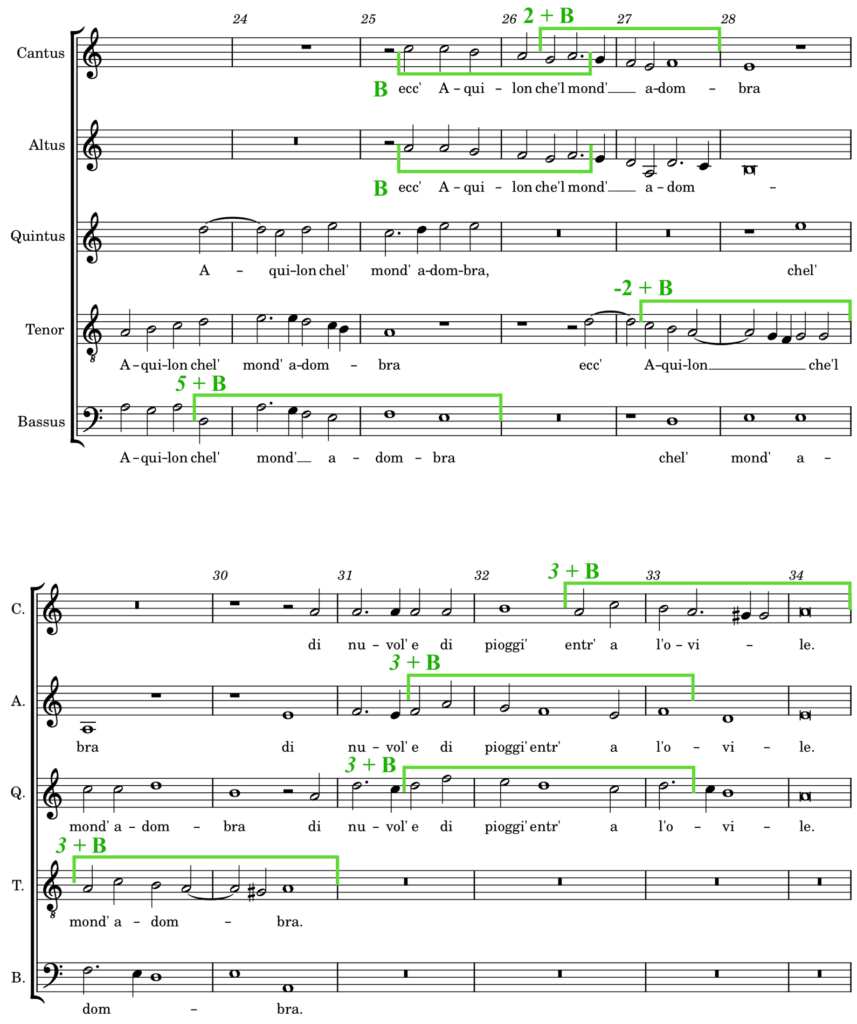
Example 6. Cluster of green strings, Quando lieta sperai, mm. 23–34,
Our understanding of compositional process will have to be revised in the light of these kinds of findings. They suggest that composers may have hidden their structural elements in longer lines, and that music and text can be recombined in more flexible ways than we thought.
Melodic strings in the Mass
Baccusi gives the red string, soggetto A, even more importance than the sighted analyst expected, by repeating it sixteen times in the first Kyrie, eighteen times in the Christe, and eight times in the second Kyrie, for a total of 32. These are diagrammed in Figure 6 by the voice in which they occur. The first five have the same head as in the madrigal. Baccusi groups these by time interval of imitation, with a longer time interval between groups (6 minims). In measure 7, Baccusi gives the melody a different head, beginning with a minor third. This version of the tune occurs six times, and after a longer time interval the original tune returns twice, followed by two entries in closer imitation (two minims, mm. 16-18). This stretto is not possible with the original version of the melody, and the sighted analyst imagines that it constitutes an intentional contrapuntal intensification the composer has saved for a climax to the first Kyrie (which ends with a singleton T-2, free counterpoint, a cadence, and a supplementum).
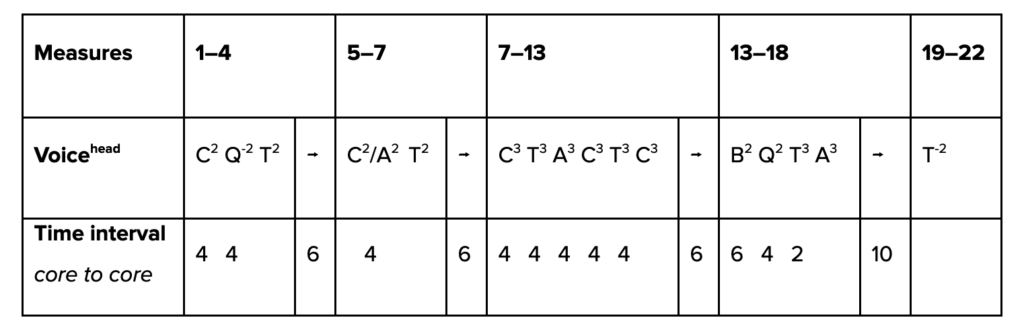
Figure 6. Kyrie, occurrences of variants based on soggetto A in the first Kyrie, mm. 1–22
C = Cantus, Q = Quintus, A = Altus, T = Tenor, B = Bassus
The arrows mark the passage from one group of imitations to another.
The Christe begins with much less regularity, mixing the two heads and different time intervals. As shown in Example 7, The sixth and seventh entries are cleverly linked in a single voice, the Cantus rising an octave. Under the second of these, Baccusi exploits the possibility of running two statements in parallel (C2 and B4 and C4 and A3). These combinations are placed around a singleton T3. This whole giant block is immediately repeated, transposed down a fourth (greyed in Example 7 and Figure 7) with some voices exchanged. Into these blocks Baccusi has woven the green soggetto B as well. Like the Kyrie, the movement ends with singletons farther apart.
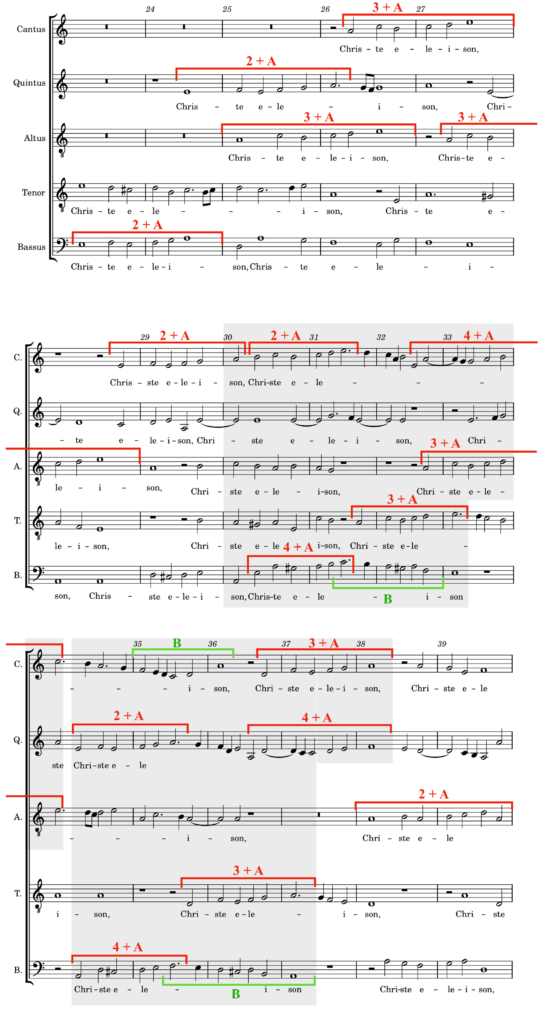
Example 7. Kyrie, occurrences of variants based on soggetto A in the Christe, mm. 28–39
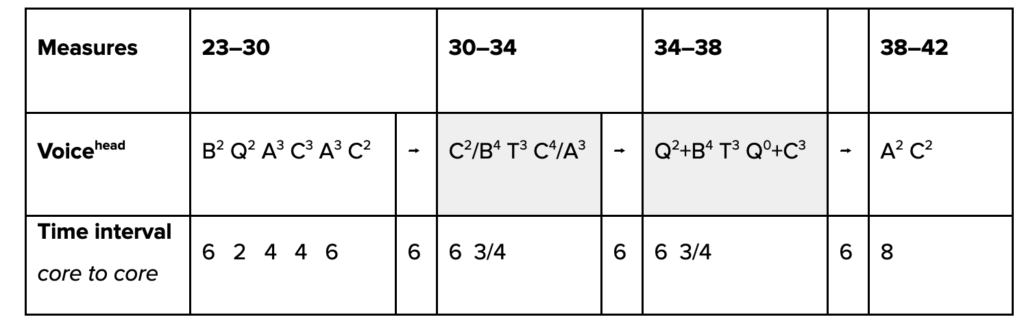
Figure 7. Kyrie, occurrences of variants based on soggetto A in the Christe
(C = Cantus, Q = Quintus, A = Altus, T = Tenor, B = Bassus)
The second Kyrie is distinguished by the use of rhythmic augmentation. It begins with two augmented versions of the red soggetto A in the Quintus that overlap with faster statements and with statements of the green soggetto B (in a kind of contrapunto ad imitatione). Some of these are also augmented (see Example 8).
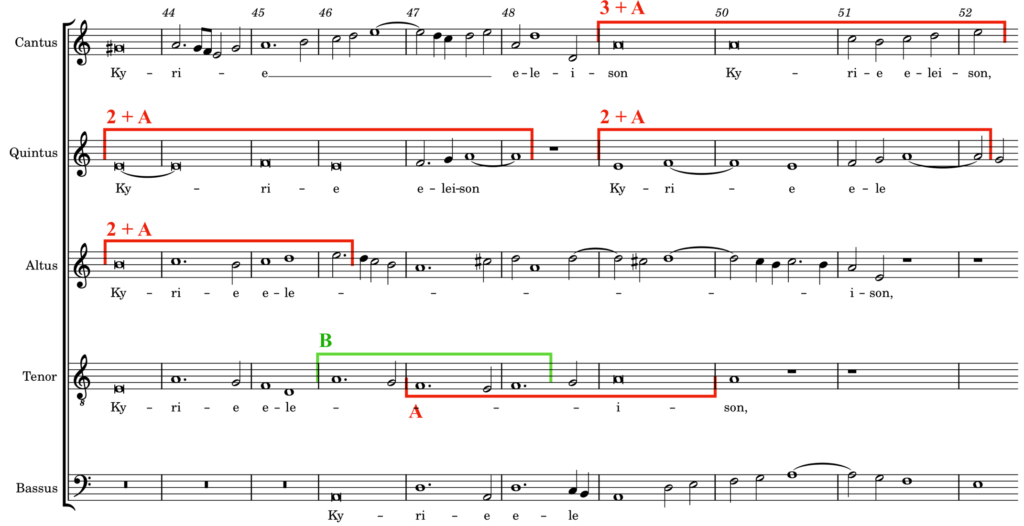
Example 8. Kyrie, occurrences of variants based on soggetto A in the second Kyrie
In one instance the red and green soggetti are overlapped in the tenor voice, making the fact that they are retrogrades obvious, as shown in Example 9. Once again, we marvel that this “generic” sequence of seven notes only appears once in the 62 breves of the movement!
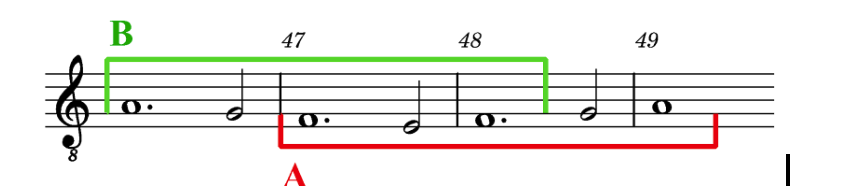
Example 9. Kyrie, the two soggetti dovetailed, Tenor, mm. 46–48
Conclusion
As music analysts, we rarely take a step back to examine the nature of our tools critically, nor do we estimate and evaluate the different phases of our work. It is only when facing a particularly vexing problem that such an occasion arises. It is however an essential step to avoid any methodological error and misunderstanding of the compositional strategies at play in a given work. Fortunately, Jean-Jacques Nattiez has provided us a clear framework to help us to operate in such hot water.
His tripartition theory is particularly effective when analyzing imitation masses in relation to their model. In our study of Rore’s Quando lieta sperai and Baccusi’s derived mass, we assumed that some repetitions in melodic intervals carried important information on compositional techniques that could have eluded us due to our analytical habits. We thus relied on computers to extract “unbiased” data to remain as neutral observers as possible. CRIM Intervals is like a musically uneducated friend who naively points out some feature of a piece that suddenly triggers a new idea and changes the perspective of the analyst. We then divided ourselves into two roles: a “blind” analyst in charge of executing requests to the computer and treating the resulting raw data, and a “sighted” analyst in charge of annotating the results in the scores and interpreting their meaning. In spite of what our cultural bias against “mere” step-motions would suggest, two such melodic patterns proved to be particularly interesting. The musical ideas that we would not have thought of, had we not followed a rigorous separation of “blind vs. sighted” analysts, include
- that meaningful motives may be hidden by preceding them with “red herrings”;
- that they may be hidden by seeming “generic” (i.e., a cantizans motion);
- that the clustering of melodic motives may be an intentional way to mark off a section;
- that the avoidance of a motive may be a deliberate way to mark off a section.
In addition, getting rid of our preconceived notions of what is and isn’t “meaningful” has allowed us to discover writing techniques that would have otherwise eluded us completely. Our role as analysts has been enhanced by the use of the computer. We are thus confident that, freed from many of their biases, many of which are the product of 19th-century notions of musical wholeness, analysts can look forward to a new age of exploration of historical music.
Bibliography
Baroni, Mario. Dalmonte, Rossana. Jacoboni, Carlo. 1995. “The Concept of Hierarchy: A Theoretical approach.” In Musical Signification: Essays in the Semiotic Theory and Analysis of Music. Ed. Eero Tarasti. Berlin: De Gruyter Mouton.
Cerone, Pedro. 1613. El Melopeo: Tractado de Musica Theorica y pratica. Naples: Gargano y Nucci.
CRIM: The Renaissance Imitation Mass. 2015–. Dir. Richard Freedman. https://guides.tricolib.brynmawr.edu/c.php?g=1277440&p=9373755.
Griswold, Wendy. 1987. “A Methodological Framework for the Sociology of Culture” Sociological Methodology vol. 17.
LaRue, Jan. 2011. “1. Fundamental Analytical Considerations.” In Guidelines for Style Analysis. Ed. Marian Green LaRue. Sterling Heights, MI: Harmonie Park Press.
Nattiez, Jean-Jacques. 1990. Music and Discourse: Toward a Semiology of Music. Tr. Caroline Abbate. Princeton: Princeton University Press.
Nettl, Bruno. 2005. The Study of Ethnomusicology: Thirty-One Issues and Concepts. Urbana: University of Illinois Press.
Pontio, Pietro. 1638. Ragionamento di Musica. Parm: Erasmo Viotto.
Schubert, Peter. 1994. “Authentic Analysis” The Journal of Musicology 12 (1).
Vendrix, Philippe. 2004. “‘La lune montait, cette lune de l’art.’” In La Renaissance et sa musique au XIXe siècle. Tours: CESR.