The Two Settings of Missa Illuminare Hierusalem by Ippolito Baccusi and Giovanni Contino: Connections beyond the Model
Alessandra Ignesti
Introduction: Two Masses, a Few Soggetti, but No Model
This paper aims to explore the relationships of melodic similarity between two Mass settings with the same title, Missa Illuminare Hierusalem, by Giovanni Contino and Ippolito Baccusi. The setting by Contino is contained in his Missarum quatuor vocum liber primus, published in 1561 (RISM A/I C 3538); the setting by Baccusi opens his first book of Masses, the Missarum cum quinque et sex vocibus liber primus, which appeared nine years later, in 1570 (RISM B/I: 1570|1a; RISM A/I B 22). Both the prints were published in Venice by Gerolamo Scotto. There are no other Mass settings with this name, which, moreover, does not have correspondence with any known liturgical text from the plainchant repertory (except, perhaps, the responsory Illuminare, illuminare Jerusalem for the Epiphany, CAO 6882). Although the title suggests that the two settings are polyphonically derived Masses (i.e., imitation Masses), neither Contino’s nor Baccusi’s settings could be associated with a polyphonic model despite careful research (Gozzi 1989; Beretta 1995). While working at my dissertation on Baccusi’s first book of Masses, I detected a few melodic similarities between Baccusi’s and Contino’s Missa Illuminare Hierusalem settings. This research hypothesis, which, in that context, could not be tested further relying on manual analysis only, has obtained final confirmation thanks to the series of customizable Jupyter NoteBooks developed in the context of Citations: The Renaissance Imitation Mass (CRIM) directed by Richard Freedman. These tools have allowed me to spot less noticeable melodic connections and to prove my thesis relying on neutral and objective results.
Contino and Baccusi are two of the many neglected musicians active during the second half of the sixteenth century in northern Italy. Born in Brescia, Contino was a well-known composer in his time and a recognized master of the Venetian school. He worked in Trent and Brescia before coming to Mantua, where he was maestro di cappella at the palatine Basilica of Santa Barbara between 1561 and 1565 (Fenlon 1980: 106). During this period, he might have come acquainted with young Baccusi. Although there is no information about when the latter left his hometown Mantua, the hypothesis that he was in contact with Contino in the early 1560s is more than pure speculation. The very fact that they both composed a setting of the enigmatic Missa Illuminare Hierusalem with clear motivic (and intertextual) connections might be a sign of their acquaintance (or, at least, that Baccusi was familiar with Contino’s Mass print).
Before exploring the relationship between the two settings, however, I need to devote some time to the description of another set of melodic correspondences that I observed between the Sanctus and the Agnus Dei of Baccusi’s Mass and the same movements of a Mass cycle that in modern chant editions is labeled as Missa XVII (Graduale triplex: 765–766). As contemporary sources such as the Giunta Gradual (Venice, 1572) demonstrates, these chant settings were associated with the Missa De Beata Virgine. This liturgical designation casts an interesting light on them, as it recalls the long-standing practice of composing Masses on cantus firmi from different movements of the Ordinary which was well-established for votive Lady Masses. The cantus firmi traditionally used for these cycles were taken from Missa IX (Kyrie Cum jubilo, Gloria, Sanctus), Missa IV (Credo, Sanctus, Agnus Dei), and Missa XVII (Sanctus, Agnus Dei). The most common schema in the sixteenth century was the following: Kyrie IX, Gloria IX, Credo I, Sanctus XVII, Agnus Dei XVII (Reese 1959), the last two being exactly those used by Baccusi. Among the Renaissance composers who contributed to the repertory of Lady Masses were Josquin, Isaac, Brumel, Arcadelt, Morales, Palestrina, and Contino, whose Missa De Beata Virgine appears in the same book of Masses that contains his Missa Illuminare Hierusalem (more on this below). Some of these composers used the cantus firmus technique, others the technique of paraphrase or a combination of the two. Although Baccusi’s Missa Illuminare Hierusalem does not belong to this repertory, it might represent an impressive new example of combinatorial creativity insofar as it mixes chant borrowings with polyphonic derivation, as the title suggests. As I will show in this paper, Baccusi appears to have assessed carefully melodic similarities between materials of different origins, which probably determined the selection of the chant borrowings themselves.
Deriving a polyphonic Mass from Ordinary chants poses obvious problems from the point of view of musical coherence because a melody will be liturgically appropriate as a cantus firmus for one movement only. The melodic similarity between the Sanctus and the Agnus Dei of Missa XVII, however, allowed Baccusi to use liturgically appropriate cantus firmi in the two final movements of his Mass without affecting the internal coherence of the work. The examination of these motivic connections will be the starting point of my analysis. Examples 1 and 2 show my full transcription of the two chant movements from the Giunta Gradual; melodic segments matching soggetti in Baccusi’s setting have been boxed and marked with tags— S1 (purple), S2 (orange), and S3 (red). Black boxes enclose the segments used in Baccusi’s setting. From now on, the melodies of the Sanctus and the Agnus Dei from chant will be referred to as cantus firmus I and cantus firmus II respectively.
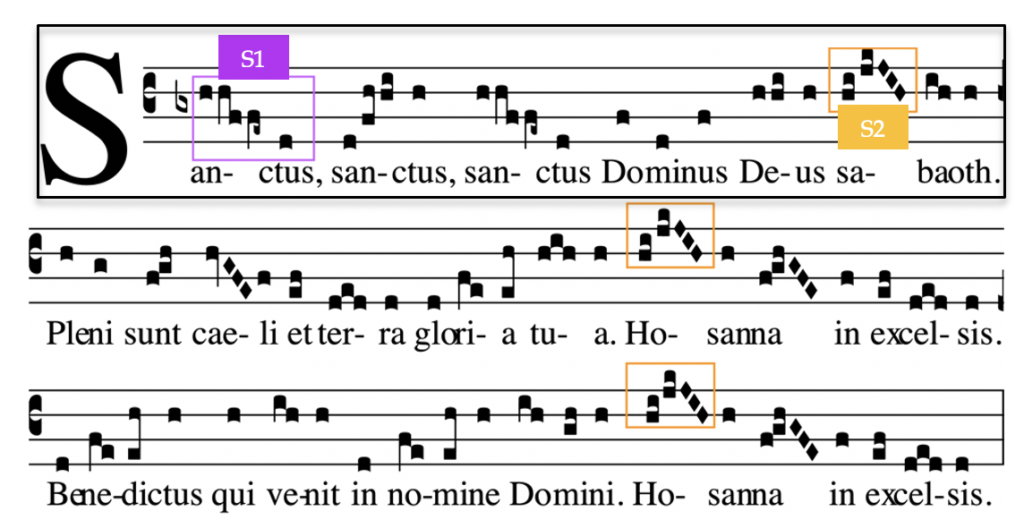
Example 1: Sanctus from Missa XVII (Giunta Gradual, vol. 2, ff. 316v-317). Recurrent motives found in the Masses are enclosed in boxes
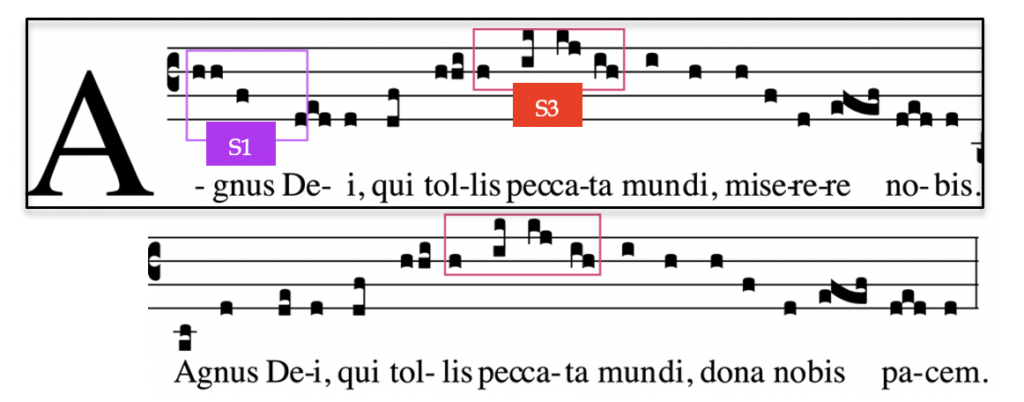
Example 2: Agnus Dei from Missa XVII (Giunta Gradual, vol. 2, f. 317). Recurrent motives found in the Masses are enclosed in boxes
I will now exemplify how Baccusi quotes this material in his Mass beginning with the full quotation of cantus firmi I and II in the top voice of the first section of the Sanctus and Agnus Dei I respectively. Figures 1 and 2 show these passages with the same colors used in Examples 1 and 2.

Figure 1 Missa Illuminare Hierusalem, Sanctus, Cantus part: cantus firmus I. All the images of Baccusi’s Missa Illuminare Hierusalem are taken form the only extant exemplar of the print preserved at the British Library. Freely available according to the JISC Collections Open Education User Licence version 1.0

Figure 2 Missa Illuminare Hierusalem, Agnus Dei I, Cantus part: cantus firmus II
Baccusi makes a few adjustments to the melodies of the cantus firmi, the most relevant of which is the replacement of the repetition of S1 with the anticipation of S2 on the third invocation “Sanctus.” Minor adjustments are made (necessarily) to cadences in both the chant paraphrases.
While projected without ambiguity in the two appropriate movements of Baccusi’s Mass, this material—limited to the three highlighted soggetti—appears in several points of imitation throughout the setting. In particular, the descending motion by thirds (S1) spelling out the structural triad of mode 5 works as a powerful unifying motivic element throughout the Mass. In all the occurrences outside the last two movements, however, Baccusi adds an ascending fifth at the end creating an opening gambit—almost a motto—easy to incorporate in the polyphonic fabric. From now on, this modified soggetto will be called S1’. As shown in Figures 3-6, it appears at the beginning of each of the first three movements as well as in the “Et in Spiritum” subsection of the Credo, with frequent unison repetitions to adjust different texts.
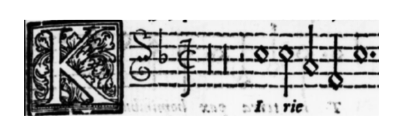
Figure 3: Kyrie, Cantus part : S1’
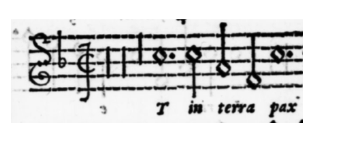
Figure 4: Gloria, Cantus part: S1’
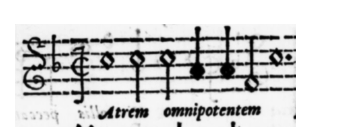
Figure 5: Credo, Cantus part: S1’
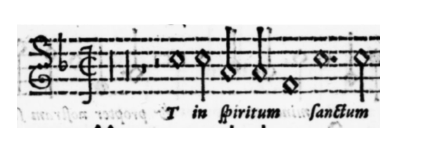
Figure 6: Et in spiritum, Cantus part: S1’
The second soggetto, S2, which corresponds with the melisma sung to the first syllable of “sabaoth” and “hosanna,” is found (among several other locations), in the Hosanna section (Figure 7). Unlike S1’, which is used almost exclusively as an opening gambit, S2 appears in several points of imitation throughout the Mass.
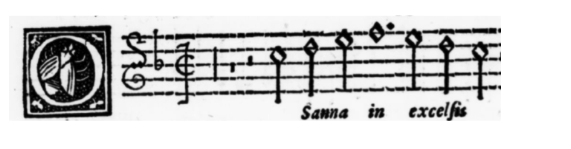
Figure 7: Hosanna section, Cantus part: S2
Finally, the archlike motive sung to “-lis peccata” (S3) appears (again, in addition to several other locations) in Agnus Dei II (Figure 8). Like S2, S3 occurs throughout the Mass both in imitation and as an isolated statement.
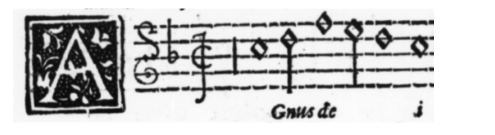
Figure 8: Agnus Dei II, Cantus part: S3
This material is used pervasively in Baccusi’s setting. It is developed, repeated, and recalled throughout the work making varied repetition the chief constructive principle of the Mass. In the first three movements, the three motives are parceled out and incorporated in the imitative texture; in the two concluding movements, they are revealed as components of the chant melody stated as long-note cantus firmus, which Baccusi combines skillfully with the technique of contrapunto fugato. This technique, which consists of placing a motive and its variations against a cantus firmus, was a way of organizing music alternative to pervasive imitation (Schubert 2008). Insofar as it results from such combination of two different techniques—polyphonic derivation in the first three movements and chant paraphrase in the last two—Baccusi’s Mass appears as a remarkable example of stylistic heterogeneity and combinatorial ingenuity. Furthermore, the juxtaposition of imitative treatment in the first three movements and long-note cantus firmus texture in the last two movements creates a neat stylistic bipartition within the Mass, in which two compositionally distinct yet melodically related projects coexist.
Contino’s four-voice setting features imitative texture throughout. It presents melodic similarities with Baccusi’s yet with the conspicuous exception of the triadic motive S1/S1’, so pervasive in Baccusi’s Mass. Instead, Contino makes frequent use of a motive related by tonal answer (here called S1’’), which is found in Baccusi’s setting as well (Examples 3 and 4). Interestingly, Contino uses the very same motive in the Agnus Dei of another Mass contained in the same book, the already mentioned Missa De Beata Virgine, which is based on the Agnus Dei from Missa XVII (Example 5). Although it is not possible to consider this setting here, it seems to be promising for future research on this topic. For now, it will be enough to acknowledge that the relationship between S1’’and the cantus firmus from Missa XVII is already found in Contino’s Missa De Beata Virgine: this might be another clue that Baccusi was familiar with the Masses published in the 1561 print.
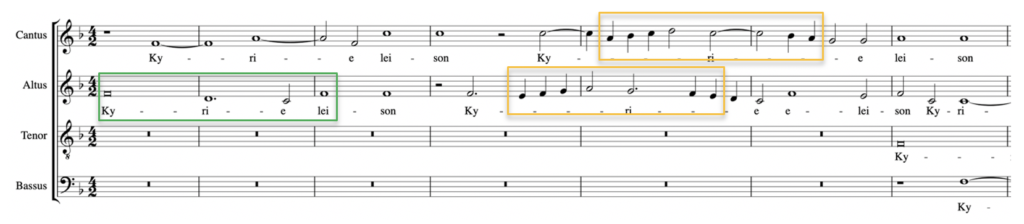
Example 3: Contino, Missa Illuminare Hierusalem, Kyrie: S1’’ (green); the archlike motive boxed in orange can be associated with S2
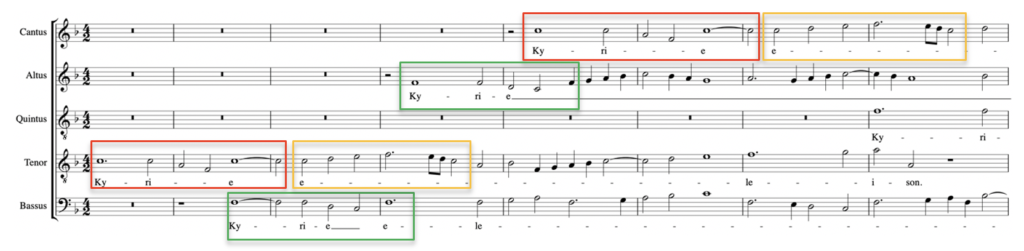
Example 4: Baccusi, Missa Illuminare Hierusalem, Kyrie: S1’ (red), S1’’ (green), S2 (orange)
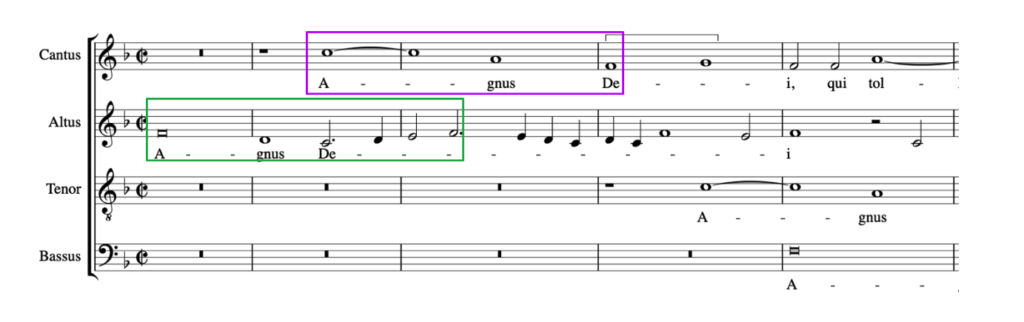
Example 5: Contino, Missa De Beata Virgine, Agnus Dei: cantus firmus with S1 (purple); S1’’ with the ascending fifth filled in (green)
This analytical overview summarizes conclusions previously achieved without the assistance of the computer. Several questions, however, remain: does Contino use the other two soggetti that Baccusi carved out of the chant melodies? Are there other (intentional) motivic connections between the two settings? Is it possible to hypothesize that Baccusi derived his Missa Illuminare Hierusalem from Contino’s setting?
The continuation of my research has benefited greatly from the series of customizable Jupyter NoteBooks developed in the context of Citations: The Renaissance Imitation Mass (CRIM) directed by Richard Freedman. The rest of this paper will present some results that provided more solid grounds for my hypotheses as well as fresh insights into the connections between Contino’s and Baccusi’s Mass settings.
A Computer-Aided Approach to the Identification of Melodic Similarities
Dealing with an indirect relationship of similarity between two Masses rather than the direct relationship between a polyphonically derived Mass and its model is challenging because it forces us to extend the comparison from one piece against five (the model against the five movements) to five against five. Detecting melodic strings shared between each pair of movements is bewildering and time-consuming, even for one single movement. For this reason, I have decided to try a non-systematic approach using the heatmap rendering available in CRIM NoteBook 08 (Model Finder and Comparisons), which helped me measure the degree of melodic similarity between the two settings as well as the internal similarity of each Mass at a “macro-level.” First, I have concentrated on each setting separately (Figures 9 and 10); then I have combined the results in one single matrix (Figure 11). This has allowed me to detect “hot” areas and restrict my search for shared melodic strings to a more manageable selection of pairs of movements.
The heatmap rendering in Figure 9 shows the degree of melodic similarity between each pair of movements of Baccusi’s Mass considering 5-grams (i.e., motives that are six notes long). The result shows, at first sight, a remarkable economy of musical material in the first four movements, which confirms the composer’s pronounced tendency to motivic reiteration in this Mass.
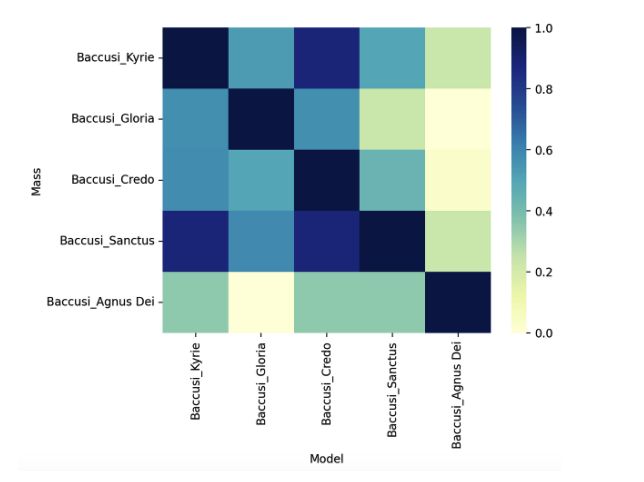
Figure 9: Melodic matrix measuring the similarities between pairs of movements of Baccusi’s Mass
In the matrix, each movement is treated once as the model and once as the polyphonic derivation. Usually, the degree of similarity is different in the two situations, although it is possible that pairs of movements display more symmetrical relationships. With one exception (24% of similarity between the Sanctus treated as the model and the Gloria) all the combinations between the first four movements display a percentage of similarity ranging from 44% to 88%. The contrast with any other pair involving the Agnus Dei is striking, especially considering the 0% of similarity between the Agnus Dei and the Gloria, regardless the latter is treated as a model or derived piece: overall, no more than 23% of the 5-grams contained in the Agnus Dei is found in any of the remaining movements. This result depends on a plurality of factors. One is the unique compositional approach used in the Agnus Dei: as observed above, Baccusi places a long-note cantus firmus at the top while repeating brief motives against it as the technique of contrapunto fugato requires (Schubert 2001). Second, as noted above, S1 (the head of cantus firmus I) differs from S1’ (see Figures 2 and Figures 3-6 above). Finally, frequent ornamentation and truncation of the shared material in Agnus Dei I make most of the soggetti unrecognizable to the machine.
The heatmap rendering for Contino’s Mass shows a lower degree of internal similarity compared to Baccusi’s. The only exception is the Agnus Dei, which represents a singularity: with the only exception of the Gloria (a curious parallel with Baccusi’s setting), it appears to contain 100% of the 5-grams of all the remaining movements (Figure 10).
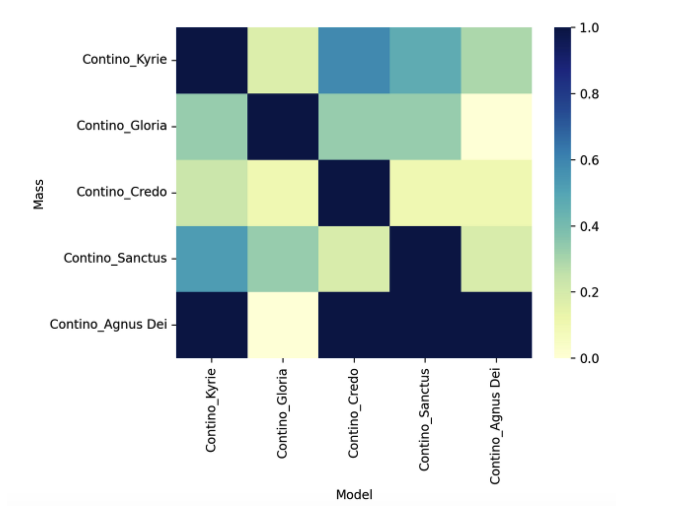
Figure 10: Melodic matrix measuring the similarities between pairs of movements of Contino’s Mass
The same singularity is observable when the comparison is extended to both the settings (Figure 11), meaning that every one of the 5 grams in all the Mass movements of both settings is found in Contino’s Agnus Dei (with the exceptions of the two Glorias). The situation does not change significantly if 4-grams are considered (Figure 12). Baccusi’s Mass displays almost the same degree of motivic homogeneity, as visible from the clear-cut, blue-shaded square in the top left corner of the matrix (enclosed in a yellow box). Less well-defined yet still recognizable is the square that represents the first four movements of Contino’s setting, which appears slightly darker in the second matrix (enclosed in an orange box).
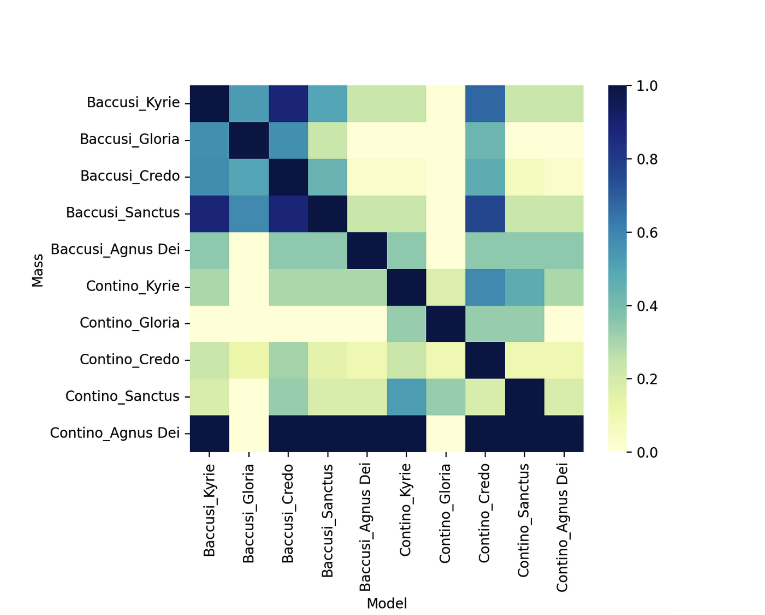
Figure 11: Melodic matrix showing the similarities between all movements (5-grams)
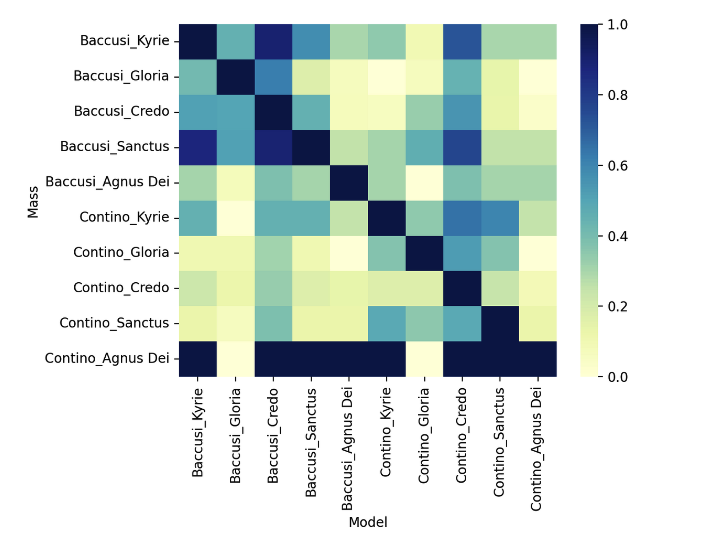
Figure 12: Melodic matrix showing the similarities between all movements (4-grams)’
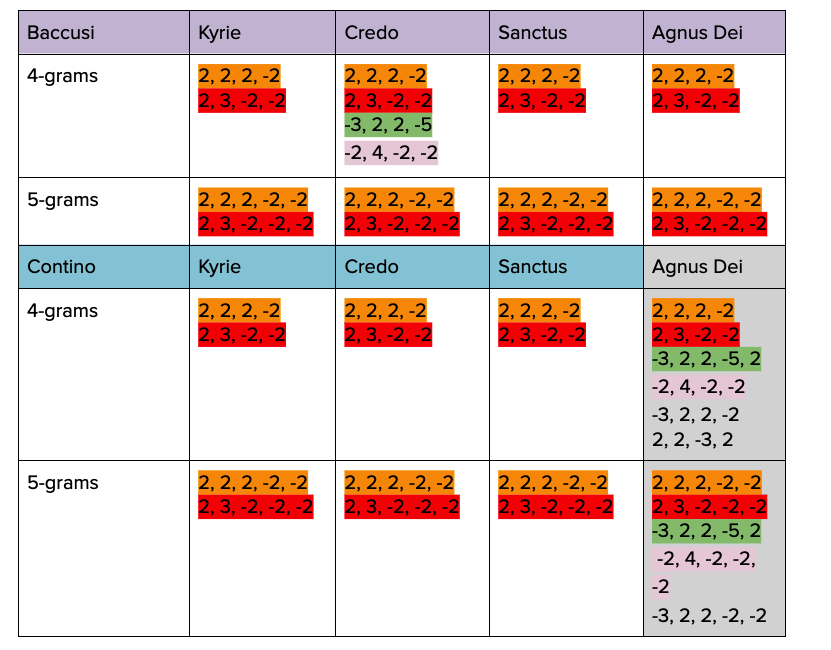
Table 1: 4-grams and 5-grams shared with the Agnus Dei by Contino. The colors used here are the same ones found in the various figures and examples above for the chant and mass excerpts
The string highlighted in pink is found once in Contino’s Agnus Dei and four times in Baccusi’s Credo; none of these occurrences appears significant. The melodic string colored in green, which appears once in the Agnus Dei and three times in Baccusi’s Credo, looks meaningful and has thus been included in the corpus of shared soggetti (from now on S4).
I will now concentrate on the use of the two most recurrent soggetti, namely S2 (= 2, 2, 2, -2, -2) and S3 (= 2, 3, -2, -2, -2) to see how much they are used. Tables 2 and 3 show the distribution of these two 5-grams across the five movements of the two settings. These results were obtained thanks to the following script suggested by Richard Freedman:
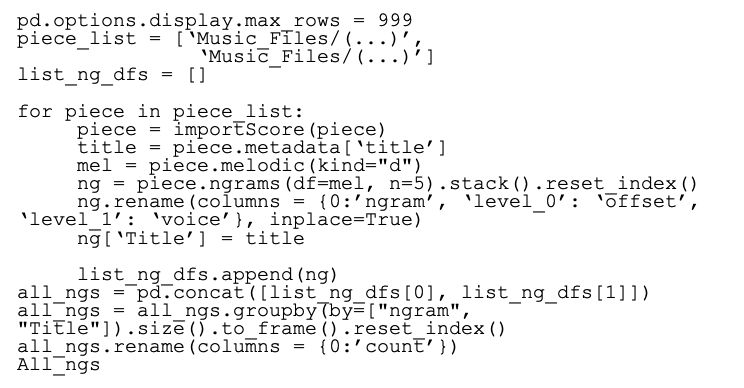
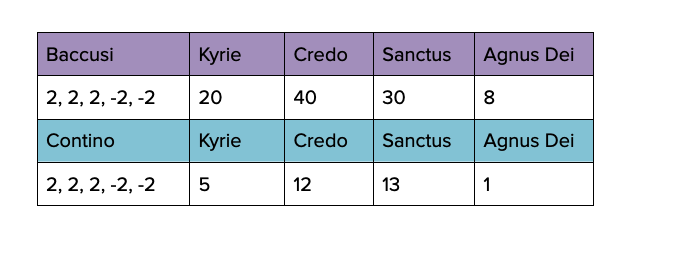
Table 2: Distribution of S2 (=2, 2, 2, -2, -2)
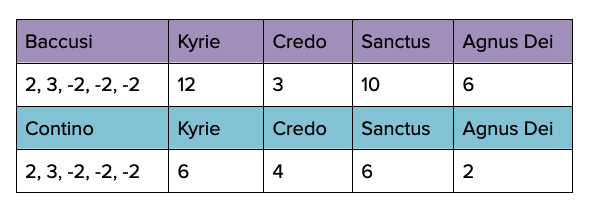
Table 3: Distribution of S3 (=2, 3, -2, -2, -2)
Contino makes considerable use of both S2 and S3; Baccusi goes well beyond using them pervasively in some movements. This is the case, for example, of the Hosanna section, substantially based on S2, and of Agnus Dei II, a relatively short section (32 breves) almost entirely based on S3. Examples will be discussed below.
The second “hot” area that leaps out of the page in the heatmaps of Figures 11 and 12 (see above) encouraged me to compare Contino’s Credo with them first four movements of Baccusi’s Mass. The percentage of 5-grams in Contino’s Credo that occur in Baccusi’s setting ranges from 43% (Gloria) to 76% (Sanctus), that is overall higher than the higher degree of similarity (59%) observed within Contino’s own setting (between the Credo, treated as the model, and the Kyrie). Table 4 shows all the shared 5-grams, always treating Contino’s Credo as the model. The situation shown in the table confirms the importance of S2 and S3 and attracts the attention on a new soggetto, from now on called S5 (colored in blue). Closer examination demonstrates that the melodic string colored in turquoise is not meaningful and associated with a soggetto.
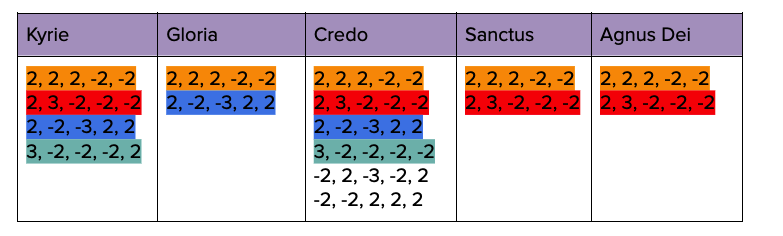
Table 4: melodic strings in Baccusi’s settings shared with Contino’s Credo
The next question is to understand where and how these motives are used by each composer. How might the placement, context, and combinations of motives help us understand the possible connections between the composers and the works? The shared 5-grams displayed in Table 4 are represented with the same colors in Figures 13–16. As observed above, those functioning as soggetti are three. This is visible already at first sight from Figures 13 and 14: the presence of clusters colored in blue, orange, and red is a clue that these 5-grams are associated with points of imitation. Moreover, as observed above, two of them correspond with well-known soggetti: the orange clusters are based on S2, while the red ones are based on S3. The blue soggetto appears in one point of imitation in Contino’s Credo and is used extensively in the first three movements of Baccusi’s Mass.
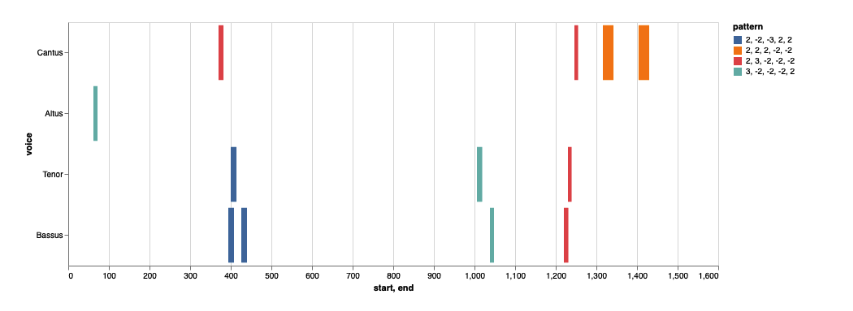
Figure 13: Distribution of the shared 5-grams in Contino’s Credo (the “model”)
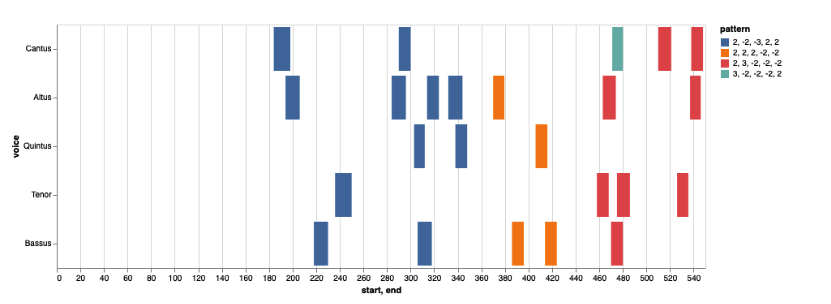
Figure 14: Distribution of the shared 5-grams in Baccusi’s Kyrie
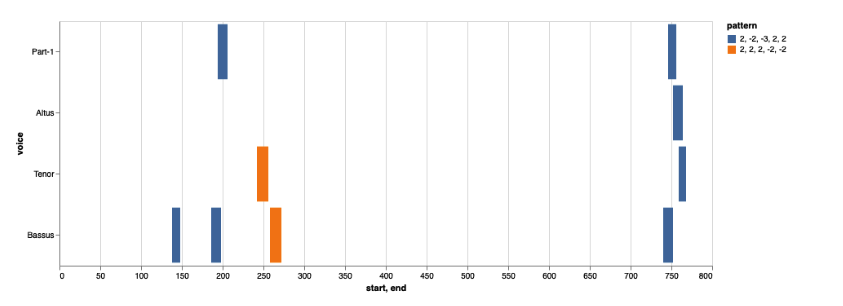
Figure 15: Distribution of the shared 5-grams in Baccusi’s Gloria
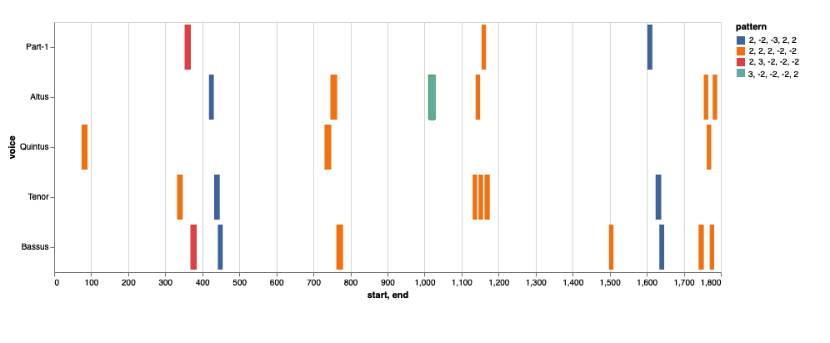
Figure 16: Distribution of the shared 5-grams in Baccusi’s Credo
In the remaining part of the essay, I will concentrate on the four 5-grams obtained from the “macro-analysis” carried out so far, which are listed below:
- S2 (= 2, 2, 2, -2, -2)
- S3 (= 2, 3, -2, -2, -2)
- S4 (= -3, 2, 2, -5, 2)
- S5 (= 2, -2, -3, 2, 2)
Although these soggetti are not necessarily the most frequently used in all the movements considered separately, at least one of them is always present among the first three most frequent 5-grams. Two of them (S2 and S3) were already known because of their association with cantus firmi I and II; the other two (S4 and S5) could hardly have been identified without the assistance of CRIM Intervals.
Back to Humans: How I Interpreted the Results
All the four soggetti listed above appear in several parts of Contino’s and Baccusi’s Masses. A few of these occurrences display a particularly deep meaning, especially if considered in the light of intertextual associations. The analysis carried out in the concluding section of this paper will concentrate on the most remarkable occurrences of these soggetti with the aim to provide further evidence about the connections between Contino’s and Baccusi’s settings as well as new insights into Baccusi’s compositional plan in relation to the preexistent setting by Contino.
Soggetto S2 [2, 2, 2, -2, -2]
This very simple archlike motive appears multiple times in every movement of Contino’s and Baccusi’s settings. On the one hand, because it is commonplace, a few of the occurrences found by the machine cannot be regarded as intentional quotations. On the other hand, especially in Baccusi’s setting, S2 appears to be particularly important, possibly because of the association with cantus firmus I. It is not an accident that this motive is often adjacent to S1’. Table 5 shows the distribution of the soggetto in the two settings.
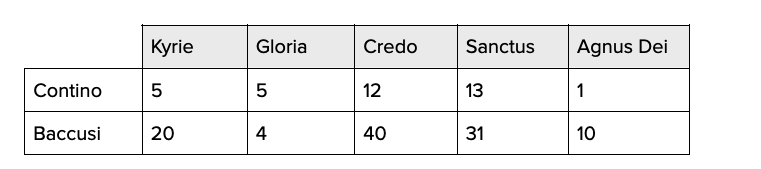
Table 5: Distribution of S2 in Contino’s and Baccusi’s settings
Although Contino uses this soggetto less frequently, he often juxtaposes an archlike melodic gesture to S1’’ in a way that recalls Baccusi’s combination of S1’ and S2. Examples 3 and 4 (see above) provide instances of these combinations in the Kyrie of the two settings.
In Contino’s Credo, S2 appears alone in two statements at the end of the movement (Example 6; see also the two orange blocks in Figure 13), although the formula might be considered a cadential cliché.
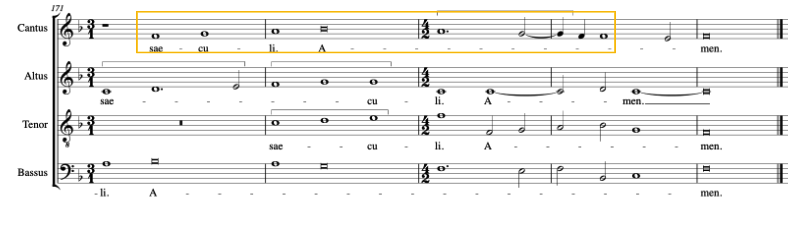
Example 6: Contino, Credo: the last statement of S2 at the end of the movement
Particularly meaningful is how Baccusi saturates the Hosanna section creating a parallel with the same passage in cantus firmus I (Example 7).
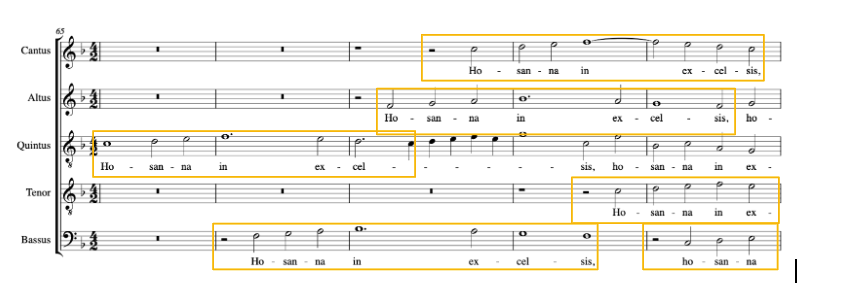
Example 7: Baccusi, Sanctus: S2 in the Hosanna section
As mentioned above, Baccusi appears to be more interested than Contino in this simple motive. My hypothesis is that this interest depends on the hybrid compositional approach he adopted in his setting, which motivated the need to create a corpus of soggetti that are compatible with both the (hypothesized) polyphonic model Illuminare Hierusalem and the cantus firmi from chant (which Contino did not use). For this reason, Baccusi might have decided to emphasize a melodic cell that, albeit somehow associated with the Illuminare Hierusalem material, was especially meaningful to him because of the cantus firmus he wanted to use.
Soggetto S3 [2, 3, -2, -2, -2]
This soggetto is probably the most relevant in terms of intertextual associations. Unlike S2, S3 possesses a more distinguished melodic profile which, in addition to the compatibility with a fragment from cantus firmus II, makes it particularly meaningful in the whole economy of Baccusi’s Mass.
Contino makes the largest use of this soggetto in the Kyrie and in the Sanctus, as evident from Table 6.
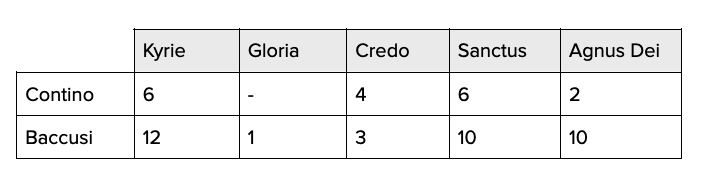
Table 6: Distribution of S3 in Contino’s and Baccusi’s settings
Particularly interesting is its pervasive appearance in the Christe, which is almost entirely based on this soggetto. Example 8 shows the incipit of this subsection. Baccusi too uses S3 pervasively in his Kyrie, more precisely in the third section (Example 9). Moreover in one passage he also appears to quote some fragments from Contino, with some recombination (which preserves a few vertical intervals): the blue fragment in the Altus appears in the Quintus as well, adjacent to the yellow fragment transposed down a third; the two descending tetrachords in green in the Tenor of Contino’s Christe are split between the Tenor and the Bassus of Baccusi’s Kyrie II; finally, the low B in the Bassus is heard in the Tenor (colored in purple). These sorts of manipulations are typical of Baccusi’s, as I have shown in my dissertation analyzing Missa Aspice Domine from the same print that contains Missa Illuminare Hierusalem (Ignesti 2022: 172–174).
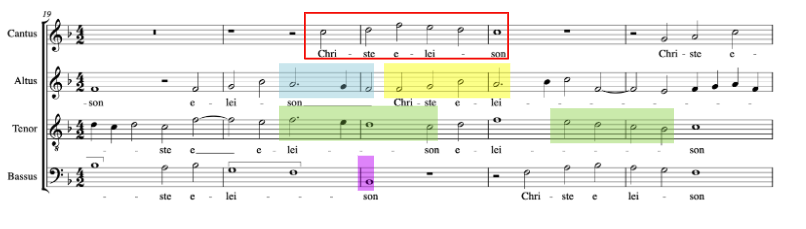
Example 8: Contino, Christe: S3 (red) and shared fragments
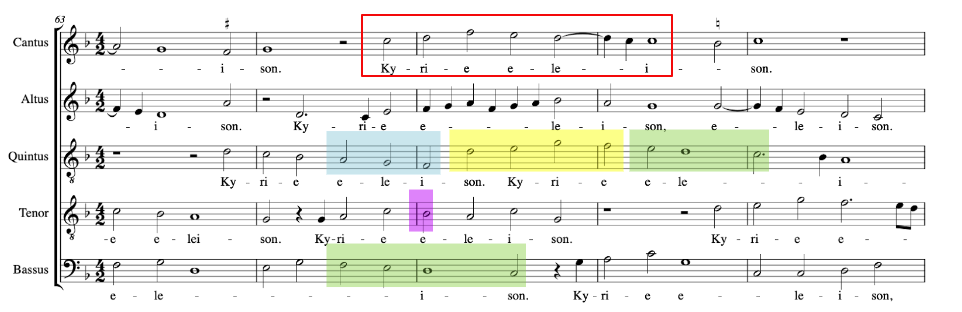
Example 9: Baccusi, Kyrie II: S3 (red) and shared fragments
Contino uses this motive twice in his Credo: first as an isolated occurrence (mm. 47–49); then within a point of imitation towards the end of the movement (mm. 152–159). The former occurrence is shown in Example 10. The soggetto is spelled out in the Cantus, sung to “per quem omnia facta sunt.” Strikingly, Baccusi uses the same motive almost at the same point of his own Credo. The passage is preceded by a fuga (mm. 44-48); then, at m. 49, the soggetto appears at the top with a slight change in the melody: the second note is C rather than D, probably to avoid bad counterpoint with the Bassus (Example 11). As seen above in Kyrie II, Baccusi appears to quote and recombine fragments from Contino’s passage. The color highlights in the examples mark all the concordances between the two passages, which can hardly be regarded as accidental.
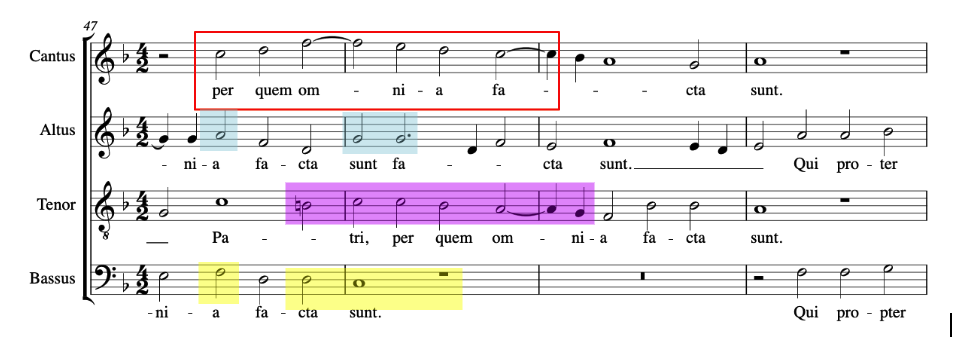
Example 10: Contino, Credo: S3 and shared fragments
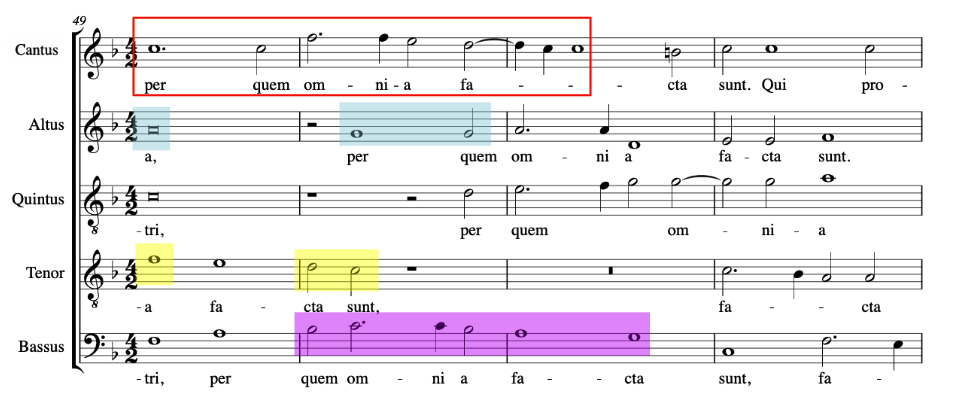
Example 11: Baccusi, Credo: S3 and shared fragments
The relevance of the motive is also confirmed by its occurrence in the opening point of imitation of Agnus Dei II (Example 12). Like the quotation of S3 in the (Example 7), the appearance of this motive in the last movement establishes a clear parallel with the corresponding section of cantus firmus II, where the melodic segment is sung to “-lis peccata.”
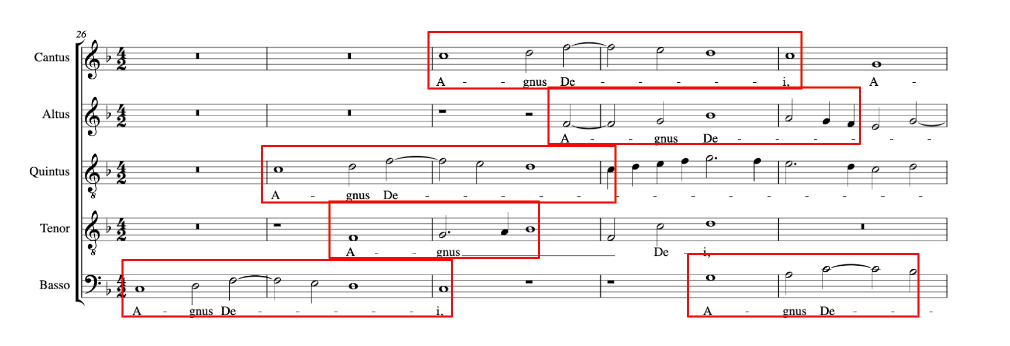
Example 12: Baccusi, Agnus Dei II: S3
As a last example, it is worth showing Contino’s use of the motive in the Hosanna section of his own Sanctus (Example 13).
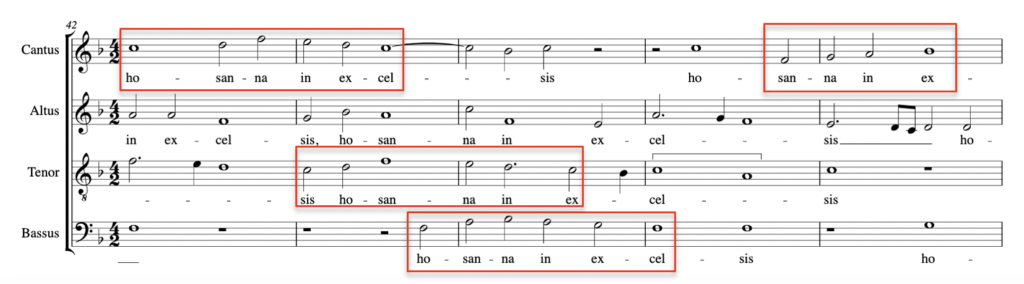
Example 13: Contino, Sanctus, Hosanna section: S3
Soggetto S4 [2, -2, -3, 2, 2]
This soggetto is much rarer than the two already analyzed, yet, notwithstanding, it occurs in a couple of meaningful passages of Contino’s Credo that have interesting parallels in Baccusi’s setting.
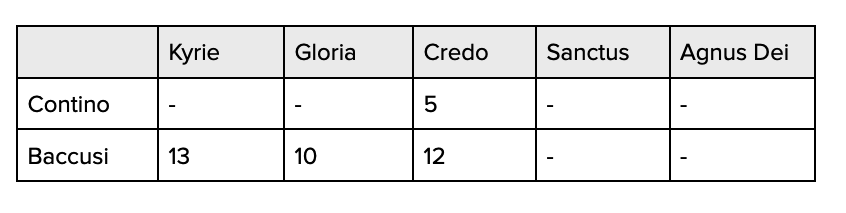
Table 7: Distribution of S4 in Contino’s and Baccusi’s settings
This motive appears only in one point of imitation in Contino’s Credo, as highlighted in Example 14. In Baccusi’s Kyrie, S4 is used pervasively throughout the Christe section (Example 15). It is impossible to ignore the intertextual relationship established with the use of this soggetto, which spells out a connection between “Qui propter nos hominem et propter nostram salutem” (that is, Christ’s mission of salvation) and the invocation “Christe eleison” in Baccusi’s Kyrie. Moreover, Baccusi associates the soggetto with the very same textual portion in his own Credo (Example 16).
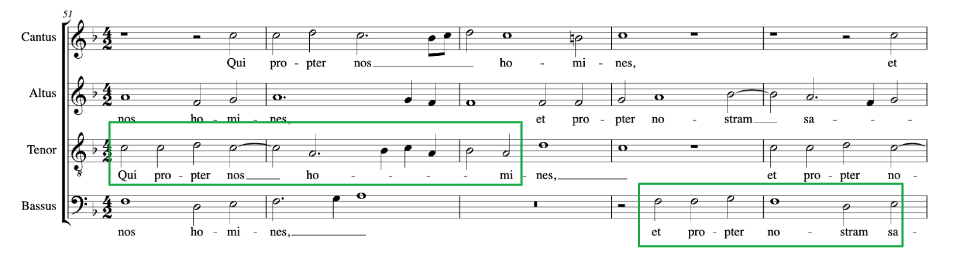
Example 14: Contino, Credo: S4
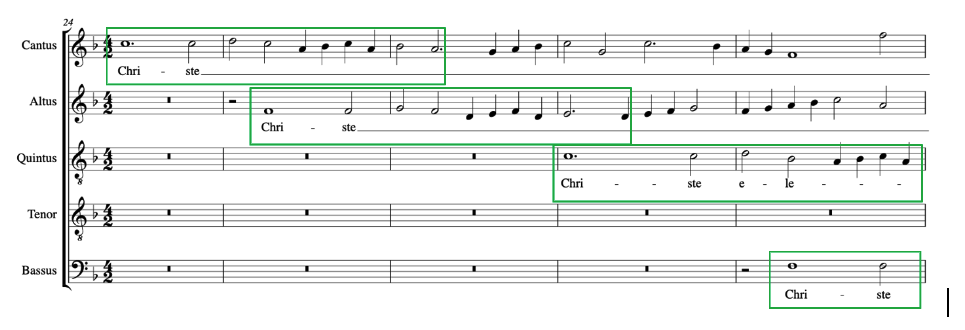
Example 15: Baccusi, Kyrie: S4
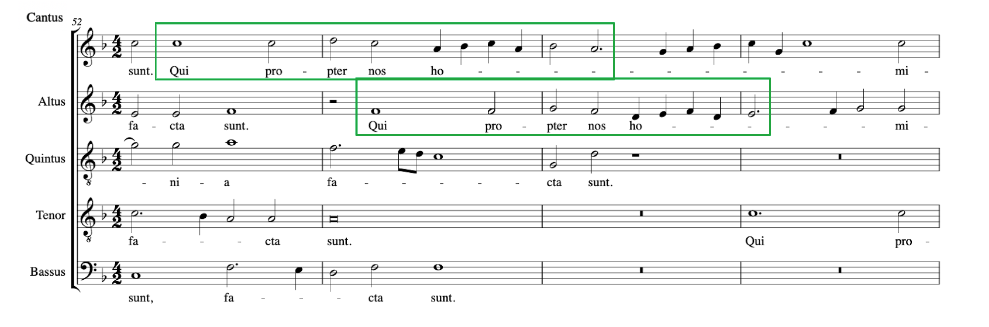
Example 16: Baccusi, Credo: S4
Baccusi’s Gloria provides one more interesting example as well: the motive appears in two main passages, one of which, sung to “propter magnam gloriam,” bears a curious grammatical resemblance with the passage in the Credo sung to “qui propter nos homines et propter nostram salutem” (Example 17).
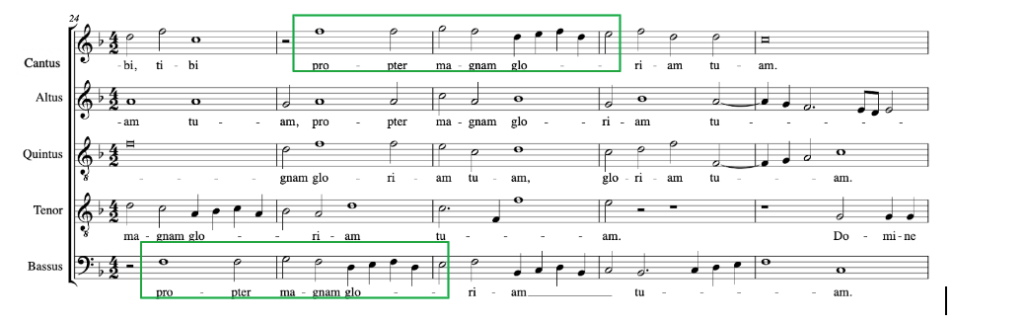
Example 17: Baccusi, Gloria: S4
Soggetto S5 [2, -2, -3, 2, 2]
In Contino’s Angus Dei, this melodic string is the head of a well-definite soggetto sung to “miserere nobis” (Example 18). In the most significant of the three passages in Baccusi’s Credo, the same soggetto is heard in a point of imitation that involves the Tenor and the Bassus (Example 19). The melodic excerpt is repeated with the same pitches everywhere and almost with the same note values; furthermore, the head of the motive sung by the Cantus in Contino’s setting (in the yellow box) enters with the same time interval of imitation as the two entries in Baccusi’s setting creating the same vertical 3-Gram at the distance of an octave (black dotted box).
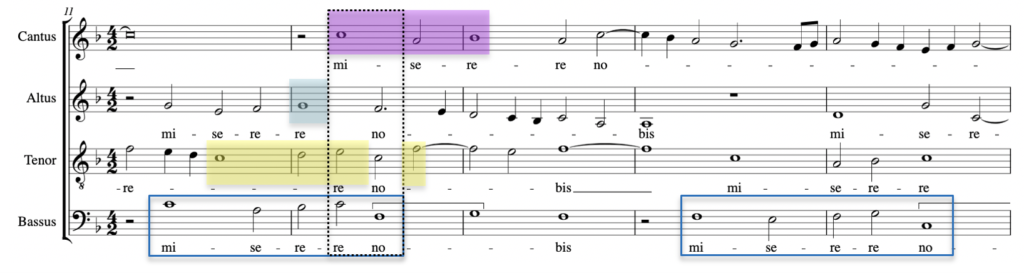
Example 18: Contino, Agnus Dei: S5 and common fragments
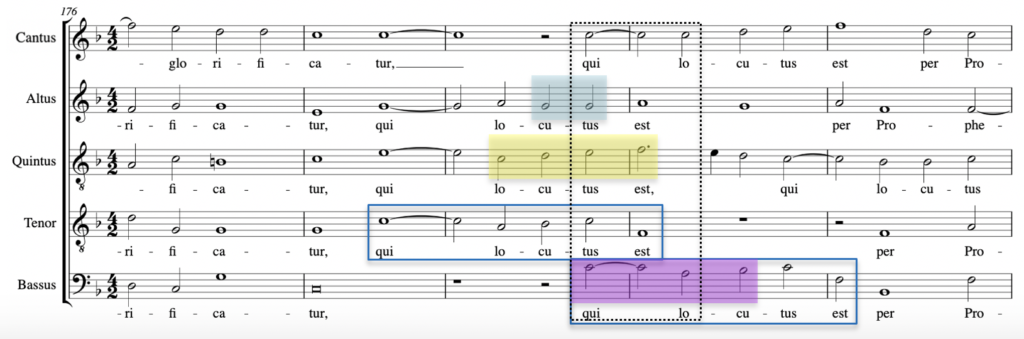
Example 19: Baccusi, Credo: S5 and common fragments
Conclusions (and Questions)
The analysis carried out in this paper was meant to test my hypothesis about the existence of a relationship between Contino’s and Baccusi’s settings of Missa Illuminare Hierusalem; in addition, it was expected to expand the corpus of known soggetti shared between the two Masses. Because the connections between Baccusi’s setting and the melodies of cantus firmi I and II from Missa XVII are strong enough to be considered objective, I have allowed myself to ground my analysis on the conclusions reached in my previous work. Thanks to this procedure, I could come to conclusions as I would not have been able to do with a completely neutral approach. Future research on this topic meant to dig into Baccusi’s sophisticated combinatorial ingenuity would surely benefit from a more neutral approach as Sylvain Margot and Peter Schubert have demonstrated in their CRIM paper (Margot-Schubert 2023).
My assumptions about Contino’s and Baccusi’s Masses, however, have not interfered with the identification of the melodic strings shared by the two settings. Relying on CRIM Intervals tools for macro-analysis in NoteBook 08, I have been able to detect the movements that display a higher degree of melodic similarity obtaining a corpus of four shared soggetti. This corpus is not presented here as comprehensive. Previous non-systematic comparisons between the two Masses have already revealed the existence of correspondences that have not been considered in this paper. These correspondences concern the conclusions of the two Kyries (Ignesti 2022: 124–125) and melodic fragments sung to “Et resurrexit” and “Et ascendit” in the Credos (Ignesti 2022: 135–137). The associated n-grams have not emerged in the analysis carried out in this paper both because of their limited occurrence and because they involve shorter n-grams (2-grams and 3-grams, with combined unisons). Again, new research passing through the data with a fine-toothed comb is surely necessary.
In addition to the existence of frequently used shared material, evidence has revealed deep connections between Contino’s and Baccusi’s settings. The intertextual associations established by a few soggetti—which, sometimes, concern the very same textual segments, as in the case of “per quem omnia” in the two Credos—suggest that Baccusi had in mind Contino’s Missa Illuminare Hierusalem when composing his own setting. Whether this depends on the use of the same (hypothetic) polyphonic model or from Baccusi’s direct borrowings from Contino’s setting cannot be established at this point. The latter scenario would be surely unusual in the repertory of imitation Masses.
Part of my research hypothesis — more precisely, Baccusi’s unorthodox commixture of polyphonic derivation and paraphrase techniques in his Missa Illuminare Hierusalem — was already emancipated from existing beliefs and common expectations associated with sixteenth-century polyphonic Mass composition. While maintaining the strictly conventional nature of the genre as a rule of testing—to be regarded as part of the “world-picture” of Renaissance sacred music, as Ludwig Wittgenstein might say—I have acknowledged the possibility of such an unorthodox treatment which, as far as I can tell, is unparalleled in the repertory. World pictures, though, are not unchangeable; on the contrary, as Wittgenstein maintains, “a language-game does change with time” (Wittgenstein 1953, § 256) and one of the ways it evolves is through “family resemblance.”(Wittgenstein 1953, § 67) One of my conclusions, after verifying how Baccusi emphasizes soggetti such as S2 and S3 that, although present in Contino’s setting, are much less visible and relevant than in Baccusi’s Mass, is that the latter carried out a modification of the usual procedure of Mass composition, which was nonetheless familiar enough to be still understandable to his contemporaries. A question, for us, could be whether we need a new term for processes of derivation from hybrid material, such as polyphony and chant, or from Mass to Mass. Be as it may, the example of Baccusi’s Missa Illuminare Hierusalem warns us about the possibility of non-obvious associations between Mass titles and musical borrowings, not rarely motivated by extra-musical reasons.
Bibliography:
Beretta, O. 1995. “Preface.” In Giovanni Contino, Missarum quatuor vocum: liber primus (1561). Milan: Suvini Zerboni.
Fenlon, I. 1980. Music and Patronage in Sixteenth-Century Mantua. Cambridge: Cambridge University Press.
Freedman, R., Fiala, D. Russo-Batterham, D., Viglianti, R., Walter, M. 2014. Citations: The Renaissance Imitation Mass, https://crimproject.org
Gozzi, M. 1989. “Preface.” In Giovanni Contino. Messa Illuminare Jerusalem a quattro voci (1561), V-X. Cremona: Editrice Turris.
Graduale triplex. 1979. Solesmes: Abbaye Saint-Pierre de Solesmes
Ignesti, A. 2022. Ippolito Baccusi and the Musical Culture of North-eastern Italy (dissertation). McGill University.
Il graduale Giunta (Venezia 1572). 2013. Monumenta liturgiae et cantus 2. Edited by Marco Gozzi. Lucca: Libreria musicale italiana.
Margot S., Schubert, P. 2023. “With Baccusi in the Jacuzzi; or, How I Learned to Stop Worrying and Love Numbers.” In CRIM Essays and Explorations, ed. Richard Freedman. Haverford College and CRIM Project.
Reese, G. 1959. Music in the Renaissance. Rev. ed. New York: Norton.
Schubert, P. 2001. “Counterpoint Pedagogy in the Renaissance,” in The Cambridge History of Western Music Theory, edited by Thomas Christensen, 503–33. Cambridge: Cambridge University Press.
Schubert, P. 2008. Modal Counterpoint, Renaissance Style. New York-Oxford: Oxford University Press.
Wittgenstein, L. 1953. Philosophical investigations, translated by G.E.M. Anscombe. Oxford: Blackwell.