Lasso Remembers Sandrin: Quotation and Form in Missa Doulce memoire
Vlad Praskurnin (McGill University)
Marked score and other supplementary materials available at: https://github.com/CRIM-Project/Essays_Explorations/tree/main/Praskurnin
Introduction
This essay presents an analysis of Lasso’s Missa Doulce memoire, paying particular attention to Lasso’s use of quotation from his model, the well-known Sandrin chanson, to articulate formal organization. After briefly discussing formal aspects of Sandrin’s chanson, I illustrate three types of quotation occurring in Lasso’s Mass, namely “polyphonic block,” soggetto, and motivic quotation, and subsequently explore the different uses of these quotation types throughout the Mass movements. Following my analysis, I propose a methodology for using CRIM Intervals to assist analysts in detecting quotation in homorhythmic settings. Through my discussion, I aim to provide some insight into the compositional process in the imitation Mass by addressing issues such as the extent to which quotation influences the individual Mass movement’s form, the justification for using a given quotation in a given place, and the justification for changing or developing quoted material.
Sandrin’s Chanson
Sandrin’s Doulce memoire first appeared in Attaignant’s 1538 collection, entitled Second livre contenant XXVII Chansons (RISM B/I 153811). Its homorhythmic texture and syllabic text setting achieve the ideal of clarity and simplicity embraced by 1530’s Parisian chanson. [An annotated score is available via this supplementary website: https://github.com/CRIM-Project/Essays_Explorations/tree/main/Praskurnin.] Table 1 provides a formal overview of the piece. The form is a typical AAB: the music of verses 1–2 is repeated for verses 3–4, and verses 5–8 make up part B. Part B’s closing phrase is immediately repeated and followed by a brief supplementum. As a general guideline, each verse tends to be set with a single musical phrase, as delineated by a single, clear cadence. Based on these cadence-delineated phrases, I have chosen to divide the chanson into seven sections, assigned in Table 1’s last column. Such a segmentation of the model reflects Lasso’s quotation within the Mass and will consequently prove convenient in the subsequent discussion; I will henceforth refer to these phrases as Sections 1–7 (always capitalized) of the model.
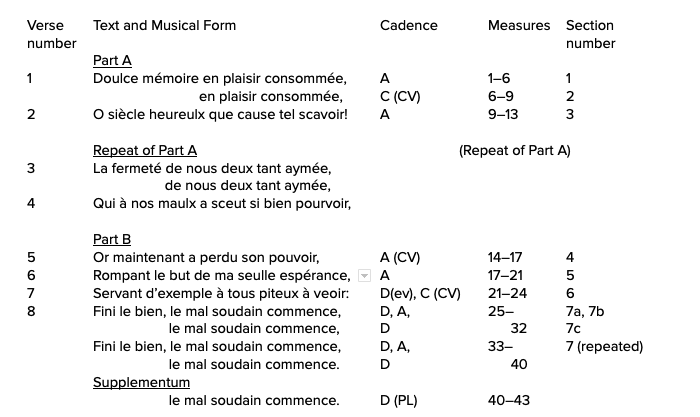
Table 1: Sandrin’s “Doulce Memoire”: Summary of Form
Note to Table 1: Cadences are Authentic, unless specified as Clausulae Verae with “CV” or Plagal with “PL”; an evaded cadence is abbreviated with “ev”.
There are three significant deviations from the above guideline of one cadence per verse-phrase, the discussion of which will provide some formal insight into the piece. First, Sandrin chooses to repeat the words “en plaisir consommee”, the second half of the poem’s first verse, to new music; since the new musical phrase resultant from this textual repetition ends with its own cadence, I consider the new passage a new section, Section 2. Second, I have grouped mm. 25–32, despite featuring three cadences, into a single Section 7 for two reasons: first, because the passage is repeated in its entirety, and second, because it is unified by a change of texture to hitherto absent running quarter notes, beginning with the Superius’s striking ascent in m. 25 and continued in m. 28 and 30–31 (see Example 1).
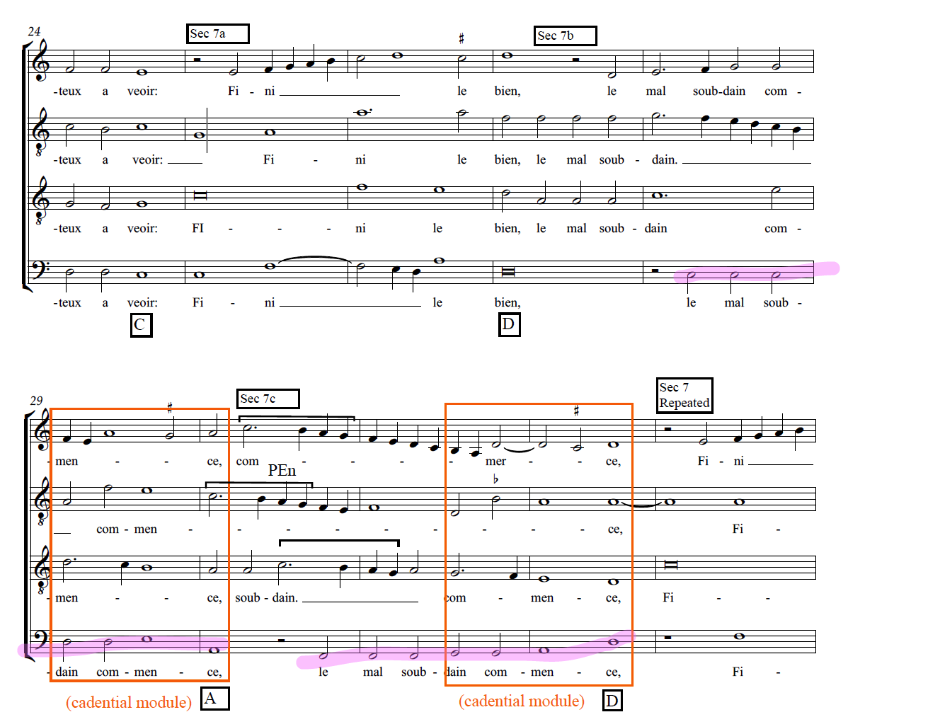
Example 1: Model’s Section 7, mm. 25–32. Sections 7b and 7c contain transpositions of the same Bassus part, allowing a cadential module to be created.
The section is nonetheless subdivided by these cadences into three subsections, 7a–c. Mirroring the repetition of the first verse’s second half, the last verse’s second half, “le mal soudain commence” set by Section 7b, is repeated in Section 7c, but in this case partly preserving the musical material: the Bassus phrase is transposed down a fifth while the top parts are partially recomposed, notably to include a three-voice PEn in mm. 30–31 but repeat the cadence of mm. 29–30 in mm. 31–32. (This essay will employ the technique of modular analysis formalized in Schubert 2007, as well as its associated terminology. The term “cadential module”, shortly to be introduced and employed in Example 1 to designate the modular repetition of a quoted cadence, is, however, mine. For a modular approach to the imitation Mass similar to the one employed here, see Lessoil-Daelman & Schubert 2013.) Third, Section 6 features two cadences and consequently two phrases (see Example 2).
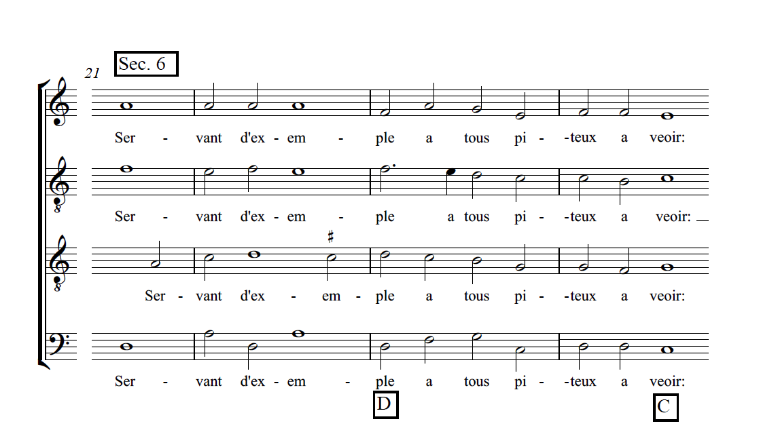
Example 2: Model’s Section 6, mm. 21–24, featuring two cadences for a single verse
I include both phrases in Section 6 because the cadence to D in m. 23 is weakened in several ways: first, by the displacement of the authentic cadence’s cantizans-tenorizans framework into the Tenor and Altus respectively; second, by the Altus’s unnecessary tenorizans evasion; and third, from a textual perspective, by occurring mid-verse (recognition of a section would make the passage only four semibreves long). The use of an evaded cadence after Section 7’s “Servant d’exemple” seems to consolidate a trend, established in Section 1 (“Doulce memoire”) and Section 4 (“Or maintenant”), of subdividing the musical phrases corresponding to the odd-numbered poetic verses into two phrase-segments, the first of which sets the verse’s first two iambs. This cadential evasion, the only one in the piece, also retrospectively highlights the syntactic strength of cadences throughout the piece, for cadential voice functions are otherwise always in their normative voices, and reaffirms the importance of cadences as formal markers of ends of verses (the aforementioned Section 7a cadence being the other exception).
Overview of Lasso’s Quotations from the chanson
Sandrin’s chanson was a quite popular source for musical borrowing and recomposition. In addition to numerous chanson reworkings, Clemens non Papa borrowed the chanson’s top voice for the last verse of his Magnificat primi toni, and Cipriano de Rore used the chanson as the basis for a five-voice mass setting; yet the most famous Doulce memoire mass is surely Lasso’s four-voice setting (for a thorough discussion of settings and reworkings, see Dobbins 1969, 93ff.). The earliest known source for Lasso’s mass is the D-As Tonkunst Schletterer 49 manuscript, dating c. 1568–69, where it is featured along with four other Masses, two of which are also by Lasso and based on French chansons. It seems likely, then, that the Mass was written in the years shortly after 1563, when Lasso took up leadership of the chapel at Duke Albrecht V’s Munich court. The Mass was first printed in a 1577 collection entitled Missae variis concentibus ornatae… (Paris, LeRoy & Ballard), along with five other Masses by Lasso (Haar, 2001).
My analysis will discuss three broad categories of quotation employed by Lasso: quotation of a polyphonic block, quotation of a soggetto, and motivic quotation. Each of these three types of quotation will be illustrated with examples from Kyrie I. The quotation of a polyphonic block, or “block quotation” for short, occurs when one of the model’s sections is quoted in its entirety, untransposed, with all its voices (Example 3). At the most basic level, block quotation involves the swapping of the model’s text for that of the Mass movement, but regularly necessitates rhythmic adjustments in individual voices to accommodate the new text and sometimes features minor melodic embellishments; thus, in CRIM relationship terminology, “Quotation with Monnayage”. Example 3, however, illustrates exact quotation; see https://crimproject.org/relationships/2824/. Occasionally only a fragment of one of the model’s sections (usually the section’s opening fragment) is quoted; I will refer to this quotation as fragmentary block quotation.
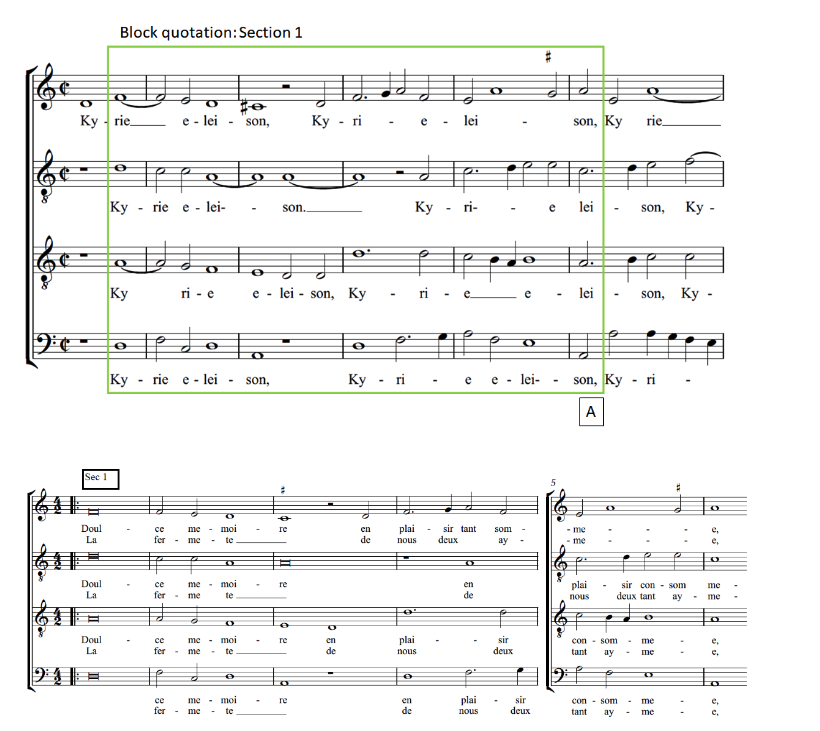
Example 3: Block quotation of Section 1 (boxed in green) which opens the Kyrie (above), and, for comparison, Section 1 of the model (below)
Soggetto quotation is defined as the presentation, in the same voice but with new surrounding material, of a voice part which was first presented within a polyphonic block quotation. While Lasso’s quotation of blocks of polyphony has been often mentioned in the secondary literature (both Lessoil-Daelman and Orlich, for example, note the alternation of passages directly borrowed from the model with freely composed episodes; Lessoil-Daelman 2002, 191 and 193, and Orlich in Lessoil-Daelman 2002, 14), the subsequent extraction of a single soggetto from a block quotation to serve as the basis of an immediately following new homorhythmic passage, as will be shown to be often the case, has been little discussed (for a similar case featuring the extraction of two voices, the Bassus and Altus, see Crook 1994, 162-163). In Example 4, soggetto quotation occurs in mm. 8–9 and again in mm. 10–12 (highlighted in red); the soggetto is taken from the second half of the Bassus part in the block quotation of Section 1. See the CRIM relationship for the soggetto quotation of mm. 8–9 (https://crimproject.org/relationships/2825/); because the soggetto is transposed, the relationship is considered in CRIM terminology a Mechanical Transformation rather than a Quotation. Soggetti presented in this way often feature cadential motion; when the soggetto’s new accompanying voices reproduce their original cadential roles, as is sometimes the case, a modular repetition of the polyphonic block’s cadence results. I will refer to this as the soggetto’s formation of a “cadential module”. In Example 4, a cadential module is created in mm. 11–12, as all four voices briefly reproduce the cadence in mm. 5–6. The cadential module consists of the fragments highlighted in orange and the Bassus part below them (see also Example 1; see https://crimproject.org/relationships/2827, considered a mechanical transformation of the cadence due to the inversion of voices, ).
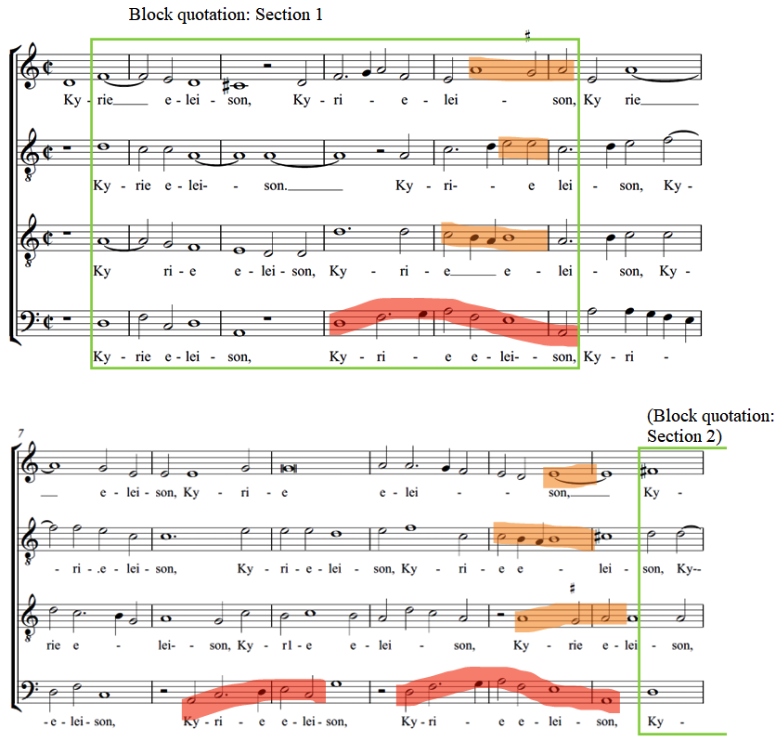
Example 4: The same block quotation of the model’s Section 1 (boxed in green), followed by two soggetto quotations in the Bassus (highlighted in red). A cadential module results in mm. 11–12 (its cadential voice functions are highlighted in orange above the Bassus soggetto).
The span between a soggetto quotation and a block quotation can be conceptualized as two ends of a spectrum; there are many gradations between these two quotation types evident in the Mass. On the one hand, cadential modules can be thought of as an amplification of a soggetto quotation, hence much closer to a soggetto quotation than a block quotation. On the other hand, approaching yet not quite reaching a full block quotation, there are cases where other voices begin a block quotation slightly after the Bassus begins its soggetto, thus resulting in a full Bassus soggetto statement but a slightly incomplete block quotation (see Example 5). Such cases, occurring only for Sections 7b–c, can be referred to as the creation of a fragmentary polyphonic block from an ongoing soggetto. While a cadential module features the creation of a module from a block quotation which has already appeared, fragmentary block quotation from an ongoing soggetto introduces that polyphonic block for the first time. This distinction aside, however, cadential modules and fragmentary block quotation from an ongoing soggetto together illustrate the possibility of achieving a full continuity in the spectrum from soggetto to block quotation.
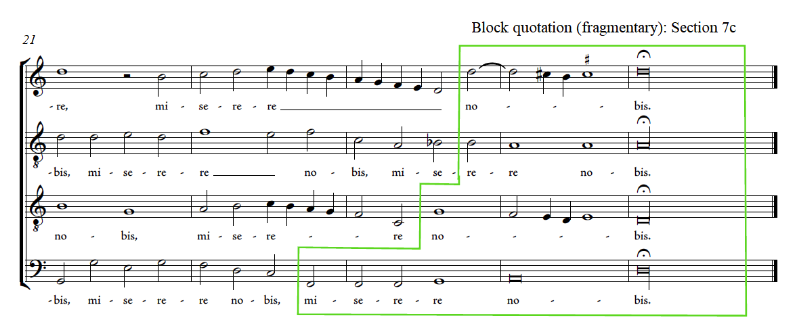
Example 5: Fragmentary block quotation from an ongoing soggetto, here from Section 7c, for the end of the Agnus Dei (mm. 21–25; the Superius part is quoted an octave higher than in the model)
Finally, motivic quotation appears in the motivic use of the Romanesca, a four-sonority progression commonly used as a ground bass for dance pieces, which occurs at the very opening of the chanson (Example 6). The Romanesca is constructed according to a commonplace formula for improvising four-voice polyphony now referred to as the parallel-sixth model (Schubert 2008, 245). While found frequently throughout the Renaissance, the Romanesca acquires motivic significance in Lasso’s Mass by being characteristically employed in two manners. In the first, the Romanesca is presented before an important formal boundary in a Mass movement, thus acquiring a formal association with ending in addition to its association with the chanson’s opening. In addition to its formal location, its status of a genuine quotation rather than an instance of the commonplace parallel-sixth model is suggested by the preservation of the chanson’s distinctive minim-minim-semibreve-semibreve rhythm. This use of the Romanesca is illustrated in Example 7, featuring two Romanescas which end Kyrie I. The use of the Romanesca as a marked of ending can be attributed to the ease with it can be used to set up an authentic cadence, as here, or to create a D-A plagal cadence (as in the end of the Christe, mm. 41–43, not shown). Other cases of this motivic use of the Romanesca, not shown, are found on “resurrectionem” near the end of the Credo (mm. 145–147, as if “resurrecting” the opening motive) and on the last words, “gloria tua”, of the Sanctus (mm. 31–32; for all cases, see ahead to Figure 2). In its second type of quotation, the Romanesca is is presented in retrograde as a means of word painting; it is identified as a quotation by being set in breves. The motivic use of the retrograde Romanesca will be illustrated in the discussion of the Gloria and Agnus Dei. (These two categories aside, there are a few occurrences of the Romanesca throughout the Mass which I have deemed non-motivic because the chanson’s rhythm is not preserved).
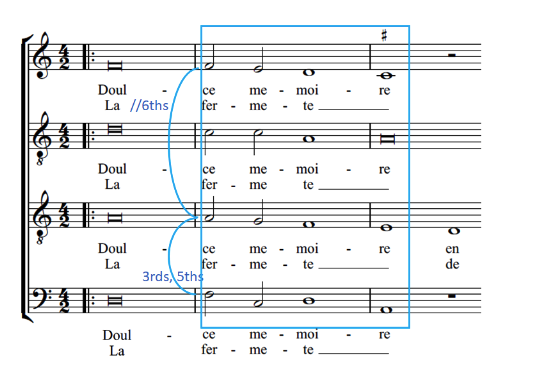
Example 6: Romanesca (boxed), in the opening of Sandrin’s Chanson. The parallel-sixth model functions as follows: the Superius proceeds in parallel sixths with the tenor, the Bassus alternates between thirds and fifths with the Tenor, and the Altus alternates between thirds and fourths with the Tenor.
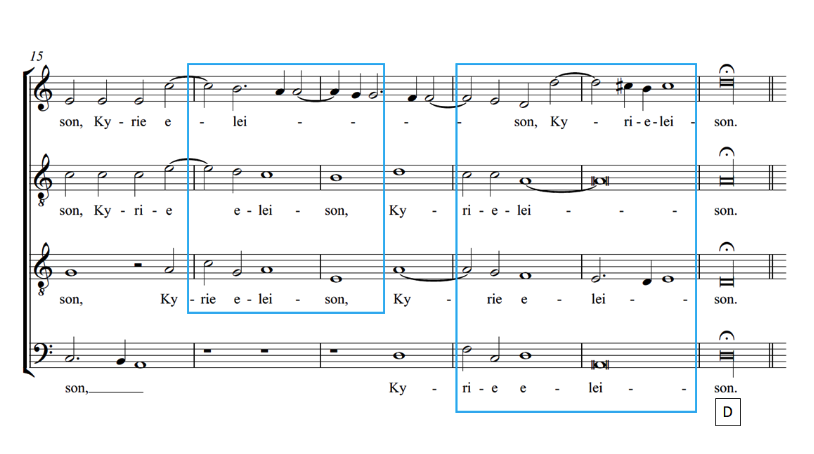
Example 7: The first type of motivic quotation, the Romanesca as a marker of ending. Two Romanescas are strung together to create a syncopated descent to the Kyrie I’s final cadence (mm. 15–20).
The Mass’s use of each of the above types of quotation is visually schematized in Figure 1. Three broad observations can be made from this diagram. First, block quotations are by far the most frequent type of quotation, occurring several times in each movement. Second, block quotations are associated with beginnings, middles and ends. The use of block quotations of Section 1 for the beginning of each movement and block quotations of Section 7 for the end of each movement is unsurprising, as this conforms to Cerone’s recommendations of beginning and ending each Mass movement with elements of the model (Lessoil-Daelman 2002, 9 exceptionally, the opening of the Agnus Dei features a reworked Romanesca in the place of a literal block quotation of Section 1, a modification to be discussed in due time). While block quotations of Section 1 tend to be exact quotations, suitable given their initiating positions, the block quotations of Section 7 tend to embellish or slightly rework the material, in keeping with the melismatic nature of this section (such reworking in the Kyrie’s Section 7 will be discussed below). More notable, however, is Lasso’s use of block quotations of Section 4 somewhere in the middle of every Mass movement: this section serves to initiate the chanson’s second half (Part B), and Lasso acknowledges this section’s formal significance in the model by including it in every Mass movement. Third, block quotations occur in their proper order. (The Credo features an exception, with a block quotation of Section 5 occurring earlier than Section 4; this exception may be due to the desire to begin the “Et in Spiritum” with Section 4 as per its just-described function of beginning second halves.) The preservation of ordering allows block quotations to serve as a formal thread between model and Mass. While sometimes this formal thread is explicit, as in the Kyrie, where all seven sections are quoted in polyphonic blocks, at other times, such as the first half of the Gloria (to be discussed below), this thread can only be speculatively traced; in other places, such as the second half of the Gloria and much of the Credo, it seems entirely absent for large chunks of a movement. In summary, these observations suggest that block quotation plays by far the most important role among the quotation types in the formal organization of the individual Mass movements.
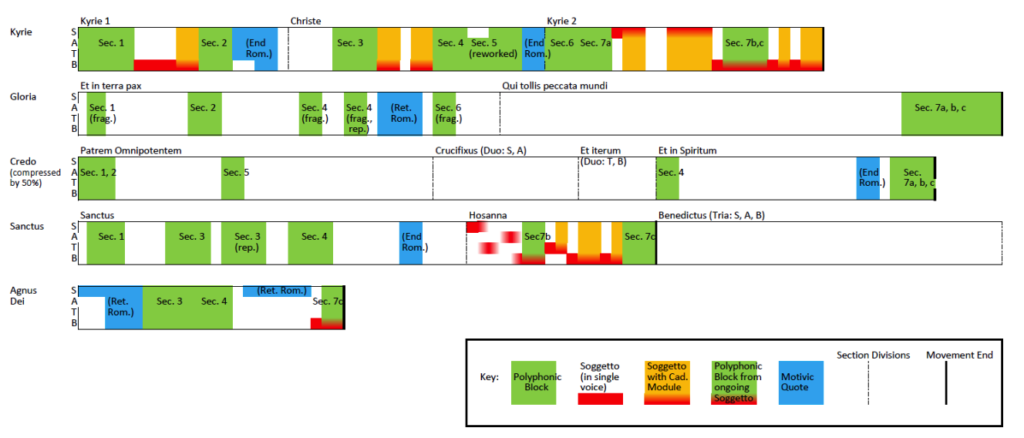
Figure 1: Diagram of quotation types found in each movement of the mass. The Credo has been compressed to half its original length to fit. The Hosanna has not been repeated after the Benedictus. The Benedictus is set in three voices while the Credo’s Crucifixus and Et iterum are duos; all three of these sections lack any significant quotation and are thus left entirely blank here.
Throughout this essay, block quotation will be represented in green, soggetto quotation in red, cadential modules in orange and motivic quotation in blue. Instances of block quotation include an indication of the section that is quoted.
Having summarized Lasso’s main types of quotation, I would like to now examine in detail several passages from the Mass, aiming to highlight both the most representative and most interesting uses of different types of quotation in different contexts. In so doing, I hope to provide a broad synopsis of the use of quotation in the Mass. Specifically, I will focus on the Kyrie and the Gloria because these movements are respectively representative of cases with few and many textual constraints. I will then briefly discuss additional notable uses of quotation in the Hosanna and the Agnus Dei.
Kyrie
Lasso follows the common practice of having the Kyrie employ the most quotation among the Mass movements; the Kyrie consists almost entirely of block, soggetto, or motivic quotations (Figure 2). Apart from the Kyrie’s initiating function, alerting the listener of the model used, the Kyrie may be the Mass movement most suitable for quotation because of the flexibility of its brief text, which can be made to “fit” almost any quoted melody. Seizing on this, Lasso chooses to use block quotation for every section of the model. He arranges the seven block quotations roughly equally across the movement: the first two sections for Kyrie I, Sections 3–5 for the Christe, and the last two sections for Kyrie II. While Sections 1, 2, 3 and 7b/c are set as independent blocks, Sections 4–5 and 6–7a combine their two sections into a single block quotation. (I will speak of “Section 7b/c” here as one section rather than two smaller ones.)
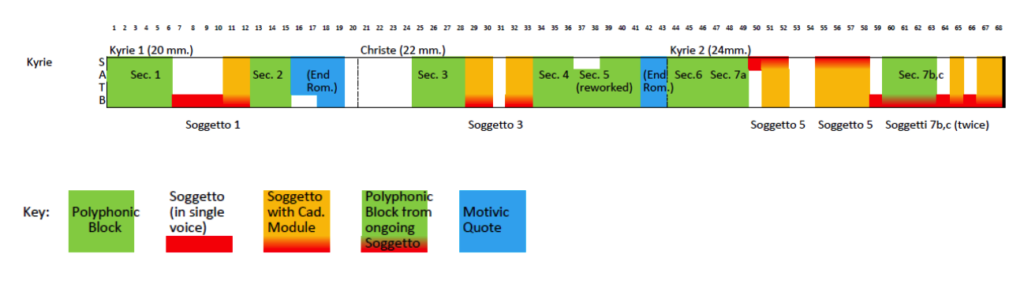
Figure 2: Extract from Figure 1, with soggetto quotation sources added (e.g. “Soggetto 1” means soggetto extracted from the block quotation of Section 1).
When extensively employed, block quotation can provide the formal framework around which the rest of the music is composed. In the Kyrie, the space created by this structural framework is filled in in several ways: soggetto quotation, ending Romanescas, and new material. Of these, soggetto quotation is the most frequent, occurring after Sections 1, 3, 7a and 7b/c. The soggetto is usually derived from the immediately preceding block quotation (these are labeled in Figure 2), and is usually presented either twice in the same voice, as what can be deemed a one-voice fuga, or as a singleton (Milsom 2005, 303 and 345), not part of a presentation type. In the paragraphs that follow, I will discuss the soggetto quotations occurring after 7a and 7b/c, as these present the most complex cases. Regarding the soggetto quotation after Section 3, let it suffice to say that the procedure largely replicates that for the music after Section 1 (previously illustrated in Example 4); among differences, now only the last five notes of the Bassus part form the soggetto, and cadential modules result on both statements of the soggetto (Example 8).
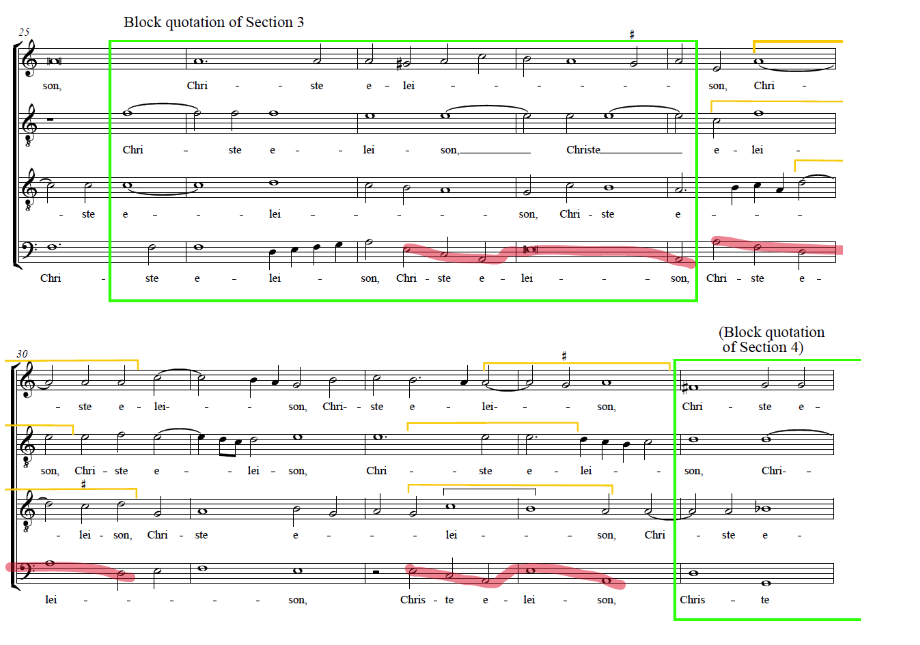
Example 8: Soggetto quotation following the block quotation of Section 3 (Kyrie, mm. 25–34)
Let’s first consider the soggetto quotation occurring after Section 7b/c (Example 9). Because Sections 7a and 7b/c are treated separately in the Kyrie (rather than as an undivided “Section 7”, as in the Gloria and Credo), Lasso is free to repeat Sections 7b/c, in the manner of the model’s repetition of the entire Section 7, without also repeating Section 7a. In its first statement, Section 7b/c is introduced as a Bassus soggetto, beginning in m. 58, which is subsequently fleshed out as a full polyphonic block quotation in mm. 59–63 (hence an instance of “block quotation from an ongoing soggetto”). To repeat Section 7b/c, the complete Bassus part returns, creating a Bassus soggetto quotation, but the block quotation is missing. In its place are three four-voice modules (labeled in Example 9 as Modules 1–3). The first, occurring first in m. 59 and restated exactly in m. 64, does not belong to the model and is created by Lasso. He highlights the Altus’s running quarters which open the model’s Section 7b by adding, at the corresponding part in the Kyrie, m. 59, running quarters in the Superius and Tenor as well; this embellishment is carried forth to the repetition of Section 7b/c, creating a module in m. 64. The second and third modules created in the repetition of Section 7b/c are both cadential modules (indicated in orange brackets in Example 9), generated by the preservation of the upper voices’ cadential voice functions above both “5–1” bassizans motions in mm. 65 and 67–68.
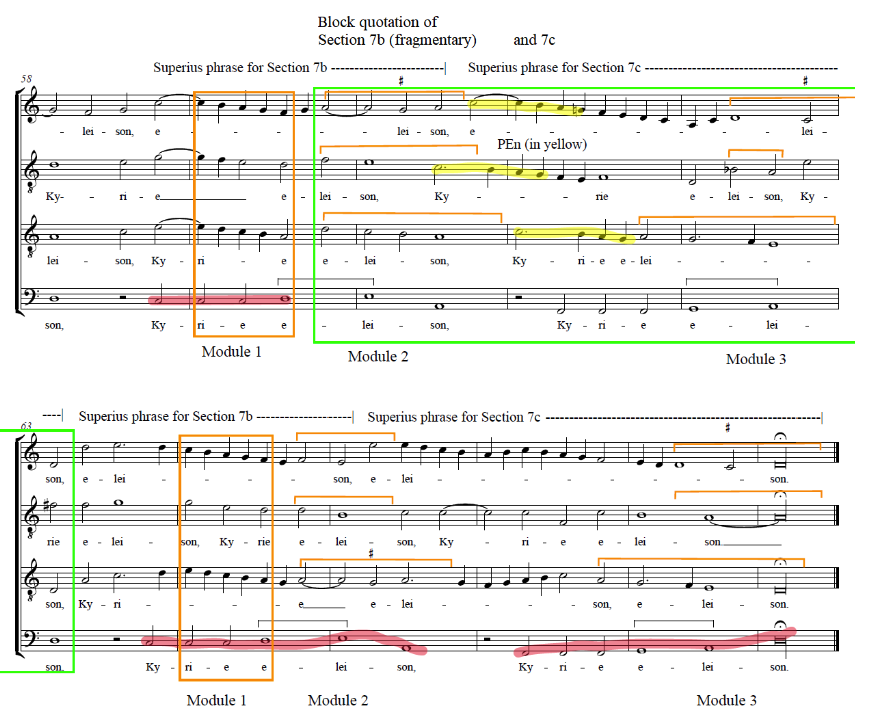
Example 9: Soggetto quotation following the block quotation of Section 7b/c (Kyrie, mm. 58–68)
Lasso’s decision to use a varied repetition of Section 7b/c, forgoing a repetition of the three-voice PEn from mm. 60–61 (highlighted in yellow), can be attributed to the desire to create an expansion of the register in the Superius: both of the Superius’s new phrases (beginning in mm. 63 and 65) now descend from an initial high E rather than a C, as formerly (beginning in mm. 58 and 60). This registral expansion is made possible by the exchange of voices that takes place in the cadence to A in m. 65, where the Superius now takes on the altizans cadential voice function. In summary, this case illustrates that several modules can serve the function of a repeated block quotation while simultaneously allowing the composer the freedom to vary the passage. (Strictly speaking, since the block quotation’s two cadences are transpositions of one another, thus cadential modules themselves, it is possible to speak of four instances of the same cadential module. Nonetheless, given the parallelism provided by the repetition of Section 7b/c, it seems reasonable to instead discuss the two cadences from Section 7b/c and their subsequent repetition as distinct entities.)
The second case I would like to discuss is the soggetto quotation occurring after the block quotation of Sections 6–7a (to be shortly examined in Example 11). This soggetto quotation presents material not from the block quotation of Sections 6–7a, that is, from the block quotation that immediately proceeded it, as do all other cases of soggetto quotation in the Kyrie, but rather from Section 5. To account for this unusual decision, an examination of Section 5’s block quotation is necessary (Example 10). The block quotation of Section 5 is the only instance in the entire Mass where the quoted material is significantly reworked: as shown in Example 10, the Superius part’s first three measures (mm. 37–39) is largely rewritten by shifting its original material into the Altus, forcing fragments of the original Altus and Tenor parts to be lost. Perhaps finding the first half of the original Superius line too uninteresting, Lasso rewrites the Superius line in the block quotation to allow a new statement in m. 37–38 of the cadencing line of m. 39–41 (marked in Example 10; this procedure replicates, now for the Superius, the Bassus quotations observed in Examples 4 and 8, resulting in “one-voice fugas”).Even though this new (first) statement is transposed down a second in relation to the original (second) statement, both of these statements are preceded with the same dotted-half C to quarter B.
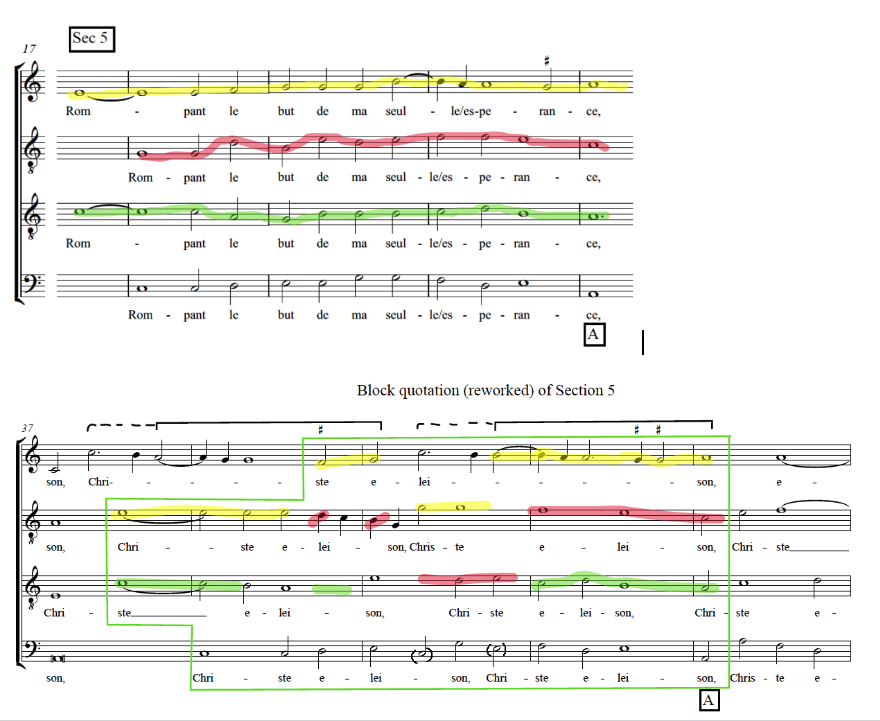
Example 10: Comparison of the model’s Section 5 (above), and its block quotation in the Kyrie (mm. 37–41; below). The model’s original Superius, Altus and Tenor parts have been colored yellow, red, and green respectively, to show how they reoccur in the mass; notes left blank in these voices are newly composed.
The cadencing line from mm. 39–41 just discussed (Example 10), now including the initial C (a semibreve, discounting the B anticipation), recurs three times following the block quotation of Sections 6–7a, each time accompanied by a cadential module (Example 11). Together, these statements evoke a process of the soggetto’s progressive compression, or “liquidation”. The first statement, occurring in mm. 49–52 and cadencing to A, features an expanded version of the soggetto: it is preceded with a stepwise ascent from A to the initiating C, which has been lengthened by a minim. The second statement, occurring in mm. 54–56, brings the soggetto’s normative form and likewise cadences to A. The third statement, occurring immediately after the second, is transposed to cadence to G, drawing a clear parallelism with the music in mm. 37–38; in addition to missing its first note, this statement is also weakened by replacing the expected authentic cadence with an “Altizans” cadence (5/3 chords on D to C) whose bassizans is evaded by a rest.
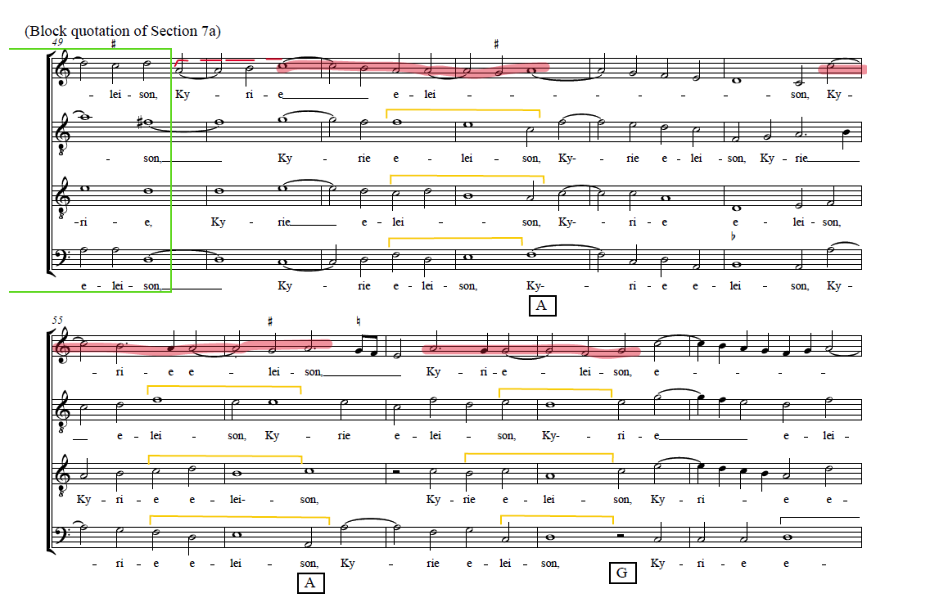
Example 11: Soggetto quotation following the block quotation of Section 6 and 7a (Kyrie, mm. 49–58)
The process of liquidation just outlined seems intended to mirror a process of phrase expansion, not yet mentioned, that occurs within the first statement of Section 7b/c (see again Example 9, mm. 58–63). In mm. 58–59, Lasso recomposes the top three voices accompanying the entry of the Section 7b Bassus soggetto to allow the Superius to partially anticipate in mm. 58 the flourishing quarters of its mm. 61 Section 7c phrase (c.f. also Example 1). From the perspective of compositional process, the Superius’s new Section 7b phrase can be described in CRIM terminology as a truncated Non-mechanical Transformation of its Section 7c phrase; considering the Superius phrase a countersubject to the Bassus soggetto, the countersubject has been shifted metrically (see https://crimproject.org/relationships/2823/). From the listener’s perspective, however, the effect of the newly added flourishing quarters is to make the Superius’s Section 7c phrase appear as an expanded repetition of its Section 7b phrase, the expansion occurring in both range (the second Section 7c phrase reaches a low A) and length (four semibreves become five). Additionally taking into consideration the previously-described registral expansion occurring during the repetition of Section 7b/c in mm. 63–68, all of mm. 49–68 can be said to participate in a process of compression and subsequent expansion.
In my discussion of the Kyrie, I hope to have demonstrated that block and soggetto quotation play important yet contrasting roles. While block quotation is used to create and formally organize the movement’s space, soggetto quotation is used to fill the created space with new material derived from the block quotations. Regarding block quotation, this function holds true throughout the Mass. As for soggetto quotation, the Hosanna will illustrate a structurally determining possibility for this quotation type.
Gloria
In her study of the Kyrie and Credo movements of select imitation Masses by Lasso, de Monte and Palestrina, Marcelle Lessoil-Daelman has observed these composers’ tendency, when composing the Credo, to place motives drawn from the model primarily in the Credo’s first section, the “Patrem omnipotentem” (2002, 195–196). While Lasso’s Doulce memoire Credo distributes quotations relatively equally through both its four-voice sections (beginning and ending the movement), Lessoil-Daelman’s observation holds true instead for Lasso’s Doulce memoire Gloria.The first half of the Gloria features all of this movement’s instances of quotation except for the last, a block quotation of Section 7 to close the movement (Figure 3). This first half notably employs fragmentary block quotation, not seen elsewhere in the Mass. The justification of such use in not clear: in a setting such as the Gloria’s, where long verses less frequently “fit” the model’s sections, the employment of fragmentary block quotation may be interpreted as a means to allow more opportunities for employing block quotation by reducing the length of the music necessary to set to new text. The Credo’s continued, rather extensive, use of full block quotation of the model’s Sections 1, 2, 5 and 4, however, seems to refute such an explanation (see again Figure 2). (The second half of the Credo, beginning with “Qui tollis peccata mundi”, alternates between phrases in duple and triple meter and is entirely freely composed.)
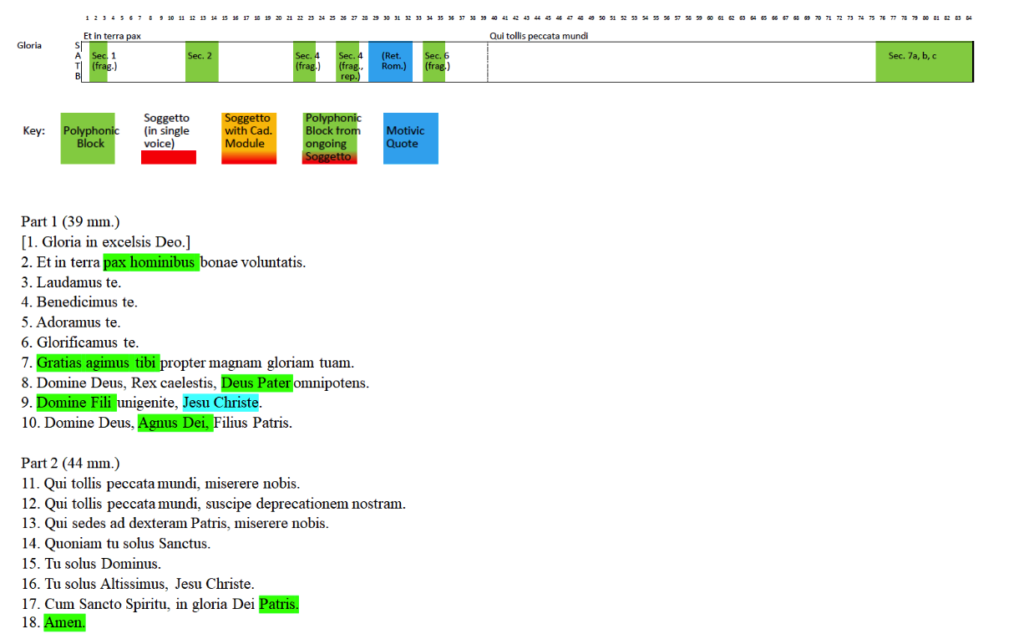
Figure 3: Extract from Figure 1 (above), and Gloria text (below). The Gloria text has been taken from the ordinary chants of the mass presented in the Liber Usualis (1961: 16ff.) and verse numbers have been added. The versification and verse punctuation may not correspond to Lasso’s (punctuation was not usually supplied in manuscripts), so all references to verses and verse numbers are for ease of discussion.
In the following paragraphs, I argue that block quotation, full or fragmentary, works together with cadence placement and texture to retrace the model’s form in the first half of the Gloria. Because the choice to employ block quotation is heavily dependent on the text’s affordances, or lack thereof, I will work line-by-line through the text to understand Lasso’s compositional reaction to it. The text of the Gloria is provided in Figure 3, with highlighted words indicating quotation.
The movement begins with a long verse, “Et in terra pax hominibus bonae voluntatis” which Lasso sets with a fragmentary quotation of Section 1, using only the opening Romanesca (on “pax hominibus”), and free material (Example 12). While Lasso preserves Section 1’s cadence to A in m. 5, he refrains from quoting the second half of Section 1, which could have easily been set to the subsequent text, “bonae voluntatis”, presumably to avoid similarity with the Kyrie’s opening (the employment of the Bb harmony in m. 2 is likely for the same purpose, variety) and to avoid Section 1’s short PEn, preserving instead a homorhythm texture. The fragmented, repetitive verses that follow, “Laudamus te […] Glorificamus te” discourags quotation; Lasso suitably sets them with short phrases and dovetailed cadences (mm. 6, 8; Example 13). Encountering another long verse, “Gratias agimus tibi propter magnam gloriam tuam” (verse 7), Lasso adopts the same procedure as for the first verse: he sets the first portion as a block quotation, for which the full Section 2 fortuitously fits perfectly, and sets the second potion freely (Example 14). Because Lasso chooses, unusually, to set the first half (“Domine Deus, Rex caelestis”) of the next verse, “Domine Deus, Rex caelestis, Deus Pater omnipotens” (verse 8), in a two-voice texture, specifically, a two-voice stretto fuga (Example 15; see Cumming and Schubert 2015, 206ff.), the cadence to A in m. 18 acquires the status of a marker of the first large subdivision within the Gloria’s first half, mm. 1–18. It seems warranted, then, to consider mm. 14–18 as functioning like the model’s Section 3, which completes the model’s Part A with a cadence on the same pitch, A. Leaving aside the above-mentioned fleeting dovetailed cadences, the Kyrie’s cadences to A in m. 5, C in m. 14, and A in m. 18 together retrace the three cadences of the chanson’s Part A.
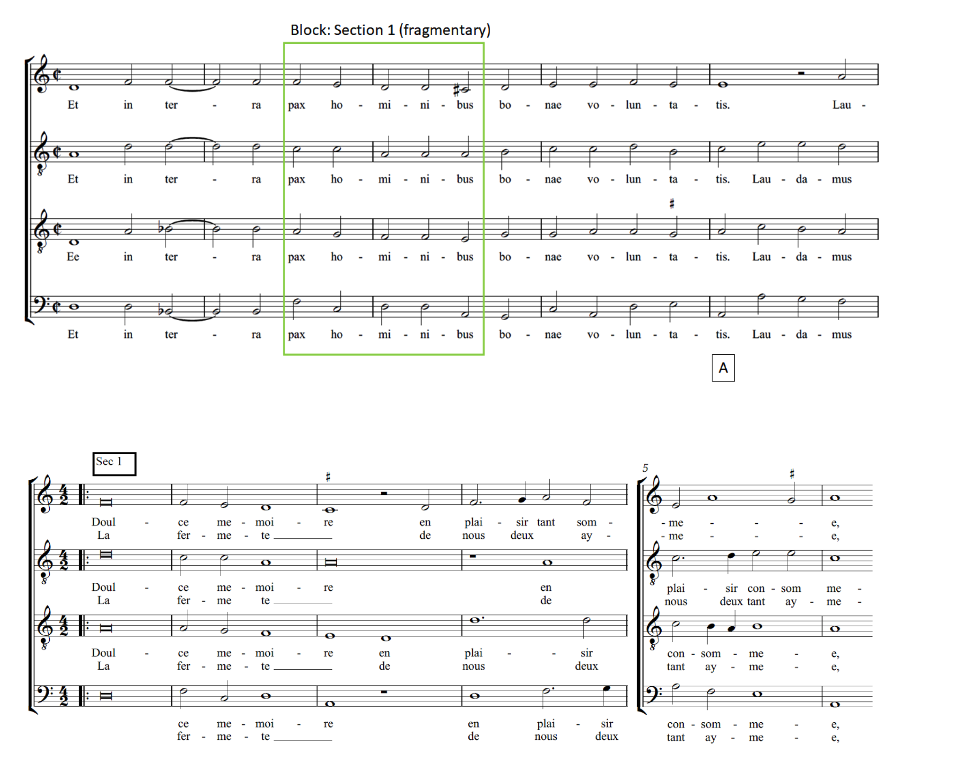
Example 12: Gloria, mm. 1–5 (above) and, for comparison, Section 1 of the model (below)
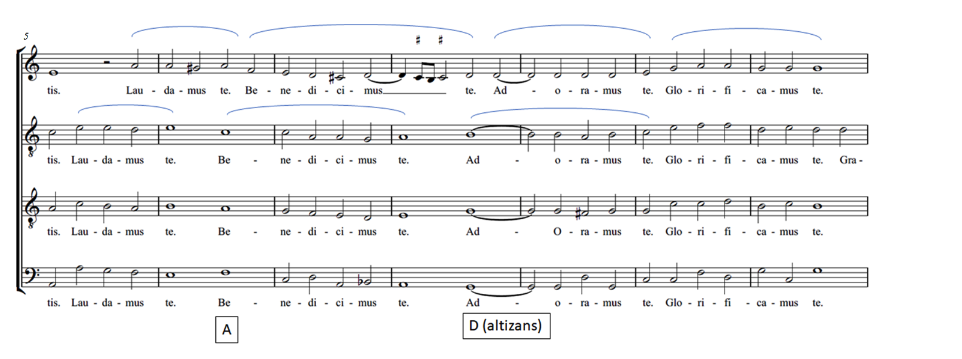
Example 13: Gloria, mm. 5–11
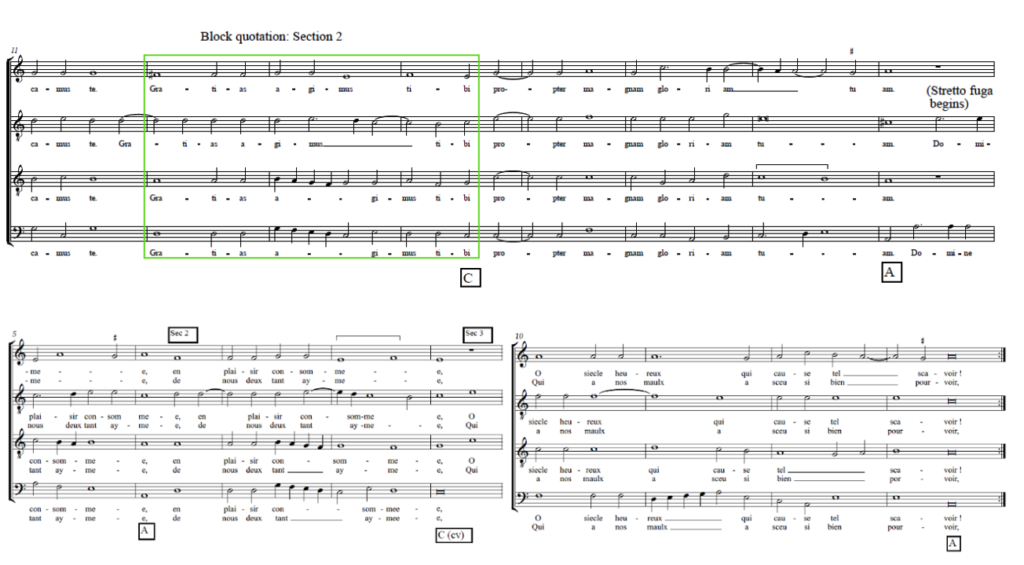
Example 14: Gloria, mm. 11–18 (above) and, for comparison, Sections 2–3 of the model (below)
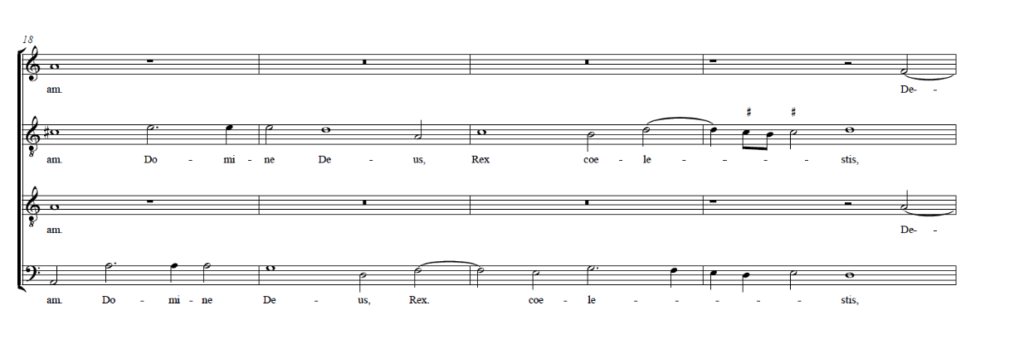
Example 15: Gloria, mm. 18–22, short stretto fuga in two voices
The verse begun with the two-voice stretto fuga passage (“Domine Deus, Rex caelestis”…, verse 8) is completed in the subsequent return to four voices (…“Deus Pater omnipotens”, verse 8; Example 16). Lasso creates a musical rhyme between this last “Deus” and the “Fili” of the next verse, “Domine Fili unigenite, Jesu Christe” (verse 9), by repeating mm. 22–23 up a step in mm. 26–27 (Example 16). I have labeled mm. 22–23 and 26–27 as fragmentary block quotations, transposed and with voices inverted at the octave, of Section 4’s initiating three sonorities. Such a label may be problematic for two reasons: first, the undistinguished nature of the material itself, which consists of the alternation between two sonorities (a plagal “I–IV–I” progression); second, the transposition and voice inversion, which is not a normal feature of block quotation (indeed, such treatment occurs nowhere else in the Mass). I believe that the plagal progression of mm. 22–23 can nonetheless be described as a fragmentary block quotation because of its formal location: due to the implied connection of the m. 18 cadence to A with Section 3 (Example 14) and the subsequent significant structural division effected by the two-voice stretto fuga (Example 15), a quotation of material from Section 4 or from a later Section could be expected in the return to a four-voice texture, and this is indeed what occurs. Additionally, the plagal progression of mm. 22–23 is lent importance by the lengthening of its first chord by a semibreve in comparison to the model (indicated in Example 16 by the black box) and the subsequent transposition up a step of this enlarged version to mm. 26–27; such transposition of a four-voice module is not a frequent procedure. (The plagal progression also occurs once slightly earlier, mm. 14–16 in Example 14, but I have not deemed this occurrence a fragmentary block quotation because I believe the cadence to A in m. 18 and ensuing stretto fuga are much stronger markers of Section 3 than mm. 14–16 are of Section 4; to consider mm. 14–16 representative of Section 4 would be to undermine the ordered progression of quotations.)
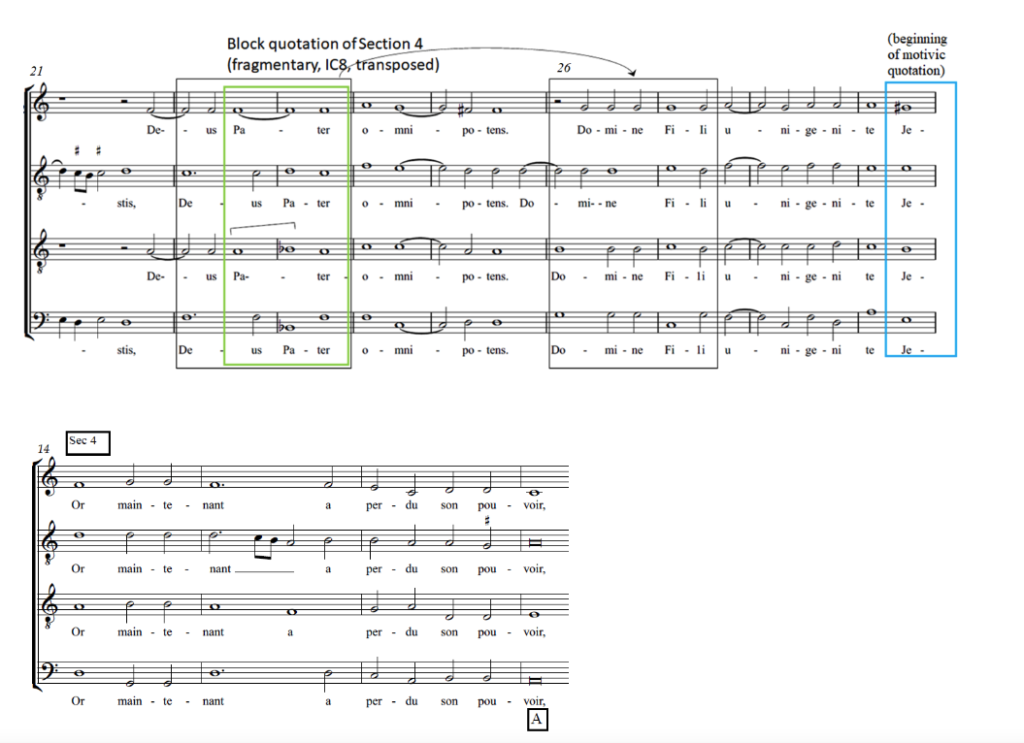
Example 16: Gloria, mm. 21–29 (above), and, for comparison, Sections 4 of the model (below)
By means of sidenote, the subsequent passage (mm. 29–32, Example 17) provides an opportunity to illustrate the type of motivic quotation not yet discussed, namely motivic quotation of the retrograde Romanesca. Lasso highlights the words “Jesu Christe”, which conclude the second of the two verses just discussed (“Domine Fili unigenite Jesu Christe”, verse 9) and occur for the first time in the Mass, by declaiming them homorhythmically in breves; the sudden shift to long values lends a sense of gravitas to the passage. I consider this a statement of the Romanesca, occurring in the Superius in retrograde and up a fifth, because the solmization of the Romanesca’s tetrachordal top voice, “ut–re–mi–fa”, is preserved (given the natural key signatures, the ficta sharps of the Kyrie’s G# in m. 29 and of the model’s C# are both solmized, in the hard and natural hexachords respectively, as “ut”). While three of the four sonorities provide the expected harmonization, the second sonority doesn’t correspond: a 5/3 chord on A replaces the expected 5/3 chord on D (see bottom of Example 17). This case illustrates that motivic quotation of the retrograde Romanesca, in contrast to other types of quotation discussed, lacks a formal function or connotation; Lasso simply chooses to highlight important words with a motive that unifies the Mass, the Romanesca. (The words “Jesu Christe” come back in the second half of the Gloria, also in striking breves, but without quotation of the Romanesca; the rationale for this is not clear, but may have to do with the return of the retrograde Romanesca in the Agnus Dei, to be discussed.)
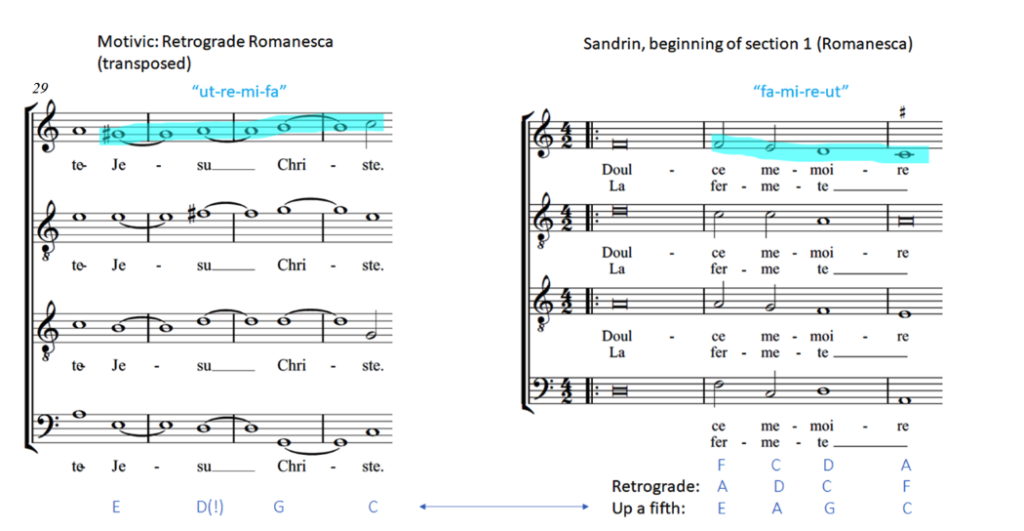
Example 17: Gloria, mm. 29–32, illustrating the retrograde Romanesca (left), and the opening Romanesca of the chanson (right)
Following the retrograde Romanesca, the last verse of the Gloria’s first half (verse 10) is set with a fragmentary block quotation of Section 6 for “Agnus Dei” (mm. 34–36, Example 18) flanked on both sides with free material. What I have identified here as a fragmentary block quotation is again highly stereotyped material, here essentially a cadenza doppia (mm. 35–36, with the cadence’s “fake suspension” in the tenor). Yet the identification of the figure as a quotation is strengthened by larger formal considerations: given that Section 7 should end the entirety of the Gloria, Section 5 and/or 6 remain to close the first half of the Gloria. It would have been possible to alternatively quote the entirety of Section 5 for “Domine Deus, Agnus Dei”; perhaps Lasso preferred to continue his use of fragmentary quotations, which Section 5 lacks and Section 6 provides (Example 18).
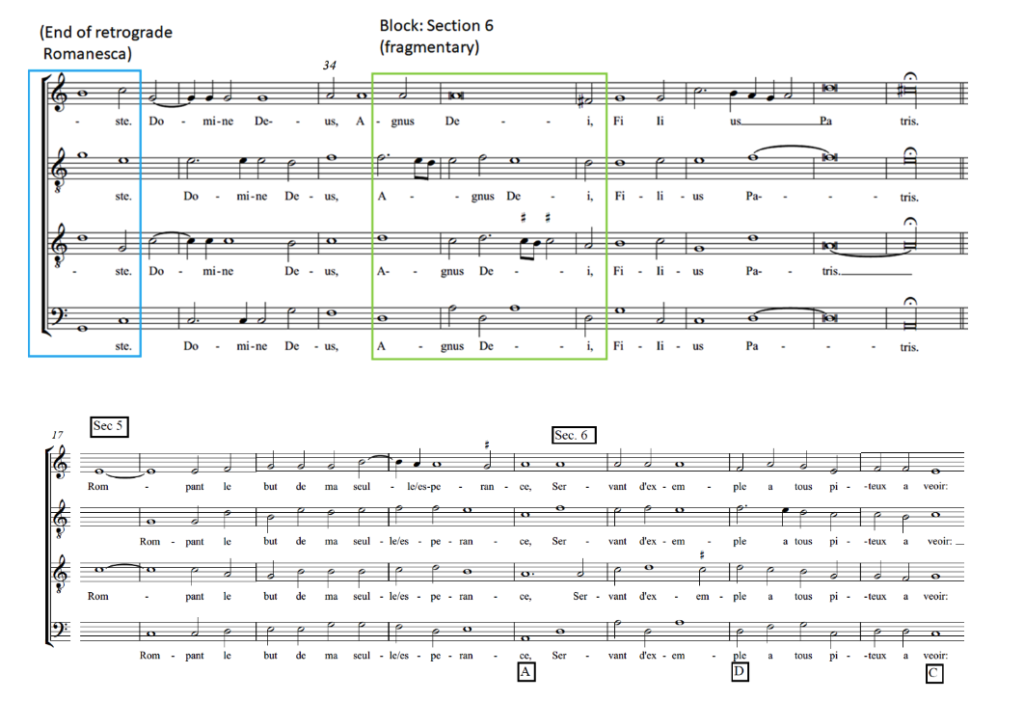
Example 18: Gloria, mm. 32–39, the end of the Gloria’s first half (above), and, for comparison, Sections 5–6 of the model (below).
Having laid, step-by-step, a formal thread through the first half of the Gloria, my analysis involves the identification of quotation in relatively undistinguished and conventional material such as the cadence to A in m. 18, the plagal progression of mm. 22–23, and, to a lesser extent, the cadenza doppia of mm. 35–36. I have argued, however, that it is not so much the nature of the material which allows this interpretation as its formal placement, particularly with reference to the two-voice stretto fuga which punctuates the Gloria’s first half and suggests the possibility of its inner bipartite reading.
Hosanna and Agnus Dei
To conclude the analytical portion of this essay, I’d like to briefly discuss two parts of the Mass, the Hosanna and the short Agnus Dei, which shed new light on the quotation types discussed. The Sanctus’s Hosanna is notable for being the only portion of the Mass featuring an imitative texture, a periodic fuga, across all four voices (Figure 4). Furthermore, the use of soggetto quotation in the Hosanna is of a significantly more structural nature than in the Kyrie: whereas in the Kyrie soggetto quotation governed usually only a few measures at a time (the use of the Superius soggetto perhaps being an exception), soggetto quotation underlies most of the Hosanna, and consequently seems to be as important, as block quotation in creating a larger-scale formal (here, imitative) structure.
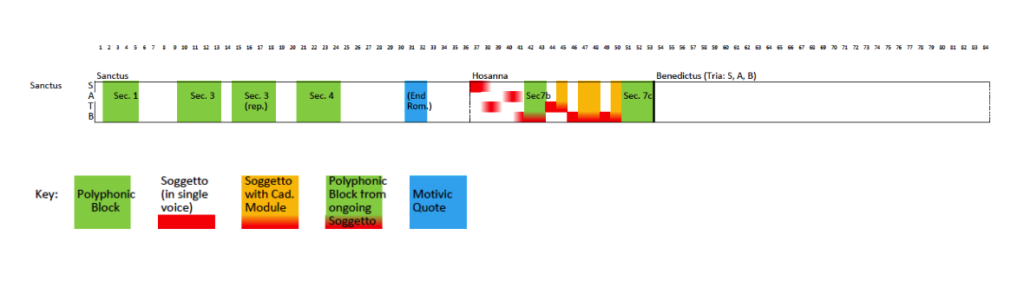
Figure 4: Extract from Figure 1, Sanctus
The Hosanna is built entirely around the imitation of the Bassus soggetto from Section 7b/c (see Example 1, mm. 28–32). The use of this soggetto for the entire Hosanna can be attributed to three mutually enforcing considerations. First, the text’s seven syllables (“Hosanna in excelsis”) match the soggetto’s seven notes. Second, employing this soggetto conserves its association with conclusion, since the Hosanna concludes the Sanctus and the Benedictus. Third, the choice to employ imitation, and consequently frequent repetition of the soggetto and its text, suitably reflects this text’s exclamation of joy and praise.
The Hosanna begins with a periodic fuga with entries occurring in the order S–T–A–B (Example 19). This periodic fuga is considered a Non-Mechanical Transformation with “new combination” because the Section 7b/c soggetto has been newly combined with itself to form new presentation type (see https://crimproject.org/relationships/2828/). For all voices before the Bassus entry (mm. 41–43), the soggetto is fragmentary, lacking the final “5–1” drop presumably because the implication of a bassizans cadential motion is unsuitable for all voices but the Bassus (hence the Bassus being presented last). Shortly after the Bassus’s entry, the upper voices form a block quotation of Section 7b (hence another instance of “block quotation from an ongoing soggetto”). Unusually, then, the initial periodic fuga creates soggetto quotation in the first three voices that precedes rather than follows the block quotation.
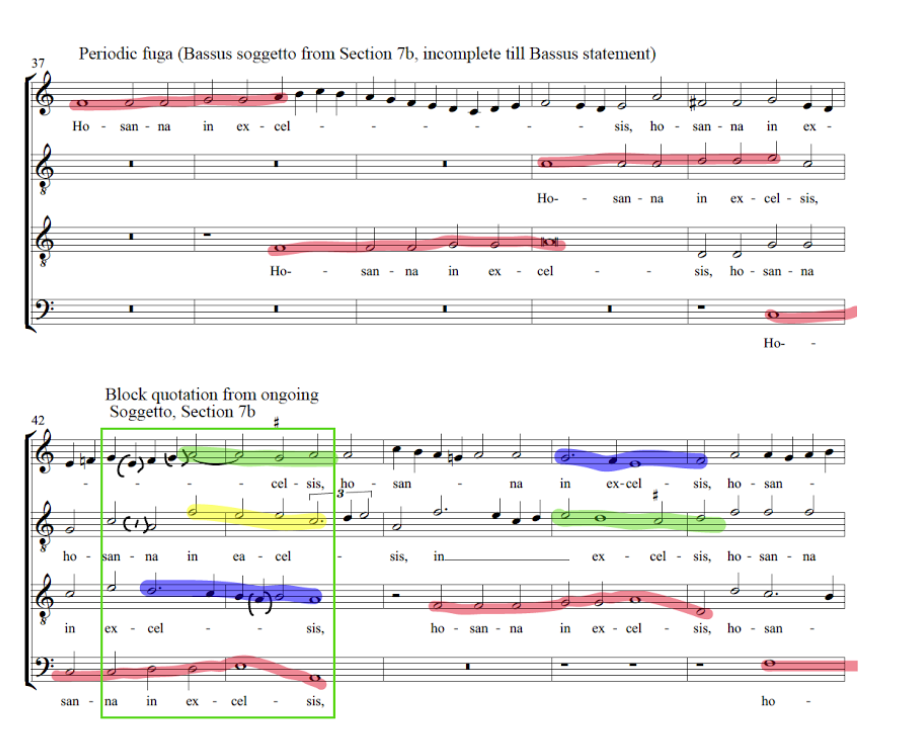
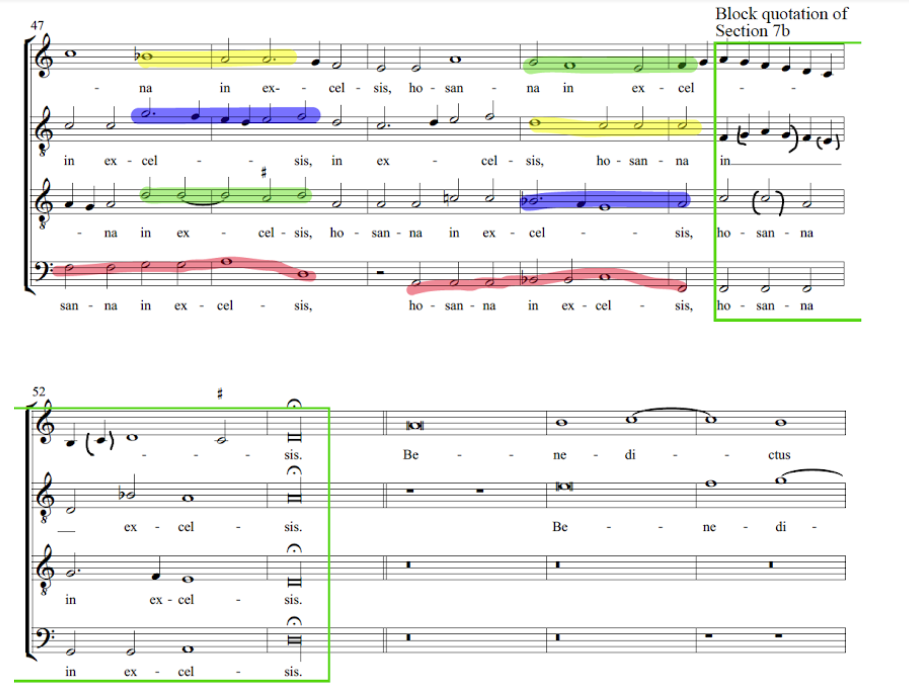
Example 19: Hosanna (Sanctus, mm. 37–53). Each cadential voice function of the cadential module has been given its own color. Notes or spaces bracketed within the block quotation indicate alterations from the model.
Assuming the presence of the block quotation of Section 7c with which Lasso concludes each Mass movement (here occurring in mm. 51–53), the form of the Hosanna after this initial four-voice periodic fuga is dictated to a considerable extent by the nature of the soggetto. Since the full soggetto involves a clear bassizans cadential voice function, it can only appear in the lowest sounding voice; Lasso maintains interest by having the soggetto appear in the Tenor (while the Bassus rests) as well as in the expected Bassus (on this technique, see Schubert’s 2018 discussion of the “bass-line soggetto”, 53–59 and 68–69). Additionally due to the cadential obligation, entry pitches must be chosen to create cadences on D, F, and A, the cadential goals appropriate for the mode. Finally, the number of statements of the complete soggetto is determined by the four-voice texture. As the three cadential voice functions above the bassizans can occur in any arrangement among the top three voices, Lasso presents all three of the possible configurations (mm. 42–48) before returning to the original one in mm. 50–51. Four statements of the Section 7b cadential module result before the concluding block quotation of Section 7c.
The Agnus Dei is notable for featuring and developing the Romanesca motive: the Romanesca is used both to form a connection with previous movements and to create a larger formal structure (Figure 5). Since every Mass movement preceding the Agnus Dei has featured a quotation of the Romanesca, whether as part of a full or fragmentary block quotation of Section 1, the Agnus Dei may be expected to start likewise. The movement starts without a block quotation of Section 1, however, and instead only evokes the awaited Romanesca: in mm. 1–4, the Superius recalls the opening descent through a 4th, from F to C# but with the E notably missing, and the first and last chords of its descent are harmonized as expected (mm. 2 and 4). Nonetheless, the striking, new harmonizations of the F (its second half harmonized with a 5/3 chord on Bb) and D (5/3 chords on Bb, then G) and the new rhythms significantly problematize the Romanesca association. Leaving aside the problematic status of mm. 1–4, the Romanesca motive is unequivocally suggested in mm. 4–7 with the presentation of a complete retrograde Romanesca on the words “Agnus Dei” (Example 20; see https://crimproject.org/relationships/2826/ considered a non-mechanical transformation due to the irregular rhythmic amplification, here). Since there are only two retrograde Romanescas in the Mass, the other being that of the Gloria (described above), and they are both presented in declamative breves, they form an association with one another; a suitable pairing of the Gloria’s “Jesu Christe” with “Agnus Dei” arises in the last movement. At the same time, however, the retrograde Romanesca is here untransposed and has all four sonorities complete, and consequently represents a true retrograde (though with the Superius and Altus voices exchanged) which can be interpreted as “solving” the “problem” presented by the Gloria’s altered harmonization of its second sonority.
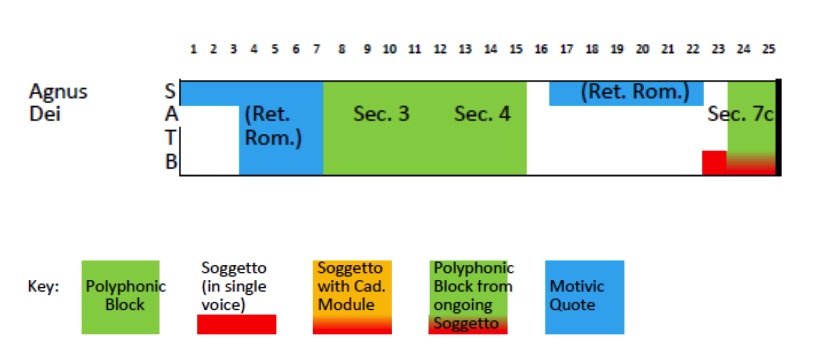
Figure 5: Extract from Figure 1, Agnus Dei
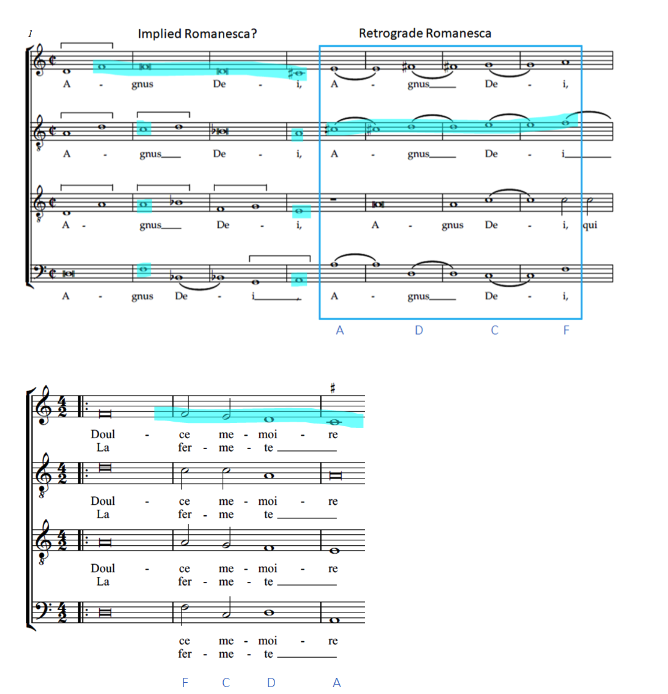
Example 20: Agnus Dei, mm. 1–7 (left), and Model’s opening (right). Lasso inverts the voices, moving the Romanesca’s top voice (highlighted in blue) into the Altus.
After subsequently presenting a block quotation of Sections 3 and 4, Lasso builds a large ascending sequential passage on “Miserere” (mm. 15–22) from transpositions of the retrograde Romanesca’s top voice ascending tetrachord (Example 21). This is the first and only time in the Mass that motivic material from the Romanesca is used to create a larger-scale formal structure. This new use signals a change of status of the retrograde Romanesca from a rhetorical device used to highlight selected words to a legitimate source of thematic material. This process entails special significance given that this motive is one which does not stem directly from the model but is rather created by Lasso. The retrograde Romanesca’s rhetorical function is not lost thereby, however, as the repetitions of “Miserere”, gradually ascending across the Superius’s register and gaining weight thereby, evoke urgency and supplication. The ascending tetrachord is stated six times, each time being transposed up a step (skipping the tritone-outlining F–B) yet harmonized differently (the harmonization is not sequenced along with the Superius). A sense of forward momentum towards the climatic high E results. Having ascended from low C# to high E, the Superius begins Section 7c’s descending scale a third higher than expected (as in the Kyrie’s repeated Section7c), which nonetheless does not prevent Lasso from linking up to a concluding fragmentary block quotation of Section 7c. Lasso’s decision to build a large passage at the end of the Mass’s last movement using the retrograde Romanesca may represent a subtle fusion of both types of motivic quotation previously identified: the retrograde Romanesca and the Romanesca as an indicator of ending.
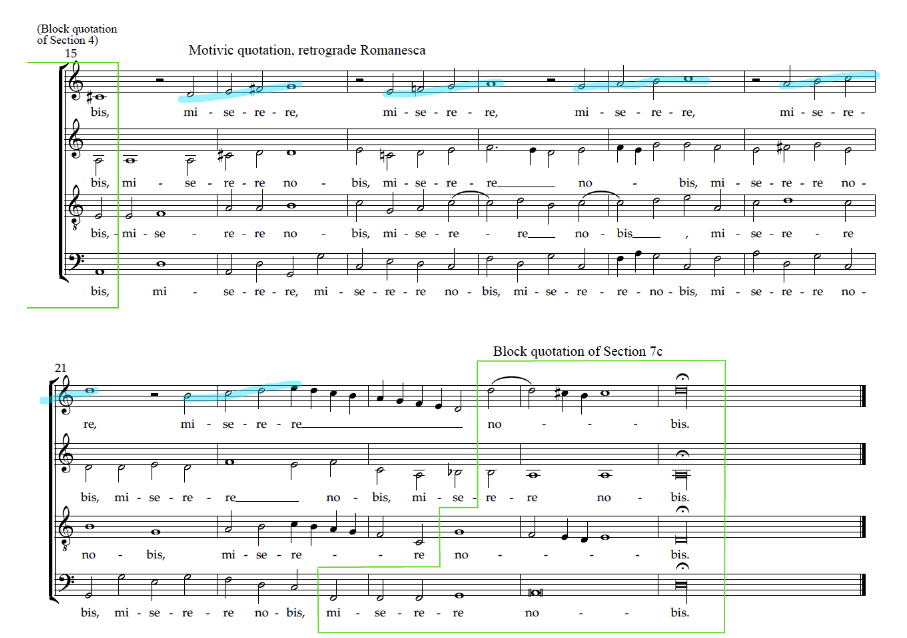
Example 21: Agnus Dei, mm. 15–25. Motivic quotation of retrograde Romanesca indicated in blue.
Through my discussion of the Hosanna and Agnus Dei, I have illustrated some uses of soggetto and motivic quotation which do not occur in the Kyrie and Gloria. In the Hosanna, soggetto quotation serves to construct a large point of imitation rather than to create new short homorhythmic passages. In the Agnus Dei, motivic quotation is also used to create a larger structure, here a steady ascent leading into the final statement of Section 7c. Having discussed the principle techniques of quotation which Lasso employs to generate the form of his mass, I now pivot to consider the ways in which CRIM Intervals can be used to detect these cases of quotation.
CRIM Intervals Methodology
The findings presented in this paper are based entirely on traditional manual analysis. While this is in part due to the nature of the questions in which I am interested, namely subjective compositional decisions rather than, for example, statistically computable tendencies, this is also at least in part due to my initial assessment of CRIM Intervals: its most important tools for the detection of quotation, the Presentation Types and Heatmap tools, are designed for finding and visualizing points of imitation and are consequently not immediately useful in the homorhythmic and almost entirely non-imitative texture which categorizes Lasso’s Mass. After initially finding little help from the CRIM tools, I completed the analysis by hand, only then returning to the CRIM Notebooks to attempt to find ways to use the CRIM tools to detect quotation within my homorhythmic context. I have found, admittedly from a retrospective perspective, that a combination of the Heatmap and the Melodic N-gram tools (explained below; taken from notebooks CRIM_02b_Melodic_Harmonic_Corpus and CRIM_07b_HeatMap_Corpus_Comparison), both slightly modified, provide a means towards my goal. These tools are illustrated in a Lasso_Quotation_Notebook which I invite the reader to consult throughout my discussion. Below, I propose a methodology to partly recreate my findings using CRIM Intervals. I immediately provide a caveat, to be discussed below in more detail: this methodology finds the vast majority of block and soggetto quotations but does not find all instances of fragmentary block quotations and cannot find retrograde Romanesca quotes.
CRIM’s heatmap tool works by displaying melodies (melodic n-grams, i.e. melodies, represented as directed intervals, of the specified length/n-value), occurring after a rest or section break, which are shared between model and Mass movement (thus “entry n-grams”). Applied to my corpus with its default setting, the tool produces a scantily-populated heatmap which essentially mirrors the results of the Presentation Types tool, though also detecting common non-thematic melodic n-grams such as -2, -2, -2, 2, 2, irrelevant for my purposes. I have modified the tool to display not only shared entry n-grams, but rather all shared n-grams between the model and a Mass movement (Cell 4 of the above notebook). Thus modified, the heatmap produces large colorful blocks which illustrate n-grams overlapping with each other within a given voice (Figure 6); blank spaces are provided only by absent n-grams, that is, rests. While this colorful diagram is at first glance unrevealing, comparing a single voice’s stripes between model and Mass movement uncovered a shared succession of colors. Figure 6 shows that such successions are most prominent in the Bassus, but also occur in other voices. These successions represent n-grams consecutively strung together within the same voice, thus a string of notes, longer than the given n-value, that is common to both model and Mass movement, and likely to be a soggetto quotation. (The width of the individual colored block corresponding to a particular n-gram is not of concern, as it is determined based on the location of the first note of the following n-gram. The value of n has been set to 5, as this valued proved to provide accurate readings while avoiding unmanageably numerous results.) Furthermore, such a soggetto quotation can also represent one voice of a block quotation. In Figure 6, block quotation is most clearly illustrated with the two passages at the end of the model which have been enclosed in black boxes; these represent the exact repetition of Section 7. The openings of the model and the Kyrie likewise begin with the same color successions in the individual voices (not boxed), presenting a block quotation.
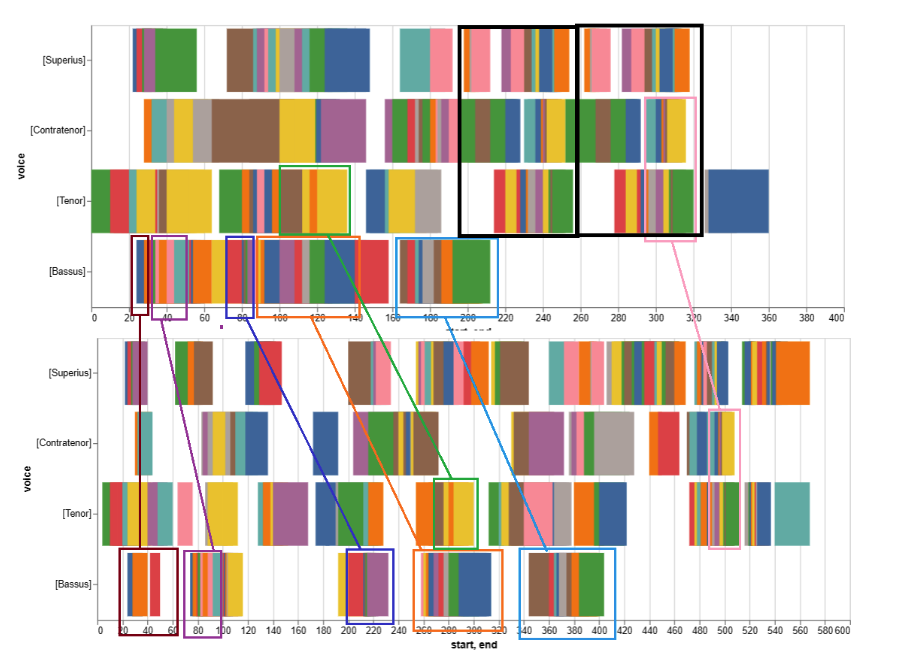
Figure 6: N-grams shared between the model (top) and the Kyrie (bottom). Shared successions have been enclosed in colored rectangles, connected via a line linking the model and the mass movement. The horizontal axis indicates offset (i.e. quarter notes), not measures. The Kyrie’s individual color bars/n-grams are thinner than the model’s because the Kyrie is longer than the model (c.f. offsets).
A further modification of the heatmap involves comparing only Bassus n-grams which are shared between model and Mass (Cell 5). Focusing on the Bassus part is prompted by two factors. First, the Bassus part is less likely to generate false positives due to its distinctive melodic profile, frequently featuring leaps unlikely to be found in the other voices. (In this case, false positives would be n-grams which are indeed shared between model and Mass movement, but which given their context and/or durational values nonetheless do not represent quotations). Second, a color succession occurring in the Bassus can represent a block quotation even if the upper voices do not likewise exhibit a color-succession. This is because the top voices, when quoted in blocks, are more likely to be embellished through passing tones or diminution, thus changing the model’s n-grams in the Mass movement, whereas the Bassus part is more likely to remain unchanged, preserving its original n-gram. The modification presented in Cell 5 thus reduces the risk of false positives and reduces visual clutter to show quoted passages more clearly.
Let me illustrate the work process of working with heatmaps through a consideration of the opening of the Kyrie (Figure 7). The Kyrie’s first color block consists of just two n-grams, brown and teal, which together represent the latter half of a block quotation of Section 1. (The opening Romanesca is not traced in the heatmap because the rest which immediately follows it creates an n-gram of 4 whereas here n=5). Skipping for a moment the second color block, consisting of the single blue n-gram, the third block begins the same way as the first and ends with a red n-gram which represents the last n-gram of Section 2. The third color block thus tracks the Section 1 Bassus soggetto, which immediately, without a rest, precedes the block quotation of Section 2, represented by the grey to red n-grams; this passage corresponds to mm. 10–12 in Example 4, where the block quotation of Section 2 begins in the second half of m. 12. The first and third of the Kyrie’s color blocks begin the same way because these color blocks both track the same bassline, first occurring as part of the Section 1 block quotation, and then as a Bassus soggetto quotation. In the third color block, the n-grams colored dark blue to a new teal which are enclosed between the brown and teal Bassus soggetto quotation and the grey to red block quotation of Section 2 are resultant from this immediate succession of two quotations and consist of notes that span both the Section 1 soggetto and the Section 2 block quotation. The heatmap’s color blocks consequently don’t always correspond neatly to a single Section from the model, as there can be extra n-grams on one or both sides of a quotation. The correspondence of the color blocks to the model’s remaining Sections is summarized at the bottom of Figure 7. (The second color block, previously skipped, represents the Bassus’s mm. 6–7 anticipation of the Section 2 block quotation’s descending quarter-note line. See mm. 6–7 in Example 4; though the Section 2 block quotation occurs immediately after the end of the excerpt).
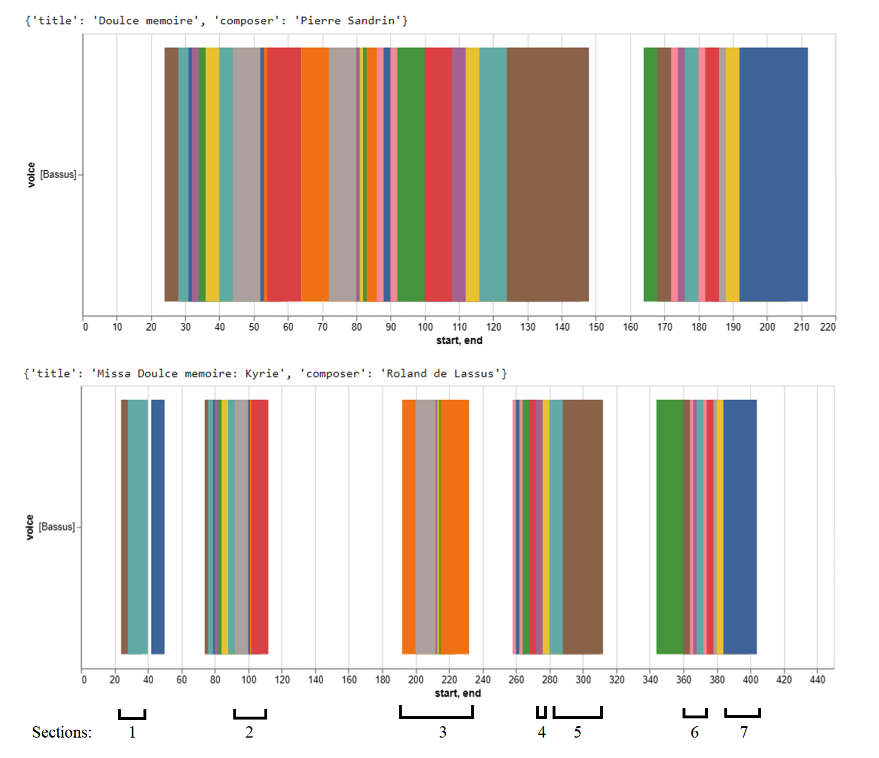
Figure 7: Bassus heatmap of the model (top) and Kyrie (bottom).
Examining the score for the passages shown in the Bassus heatmaps should quickly turn the analyst onto the idea of block quotation of the model’s seven Sections throughout the Mass. The analyst can simply input the Bassus n-grams of each of the model’s Sections into the Melodic N-gram tool (which tabularly lists all occurrences of a given melodic n-gram) to more systematically detect cases of block quotation (see Cell 6 and 7; the Melodic N-gram Corpus tool has been slightly altered to combine unisons). I have compiled the results of such a search into this spreadsheet (each Section has a separate sheet). When conducting such a melodic n-gram search, the value of n will have to be adjusted for every Section’s n-gram, as each Section is of a different length; for Sections involving rests, as is the case in Sections 1 (after the Romanesca) and 7b/c (before and after the 3–4–5–1 Bassus soggetto), the melodies before and after the rest will have to be searched for independently.
There are several limitations to this proposed methodology. First, searching for Bassus n-grams via the Melodic N-gram tool will miss instances where the Bassus part has been modified in the Mass (there are four such instances, seen in sheets 2, 5, and 7 of the above spreadsheet). Sometimes, however, at least one of the n-grams that make up such a passage can still be detected in the Heatmap tool, allowing the analyst to reveal the whole passage; this is the case, for example, in Figure 7 for the quotation of the model’s Section 5. Other times, the Melodic N-gram tool will bring the analyst to a passage which is immediately next to the missed Bassus n-grams, making the missed n-gram easy to spot in context. Second, both tools will miss quotations that are below the specified n-gram value; fragmentary block quotation of Sections 1 (opening Romanesca) 6 (till cadence on D), for example, will be missed. A possible solution would be to reduce the value of n, of course, but this comes at the risk of complicating the search process with many more results that possible to manually sift through. Alternatively, if one such fragment is found manually, the analyst can identify similar passages and search for the in the Melodic N-gram tool; one can look, for example, for the Bassus n-gram associated with the fragmentary block quotation of Section 4, as has been done in sheet 4 of the above spreadsheet. Third, the results of Bassus n-grams searches, whether with the Bassus Heatmaps or Melodic N-gram tools, do not by themselves specify whether the Bassus part is used in freely composed homorhythm, imitation, or block quotation. In this sense, the tools tell the analyst where to look rather than what to expect. Despite these methodological limitations, the Heatmap and Melodic N-gram tools nonetheless complement one another to together provide a framework within CRIM for semi-automated quotation detection.
Conclusion
Lasso is known for his stylistic variety; in the context of intertextual writing, the flexibility with which he adapts his compositional approach and style to best suit his models has gathered praise in more recent studies (see for example Crook 1994, 171ff and passim). In this Mass, I believe that the employment of block quotation and soggetto quotations derived from these polyphonic blocks, Bassus soggetto quotations in particular, are Lasso’s compositional responses to a homorhythmic model: given the model’s lack of imitatively-presented soggetti for quotation and recombination in the Mass, these are the principle techniques employed to link Mass movement to model. Block quotation from the model has been shown to serve as a framework for shaping the form of individual Mass movements, whether quite explicitly for the Kyrie, or somewhat less so for the Gloria, and soggetti derived from a block quotation have been shown in the former movement to underpin the composition of short new passages. Soggetto quotation can nonetheless also take on a larger structural, and consequently formal, role, especially when used imitatively, as seen in the Hosanna. While motivic quotation, also employed by Lasso, has been shown to normatively function as an incidental technique for highlighting key words, the discussion of the Agnus Dei has similarly illustrated the possibility of motivic quotation taking on structural dimensions.
There remain many questions insufficiently addressed. In most cases, for instance, it is difficult to justify why a block quotation of a certain section was used instead of that of another. Often, opportunistic compositional use of fortuitous pairings of new text and old music seem at play, yet in many other cases, solutions not used could have worked equally well. I have attempted to propose some possible reasonings for many compositional decisions, but these are merely speculative; very many such decisions have been simply left unmentioned. As a further step in understanding Lasso’s quotation of homorhythmic models, and in particular in assessing the frequency of use of quotation types explored in this essay, comparison with his settings of other homorhythmic French chansons as imitation Mass models, such as Lupi’s “Puisque j’ay perdu” or Sermisy’s “Il me souffit”, are surely worthwhile. With all these imperfections in mind, I hope nonetheless to have provided some points of entry into reconstructing Lasso’s compositional process as he quotes and develops material from the model in his Mass.
Bibliography
Crook, David. 1994. Orlando Di Lasso’s Imitation Magnificats for Counter-Reformation Munich. Princeton, New Jersey: Princeton University Press. https://doi.org/10.1515/9781400863785.
Cumming, Julie and Peter Schubert. 2015. “The origins of pervasive imitation.” In The Cambridge History of Fifteenth-Century Music, edited by Anna Maria Busse Berger and Jesse Rodin, 200–228. Cambridge, UK: Cambridge University Press. https://doi.org/10.1017/CHO9781139057813.018
DIAMM. n.d. “D-As Tonkunst Schletterer 49.” Accessed 28 December, 2022. https://www.diamm.ac.uk/sources/3816/#/.
Dobbins, Frank. 1969. “’Doulce Mémoire’: A Study of the Parody Chanson.” Proceedings of the Royal Musical Association 96: 85–101.
Haar, James. 2001. “Lassus [Orlando di Lasso], Orlande [Roland] de.” Grove Music Online, ed. Stanley Sadie, et al. Oxford Music Online. Accessed 28 December, 2022.
http://www.oxfordmusiconline.com.
Lessoil-Daelman, Marcelle. 2002. “Une Approche Synoptique des Motifs et des Modules dans la Messe Parodique.” PhD diss., McGill University. https://escholarship.mcgill.ca/concern/theses/jm214p62z
Lessoil-Daelman, Marcelle and Peter Schubert. 2013. “What Modular Analysis Can Tell Us About Musical Modeling in the Renaissance.” Music Theory Online 19, no. 1 (March). https://mtosmt.org/issues/mto.13.19.1/mto.13.19.1.schubert_lessoil-daelman.html
Milsom, John. 2005. “Crecquillon, Clemens, and Four-Voice Fuga.” In Beyond Contemporary Fame: Reassessing the Art of Clemens non Papa and Thomas Crecquillon, edited by Eric Jas, 293–345. Turnhout, Belgium: Brepols.
RISM. n.d. “27 Chansons; Print.” Accessed 28 December, 2022. https://rism.online/sources/993104199.
Schubert, Peter. 2007. “Hidden Forms in Palestrina’s First Book of Four-Voice Motets.” Journal of the American Musicological Society 60: 483–556. https://doi.org/10.1525/jams.2007.60.3.483
Schubert, Peter. 2008. Modal Counterpoint, Renaissance Style. 2nd ed. New York: Oxford University Press.
Schubert, Peter. 2018. “Finding the ‘Air’ in Maddalena Casulana’s Madrigals.” In Analytical Essays on Music by Women Composers: Secular & Sacred Music to 1900, edited by Laurel Parsons and Brenda Ravenscroft, 47–73. New York, NY: Oxford University Press. https://doi.org/10.1093/oso/9780190237028.003.0003