Automated Detection of Renaissance Cadential Voice Functions and Cadences
Alexander Morgan (EcoRate)
Introduction
A musical cadence is a clearly expressed articulation in musical form. There is considerable variety in musical cadences, and what functions as a cadence depends on the established practices of a given style. Cadential voice functions (CVFs) are the building blocks of suspension-based cadences in Renaissance. CVFs and cadences are critical components of Renaissance syntax and automating their detection is valuable for two primary reasons. First, automated detection can be used to parse music syntactically and identify endpoints at all formal levels, and this information can then be applied to help identify other types of musical events. Secondly, automated detection is an expression of our understanding of a given musical style. With this litmus test in mind, I would like to thank Richard Freedman, Mirjam Visscher, Vlad Praskurnin, Michael Winter, Erik Bergwall, Jessie Ann Owens, and many others who helped me improve the cadence classifier, and by extension my understanding of Renaissance style. One particularity of my approach here is that I use interval succession information exclusively to detect CVFs and subsequently cadences. Given how critical the numerous other musical domains (rhythm, duration, timbre, text setting, etc.) are to this style, it is somewhat surprising that they are not needed to detect CVFs and suspension-based cadences with high accuracy. This paper is an update from an earlier paper I published last year with Richard Freedman and Daniel Russo-Batterham (Morgan, Freedman and Russo-Batterham 2022). I have made significant improvements to the accuracy and reliability of the analysis tools.
In this article, I build on a long tradition of distinguishing between CVFs, which are labeled one per voice, and cadences which are observations shared by all voices at a given moment. I created the analysis tools used in this study specifically for the analysis of CVFs and cadences in Renaissance music. Some of the more rare cadential voice functions and cadence types the tools identify are first (and perhaps exclusively) found in certain sixteenth-century repertories. However, the bulk of the CVFs and cadences these tools find originate from well before 1400.
Theoretical and Compositional Origins
It is important to note that the cadence analysis detailed here only applies to what I call suspension-based cadences. These are cadences where the driving syntactical telos uses a dissonant suspension in a two-voice framework to highlight an arrival at a perfect interval. Indeed, the tools described here consider a cadence as a kind of contrapuntal module–a collection of one or more pairs of voices that accentuate a perfect interval through the expression of all four phases of the formula: preparation, suspension, resolution, and perfection. One can even go as far as to say that cadences are the contrapuntal module, as they are some of the most characteristic and recognizable features of this style. I will also discuss ways this approach can extend to other interval succession based cadences, even when they do not include proper suspensions. But the approach used cannot apply to cadences defined by other means (such as harmonically based cadences).
The earliest clear theoretical expression of the core concept of interval succession ethos is that of Marchetto of Padua in the early 14th century (Cohen 1993 and 2001, and Dahlhaus 1990). The earlier works by Leonin and Perotin, for example, also abound with these cadences, and they are by no means the first. I validated and refined these tools with Renaissance music analysis in mind, but they broadly apply to many Early music repertoires. While I cannot pinpoint the origin of the types of CVFs and cadences I discuss here, I take them to be the established and primary means of cadencing already at the start of the Renaissance.
The Fall of Suspension-Based Cadences
There was no hard endpoint to this means of musical punctuation. Instead, these CVFs and cadences gradually gave way to non-suspension-based means of cadencing. I consider the rise of non-suspension-based cadences to be a critical component of the shift from modal to tonal music. It would be fascinating to chart the prevalence of suspension-based cadences and non-suspension-based cadences over time. I would guess that this would look like an inverted sigmoid and a sigmoid (respectively) crossing but with neither one ever making up 100% of the cadential patterns at any given time, as illustrated in Figure 1. However, this chart is only a guess. To actually measure this would require another automated analysis tool that detects non-suspension-based cadences.
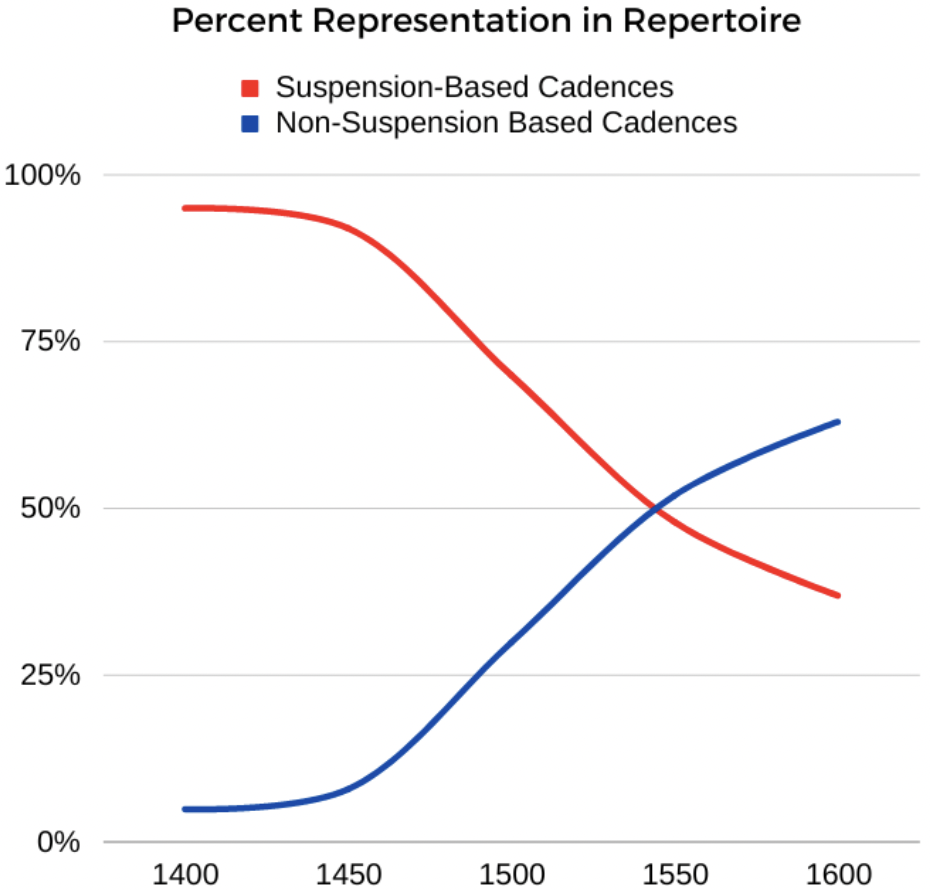
Figure 1: Hypothetical Timeline of Cadential Types
Non-Suspension-Based Cadence Detection
A non-suspension-based cadence finder would be a very valuable tool and seems like it should be possible. But I do not know how to write it. There may be cadence definitions that work well for a given composer or brief stylistic trend. Writing highly focused analysis tools based on these definitions is a valuable pursuit and we have a great example of this in Owens and Freedman’s essay in this collection (Owens and Freedman, 2023). But the approach I’ve taken here applies broadly (though admittedly not exhaustively) to over two hundred years of compositional practice. Although there was still considerable variety in this music, that kind of stability over time with respect to the definition of a cadence is without parallel in Western music. In later works, it is uncanny how confident we can be that we hear a cadence at a given moment, but that we still struggle to define it systematically. Even if we could get this hypothetical tool to work well for realized authentic cadences, getting the level of granularity I have achieved with suspension-based cadences (multiple types of realized, evaded, and abandoned motions, both for CVFs and cadences) would be a considerable challenge. This challenge only compounds if the tool is intended to apply to a similarly broad span of compositional practice. Generally speaking, “I know it when I hear it but I can’t define it” search problems are well-suited for machine learning, so that may be a promising approach for a non-suspension-based cadence finder in the future.
Cadential Voice Functions
Since our goal is to analyze cadences in a manner informed by period concepts of demarcation and phrasal delineation, we must first understand what CVFs are. Bernhard Meier offers a good modern introduction to CVFs (Meier 1988: 90–101). An important distinction between Meier’s definition of CVFs and my own is that he considered suspensions to be common ornamentations of CVFs. I agree that they are common, but I go as far as to say that suspensions are the primary and almost exclusive means of articulating CVFs. In fact I do not consider suspensions to be ornamental, but rather core intervallic syntax in this style. A smaller distinction between us is that I spell the bass one as Bassizans instead of Basizans.
While the reader is no doubt familiar with the Cantizans, Altizans, Tenorizans, and Bassizans, it is important to underscore that the definition of all CVFs here require each CVF to participate in a dissonant suspension. For this reason, Example 1a and Example 1b constitute cadences with the labeled CVFs detected. However Example 1c has no CVFs at m. 4, beat 4 using this definition because it does not have a dissonant suspension..
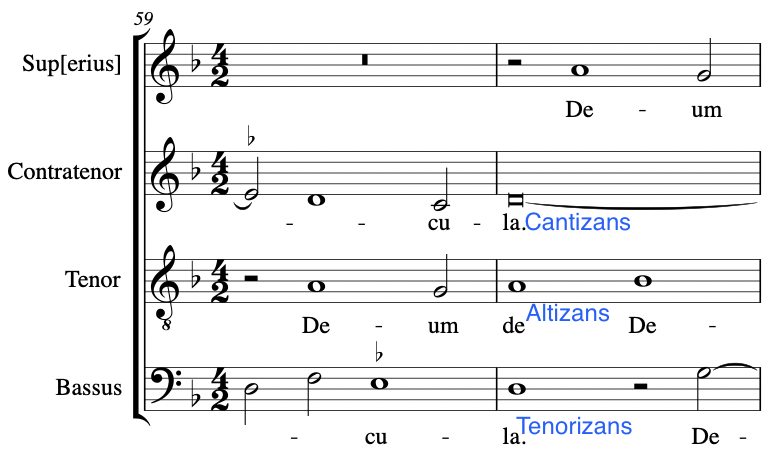
Example 1a: Suspension-based cadence with Cantizans, Altizans, and Tenorizans cadential voice functions, Antoine de Févin, Missa Mente tota: Credo (https://crimproject.org/pieces/CRIM_Mass_0014_3/)
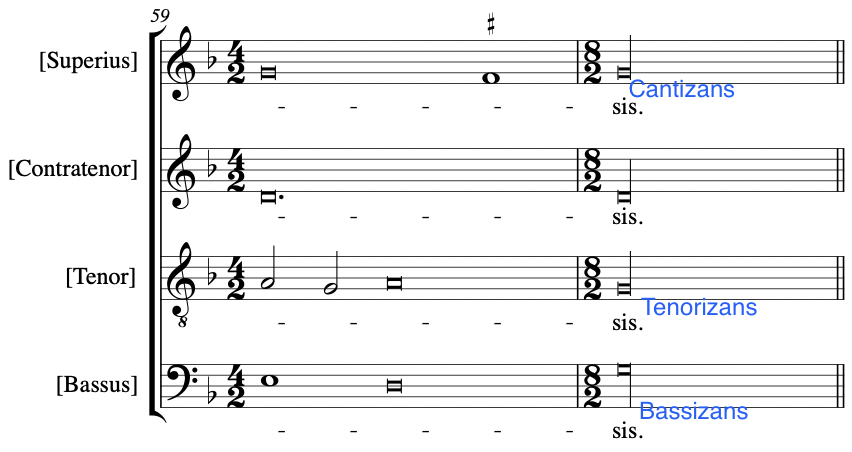
Example 1b: Suspension-based cadence with Cantizans, Altizans, and Tenorizans cadential voice functions,Pierre Daulphin’s, Missa Je n’en puis plus durer: Sanctus (https://crimproject.org/pieces/CRIM_Mass_0011_4/).
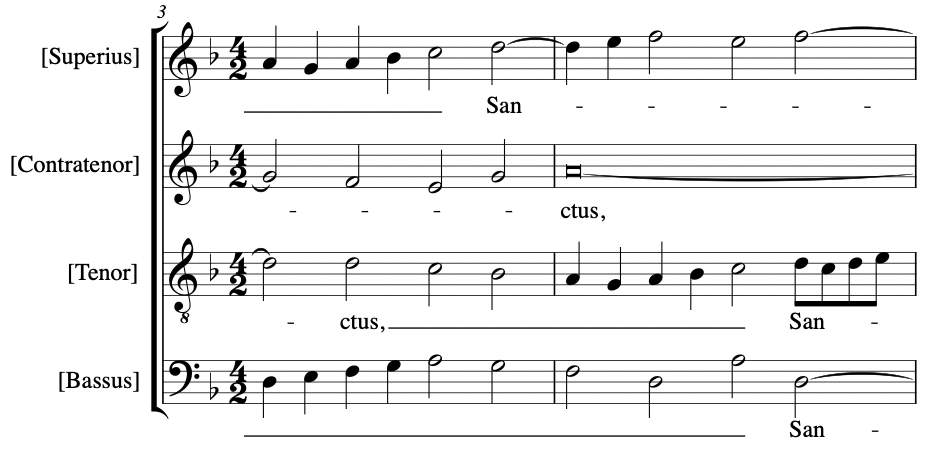
Example 1c: No Cantizans, Bassizans, or any other cadential voice function is detected at m. 4, beat 4 of Pierre Daulphin’s, Missa Je n’en puis plus durer: Sanctus (https://crimproject.org/pieces/CRIM_Mass_0011_4/)
Beyond the Cantizans, Tenorizans, Bassizans, and Altizans that Meier discusses in depth, the CVF finder also identifies four others: Leaping Contratenor, Plagal, Quintizans, and Sestizans. I will now give an example of each of these.
Leaping Contratenor Cadential Voice Function
Meier did in fact mention the Leaping Contratenor, but only briefly as a variant of the Bassizans, and without codifying it as a CVF in its own right (Meier 1988: 92-93). This well known figure begins the same as a Bassizans but goes up an octave at the perfection where it may end up fifth above or a fourth below the Cantizans that it pairs with. This usually results in another voice performing a Tenorizans CVF stepping down to the lowest pitch at the perfection, as in Example 2.
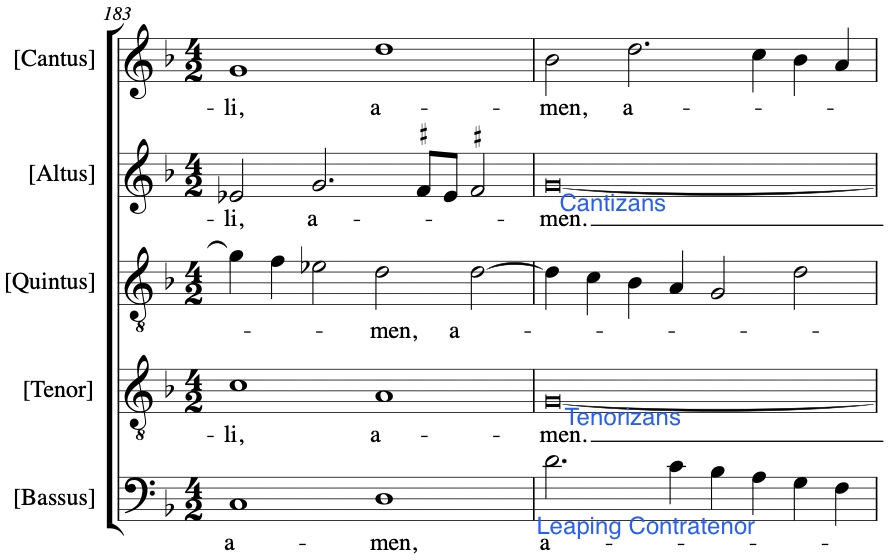
Example 2: A Leaping Contratenor cadential voice function in m. 184 of Claudio Merulo’s, Missa Susanne un jour: Credo (https://crimproject.org/pieces/CRIM_Mass_0050_3/)
Plagal Cadential Voice Function
The Plagal CVF is not to be confused with a Plagal Cadence. I use the term “Plagal” here because this CVF is characterized by its bass motion down a fourth or up a fifth at the moment of perfection. This is different from a regular Bassizans motion of a fourth up or a fifth down, as noted in the CRIM musical vocabularies. Meier mentions these motions but does not give the figure a precise name. The suspension that it creates is a “9-8” suspension with the final target of a perfect fifth at the perfection. Contrapuntally, if you want to add a dissonant suspension against the bass of a harmonic motion of IV to I, this is the only option. This is also the only bass that can meaningfully contribute to intervallic perfection of an otherwise two-voice Phrygian Clausula Vera, as in Example 3.
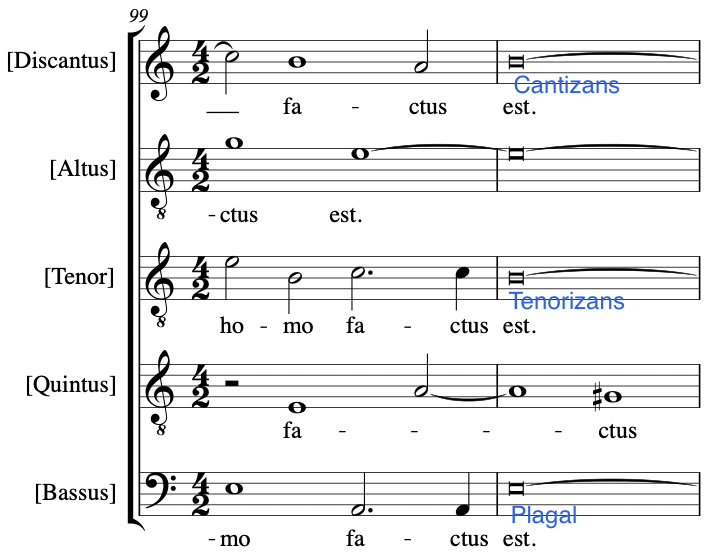
Example 3: A Plagal cadential voice function filling out a Phrygian clausula vera in m. 100 of Lassus’s, Missa Super Ite rime dolenti: Credo (https://crimproject.org/pieces/CRIM_Mass_0021_3/)
Quintizans Cadential Voice Function
The Quintizans is like a Tenorizans that moves up by fourth or down by fifth at the perfection instead of down by step. This name refers to the fact that this type of contrapuntal scenario is generally only found in thicker textures where one often encounters a fifth part named the Quintus. In suspensions where the prepared dissonance is a seventh, multiple voices are needed because this creates a fourth below the Cantizans at the perfection. So another voice is needed to make this fourth consonant, and this is usually a Tenorizans sounding below both the Cantizans and the Quintizans, as in Example 4a. A Bassizans can also fulfill this role, but this causes consecutive fifths by contrary motion between the Bassizans and Quintizans, as in Example 4b. If we invert the Cantizans-Quintizans pair at the octave (producing a dissonant second instead of a seventh), it is possible to have this pair create a viable fifth at the perfection, thereby relieving the necessity of another voice.
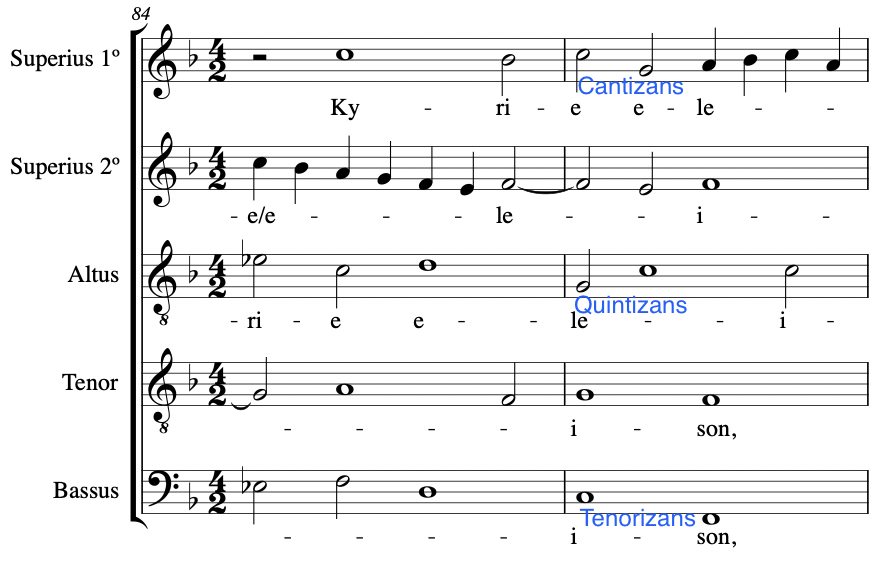
Example 4a: A Quintizans cadential voice function in Francisco Guerrero’s, Missa Sancta et immaculata virginitas: Kyrie (https://crimproject.org/pieces/CRIM_Mass_0025_1/)
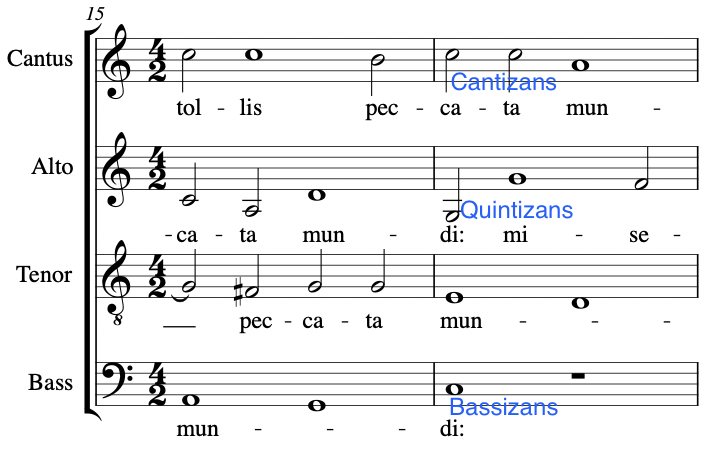
Example 4b: Quintizans and Bassizans cadential voice functions creating consecutive fifths by contrary motion in Tomás Luis de Victoria’s, Missa O quam gloriosum: Agnus dei (https://crimproject.org/pieces/CRIM_Mass_0042_5/)
The above situations obtain when the Quintizans is used in a cadence whose dissonant suspension is a seventh or second, which is why I stated that the Quintizans is like a variant on the Tenorizans in a Cantizans-Tenorizans pair. But what about dissonant fourths in Altizans-Tenorizans pairs? Here a dissonant fourth resolves to a third in the typical fashion, but then the Quintizans moves down by fifth (or up by fourth) into the perfection. Of course this perfectly describes the Cantizans-Bassizans pair. But, it is possible to have a third CVF, a Tenorizans, also pairing this “Cantizans”. In this case the Tenorizans is below the Quintizans, and enters the dissonance phase of the suspension on the same pitch class. So while we would hear a Cantizans-Bassizans pair in isolation, with the added Tenorizans that supposed Cantizans get “reinterpreted” as an Altizans. And since the Bassizans contrapuntally cannot act as a suspension agent for the Altizans, we understand the Bassizans in this case to actually be a Quintizans. For this reason, the cadences method labels this complex the “reinterpreted cadence”. It is the only case where a third CVF can influence the labeling of a given pair of CVFs. Ex shows an example of this, though it is quite complex. Keep in mind that the Quintizans and the Sestizans we will look at next tend to occur in just these sorts of busy textures. This example also includes an evaded CVF, a topic I will discuss shortly.
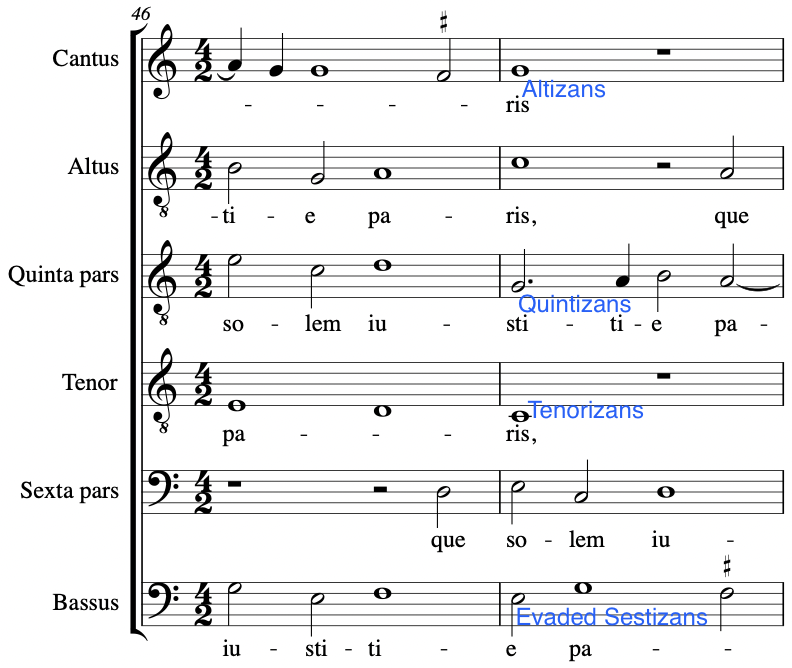
Example 5: A Quintizans cadential voice function in a “reinterpreted cadence” in Loyset Pieton’s, Benedicta es (https://crimproject.org/pieces/CRIM_Model_0023/)
Sestizans Cadential Voice Function
Similar to the Quintizans, the Sestizans is an agent-type CVF only found in thicker textures, perhaps in a “Sesta pars.” The Sestizans moves down a third into a perfection. It is more common in the 9-8 or even 16-15 voicings than as a 2-1. It only pairs with the Cantizans, though a Bassizans is also usually present below the Sestizans. This is because the Sestizans-Cantizans pair emphasizes a perfect fourth so a note a fifth below the Sestizans (and an octave or two below the Cantizans) is needed at the perfection. In this respect it is similar to the Quintizans and this likely is the reason both of these are typically found in thicker textures. There is some debate about what accidental it should carry as both possibilities impart pronounced harmonic dissonance. With respect to the Cantizans’ goal tone at the perfection, the Sestizans descends by third from scale-degree 7 to scale-degree 5 If this starts on the raised form of scale-degree 7, then at the dissonant phase of the suspension, the tone being cadenced to will sound above its leading tone. In addition to the pronounced dissonance, this explicit doubling of the leading tone can suggest a motion of parallel octaves even though there are none. Consider the dissonance ramifications of using F or F# for the Sesta pars‘s F in Example 6.
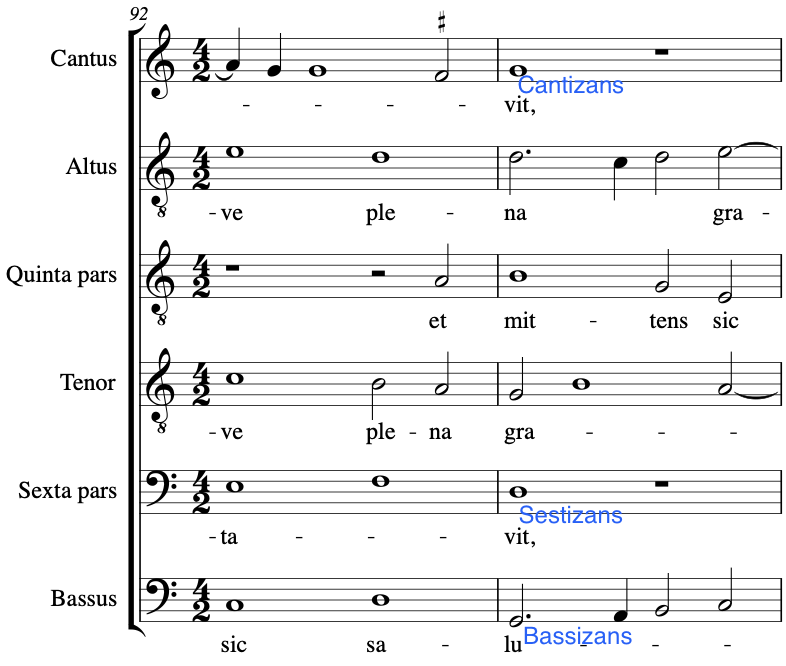
Example 6: A Sestizans cadential voice function in Loyset Pieton’s, Benedicta es (https://crimproject.org/pieces/CRIM_Model_0023/)
Using the lowered form of scale-degree 7 here makes the dissonance phase of the suspension smoother, but then at the resolution phase we hear a simultaneous cross relation of a flattened scale-degree 7 below the same degree with a sharp or natural. This is similar to, but different from the better known “Hendrix chord” or dominant seventh with a sharp ninth in popular music. While they can both be thought of as harmonies with a split third, the cross-relation approach to realizing the Sestizans puts the flattened scale-degree 7 below one with a sharp or natural, whereas the Hendrix chord does the opposite. For a thorough investigation of how to apply ficta in this scenario, and also a general overview of the particularities of thicker 16th century Franco-Flemish textures (see Arlettaz, 2000).
Detection Methodology
I map 111 cadential interval successions to a given CVF label in each voice of the pair. More interval successions are added as needed when missing patterns are identified. So many are needed because there are many combinations of CVFs, and also because of the many cases of ornamentation, contrapuntal inversion, and score inversion. “Score inversion” is when a part lower on the page has notes above a part above it on the page. Each of these interval successions corresponds to the four phases of a dissonant suspension.
Refinement of Interval Succession Notation
The development of CVF and cadence detection required some refinement to the interval succession notation I used. In all of the following examples, I will take the example of a Clausula Vera which consists of a Cantizans-Tenorizans pair like that in Example 7. All of the successive ways of notating interval successions refer to this same example.
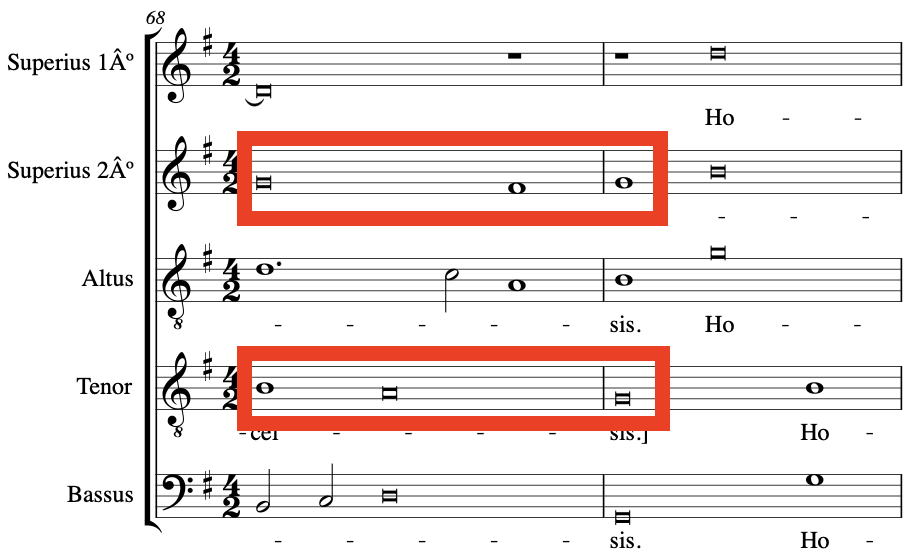
Example 7: A standard Cantizans-Tenorizans pair, sung by the second Superius and Tenor, highlighted in an authentic cadence in measures 68-9 of Francisco Guerrero’s Missa Congratulamini mihi: Sanctus (https://crimproject.org/masses/CRIM_Mass_0024/). I convey the pair’s interval succession in the highlighted section with the label 6_-2:1, 7_1:-2, 6_-2:2, 8.
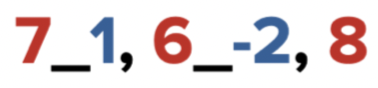
The interval successions I use to identify CVFs began in the following format. The harmonic intervals (in red below) start each “slice” and are to the left of the underscores. The melodic intervals of the lower voice (in blue below) are indicated to the right of the underscore. “Lower” in this case means the voice whose staff is lower in the system. Slices are separated by a comma and a space. Since the last harmonic interval has no melodic intervals connecting it to another harmonic interval, the last slice is just a harmonic interval. Inverted harmonic intervals and descending melodic motions are indicated with negative numbers. All intervals are diatonic and compound intervals are reduced to within the octave (inclusive):
I originally wrote the interval succession patterns going from the dissonance to the perfection with the thinking that anything goes for a preparation. It is more accurate to say that there are many valid options for a suspension preparation, but not anything. So I added a preparation for more needed context. This means that an unornamented interval succession corresponding to a suspension-based cadence is represented with four slices instead of three. The preparation is critical to understanding which voice is the agent or patient in the dissonance. In a suspension, the agent is the one that attacks a note to create a dissonant interval against a sustained (or rearticulated) note from the patient. In Example 7, the Tenor is the agent and the second Superius is the patient in the highlighted suspension.

The notation above still fell short in more complex cases where a rest is present in a low-voice agent at the preparation. It is also possible for one or both voices to rest at the perfection in the case of abandoned cadences which I will address shortly. To address these cases, the melodic motion of both voices is explicitly included at each step. I also add a colon to separate the melodic motions of the lower and upper voices. The melodic motion of the lower voice appears first.

The format above is complete but since there are so many valid options for the preparation and the ensuing melodic motion of the agent, I used regular expressions to allow for all the valid options for the agent in the preparation phase. The actual regular expressions used have been simplified here with asterisks to show that almost anything is acceptable in these locations:

Without this level of detail it is not possible to use interval successions alone to classify CVFs and cadences.
Sufficiency of Interval Successions
In searching for cadences, only interval succession information is used. Otherwise stated, specific rhythm, duration, metric placement, position in piece, text setting, etc. are not considered. The purpose of this analytical constraint is not to refute the importance or weight of these non-intervallic musical domains. Rather, it is to determine whether or not interval succession information is sufficient on its own to find and classify CVFs and suspension-based cadences. Other musical domains not under analysis here may also be independently sufficient in this same fashion, but it is my suspicion that they are not. While rhythmic or other patterns seem likely to correlate with cadences, it is implausible that one could get to anywhere near the same level of specificity in CVF and cadential classification using any other single musical domain as I have with intervallic analysis. For example, it is hard to imagine being able to distinguish between evaded and realized cadences based on the rhythm alone. That being said, I should note that while the interval successions I use for CVF detection do not encode specific rhythmic information, they do show the order of attacks which is a critical aspect of dissonance analysis and can be understood as an abstraction of the rhythm.
At the CRIM meetings in Tours and Haverford in 2022, some scholars expressed concerns that the cadence tools allow for the possibility of finding a cadence at any metric placement. But the argument that cadences should only happen in strong metric positions and therefore should only be searched for in these places, is somewhat self-defeating. If it is indeed the case that cadences don’t happen on weak metric positions in this repertoire, then it is no problem to search for them there as well because presumably none would be found. Furthermore, if you wanted to empirically support the assumption that no cadences happen at weak metric positions, then you would explicitly want to look for them in weak metric positions to confirm that they are not there.
Patient- and Agent-Type Cadential Voice Functions
Beyond needing two different CVFs to occur simultaneously for any to get detected, each pair must have exactly one patient-type CVF which sustains or repeats a note from the preparation into the dissonance and is either a Cantizans or an Altizans, and one agent-type CVF which attacks a note at the dissonance and is any of the others. All eight CVFs and their patient- or agent-type classifications are shown in Table 1.
| Patient-Type | Agent-Type |
|---|---|
| Cantizans | Tenorizans |
| Altizans | Bassizans |
| Leaping Contratenor | |
| Plagal | |
| Quintizans | |
| Sestizans |
Table 1: Patient-Type and Agent-Type Cadential Voice Functions
Many of the interval successions are the same but for some minor ornamentation. The Clausula Vera (i.e. Cantizans-Tenorizans combination) is the primary CVF pair that can withstand inversion at the octave and still retain its cadential weight. As mentioned earlier, it is also possible for the Cantizans-Quintizans pair to be found with the Quintizans on top, but this is considerably less common. Disregarding cases of ornamentation and inversion, we may expect that there would be twelve possible pairings of the CVFs since there are two patient types that need to pair with one of the six agent types. However, many of the pairs are not viable for contrapuntal reasons. For example, the Bassizans, Leaping Contratenor, and Sestizans cannot serve as agents against an Altizans because the notes they attack at the dissonant phase of a suspension do not create dissonant intervals against the note an Altizans sustains at this point. Therefore eight pairings are possible, and all the 111 patterns I use are variations of those. And there are only two primary pairings, the Cantizans-Tenorizans and the Cantizans-Bassizans. It makes sense that the number of core patterns is quite small. The limited number helps make cadences easily recognizable which is essential to their rhetorical effect.
Pairwise Analysis
This analysis is done in a pairwise fashion, meaning that only events in two voices are considered at any given time. There are only two small exceptions to this pairwise approach: the classification of fourths as consonant or dissonant, and the reinterpreted cadence. A fourth is considered dissonant if it is a fourth against the lowest sounding note, even if that note is not in the pair under analysis. Two different pairs of voices that share a common voice can have contradicting CVF labels for that common voice. In practice this only occurs in the case of the reinterpreted cadence discussed earlier. So this analytical disagreement or “overwriting” is not a problem. Other than these two exceptions, the CVF analysis is completely pairwise. This maximally pairwise approach was used to follow the established tradition of interval succession treatises. We only need to analyze each pair once, so the pairs are combinations rather than permutations of voices. In order to get the number of pairs in a piece we can use the equation (v2–v)/2 where v is the number of voices in the piece.
Realized vs. Unrealized Cadential Voice Functions
So far, I have mainly dealt with realized cadential voice functions wherein our cadential expectations for a given voice are satisfied with the presentation of a full cadential pattern. A realized CVF’s interval succession must include all four phases of a suspension: preparation, dissonance, resolution, perfection. The perfection phase is an arrival at a perfect interval in realized CVFs. While this is the default expectation, CVFs don’t always come to fruition in this way. While I offer realized vs. unrealized terminology, this concept is not new. We will see an example by Zarlino that highlights this dichotomy, and examples from both categories can be found in countless Renaissance compositions.
In contrast to realized CVFs, a CVF is unrealized when it is evaded or abandoned. A CVF is evaded when that voice derails an expected perfection by moving to a note that does not create a perfect interval in the pair under analysis. An abandoned CVF places a rest at the moment of expected perfection.
As I highlighted in an earlier article, Zarlino provided an extended example of cadential evasion and abandonment (Morgan, 2019). The example, reproduced in Example 8, is 35 measures long and includes 22 suspensions, all of which contain unrealized CVFs except for the very last suspension. As he puts it: “Therefore let it suffice to say that a cadence is evaded, as I said, when the voices give the impression of leading to a perfect cadence, and turn instead in a different direction.” (Zarlino, 1558).
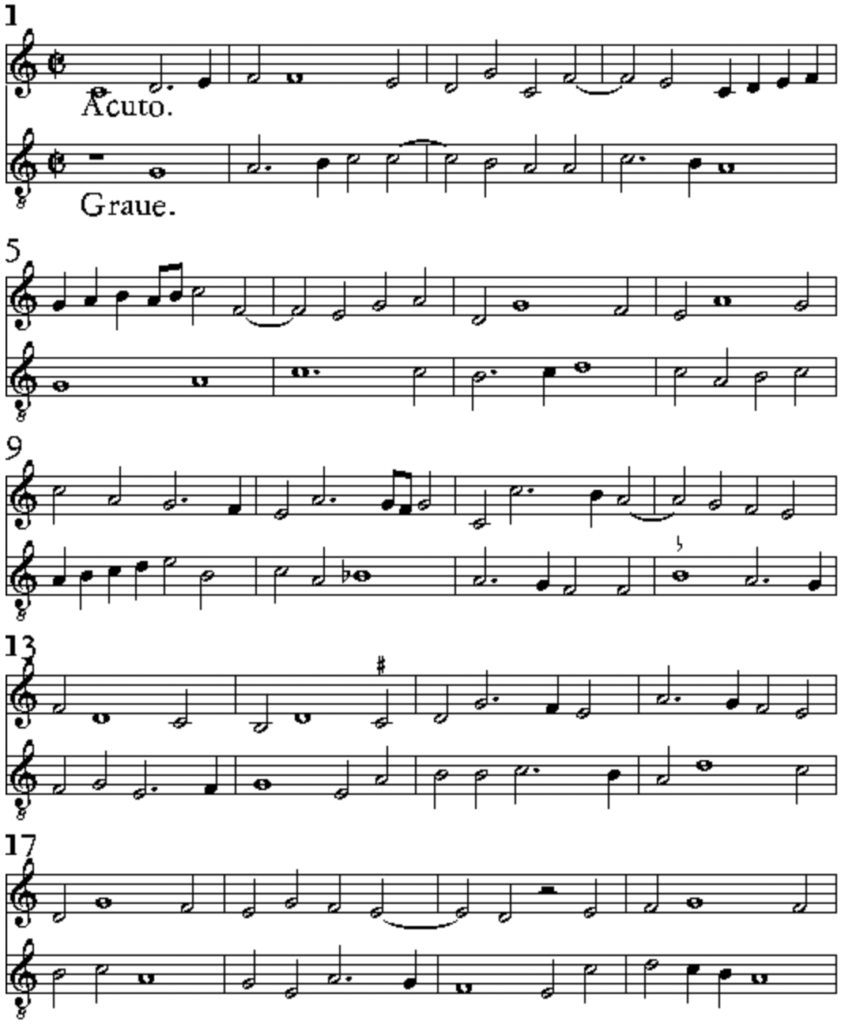
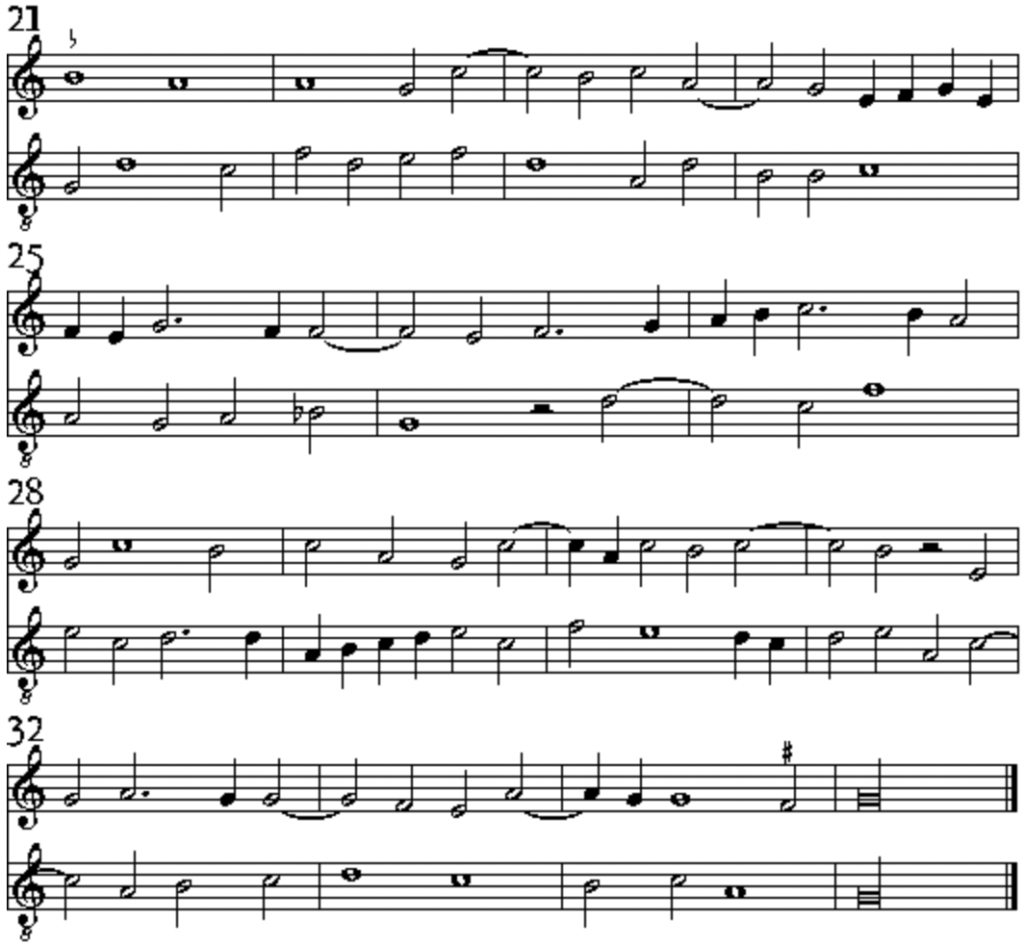
Example 8: Zarlino’s example of evaded suspension-based cadences.
CVF evasion and abandonment is assessed separately for each voice in a pair. So if a Clausula Vera is set up, and the Cantizans voice steps into the perfection phase of the suspension as expected but the Tenorizans voice drops out, it is just the Tenorizans voice that was abandoned while the Cantizans CVF was still realized. Does the combination of a realized Cantizans and an abandoned Tenorizans still constitute a cadence? Assuming there are no other CVFs at play, the answer is no. However, CVF evasion or abandonment in one or more voices does not necessarily mean the whole cadence will be evaded or abandoned. How CVFs combine to form realized or unrealized cadences is a question we will turn to shortly in the discussion of the cadence finder.
Rejecting Cadential Voice Function Analysis
It is possible to reject this CVF-based analysis. CVF-based cadential syntax can overlap with tonal cadential syntax. A prepared Clausula Vera can easily be integrated into a tonic-predominant-dominant-tonic motion. If a Clausula Vera is supported by a third voice that is meant to participate meaningfully in the cadence, a Bassizans, Cantizans, and Tenorizans together can easily be heard as a perfect authentic cadence in the tonal sense. But these ways of hearing are anachronistic. Nothing is necessarily wrong with an anachronistic hearing, and it can be hard to avoid when it sounds patently obvious. But refusing the concept that suspension-based cadences are the primary means of cadencing in this repertoire ignores a critical component of Renaissance style. It rejects the entire intervallic ethos of dissonance driving the syntax through imperfect consonance and finally to the goal of a perfect interval.
Embracing Cadential Voice Function Analysis
If instead we embrace cadential voice function analysis, it makes sense to use it to go from purely pairwise identification of CVFs, to all-voice suspension-based cadences. And by extension, it makes sense that, as interval successions are the means of identifying CVFs, they are also likely a sufficient and complete means of detecting cadences.
This approach is supported by the preponderance of evidence in primary sources, and now the empirical evidence that we can measure thanks to the present analysis tools. The most thorough way to be confident that these interval successions are exclusive to cadential moments is to look for them everywhere in all pairs of voices. With the gradual refinements we have made to the tools I am now confident that there are very few cases of false positives (detection of CVFs when there are none) and false negatives (no detection of CVFs when they are in fact present). When these do occur, they are generally the case of a missing ornamentation pattern, and these errors are rectified by growing the list. The fact that these suspension-based interval successions are exclusive to cadences is a strong argument in support of their salience and therefore their appropriateness for this critical rhetorical role.
Musical Redundancy
Beyond the analytical applications of the CVF and cadence finders, I am even more interested in what my specific approach has uncovered about the nature of suspension-based cadences. Without considering the durations, prevailing mensuration, meter, metric placement, position in a piece, or any other domains, the intervallic content of these patterns is exclusive to cadences. This finding was uncovered by limiting inputs to the cadence finder to only intervallic information. Perhaps this is why many period treatises focus solely on intervallic information. This may also be a window into why interval succession treatises were a common way of teaching musical syntax.
This does not mean that those other musical domains do not also play their own roles in cadences. Rather, this is a demonstration of the rhetorical redundancy in this style. In this context, “redundancy” has no negative connotation whatsoever. Redundancy is a very common element of communication as it helps ensure that the correct meaning will be conveyed even if the message is only partially transmitted. In speech, many languages convey that a sentence is a question by inverting the word order of a subject and its verb. Similarly in many languages, this interrogative marker can be reinforced by rising inflection at the end of the sentence. Either one of these speech signals could be sufficient to convey that a question is being asked, and together they offer a degree of redundancy that does not impact the meaning of the sentence, but does make the interrogative nature of the message more reliably understood by a listener.
While it is not enough to classify the cadence type on its own, the syncopated rhythmic layout inherent to a suspension is another cadential marker in this style. The difference between singing a note and observing a rest is one of the clearest timbral contrasts in this music, and since a cadence between two voices is often followed by a rest in one or both of those voices, we can say that timbre is similarly redundant with the intervallic cadential markers I use. There may be more markers that are somewhat less obvious. Since the cadence classifier’s automated analysis gives easy access to thousands of identified cadences, we can also look for other musical events that correlate with these moments. Perhaps there are other cadential markers that were better appreciated in their time but now go mostly unnoticed.
The fact that the intervallic content of these patterns is exclusive to cadences in Renaissance music does not mean that this same musical domain will be a cornerstone of other musical styles as well. I suspect that most musical styles have their own highly revealing musical domains. This is often the kind of thing that a versed listener knows intuitively, but it can be difficult to put into words. If you want to find other stylistic markers, I can recommend writing a classifier since this forces you to be rigorous and systematic.
Beyond Suspension-Based Cadences
The analysis tools documented here fully embrace the world of suspension-based cadences. But there are of course other types of cadences too. The extent to which we can use these same tools to detect other types of cadences is quite limited. It is possible to extend the present process of detecting suspension-based cadences to other interval succession based cadences. I will now discuss two such extensions: one cadential interval succession from the Eton Choirbook, and a group of interval successions that are quite close to suspension-based cadences.
An English Cadence
Going a little beyond suspension-based CVFs, we can loosen our requirements to include interval successions that do not include a suspension, but still use purely intervallic means of marking an arrival at a perfect interval. Michael Winter pointed out a clear example of this to me from the Eton Choirbook, shown in Example 9. This case also highlights the fact that specific CVF patterns and cadence types come in and out of fashion over time, and vary considerably regionally as well. Winter found this pattern in several pieces from the Eton Choirbook and also in a work by John Taverner from before 1530. The composition dates of these pieces span roughly 60 years. In contrast, this cadential figure was not found at all in the entire CRIM database, which is currently about 250 pieces. These results suggest that this is a primarily English cadential pattern, perhaps exclusively so.

Example 9: A cadential interval succession with no suspension from William Horwood’s Salve Regina, bars 59-62 (courtesy of Michael Winter)
By setting the “keep_keys” parameter of the cvfs method to True, the resultant table will include an extra column showing the specific interval succession that triggered each CVF pair detection. So you can find one case that matches the interval succession you are interested in, and then search the table for all instances of it. That is how we are able to confidently say that the English pattern above does not appear in the CRIM database. As we expand our list of cadential interval successions, this is one technique we use to ensure that new false positives do not creep into the results. This is also the way you would trace the frequency of one cadential interval succession as it comes in and out of favor over time or gets used by certain composers but not others. For more on English cadences, the concurrent paper by Jessie Ann Owens and Richard Freedman looks at cadences in Morley’s works. I will now turn to a group of interval successions that are similar to suspension-based cadences but play with the agent and patient roles a bit.
The Fake Suspension
A more common interval-based cadence that does not have a true suspension in it is the cadenza doppia or “fake” suspension. Jeppesen called this the “consonant fourth” and described it in the following way:
The so-called “consonant fourth” is a fourth brought in stepwise upon the thesis (weak beat) over a stationary bass tone. Thereafter it is tied over to the next following arsis (strong beat), where it is changed into a stronger dissonance; but finally manages to make its regular resolution upon the next thesis (weak beat), for example (Jeppesen 1939: 193):
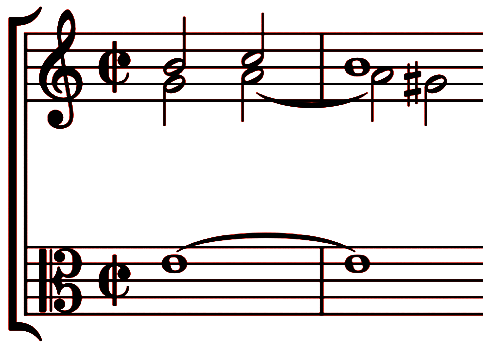
Example 10: Jeppesen’s “Consonant Fourth” example.
Here Jeppesen makes the standard mistake of omitting the perfection phase from the suspension. Can you imagine if skydiving instructions didn’t mention anything about landing! He does provide detailed metric placement information which is also typical for descriptions of the fake suspension. Even in treatises where no metric information is provided, they usually are exceptionally provided in the case of the fake suspension. Why is that?
Since the interval succession patterns I use to look for CVFs are quite permissive with respect to what is allowed as a valid preparation, these patterns were already being found provided that the pedal of the Bassizans or Tenorizans is rearticulated at the dissonance phase of the suspension. But since the agent-type CVF in a fake suspension does not always re-attack at the dissonance phase (as in Jeppesen’s example), the tool I created was missing those cases.
I first dealt with this subtype of fake suspension six years ago in creating the Renaissance dissonance classifier for Humdrum and the Josquin Research Project in 2017 (Sapp and Morgan 2017). It was the “M” and “m” dissonance types. In creating that dissonance classifier with Craig Sapp, I saw that searching for the pattern was easier when you include the interval before the preparation as well. Since the preparation phase is itself dissonant, it is preceded by a consonance. The pedal tone of the agent-type CVF begins at the onset of this preceding consonance or earlier. The Cantizans in the pattern usually approaches the dissonant preparation phase by step up or down. There is no attack in either voice at the dissonant phase of the suspension, meaning the interval successions I use to find this case observe no event at the dissonance phase. But with the preceding consonance added, there are still four events in the interval successions.
Since these patterns don’t include an attack from the sustained agent-type CVF, I was worried that including the pattern would cause several false positives in cases where neighbor-tone figures happened to be followed by perfect octaves. But as mentioned earlier, it is better to explicitly look for all instances of patterns rather than to guess at whether or not they are exclusively cadential. I found 72 cadential interval successions of this type in 63 cadences using these types of interval successions in the CRIM repertoire which is about 1% of all the cadential observations. There are slightly more of the cadential interval successions than there are cadences because some of the cadences contain both a Bassizans-Cantizans and a Tenorizans-Cantizans fake suspension pair.
I reviewed all of these 72 “hits” and only three of them were false positives. All three of these are shown in Examples 11a-c. All three are Tenorizans-Cantizans variants of the interval succession.
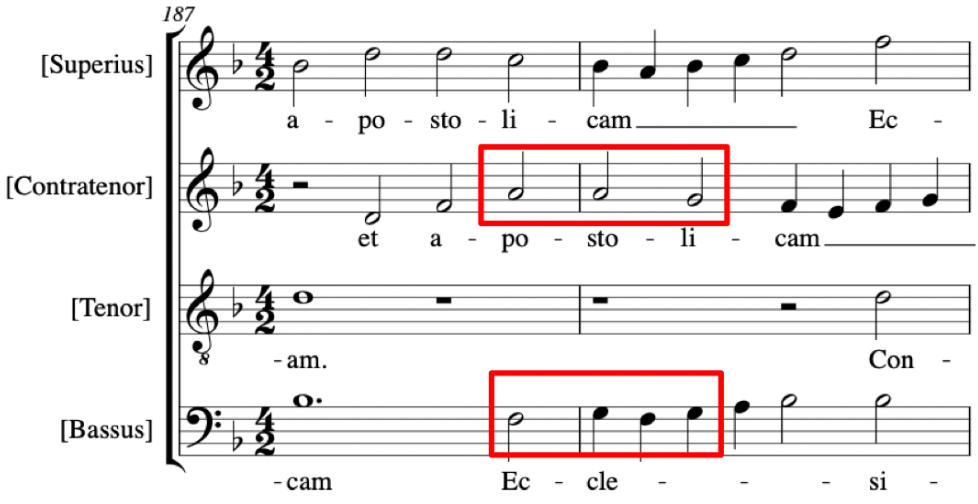
Example 11a: False positive fake suspension pattern, from Pierre de Manchicourt, Missa Quo abiit dilectus tuus: Credo, measures 187-88 (https://crimproject.org/masses/CRIM_Mass_0013/)
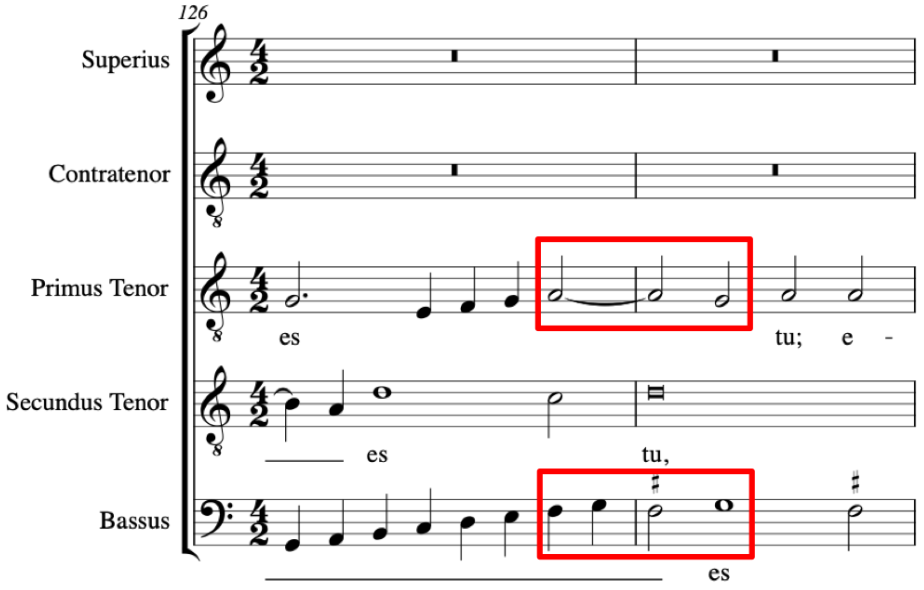
Example 11b: False positive fake suspension pattern, from Claudin de Sermisy, Quare fremuerunt gentes, measures 126-27 (https://crimproject.org/pieces/CRIM_Model_0010/)
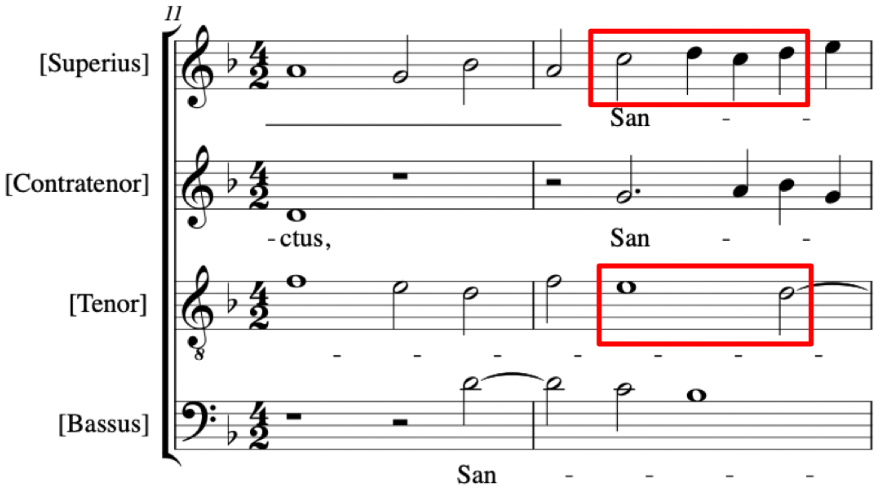
Example 11c: False positive fake suspension pattern, from Jean Guyon, Missa Je suis déshéritée: Sanctus, measures 11-12 (https://crimproject.org/masses/CRIM_Mass_0006/)
This cadential interval succession is very well documented in the literature. In a previous article, I noted that most thorough counterpoint treatises and textbooks explicitly discuss this pattern including many primary sources (Morgan 2019). A possible reason for this special treatment is that this particular subset of interval successions is not absolutely exclusive to cadences, unlike the other cadential patterns.
Looking at the false positives in Examples 11a-c, there are ways that we could correct them by analyzing metric and/or durational information. But we only know that because we began by searching with exclusively intervallic criteria. It is also not as simple as one might expect to define metric and durational rules as fake suspensions exhibit a fair amount of variation in these two regards. I take these three false positives as the exception that proves the rule that interval successions alone are sufficient in almost all cases to detect and classify CVFs and cadences. With respect to the methodology, it was easy for the cvfs and cadences methods to also detect these cases because they have concrete cadential interval successions, even if they are not suspension-based. Please note that the analysis tools I describe here detect CVFs, cadences, and supplementa. The names of the methods in CRIM Intervals that return these analysis results naturally have the same names. To distinguish between these terms, all references to the encoded methods themselves are in italics, specifically cvfs, cadences, and supplementum. I will now explain how the cadences method uses the results of the cvfs method to generate cadence labels.
From Cadential Voice Functions to Cadences
For their automated detection, I define cadences as discrete combinations of simultaneous contrapuntal voice functions. For any combination of CVFs, the cadence finder assigns a specific cadential label. These are combinations, not permutations, so the score order and pitch order are ignored. These label assignments are “many-to-one”, because several different combinations of CVFs can have the same cadence label, but any given combination of CVFs corresponds to exactly one cadence label. The fact that I get the cadence labels from the simple process of looking up the CVF labels in a table is why the bulk of this paper has been focused on the much more complex and theoretically involved process of detecting CVFs.
There has generally been more interest in using the cadence results to pursue research questions than there has been in the CVF results. In the remaining portion of this article I will offer some preliminary thoughts about how the cadence results can be used to pursue research questions.
Syntactically Informed Analysis
The cadence finder makes it possible for automated analysis to segment a piece according to syntactic criteria explicitly defined in primary sources. There have been some plausible but as yet unquantified relationships between cadences and compositional process. Did the “primary” cadencing duo of a three- or four-part composition come first? Now that CVF detection has been reliably automated it is considerably more tractable to undertake a study of this relationship at a convincing scope. I would be delighted to see another researcher use these tools for such a study.
I am particularly interested in leveraging these new tools’ ability to segment a piece according to its musical syntax. It will be especially interesting to pair these cadence tools with Richard Freedman’s presentation type finder which is also part of the CRIM Intervals suite of tools. The presentation type finder compliments the CVF and cadence finders because they are syntactical analysis of beginnings and endings respectively. Concerning endings, I will now explain how we can use the cadence tool to find supplementa.
Cadence Based Supplementum Detection
As a first application of syntactically based segmentation using these cadence tools, I applied the cadence finder results to automatically identify supplementa. What is a supplementum? It is generally thought of as the Renaissance equivalent of a coda. There are often one or more voices that sustain a note throughout a supplementum. They often end in a plagal harmonic cadence. Composers also occasionally seize the final opportunity supplementa provide to sound a primary soggetto one last time. These sorts of observations are useful, and we may use them to arrive at an accretive definition of a supplementum. That is, perhaps if a final passage of a piece has, for example, four out of six common characteristics of a supplementum then it should be considered as such. For the purposes of demonstration, let’s say that a supplementum is the portion of a piece after the last suspension-based cadence. This is the working definition CRIM’s experimental supplementum method uses.
Alongside the cadence type identified, the cadence classifier also provides a lot of contextual information which will be of interest for certain queries. To find supplementa, we can take a closer look at the “Progress” column of the cadence results. This is a number between 0 and 1 that summarizes how far along in a piece a cadence is found. 0 is the beginning of the piece and 1 is the onset of the last attack. So assuming we don’t have suspension-based cadences in or at the end of a supplementum, then we can look at the last suspension-based cadence of each piece; if that cadence’s Progress value is less than 1, we can expect a supplementum to begin right at the perfection of that last suspension-based cadence. This could be a couple of notes, or several measures.
This simple definition makes it easy to peruse the supplementa of pieces if they are present. However, the fact that this definition of a supplementum is easy to use does not mean that it is correct. The ease of use is significant though, because it facilitates testing the definition to see how well it holds up. According to this simple syntactically based definition of a supplementum, 144 of the 256 polyphonic pieces currently in the CRIM project corpus have a supplementum. This quick exploration of supplementa is offered as a demonstration of the potential of the syntactical applications of automated cadence detection.
Conclusive Cadences
The final suspension-based cadences of pieces are disproportionately authentic cadences (including at least a Bassizans and a Cantizans). Authentic suspension-based cadences account for only 28.08% of all the cadence labels assigned to the CRIM corpus but 67.48% of the last suspension-based cadences of each piece in the corpus, as shown in Figure 2.
In contrast, Clausula Verae (including Phrygian Clausula Verae) make up the plurality (43.86%) of all the cadence observations but only 19.12% of the last suspension-based cadences. They are therefore underrepresented as the final suspension-based cadence of a work. Automated cadence detection facilitates these kinds of empirical observations.
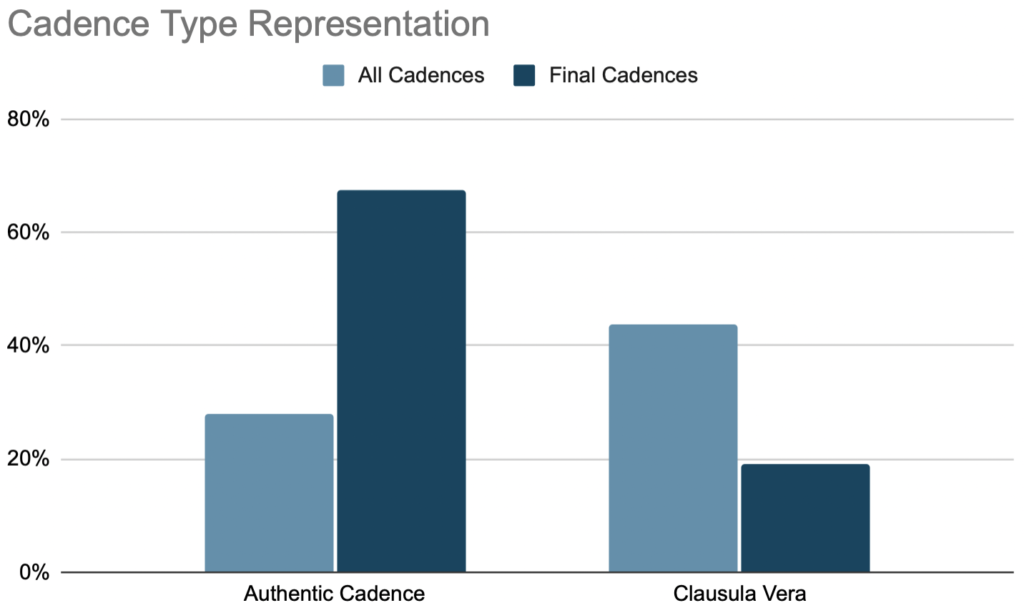
Figure 2: Percent representation of authentic and Clausula Vera cadence types in the CRIM corpus.
These percentages change considerably, however, if we only look at the pieces whose last cadences have only two sounding voices at the moment of the perfection. We do this by looking at the “Sounding” column in the cadences method’s results table. There are only eight pieces in the CRIM repertoire that match this description all of which use Clausula Verae as their final cadences. As Meier has pointed out, Zarlino explicitly stated this preference for a Clausula Vera as a final cadence in two voices (Meier 1988: 90-91; Zalino 1558: bk. 3 ch. 51-52).
Conclusion
The cadential voice function and cadence analysis tools I describe here have a lot of potential to illuminate questions of style change, attribution, and musical syntax. I am eager to see the ways other researchers will apply these tools for corpus studies, especially in applications where CVF and cadence results are used to parse music syntactically.
It is easy to assume that we have a good grasp of patterns we see all the time. Automating an analysis we would otherwise do “by hand” lays bare the strengths and weaknesses of our assumptions. For this reason I highly recommend it as a way to demonstrate our understanding of a subject. I invite the reader to take the CVF and cadence tools I describe here as a model for creating their own set of automated analysis tools, and in the process enrich their own understanding of this repertoire.
Works Cited
Arlettaz, Vincent. 2000. Musica Ficta: Une histoire des sensibles du XIIIe au XVIe siècle. Pierre Mardaga: Sprimont, Belgium. Originally published as a dissertation: 1998. “Etudes sur l’apparition du langage tonal.” L’université de Paris-IV Sorbonne.
Cohen, David. 1993. “Metaphysics, Ideology, Discipline: Consonance, Dissonance, and the Foundations of Western Polyphony.” Theoria (7): 1–86.
———. 2001. “‘The Imperfect Seeks Its Perfection’: Harmonic Progression, Directed Motion, and Aristotelian Physics.” Music Theory Spectrum 23 (2): 139–169.
Dahlhaus, Carl. 1990. Studies on the Origin of Harmonic Tonality. Translated by Robert O. Gjerdingen. Princeton: Princeton University Press.
Freedman, Richard, Alexander Morgan, Oleh Shostak, Freddie Gould, et al. 2023. Intervals https://github.com/HCDigitalScholarship/intervals
Jeppesen, Knud. 1939. Counterpoint: The Polyphonic Vocal Style of the Sixteenth Century. Translated by Glen Hayden from the original Danish edition (Wilhelm Hansen, Copenhagen, 1931). Englewood Cliffs, New Jersey: Prentice Hall Inc.
Meier, Bernhard. 1988. The Modes of Classical Vocal Polyphony. New York: Broude Bros.
Morgan, Alexander, Daniel Russo-Batterham, and Richard Freedman. “Defining Renaissance Cadences Systematically.” 2022 MEI Conference Proceedings.
Morgan, Alexander. 2019. “Renaissance Ternary Suspensions in Theory and Practice”, Intégral, 33/2019.
Sapp, Craig. 2023. Humdrum. https://github.com/humdrum-tools
Schubert, Peter. 2008. Modal Counterpoint, Renaissance Style, 2nd ed. New York: Oxford University Press.
Zarlino, Gioseffo. 1968 (1558). Art of Counterpoint. Translated by Guy Marco and Claude Palisca, edited by Claude Palisca. New Haven and London: Yale University Press.