Manchicourt and Compositional Process in Quo abiit
Ian Lorenz (McGill University)
Introduction
In this paper, I examine Manchicourt’s four-voice motet, Quo abiit, through the lens of the CRIM Project, incorporating both human and machine-aided analyses to support my preliminary conclusions based upon this research. Throughout the process of converting my results into a study, I became aware of two aspects that helped shape this project: one is Richard Freedman’s study of Pierre Manchicourt, in which he evokes a perspective of a sixteenth-century composer rarely seen, one not only of a composer, but also an analyst and listener:
Manchicourt’s preface to the chanson book in particular reveals a man steeped in humanist discourse about the properties of style borrowed from the world of the poets and orators: “You should understand,” he wrote to Joachim Polite [an Antwerp lawyer and town elder], “that just as the low and middle styles are distinct from the high and heroic, so too the art of the chanson is to that of motets and serious subjects; they must be more humble, and less aware of their own artifice” (Freedman 2012).
Beyond this unique perspective of a composer-as-analyst and listener, I also became aware of Kofi Agawu’s writings about semiotics in classical music and how paradigmatic musical features, when divorced from their original function, can act as a kind of compositional play. As such, in this paper, I take Freedman’s idea related to Manchicourt in relation to his astute learned-ness, and the roles he played as composer, listener, and analyst to include more than just the text, but also counterpoint and imitation as an element of form. In overlaying this compositional approach from motet to Mass, I find that Manchicourt has substantively changed specific passages of the Mass in ways familiar to Agawu’s conception of play. In all, this paper strives to show how a sixteenth-century composer like Manchicourt fashioned his motet around fundamental textual elements of the motet. I then conclude by examining three movements of Manchicourt’s Mass based upon the same motet in which the composer consciously deviates from expectations established in the motet.
Manchicourt’s Re-interpretation of Quo abiit
| Part | Phrase | Measures | Text |
| 1 | 1 | 1-25 | Quo abiit dilectus tuus, o pulcherrima mulierum? |
| 1 | 2 | 22-36 | Quo declinavit dilectus tuus? |
| 1 | 3 | 34-47 | Et quaeremus eum tecum. |
| 1 | 4 | 43-84 | Dilectus meus descendit in hortum suum ut pascatur in hortis suis et lilia colligat. |
| 2 | 5 | 85-103 | Qualis est dilectus tuus, o pulcherrima mulierum? |
| 2 | 6 | 99-123 | Sicut malus inter lingua silvarum, sic dilectus meus inter filias. |
| 2 | 7 | 121-166 | En dilectus meus loquitur mihi surge propera amica mea, columba mea, formosa mea et veni. |
Table 1: Text of Quo abiit (derived from https://crimproject.org/pieces/CRIM_Model_0015/sources/)
The text of Manchicourt’s motet is derived from the Song of Songs, Chapter 5. The first three phrases of part 1 are derived from 5:17, which translates to “Wither is thy beloved gone, O thou most beautiful among women? [W]hither is thy beloved turned aside, and we will seek him with thee?” (Douay-Rheims 1899). Phrase 4, the final phrase of the opening part (prima pars) of the motet comes from 5:1, translating to “Let my beloved come into my garden” (Douay-Rheims 1899). While the prima pars is derived from whole parts of Chapter 5 of the Song of Songs, the second part (secunda pars) is loosely derived from other sections of the chapter: Phrase 5, for instance, borrows from 5:9; and Phrase 7 is loosely derived from 5:2.
Chants based upon Quo abiit that I have been able to locate through the chant database Cantus Index only make use of the first three phrases of Manchicourt’s text; of the eight total chants on Cantus Index based upon Quo abiit, those that have a text are derived only from the first three phrases (Cantus Index 2022). While Quo abiit has an established history through chant, Manchicourt had to further interpret Chapter 5 of the Song of Songs in order to create a motet of two parts, encompassing more text than the chant. The chant text itself eschews many of the vivid descriptions of the bride and groom from the Song of Songs and instead places the terminal interrogative question at the beginning of the motet (“Where has my beloved gone?”). Manchicourt doesn’t make the original chant the only text of the prima pars, however: he uses an additional text phrase to close out the prima pars taken from the opening lines of the Song of Songs (“Let my beloved come into his garden”). This final text phrase has been amended by Manchicourt to eliminate what had in the Song of Songs been a full discussion of what had been gathered in the garden, including myrrh, aromatic spices, and honeycomb, into “collecting lilies” (“et lilia colligat”). Seeing as how there is a reference to lilies in Chapter 5:13 of the Song of Songs (“His lips are as lilies dropping choice myrrh”), it could very well be that the composer is taking an existing piece of text and loosely adding it to his motet text. The moment in question, however, is used at an important moment in the text (the final phrase of the prima pars). It seems to me, then, that Manchicourt has gone further and changed the very meaning behind lilies: in 5:13, I take the author to be referring to lilies in order to describe the color, whereas the composer has divorced lilies from a color reference and made it an object unto itself, which may or may not be an overt metaphor to Christian symbolism.
The argument I set forth here has less to do with the very meaning of Manchicourt’s text and the changes therein, but with the fact that emendations represent a composer using an interpretive framework to create a motet text that incorporates historical features from the chant with new features from the composer himself.
The combination of old and new features into a wholly new creation also carries over into the melodic material for the motet as well. According to Cantus Index (2022) there are three facsimiles of chant melodies based upon the text for Quo abiit (see Example 1). While it appears that there are many distinct melodic passages that Manchicourt could have chosen from the chant, such as the opening which contains melodic intervals (-3+2-2-2), the composer chose a soggetto with an opening fifth to begin his motet (see Example 2). This may be a slightly amended version of the melody in the red box (Example 3), but, presuming that the composer knew this particular tune, Manchicourt has deviated from the chant melody with the opening soggetto of his motet. Aside from perhaps the general liturgical association between the chant and the function of the motet (or later the Mass), it is hard to say how familiar Manchicourt would have been with the chant tradition as to why he altered the opening soggetto of the motet. (We cannot know what specific version of this melody Manchicourt might have heard at any given point in his life, but it is certainly notable that his presentation of it in this motet, in fact, involves varied treatment of the leaping figure noted in the examples cited below and that he presented it in modally complementary ways.) I argue, however, that Manchicourt opted for a different opening soggetto from the chant is that the composer wanted to implement a specific type of imitation at the beginning of the motet, one based upon contrapuntal repetition.
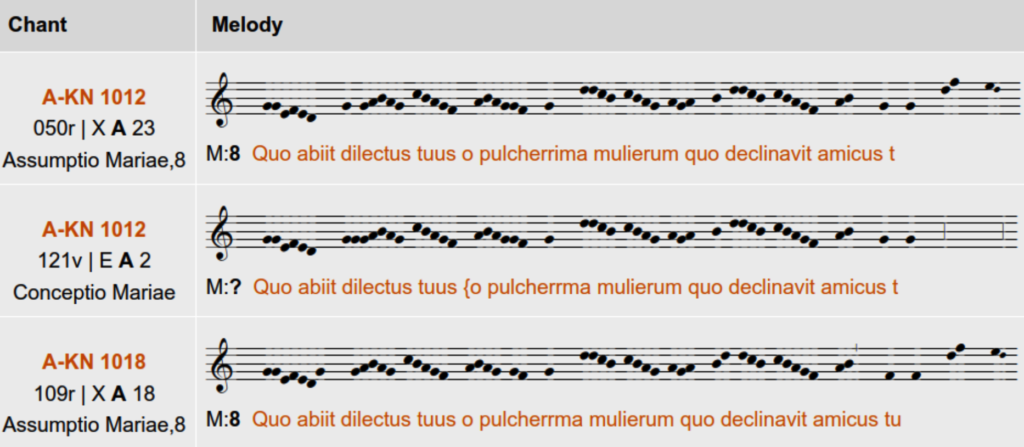
Example 1: Three facsimiles from Cantus Index showing the basis of the chant
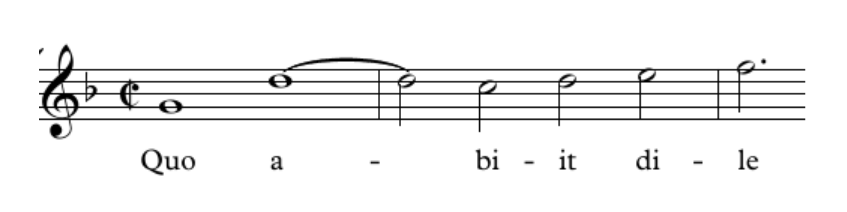
Example 2: Opening of Manchicourt’s motet

Example 3: Potential soggetto used as the opening of the motet
The structure of the motet, like most other Renaissance motets, prioritizes points of imitation as the fundamental structural unit. As I discuss in my forthcoming dissertation, “[I]n music of the late fifteenth and early sixteenth century one of the most important structural units for compositions was the point of imitation (oftentimes shortened to the “point”), which occurs when one soggetto or multiple soggetti are aligned with one phrase of text, and the voices do not all enter at the same time” (Lorenz 2023). In CRIM parlance, the opening “point” of Quo abiit uses imitative duos, or an ID, which are defined as “two or more imitative pairs in which the same soggetto is heard in each successive voice part…Each pair of voices is normally separated by the same vertical and time interval between the imitative entries. Successive pairs can follow at longer or shorter time intervals…” (Freedman et al, 2022). In short, two duos share the same time intervals of imitation but are separated by a time interval that is distinct from that of the duos. The pattern of time intervals looks something like x/y/x, where x is the time interval between the duos and y is a distinct time interval. The moment that y becomes the same time interval as in the duos (e.g., x/x/x), that creates another CRIM presentation type, a set of periodic entries or a PEn. The imitation that results from a repeated soggetto used against itself after a specific pattern of time intervals, such as found in IDs and PEns, ends up creating repeated modules, or a series of harmonic intervals between pairs of voices that is then repeated. When there are different time intervals between each entrance of the soggetto, no modules can be adduced from these patterns and therefore make a new presentation type, a fuga. What is most important for the opening of the motet is that Manchicourt wanted to use a “structured” presentation type so as to create repeated contrapuntal intervals, and, in order to do so, changed the soggetto from the opening of the chant.
The opening point of imitation for the motet is not the only time that Manchicourt aligns what I am calling “structured” presentation types–those that contain a module–with important formal and structural elements of the motet. Table 2 lists the number of points of imitation within both sections of the motet, the melodic material encompassed within that point (soggetto), the text contained within the point, the presentation type structuring it, which measures the point begins, the voices incorporated in the point and the presentation type (and the order of their presentation), and singletons. The solid black lines show where complete text phrases are divided, while the dotted black lines show subdivisions within longer text phrases (like text phrase 4 at the end of the prima pars).
The brilliant thing about Table 2 is that much of the information contained therein was generated from computer-aided heuristics (see Example 4). CRIM Intervals (run via the Jupyter Notebook) and in particular the PresentationType method, with its capacity to report data about measures, melodic entries, melodic intervals of soggetti, etc. (see Example 4). With such streamlined procedures, analysts like myself are afforded the opportunity to parse the information in a much more timely and efficient manner.
One of the most discernible elements in Table 2 is the interaction between points of imitation, presentation types, and text phrases. We can see, for instance, how Manchicourt shapes the opening text phrase of the motet (“Quo abiit dilectus tuus o pulcherrima mulierum”) into three total points of imitation, two of which are IDs (points 1 and 3) separated by a fuga (point 2). As we scroll through Table 2, we can see that Manchicourt structures text Phrase 2 in a similar way to text Phrase 1 through the use of an ID and a fuga (points 4 and 5), except for the fact that text Phrase 1 had two IDs instead of just one. And, finally, text Phrase 4 includes two IDs: one at the beginning of the text phrase (point 8) and the other at the head of the third and final subdivision (point 12). The use of IDs is not as pervasive in the secunda pars, occurring only at the beginning (point 15). Amidst the sea of fugas that follows thereafter, Manchicourt incorporates a different presentation type near the center of the secunda pars by using a PEn (points 22 and 23). This is not arbitrary, considering that Phrase 7 serves as the rhetorical climax of the motet, with the narrator shifting from a third-person description of the events to embodying a first-person perspective: “En dilectus loquitur mihi: surge propera amica mea, Columba mea, formosa mea…” or roughly translated as “and the beloved speaks to me: get up soon my love, my dove, my beautiful…” (Someone as particularly attentive to understanding both style and genre would also be attentive to the arc of texts.) This change in perspective also brings with it the use of a structured presentation type, or PEns. Notice how Manchicourt chooses to implement the PEns not during the opening of the text, but where there is a change of speaker from third person (“En dilectus”) to first person, emphasizing in particular “my love” (“amica mea”), and “my dove” (“columba mea”). In order to set this text much differently from the surrounding fugas, Manchicourt uses a presentation type that is more structured than the preceding fugas in PEns. Based on the data in Table 2, therefore, we can say that the disposition of presentation types (IDs and PEns in particular) does not seem arbitrary, but, on the contrary, quite intentional. As such, much like the humanistic displays of learning found in the composer’s own writings (such as in prefaces to his own musical works) (Freedman 2012) there seems to be a self-aware aspect to Manchicourt’s disposition of points of imitation to structural and formally important elements of the motet text.
| No. of Points | Soggetto | Text phrase | Pres. Types | Measures | Voices/Order of Entries |
| Prima pars | |||||
| 1 | 1A | Quo abiit dilectus tuus | ID | 1 | S, Ct, T, B |
| 2 | 1B | …o pulcherrima mulierum | fuga | 5 | S, Ct, B |
| 3 | 1B | …o pulcherrima mulierum | ID | 14 | T, B, Ct, S |
| 4 | 2 (A+B) | Quo declinavit dilectus tuus? | ID | 22 | Ct, S, B, T |
| 5 | 2B | …dilectus tuus? | fuga | 31 | S, Ct, T |
| 6 | 3 | Et quaeremus eum tecum | fuga | 34 | B, S, Ct, T |
| 7 | 3 | Et quaeremus eum tecum | fuga | 40 | B, T, Ct |
| 8 | 4 (A1 + A2) | Dilectus meus descendit in hortum suum | ID | 43 | S, Ct, T, B |
| 9 | 4A2 | …descendit in hortum suum | fuga | 52 | Ct, S, B, T |
| 10 | 4B | …ut pascatur in hortis suis | fuga (duo) | 56 | Ct, S |
| 11 | 4B | …ut pascatur in hortis suis | fuga | 60 | T, B, Ct, S |
| 12 | 4C | …et lilia colligat | ID | 67 | B, S, Ct, S |
| 13 | 4C | …et lilia colligat | fuga | 74 | B, T, S, Ct |
| 14 | 4C | …et lilia colligat | fuga | 79 | B, T, Ct, S |
| Secunda pars | |||||
| 15 | 5 (A+B) | Qualis est dilectus tuus o pulcherrima mulierum? | ID | 85 | S, Ct, T, B |
| 16 | 5B | …o pulcherrima mulierum? | fuga | 93 | T, B, Ct, S |
| 17 | 6A | Sicut malus inter lingua silvarum | fuga | 99 | B, T, Ct, S |
| 18 | 6A | Sicut malus inter lingua silvarum | fuga (duo) | 106 | T, B |
| 19 | 6B | …sic dilectus meus inter filias | fuga (duo) | 110 | Ct, S |
| 20 | 6B | …sic dilectus meus inter filias | fuga | 114 | B, T, Ct, S |
| 21 | 7A | En dilectus loquitur mihi | fuga | 121 | B, Ct, S, T |
| 22 | 7B | …surge propera amica mea | PEn | 132 | S, T, B (Ct is additional entry) |
| 23 | 7C | Columba mea | PEn | 139 | [Ct, add. entry], T, B, S |
| 24 | 7D | …formosa mea | fuga | 143 | Ct, T, B |
| 25 | 7D | …formosa mea | fuga | 147 | S, Ct, B, T |
| 26 | 7E | …et veni | fuga | 154 | S, T, Ct, B |
| 27 | 7E | …et veni | fuga | 159 | S, Ct, B |
| 28 | 7E | …et veni | supp. | 163 | B, Ct, T |
Table 2: Types of imitation throughout Quo abiit
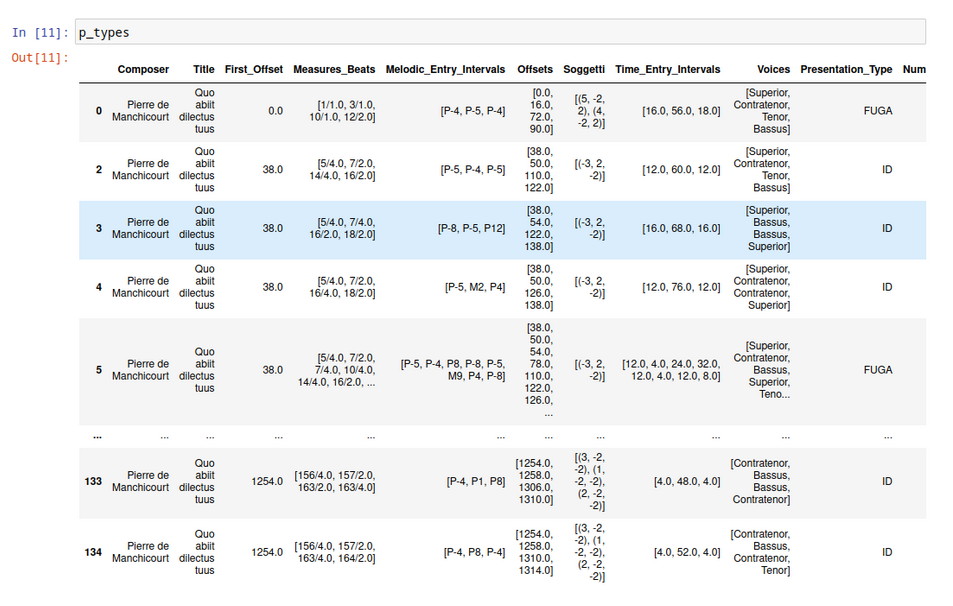
Example 4: Presentation-Type Finder on Jupyterhub showing the data resulting from CRIM, listing information like presentation types and measures
What we see throughout the motet, then, is Manchicourt’s clever implementation and disposition of structured (IDs and PEns) versus unstructured presentation types (fugas). Based upon these uses of structured and unstructured presentation types, Manchicourt has crafted his own interpretation of Quo abiit, his own way of communicating his interpretation through imitation and counterpoint: he associates soggetti within the motet with a text phrase and a specific presentation type. More importantly, however, he saves IDs and PEns for specific moments within the motet: IDs at the start of a new text phrase (at least in the prima pars), and PEns for the rhetorical climax of the motet. These relationships that Manchicourt creates throughout the experience of the motet become a foundational framework from which to view transformations that might or might not occur when applying the work to another genre, such as Missa Quo abiit.
Manchicourt’s Compositional Process from Motet to Mass
Given what we know about the motet, I was curious to see how these features would carry over into the composer’s own imitation Mass based upon the motet. For this paper, I will be examining three Mass movements: the Kyrie, the Gloria, and the Agnus dei. The reason I have chosen these three movements is that they vary in their text settings and their locations within the Mass writ large: the Kyrie is a highly melismatic text, not containing much text, and important as the first Mass movement; the Gloria is highly syllabic, uses a large amount of text; and the Agnus dei, which is again highly melismatic given prominence because it is the final movement of the Mass Ordinary. This spread of different kinds of texts (short and long) and also locations within the Mass (beginning and ending) afford us the opportunity to see how Manchicourt’s compositional process changes between Mass movements.
See Table 3 for an analysis of the number of points, the relationship between a given soggetto found in the motet and where it takes place in the Kyrie, the associated presentation type in the Mass movement, the measure where it begins, the voices/order of entries involved in the point, and any singletons that take place on the outskirts of the point. Across the tripartite division of the Kyrie, we can see that Manchicourt uses soggetti from the prima pars of the motet (soggetti 1 and 3) in the Kyrie I and Christe sections, while he uses soggetti 5 and 7 from the secunda pars of the motet for Kyrie II. From this, we can see that Manchicourt establishes the Kyrie I and Christe movements as motivically belonging to the prima pars and Kyrie II as belonging to the secunda pars. While Manchicourt keeps the general structure of the prima and secunda pars of the motet in his application to the Kyrie movement, we can see that the composer has made some nuanced (and some substantial) changes with respect to presentation types.
| No. of Points | Soggetto from motet | Prima / Secunda pars | Presentation Type | Measures | Voices/ Order of Entries |
| Kyrie I | |||||
| 1 | 1A | P | ID | 1 | S, Ct, T, B |
| 2 | 1B | P | fuga | 11 | T, S, B, Ct |
| 3 | 1B | P | fuga | 17 | S, B, Ct, T |
| 4 | 1B | P | fuga (duo) | 21 | S, Ct |
| Christe | |||||
| 5 | NEW | ? | ID | 26 | B, T, Ct, S |
| 6 | 3 | P | fuga (duo) | 34 | T, B |
| 7 | 3 | P | ID | 36 | Ct, S, T, B |
| 8 | 3 | P | fuga | 41 | T, B, Ct |
| 9 | 3 | P | ID | 44 | T, S, B, Ct |
| Kyrie II | |||||
| 10 | 5A | S | fuga | 51 | T, B, Ct |
| 11 | 5A | S | ID | 56 | S, Ct, T, B |
| 12 | 5B | S | fuga | 63 | S, T, B, Ct |
| 13 | 7E | S | ID | 71 | S, T, Ct, B |
| 14 | 7E | S | fuga | 76 | S, Ct, B |
Table 3: Soggetti and Presentation Types in the Kyrie of Missa Quo abiit
First and foremost, Manchicourt clarifies the rather obtuse opening point of imitation for the motet. As can be seen in Example 5, he opens Quo abiit with an ID that contains a rather large time interval between the same duos (in this case, 28 minims). In Example 6 Manchicourt halves the time intervals between duos, turning an expansive and irregular ID into a concise point of imitation. As we will see throughout the remainder of this paper, Manchicourt wavers back and forth between choosing to present the opening as an ID (using two duos) and as a fuga (using only one duo).
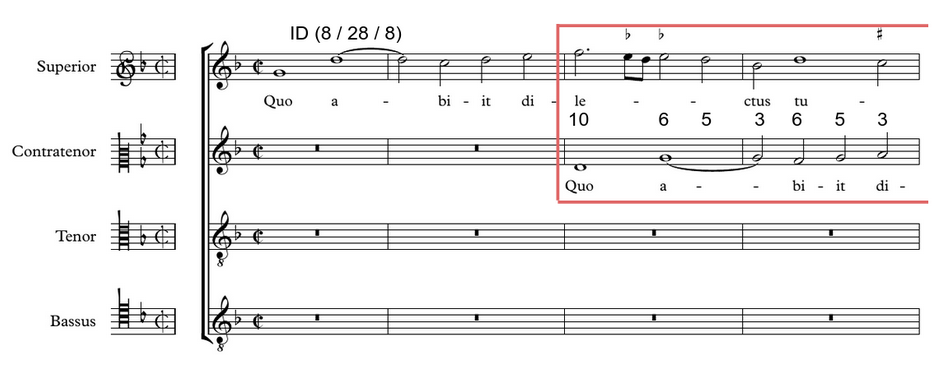
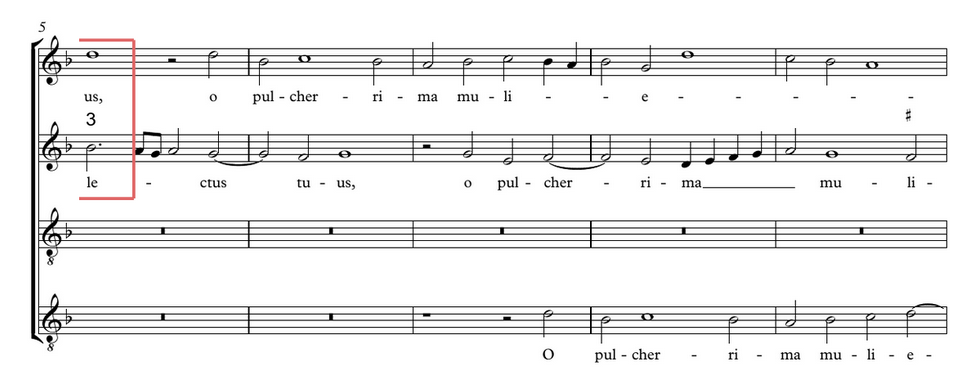
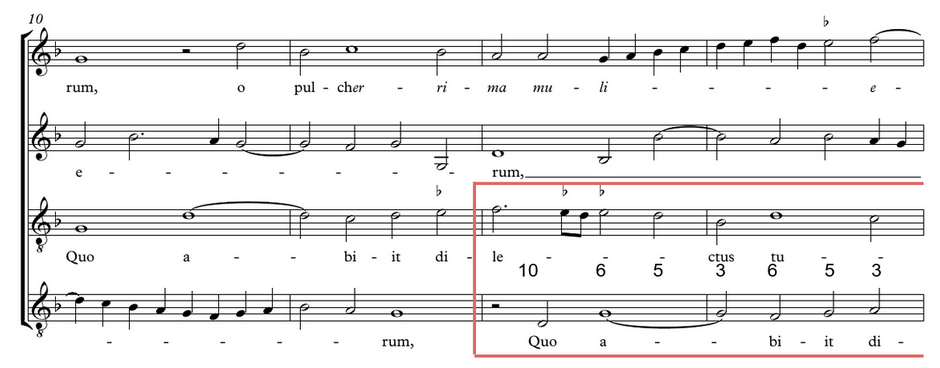
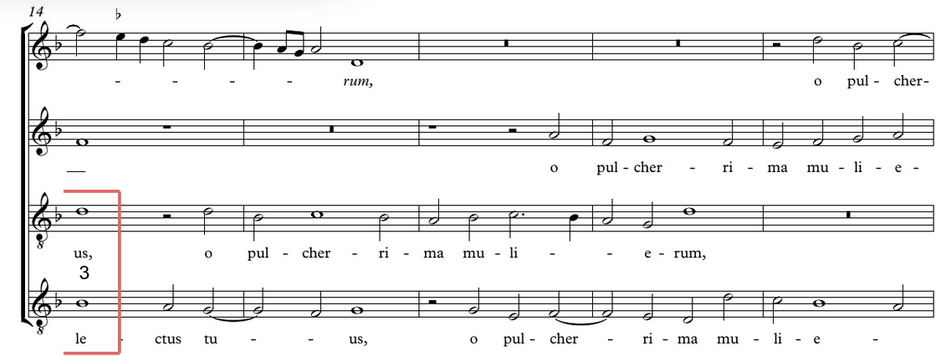
Example 5: Opening ID of Quo abiit (mm.1-14)
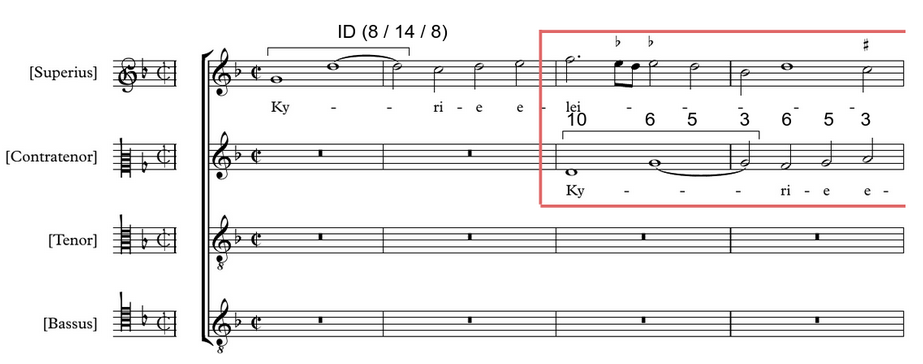
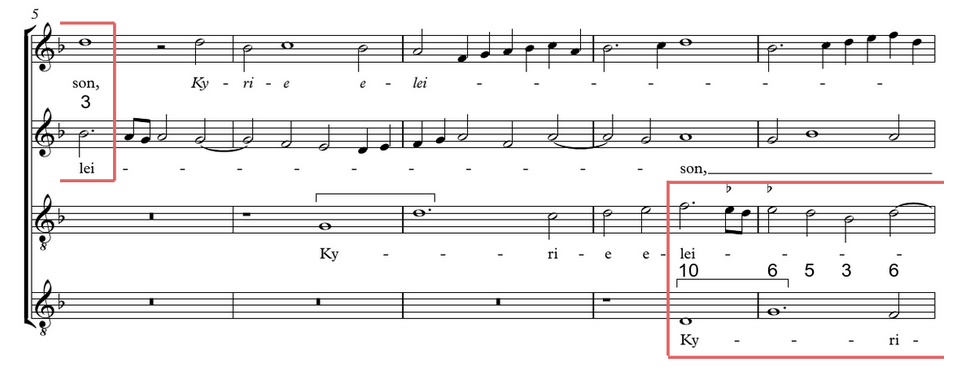
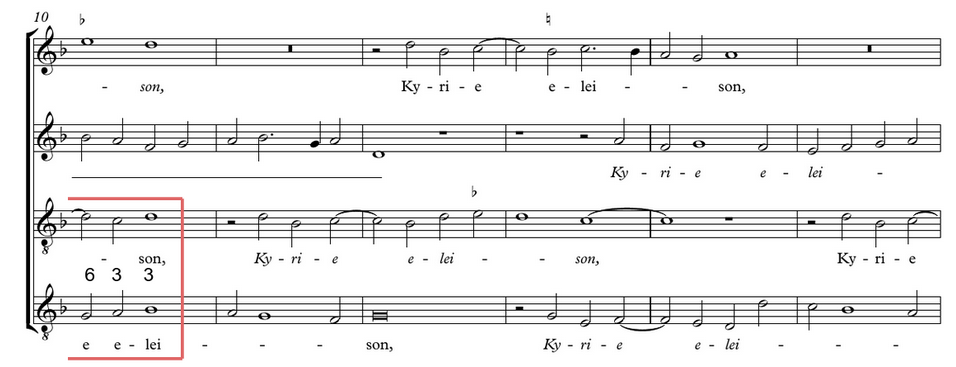
Example 6: Opening of Kyrie I from Missa Quo abiit
In the motet (see Table 2 above) Manchicourt uses two IDs for soggetto 1: he uses one for 1A and also 1B (point no. 3 in Table 2). In the Kyrie movement, however, the only ID that takes place in relation to soggetto 1 occurs at the very beginning of the movement. The elimination of the second ID between the motet and Mass ends up prioritizing the initial ID of the piece.
When Manchicourt moves to the Christe movement, the composer again makes changes to the presentation types associated with soggetto 3 in the motet. As we have seen in Table 2, soggetto 3 (points 6 and 7) was only associated with fugas, whereas in the Christe movement, Manchicourt included two IDs (points 7 and 9). Why might this be? At the beginning of the Christe section (point 5 in Table 2), the composer begins with an ID from new material not derived from the motet. The inclusion of this new material starts a chain reaction of alternating IDs and fugas (from points 5-9). This alternation seems to be a strong enough idea for Manchicourt that it actually permeates into the succeeding Kyrie II (point 10).
This is an important point both in the original motet and structurally here in Kyrie because of the structural importance of soggetto 5A as the opening of the secunda pars. As we can see in Example 7, the opening of the secunda pars of Quo abiit parallels the initial opening point of imitation in the prima pars: both points are IDs, and the order of entries for both points moves from superius to contratenor, contratenor to tenor, and tenor to bassus. For Manchicourt, the similarity of presentation types and order of entries in both points creates a symmetry unifying the motet as a whole. As can be seen in Example 8, however, Manchicourt begins Kyrie II as a three-voice fuga, breaking the standardized order of entries and the presentation type (point 10 in Table 3). The following point of imitation (point 11 in Table 3) (see Example 9), however, shows Manchicourt giving us exactly what we were expecting: an ID based upon the same order of entries as in the motet. While not nearly as long as the ID is at the opening of the secunda pars of the motet, Manchicourt placates the listener/performer by giving them an abbreviated ID based upon the same melodic material.
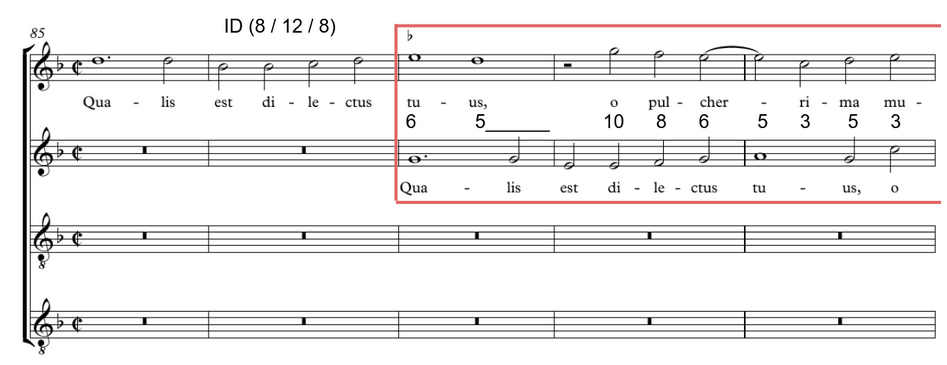
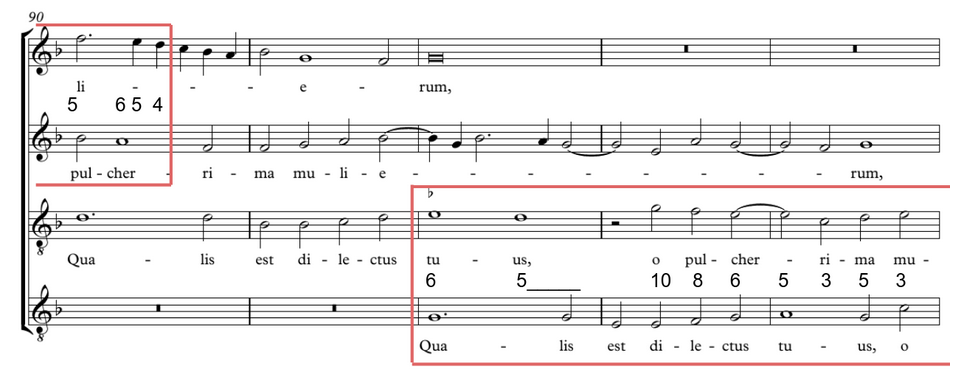
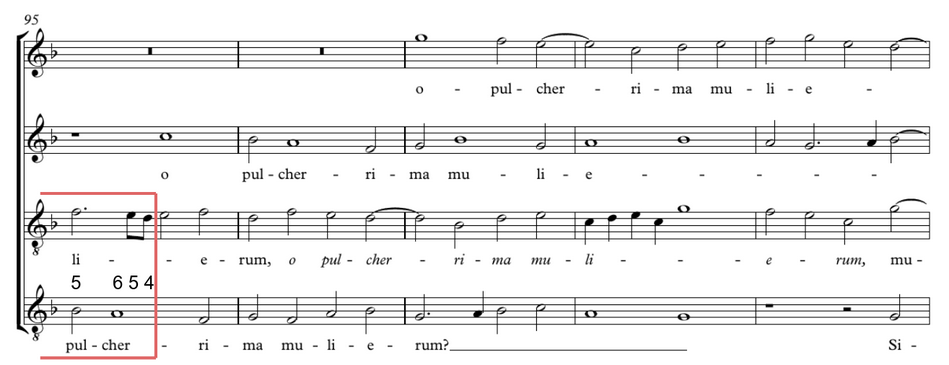
Example 7: ID in Point 1 of Secunda pars from Quo abiit (mm. 85-95)
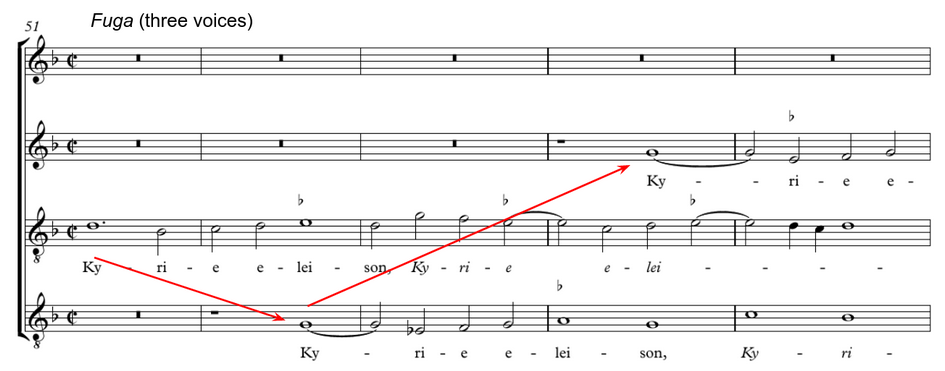
Example 8: Fuga at opening of Kyrie II (mm. 51-54)
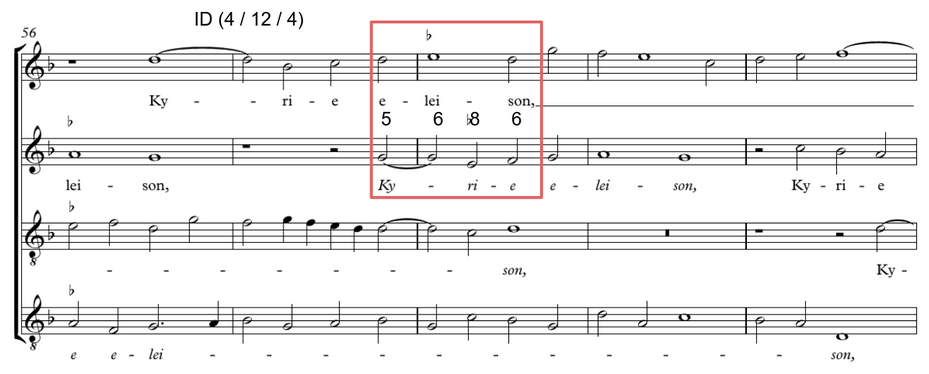
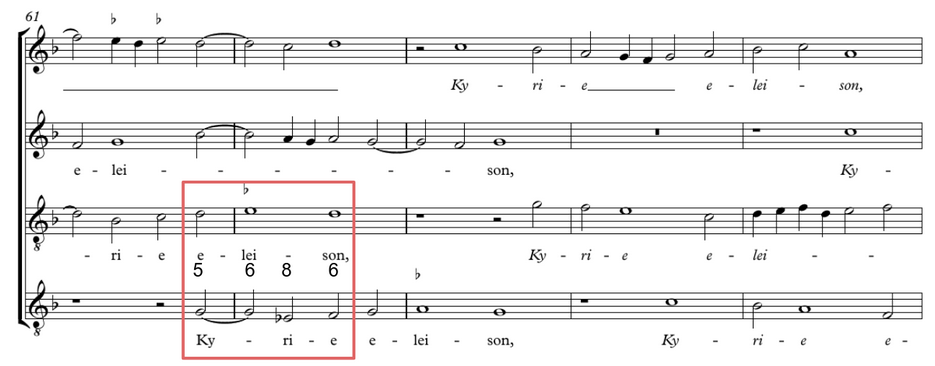
Example 9: ID in point 11 of Kyrie II (mm. 56-62)
What we find here, is Manchicourt consciously deviating from our established expectations, or what Kofi Agawu terms “play.” In Playing with Signs, Agawu discusses play in relation to what he calls the “Beginning-Middle-End Paradigm” with “pure” (or purely musical) signs:
The examples discussed so far lend weight to the argument that in the Classical period, beginnings are beginnings, middles are middles, and endings are endings, that there are specific attitudes to these three interrelated and interdependent segments of the syntagmatic chain, and that although they share certain features, they are, on the whole, not interchangeable. To recognize these functions is, paradoxically, to recognize their potential interchangeability, the possibility of playing with them, of reinterpreting them or working against their normative prescriptions—in short, of using them creatively (Agawu 2014: 71-2).
For Agawu, certain beginnings, middles, and endings have specific features. In the case of Quo abiit, Manchicourt establishes relationships between particular presentation types and text phrases. That kind of approach affords the composer the opportunity to play with their associations, reinterpreting them and deviating from established expectations.
The large-scale deviation in the case of the Kyrie movement is engendered through the alternation of IDs and fugas, and, given the fact that Kyrie I and Christe opened with IDs, plays on that expectation by beginning Kyrie II with a fuga. But there is a double deviation because the opening soggetto of Kyrie II (soggetto 5A) is also associated with an ID in the motet. This double deviation seems to show a composer almost consciously winking at the audience or performer, using an unstructured presentation type in a place that should be structured. There is also a deviation later in Kyrie II when Manchicourt uses an ID in combination with soggetto 7E, which, in referring back to Table 2, was previously only associated with fugas. The overarching design of the Kyrie, then, appears to be Manchicourt’s preoccupation with the alternation of IDs and fugas beginning in the Christe movement and carrying that pattern through the remainder of the movement. In doing so, he plays on our established expectations from the framework of the motet.
In the Gloria movement, we immediately see Manchicourt playing with the opening soggetto of the motet and altering its association with an ID (see Table 4). As we have seen previously in Examples 2 and 3, Manchicourt has structured the opening ID of the motet in such a way that it can lend itself toward two duos or one duo. In the opening of the Gloria, the composer gives us the fuga version followed immediately by what looks to be an ID that conforms to the same order of entries as in the ID of the motet. Upon closer inspection, however, Manchicourt has structured the second point as an ID using a different soggetto; expectations dashed once more.
In moving to the opening of the Qui tollis section of the Gloria (point 16 in Table 4), we see once again that Manchicourt refuses to establish soggetto 5A with the ID so structurally pivotal to the motet, and, instead, opts for another fuga. Interestingly enough, the terminal point of the previous section (point 15 in Table 4) highlights that Manchicourt uses not one ID but two IDs within the same point, but the melodic material is dissimilar from soggetto 5. The curious placement of the two IDs prior to the location where they should be seems again to show the composer playing with our expectations.
It could also be that Manchicourt has created a kind of narrative “internal” to the Mass itself, wherein soggetto 5 functioning more in terms of fugas becomes the norm as opposed to the exception. The same can also be said for soggetto 7E, where, in the motet it was associated with a fuga, the Kyrie and Gloria movements both treat it as IDs (see point 13 in Table 3 and point 25 in Table 4). For whatever reason, Manchicourt has not chosen the soggetti associated with the rhetorical climax of the motet (soggetti 7B and 7C), but instead has chosen 7E, the melodic material most commonly associated with the very ending of the motet. The substitution of 7E as the de facto ending material makes sense, given that there is only so much that can be translated between motet and Mass. This material, however, is not treated with a PEn presentation type, as in the motet, but as IDs in the Kyrie and Gloria. It seems that Manchicourt decided that soggetto 7E will stand in as the melodic material for the ending of the motet, and, as such, needs to be formally emphasized through the use of an ID. Moreover, it appears that soggetto 7D (points 10 and 11 in Table 2 and point 24 in Table 4) has assumed the role of rhetorical and climactic highpoint for the Mass. In place of a PEn presentation type in the motet for soggetti 7B and 7C, Manchicourt uses a stretto fuga as the highpoint.
| No. of Points | Soggetto from motet | Prima or Secunda pars | Presentation Type | Measures | Voices |
| Et in terra pax | |||||
| 1 | 1A | P | Fuga | 1 | S, Ct |
| 2 | 1B | P | ID | 6 | S, Ct, T, B |
| 3 | 2A | P | ID | 12 | Ct, B, S, T |
| 4 | 2B | P | Fuga | 14 | B, T, S |
| 5 | 3 (mod.) | P | ID + fuga | 17 | [B, T] [Ct, S]* |
| 6 | 2B | P | Fuga | 24 | S, B |
| 7 | 4 (A1) | P | Fuga | 27 | T, S, Ct |
| 8 | 4 (A1) | P | Fuga | 32 | B, S, Ct, T |
| 9 | 4(A1) | P | Fuga | 37 | B, T, Ct, S |
| 10 | 4(A2) | P | Fuga | 41 | S, T, B, Ct |
| 11 | 2B | P | Fuga (duo) | 47 | S, Ct |
| 12 | 4B | P | Fuga | 50 | T, B, Ct, S |
| 13 | 4B | P | Fuga (duo) | 55 | B, T |
| 14 | NEW | ? | Fuga | 63 | Ct, S, T |
| 15 | NEW | ? | 2 IDs | 68 | [B, T; B, T] [S, T; Ct, S] |
| Qui tollis | |||||
| 16 | 5A + 5B | S | Fuga | 79 | S, Ct, B |
| 17 | 5B | S | Fuga | 86 | T, S, Ct, B |
| 18 | 5A | S | Fuga | 91 | S, Ct, T |
| 19 | NEW | ? | HR (P-6 Model) | 97 | All |
| 20 | 6A | S | Fuga | 104 | Ct, S, B, T |
| 21 | 6B | S | Fuga | 110 | Ct, S, T |
| 22 | 6B | S | Fuga | 115 | B, Ct, S, T |
| 23 | NEW | ? | S.f. {2}** | 123 | Ct, S, T, B |
| 24 | 7D | S | S.f. {4} | 127 | B [Ct, T, B] S |
| 25 | 7E | S | ID | 136 | [S, T] [Ct, B] |
| 26 | 7E | S | Fuga | 143 | B, Ct |
Table 4: Soggetti and Presentation Types in the Gloria of Missa Quo abiit
Table Notes:
In place of a PEn presentation type in the motet for soggetti 7B and 7C, Manchicourt uses a stretto fuga as the highpoint, something that I have previously associated with climactic function in my work on Gombert (Lorenz 2023). As an aside, stretto fuga is technically not a term from CRIM, but coined by Milsom that explains if the lead voice (dux) of a stretto fuga adheres to a specific melodic interval pattern, then the following voice (comes) will create correct counterpoint against the lead voice: “There are many kinds of fuga. Some are more formulaic than others, and the forms of fuga within which composers have fewest choices are those in ‘stretto’, where the two voices are temporally separated by what may be termed the ‘unit’ of the counterpoint itself” (Milsom 2005: 146).
* Brackets are used when information related to order of entries might be obfuscated by presentation-type information. For instance, the brackets found in point 5 of Table 5 indicate which entries take part in the ID: the first duo is between bassus and tenor, and the second is between contratenor and superius. The brackets in number 15 show which voices partake in each ID, since there are two. Finally, the brackets used in number 24 show which voices take part in the stretto fuga.
** The number in brackets indicates the time interval in minims.
Based upon what we have seen so far, let us see how Manchicourt treats the final movement of his Mass (see Table 5). The opening point of Agnus I sees Manchicourt returning to the framework of both the motet and Kyrie I by using an ID with the same order of entries. Similarly, all of the soggetti used in Agnus I are derived from the prima pars of the motet. In Agnus II, Manchicourt does all he can to tell the listener/performer that this section is the last of the Mass, since eight out of a possible ten points of imitation that occur in Agnus II are derived from text Phrase 7–the final line of text–of the motet.
In the five-voice Angus II, Manchicourt makes some interesting changes from the established framework of the motet. First, he modifies soggetti 1 and 5 so that they can form one cohesive motive, and he changes the opening of Agnus II from the ID common to both soggetto 1 and 5 to a combination PEn + fuga. (As an aside, this is a rather complicated motivic aspect that unfolds across most of the Mass movements. The creation of this new combination of soggetti 1 and 5 results from Manchicourt’s decision to slowly remove soggetto 5B from 5A and to tag a new ending onto 5A. This process happens initially in the Credo (see mm. 133-137) where 5B has been replaced by a new counter soggetto. In the Sanctus movement, Manchicourt carries over the new 5A with counter soggetto from the Credo but adds the opening fifth common to soggetto 1 (Sanctus, mm.100-103). This newly combined soggetto is the one that carries over into the Agnus movement.) Most unusual about the Agnus, however, is Manchicourt’s use of a presentation type hitherto unused by Manchicourt in the motet or the Mass, a non-imitative module, or NIM (see Example 7). The NIm comes as the final of four total utterances of soggetto 7A (point 12), a soggetto that up to this point has not been featured at all in the Mass. It is hard not to assume such privilege to such an ephemeral and passing moment, but the non-existence of this presentation type prior to this point in the Mass and the motet, and the fact that it comes at a distinct highpoint in the Mass (near the conclusion and just prior to the closing motivic material of soggetto 7E) seems to establish this as a structurally important moment across the Mass movements considered in this paper.
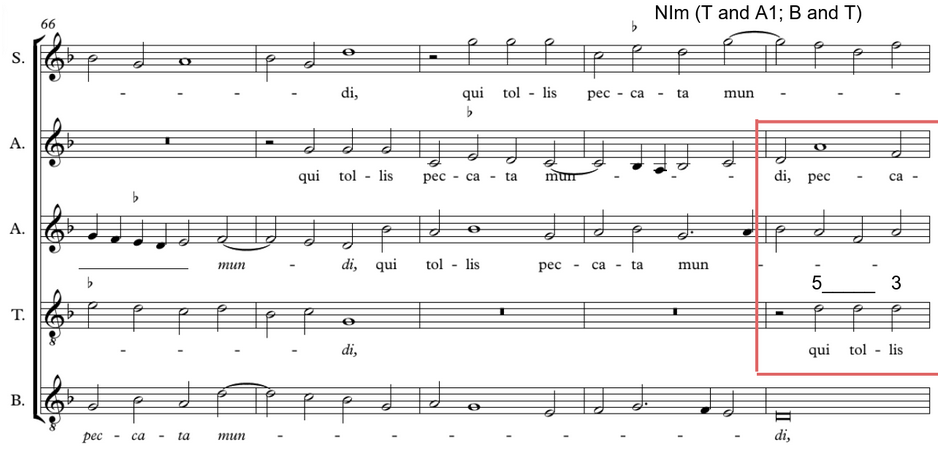
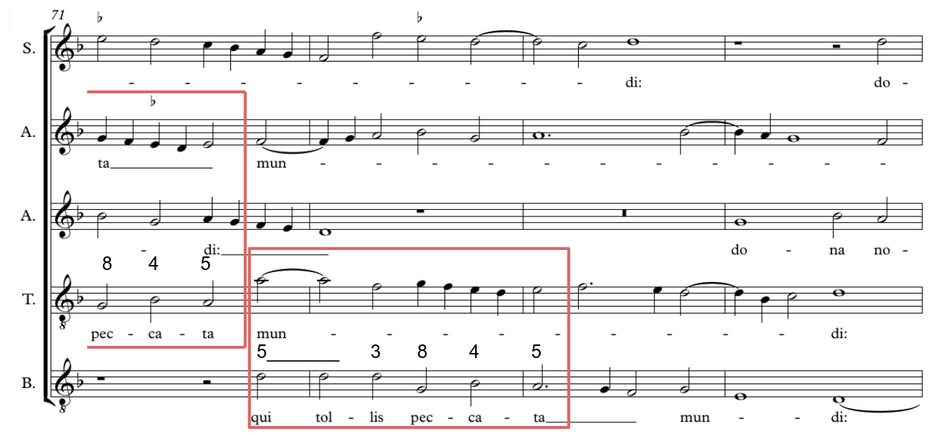
Example 10: NIm in Point 12 of Agnus II (mm. 70-73)
| No. of Points | Soggetto from motet | Prima or Secunda pars | Presentation Type | Measures | Voices |
| Agnus I | |||||
| 1 | 1A | P | ID | 1-9 | S, Ct, T, B |
| 2 | 1B | P | ID | 9-15 | T, B, Ct, S |
| 3 | 1B | P | Fuga | 16-23 | B, T, Ct, S, T, B |
| 4 | NEW (Modified 4B) | ? | ID (3) | 24-29 | [Ct, S] [B, T] [Ct, T] |
| 5 | NEW (Modified 4B) | ? | Fuga | 30-32 | S, Ct |
| 6 | NEW (Modified 4B) | ? | ID | 33-36 | B, T, S, Ct |
| Agnus II | |||||
| 7 | NEW (Combination 1A + 5A) | P/S | PEn + fuga | 39-46 | S, Q, T, B |
| 8 | NEW (Combination 1A + 5A) | P/S | Fuga | 46-52 | Ct, Q, S, B |
| 9 | 7A | S | Fuga | 54-60 | Ct, S, T, Q, B |
| 10 | 7A | S | ID | 61-64 | [Ct, T] [S, Q] |
| 11 | 7A | S | Fuga | 65-69 | B, Ct, S |
| 12 | 7A | S | NIm | 70-73 | [T, Ct] [B, T] |
| 13 | 7E | S | Fuga | 74-79 | S, T, B, A |
| 14 | 7E | S | Fuga | 79-84 | S, Q, T, A, B |
| 15 | 7E | S | Fuga | 84-87 | S, T |
| 16 | 7E | S | PEn | 87-88 (Supp.) | B, Q, Ct |
Table 5: Soggetti and Presentation Types in the Agnus dei movement of Missa Quo abiit
Conclusions
In discovering the music of Pierre Manchicourt through the course of the CRIM project going all the way back to 2016, I was immediately struck by the relationship between, on the one hand, the composer’s use of melodic material (soggetti) and points of imitation, and the text phrases of the motet on the other hand. My initial estimation was, given the rigidity of the compositional process, that Manchicourt would borrow from some of these formal-compositional traits and overlay them on top of Mass movements. In addition, the combination of human and machine-aided analysis would help scholars further come to terms with the composer’s compositional process. These lofty goals might not have come to fruition as I had initially thought–much like any research project–but there are certain musical features that have come to the fore throughout our analysis of Manchicourt’s Quo abiit and the imitation Mass based upon the same name. For one, picking up where Freedman left off, this essay has argued that the composer’s division of melodic material and presentation types are descended from the structure of the motet text, which itself draws from the chant tradition of Quo abiit. Two, given what we know about the composer’s approach to the motet, Manchicourt makes substantive changes to soggetti associated with particular musical locations akin to what Kofi Agawu terms play (2014). And finally three, these changes show a composer willing to deviate from established expectations, creating, at least in some sense, a wholly new musical experience while also retaining familiar structural elements that anchor the experience. To this end, there are features of this paper that I have not had the opportunity to explore in greater detail and which would further establish this study.
- One of the many problems associated with a study that includes big data, like the CRIM Project, comes from an overabundance of information. This is, of course, a good problem to have, but it also requires that artificial lines be drawn in the analytical sand. For this paper, I have chosen to examine how Manchicourt structures his motet according to presentation types and see how these elements change or stay the same across three out of five possible Mass movements. Given my overriding focus on Manchicourt’s formal structures, I have downplayed a number of interesting points that could be the subject of individual studies going forward. First, I have mostly looked at the beginnings and ends of Mass movements and the relationship these have to the model motet, but I have not looked at middles, how Manchicourt has rearranged soggetti and what effects, if any, this rearrangement might have on the Mass or the motet.
- The disposition of completely new material from beyond the model should be explored in further detail. As we have seen throughout the course of this paper, such material not only affords Manchicourt the opportunity to develop and further refine his ideas from the original motet, but they also tend to play a notable role in each Mass movement. In the Kyrie, the use of new material set off a chain of alternating IDs and fugas which ultimately led to the overriding of an important presentation type at the opening of Kyrie II. In the Gloria, Manchicourt explored new material prior to the close of “Et in terra pax,” which saw the composer implement one of the more complicated points of imitation in the whole Mass in addition to new material prior to the stretto fuga near the end of the movement. Finally, in the Agnus dei, new material was used to create the complicated ID with three duos instead of the usual two, and it allowed the composer to create an entirely new soggetto out of soggetti 1 and 5. It appears, at least on the surface, that, the use of new material serves as a creative catalyst for the composer, and one that needs to be further explored.
- Finally, I have not, as of yet, fully explored the phenomenological constraints that constitute a musical experience for Manchicourt. This is, to some extent, impossible, since there is no way of truly recreating or reimagining what would have shaped a musical experience for the composer, the singers in the choir, or the audience. My analysis, in this regard, is shaped by my own musical background as a singer, a theoretician, and an analyst. As such, it is shaped completely by my own biases, even if they are engendered by a type of expertise, and should be held only as opinions. It fell beyond the subject of this study to go into depth on these matters, but I do believe, in all sincerity, that the inclusion of phenomenology to this analysis would yield substantial results.
Reference list
Agawu, Kofi. 2014. Playing with Signs: a Semiotic Interpretation of Classic Music. Princeton: Princeton University Press.
Cantus Index. 2022. “Chants by Cantus ID: 204192.” Accessed 21 February 2023. URL: https://cantus.uwaterloo.ca/id/204192
Freedman, Richard, et al. 2022. “CRIM Thesaurus of Musical Types.” CRIM Project. Accessed 21 February 2023. URL: https://sites.google.com/haverford.edu/crim-project/vocabularies/musical-types?authuser=0
Freedman, Richard. 2012. “Pierre de Manchicourt’s Pater peccavi: Listening to the Prodigal Son.” Paper presented at the McGill University conference Talking About the Lost Generation, Montreal, QC, 19 May 2012.
Lorenz, Ian. 2023 (forthcoming). “Style and Process in the Magnificat Cycle of Nicolas Gombert.” PhD diss., McGill University.
Milsom, John. 2005. “Imitatio, Intertextuality, and Early Music.” In Citation and authority in medieval and Renaissance musical culture: learning from the learned, edited by Suzannah Clark and Elizabeth Eva Leach, 141-151. Woodbridge [UK]; Rochester, NY: Boydell Press.
“Song of Solomon, Chapter 5.” 2023. Internet Sacred Text Archive. Accessed 24 February 2023. https://www.sacred-texts.com/bib/poly/sol005.htm