Echoes of Lasso: Susanne un jour and the Imitation Mass Tradition with CRIM digital tools
Andrea Puentes-Blanco (Institución Milá y Fontanals de Investigación en Humanidades, CSIC)
This essay is a written revised version of my talk at the International Workshop Conference ‘Digital Counterpoints: Exploring Similarity in Renaissance Music’, Haverford College, 20-22 October 2022. It is also part of the results of the following research projects: ‘Música y Humanidades Digitales en Barcelona (c. 1550-1650): fuentes, músicos, espacios, prácticas y redes musicales’ (202210I142), funded by the Consejo Superior de Investigaciones Científicas (CSIC), and “Prácticas polifónicas hispánicas (siglos XVI-XIX) en perspectiva digital: fuentes musicales, pervivencias, mujeres” (PID2021-123990NB-I00), financed by the Spanish Ministerio de Ciencia e Innovación. I am currently working on an expanded version of this essay.
An appendix of PDF scores and html version of the Jupyter Notebook cited in this essay can be found here.
Abstract
Susanne un jour is certainly the most famous spiritual chanson of the sixteenth century. It began its musical life in 1548 as a four-voice setting by Didier Lupi II of a poem by Guillaume Guéroult. The chanson was arranged and transformed by dozens of musicians and composers, perhaps none more famous than Orlando di Lasso’s five-voice chanson, which itself served as the basis of his own imitation Mass. This essay focuses on the late sixteenth-century and early seventeenth-century reception of Lasso’s reading of the piece through the analysis of three Susanne un jour imitation Masses by Orlando di Lasso himself, Claudio Merulo, and the little-known Spanish composer Pere Riquet. After introducing what had been called the “Susanne complex” in sixteenth-century Renaissance music, I first analyze the main features of Lasso’s chanson. Following this analysis, I then focus on the Kyrie of Lasso’s, Merulo’s, and Riquet’s Masses in order to understand how these composers reworked and transformed the chanson into a new composition. Finally, using CRIM Intervals digital tools, I try to offer a “bigger picture” of these three Masses and their degree of similarity to Lasso’s chanson.
Introduction: the “Susanne complex”
The story of ‘Susanna and the Elders’ is an apocryphal narration added to the Book of Daniel that tells the story of a Hebrew woman accused of adultery by two old men who had tried to abuse her (Wigoder, Skolnik, and Himelstein 2002). It is a story that deals with very substantial topics in the Christian context, such as female sexuality, adultery, abuse of power or punishment, and this is probably why this narration gave rise to numerous interpretations and recreations in different historical periods and places. The story had a wide resonance in the culture and arts of the Renaissance (Clanton 2002: 1). There are endless depictions of Susanna’s story signed by famous artists such as Tintoretto, Artemisia Gentileschi, Rembrandt or Rubens, among many others (for a selected list of art works based on Susanna during the Renaissance see Clanton 2002: 348-350).
This biblical episode also strongly resonated among many Renaissance composers. In a classical article published in 1953 musicologist Kenneth Levy talks about the “Susanne complex” to describe the importance of the story of Susanna in the musical culture of the Renaissance (Levy 1953). This “Susanne complex” in Renaissance music can be summarized as follows. In 1548, the French composer Didier Lupi II was the first to set to music a text by the Huguenot poet Guillaume Guéroult, which was aimed at devotional use among protestants. [See Premier livre de chansons spirituelles, par Guillaume Guéroult, mises en musique à 4 parties par Didier Lupi second & aultres (Lyon: Beringer, 1548). For a context on the dissemination of the spiritual chanson among protestants, see Freedman 2001.]
The strong moral charge of Guéroult’s poem together with a very appealing tenor melody conceived by Lupi seems to have captivated the audience and the musical ambiances of that time, if we judge by the countless number of versions that were written in the decades that followed. In Levy’s words, “many more Susanne settings are preserved than of any other 16th century secular text in any language”, and “already by the ‘70s, Susannes were in printed collections more often than any other chanson” (Levy 1953, 376). According to Levy, there are thirty-seven vocal settings of the Susanne un jour poem written by twenty-six different composers between 1556 and around 1642, the vast majority of which uses Lupi’s tenor melody. Just to name a few, we could cite the settings written by Thomas Champion, also known as “Mithou” (1556), Orlando di Lasso (1560), Jean de Castro (1569), Cipriano de Rore (1570), Philippe de Monte (1570), Pierre Certon (1570), Claude Le Jeune (1572 and 1585), Pevernage (1589) or Eustache Du Caurroy (1610 and 1636), among many others. The poem was even set to music by other composers in Flemish, German and English.
In this big complex of Susanne settings, Lasso’s chanson has special importance because it was the one most often reprinted during the decades which followed. More importantly, it is also the one that served as a model for the composition of imitation Masses from the last decades of the sixteenth century to the early seventeenth century by different European composers: the Franco-Flemish Johannes Mangon, Lasso himself, the Italians Claudio Merulo, Marc’Antonio Ingegneri, Mauro Palermitano, and Girolamo Lambardi, and the little-known Spanish composer Pere Riquet. Table 1 lists the composers who wrote imitation Masses based on Lassus’s chanson, as well as the sources in which these Masses appear, their dates, and their number of voices. All the Masses are for five voices, except Pere Riquet’s, which is for four.
| Composer | Date of the Mass | No. of voices | Source |
| Johannes Mangon (c. 1525-1578) | c. 1567-1577 | 5vv | D-AAm Chorbuch I (175v-190v) (see note a) |
| Orlando di Lasso (1530/32-1594) | 1570 | 5vv | RISM 1570/1 (see note b) |
| Claudio Merulo da Correggio (1533-1604) | 1573 | 5vv | RISM M 2357 |
| Marc’Antonio Ingegneri (1535/36-1592) | 1573 | 5vv | RISM I 41 |
| Mauro Ciaula [Palermitano](c. 1544-c. 1603) | 1588 | 5vv | RISM M1448 |
| Girolamo Lambardi (fl. 1586-1623) | 1601 | 5vv | RISM L 368 |
| Pere Riquet (fl. 1598-1619) | c. 1605-1616 | 4vv | E-Bbc 859 (169v-182r) |
Table 1: Composers of Susanne un jour imitation Masses based on Lasso’s chanson
Notes to Table 1:
Note a: According to Rudolf Pohl (Pohl 1961: 81), the terminus ante quem and post quem for this manuscript are, respectively, 1567 and 1577. DIAMM (the Digital Image Archive of Medieval Music) indicates a different date for the manuscript: after 1571-before 1580. See “D-AAm Chorbuch I (Mangon Choirbook I)”, DIAMM (the Digital Image Archive of Medieval Music), accessed January 22, 2023, https://www.diamm.ac.uk/sources/4146/#/.
Note b: Lasso’s Susanne un jour Mass was first published in 1570 but was composed in 1563. For a modern edition, see Hermelink 1964.
In 2006, Gabrielle Giacomelli considered Lasso’s, Merulo’s, and Ingegneri’s masses (Giacomelli 2006). My research on the Susanne un jour imitation Masses was originally motivated by the study of Riquet’s Mass whose only copy is found in a polyphonic choirbook preserved nowadays in Barcelona: manuscript Barcelona, Biblioteca de Catalunya, M 859 (E-Bbc 859) (for a study, contents, and inventory of this manuscript, see Puentes-Blanco 2018, 156-167, vol. I, and 119-129, vol. II). [See also “E-Bbc 859”, Books of Hispanic Polyphony, ed. Emilio Ros-Fábregas, accessed November 15, 2022, https://hispanicpolyphony.eu/source/13219.]
Figure 1 shows the opening of the Mass in manuscript E-Bbc 859 (fol. 169v-170r). Who was Pere Riquet? Pere Riquet is a virtually unknown composer, even for Spanish musicologists. As far as we know, he never worked outside the Catalonia region. We know very scarce data about his trajectory. In 1598, he was appointed chapel master at the cathedral of La Seu d’Urgell, where he remained until 1602, and he held the same position there again between 1605 and 1616. From 1616, he directed the musical chapel at the Tarragona cathedral until 1619. Just as we know very little about his life, we do not have much information about his works either. Only a small number of his works have been preserved (Bonastre 1999-2002: 209, and Cabré i Cercós 1997: 197-200): two versions of a Spanish romance entitled Ya es tiempo de recoger; the five-voice religious villancico Cristalinas perlas; another religious villancico for seven voices in two choirs entitled De este pan divino; a four-voice setting of the hymn Vexilla regis prodeunt; a Holy Friday Passion for four voices; and the Susanne un jour imitation Mass which has special importance because is the only Susanne un jour Mass known written by a Spanish composer. The Mass was edited for the first time in 1982 (Bonastre 1982) but it has never been analyzed. In 2021, when I started my participation in the CRIM project directed by Richard Freedman, I did a new edition of this Mass from its original source (Puentes-Blanco 2021). Since then my purpose has been to study this Mass applying the CRIM methodology and tools in order to explore how it relates to its model piece, the famous Lasso’s spiritual chanson, and in the broader context of other Susanne un jour Masses.
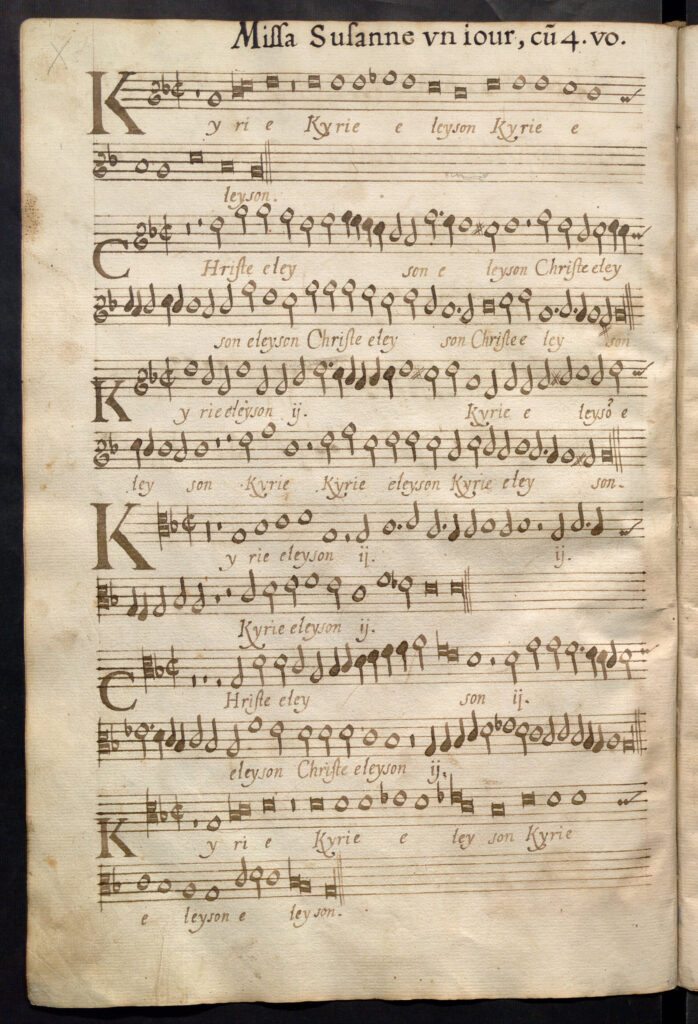
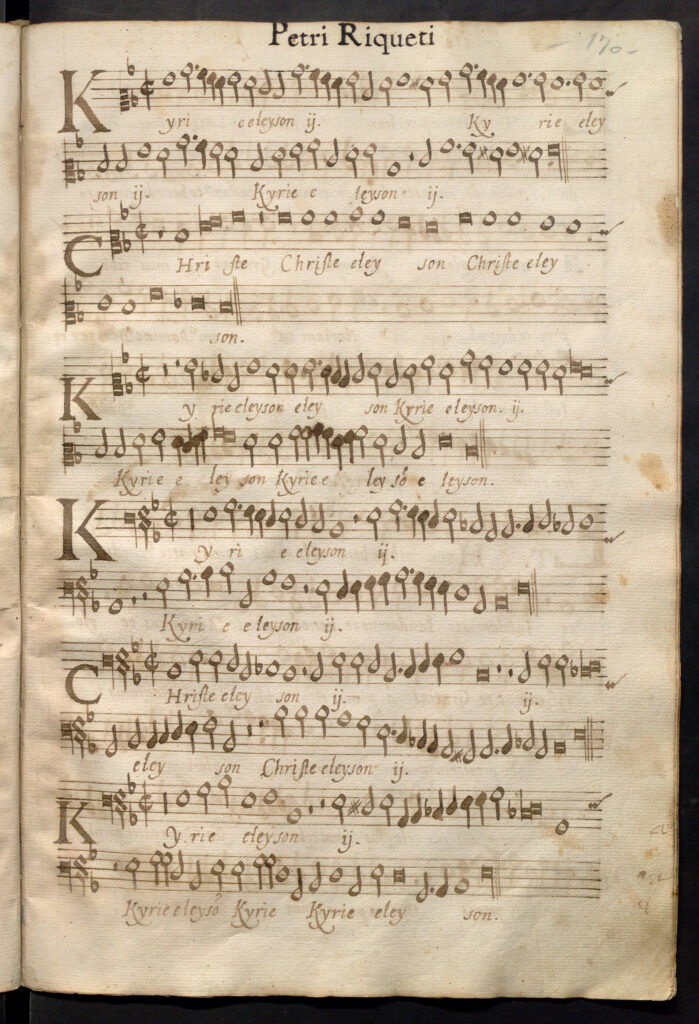
Figure 1: Opening of the Mass Susanne vn iour by “Petri Riqueti” (Pere Riquet) in E-Bbc 859 (fol. 169v-170r). Barcelona, Biblioteca de Catalunya, M 859 (https://mdc.csuc.cat/digital/collection/partiturBC/id/71068)
But before we can begin to situate Riquet’s Mass in the wider context of the Susanne complex, we should first pause to understand the history and structure of the chanson on which it was based.
Lasso’s chanson
Lasso’s chanson Susanne un jour was first published in 1560 in the Tiers livre des chansons a quatre cincq et six parties (Louvain, Pièrre Phalèse), and was reprinted up to five more times in different chanson anthologies published in Paris and London (in 1567, 1570, 1571, 1575 and 1588). The modern edition of the chanson that I will refer to in this article can be found in the CRIM website (https://crimproject.org/masses/CRIM_Mass_0032/). Regarded from the standpoint of CRIM Project musical vocabularies, what are the key features of this piece? What is the overall musical structure? Which presentation types are used? What cadential plan is at work?
Lasso uses Lupi’s tenor as a cantus prius factus, quoting it almost verbatim in the tenor. Appendix 1 contains the score of Lupi’s chanson in which I have marked the different soggetti of the tenor melody, and Appendix 2 contains the score of Lasso’s chanson, marking also the different soggetti of Lupi’s tenor melody which are quoted by Lasso in the tenor voice too. I have assigned sequential number to the soggetti. In both scores, each number is preceded by a uppercase letter that indicates the musical section of the chanson. I have highlighted these soggetti because they constitute the main melodic material that Lasso uses to build points of imitation throughout the chanson. The only changes that Lasso applies in his chanson to the presentation of Lupi’s tenor are the following: the addition of a brief fragment on measures 5 to 8 which does not belong to Lupi’s tenor; the transfer of the melody from the tenor to the quintus voice in measures 17-28; and the introduction of two different notes in measures 27 and 38 which are marked by a circle in the score. In addition to Lupi’s tenor soggetti, the score of Lasso’s chanson in the Appendix also highlights and enumerates with lower-case letters other soggetti that have melodic and structural significance in Lasso’s chanson or that will be important in the derivative Masses but that do not belong to Lupi’s piece.
Lasso maintains the typical tripartite structure of the chanson that Lupi uses too (that is, AAB), although in a more elaborate form, as it is shown in the following Table 2. This table displays the text of the chanson alongside with information about the musical sections, the presentation types used throughout the piece, and the most important cadences.
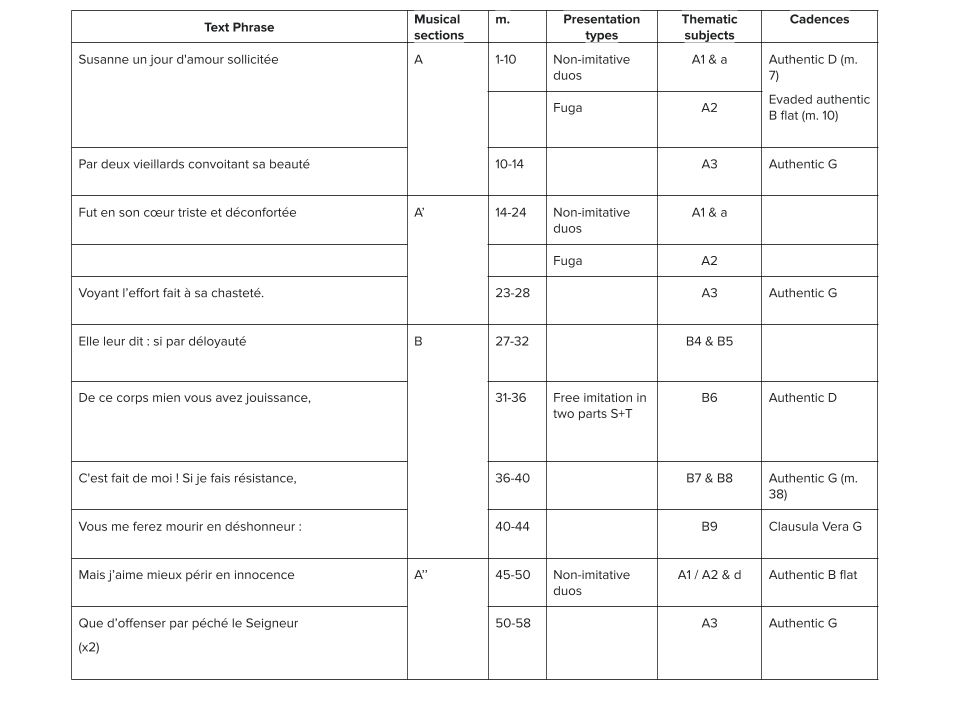
Table 2: Summary of the main analytical elements of Lasso’s chanson Susanne un jour.
Lasso elaborates section A of the chanson, and particularly verse 1, building contrapuntal structures from soggetti A1 and A2 of the tenor melody. He first opens the piece with a pair of non-imitative duos pairing A1 (G-Bb-C-D) with a countermelody in the contratenor made up of two descending thirds and an ascending fifth (countermelody labelled as ‘a’: G-Eb-C-G; ), and then repeating that structure in the tenor and the bass (Example 1). On measures 5 and 6, the bass sings A1 but transposed a fourth down (D-F-G-A). Before the tenor introduces A2 from measure 8 —that is, D-D-D-Eb-E-C-Bb—, the first five notes of A2 are already sounding transposed in the contratenor in measures 6 and 7 (A-A-A-Bb-A), and in the quintus, in measures 7 and 8, in this case in the original pitches, forming then a short fuga among the three voices (contratenor, quintus and tenor). The superius does not strictly participate in the fuga but it sings a similar pattern of three repeated notes, followed then by a descending and an ascending third instead of the ascending and descending seconds (Example 2).
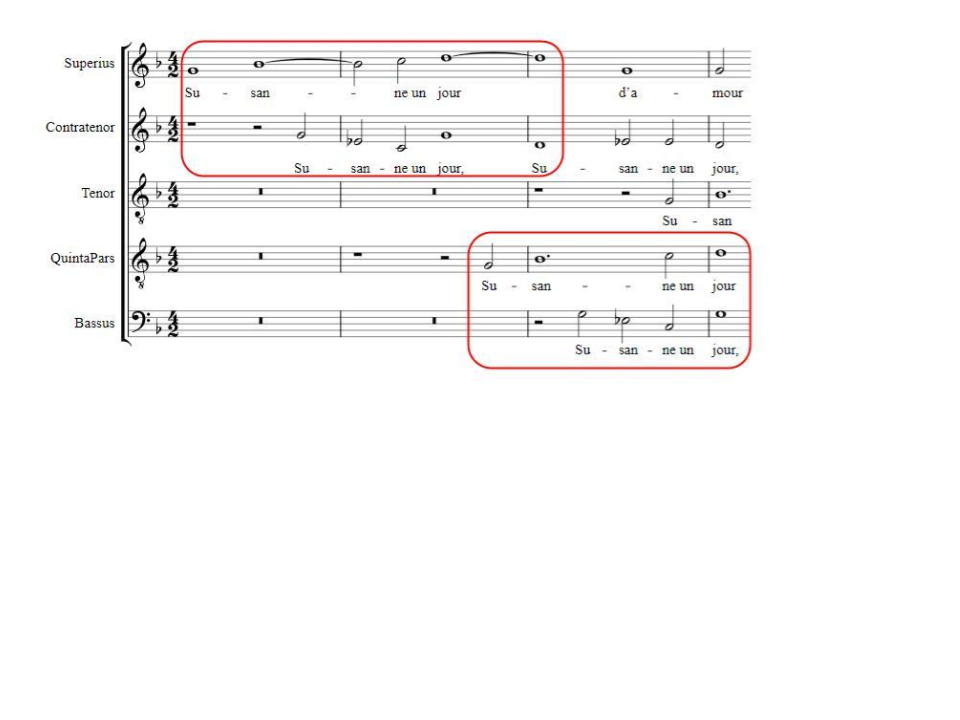
Example 1: Opening of Lasso’s chanson Susanne un jour with a pair of non-imitative duos between the superius and the contratenor, and the quinta pars and the bassus (m. 1-4).
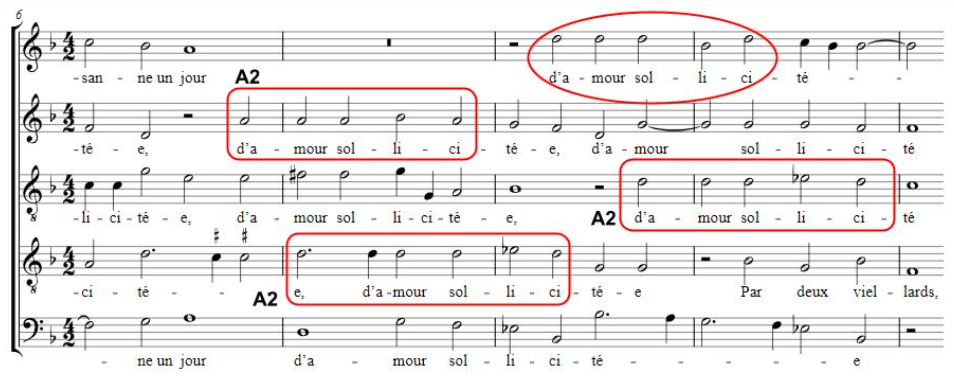
Example 2: Lasso, Susanne un jour: short fuga introducing the chanson verse “d’amour sollicitée” (m. 6-9).
Section A ends with the text phrase “Par deux vieillards convoitant sa beauté” in which the voices enter successively from the lowest to the highest, and closes with an authentic cadence on G. Section A’ (measures 14 to 28) is an almost literal repetition of section A. The only difference is that, from measure 16, the tenor sings the melody corresponding to the quintus in section A, and the quintus sings the melody presented earlier by the tenor.
Section B is the longest (m. 27-44), encompassing four verses of the chanson. In the first verse of this section (“Elle leur dit : si par déloyauté”) the five voices progress in free counterpoint. It seems significant that the texture breaks up in this way just at the moment that Susanne at last speaks for herself. In this first verse of section B the tenor takes up again the quotation of Lupi’s melody that had been transferred to the quintus in section A’. From the standpoint of the rhetorical aspects of the poem and chanson this seems also relevant. The reprise of the opening soggetto could be consider a way of expressing through the music the initial assault as she speaks for herself and remembers it. In this verse, the upper voices sing melodic material already heard in section A: the motif sung by the soprano in measures 28-29 (D-Eb-Eb-D-A) could be considered as a variant of soggetto b introduced by the contratenor in measure 3 (D-Eb-Eb-D-G), and the one sung by the contratenor in those same measures 28-29 (D-G-G-F) it could also be labeled as a variant of soggetto c presented by the contratenor in measures 8-9 (D-G-G-G-F).
The disposition of the musical material in the second verse of section B —“De ce corps mien vous avez jouissance”— could be described as what Julie Cumming has labeled as “FI-2 S+T”, that is, free imitation between superius and tenor only, which usually appears in combination with unrelated melodic material in other voices (Cumming 2012: 99). That is the case here: the soprano (m. 31-33) introduces the motif D-D-D-C#-D, and it is immediately imitated by the tenor (m. 33-34), while the surrounding voices present unrelated melodic material. This verse finishes with an authentic cadence on D on the word “jouissance” (m. 35-36). The beginning of the third verse of section B (“C’est fait de moi ! m. 36-38) cadences on G, and, after a minim’s rest, all voices sing homorhythmically the words “Si je fais résistance” (‘If I resist’). It seems clear that Lassus intended to musically highlight here the concept of “resistance” through a homorhythmic texture, breaking the imitative flow and making all the voices sing at the same time to emphasize those words. In the last verse of section B (“Vous me ferez mourir en déshonneur”) there is no imitation between the five voices, and the verse cadences on a clausula vera on G.
Finally, the last section of the chanson, which I have labelled as A’’ (m. 45-58) is not a literal repetition of the first section A. The superius, contratenor, quintus and bassus sing different melodies than those presented in the first section A. However, we could call it A’’ because the tenor melody presented earlier in sections A and A’ (that is Lupi’s tenor) is resumed again here until the end of the chanson, and this time without the additional new fragment (m. 5-8) introduced in the first section A. Moreover, Lasso uses here the same presentation type as in the opening of the chanson: a pair of non-imitative duos built with A2 (D-D-D-Eb-D-C-Bb) and a new counter-soggetto (Bb-G-G-Bb-A-G-A-Bb) —the soggetto that I have labeled as d in the Appendix 1— , presented first by the soprano and contratenor (m. 46-49) and then by the tenor and the quintus (m. 48-50). By doing this, Lasso highlights first in the superius the tenor’s melody motif A2; see Example 3 below. This strategy, that is, make the tenor melody sound in the superius prior to the moment in which it actually sounds in the tenor, could be seen as a way of enacting Susanne’s voice. Lasso uses the same strategy for the last verse of the chanson (“Que d’offenser par péché le Seigneur”); see Example 4. Before the tenor sings the last motif of its melody in measures 53-58 (motif A3: D-D-D-C-Bb-A-G-C-A-G), it sounds first in the superius in measures 50-53, although in reduced values and, partially, in homorhythmic declamation with the contratenor and the quintus (m. 50-52).
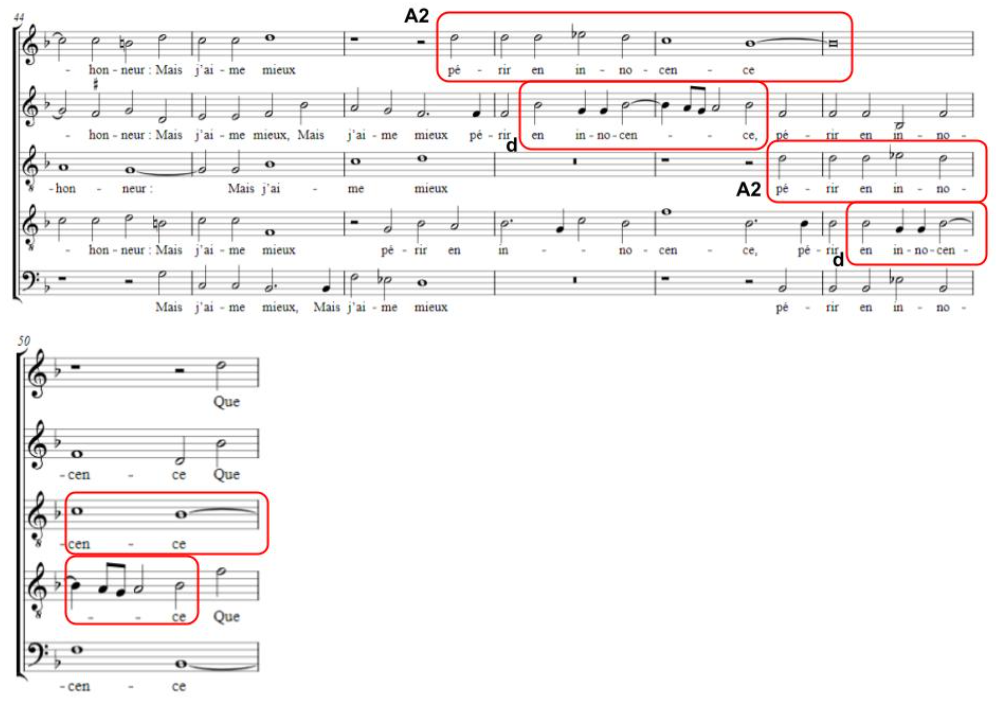
Example 3: Lasso, Susanne un jour: pairs of non-imitative duos with soggetti A2 and d (m. 46-50).
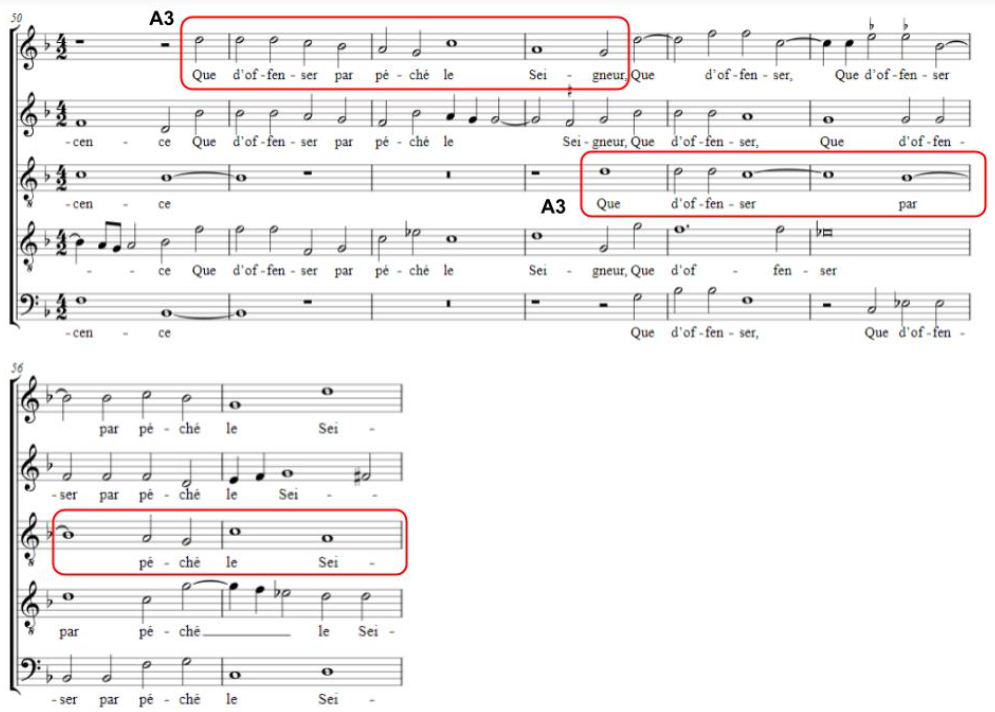
Example 4: Lasso, Susanne un jour: soggetto A3 in the soprano (m. 50-53) and in the tenor (m. 53-[58]).
A close look to the Kyrie of the Susanne un jour Masses
The first movement of the Mass ordinary is a relevant point to look at in detail since it acts like a kind of “presentation card” of the piece that is going to be “imitated”. It can often also predict which materials from the model will be borrowed in the other movements of the Mass. In his Ragionamento di Musica (1588), theorist Pietro Pontio explains how each movement of an imitation Mass should relate to the model piece (Pontio 1588; for an English translation see Strunk 1998: 472-474). The same passage of Pontio’s treatise was borrowed verbatim twenty-five years later, in 1613, by Pietro Cerone in his El melopeo y maestro (Cerone 1613: 687-688; for an English translation see Strunk 1950: 265-268). For the Kyrie, both theorists specify that the first Kyrie should begin with the model’s opening, then the Christe should make use of a subsidiary soggetto of the model (or even of a freely composed soggeto as long as it is appropriate to the tone of the Mass), and, finally, the last Kyrie should be built with material derived from the model or with independent material, but always recreating the final cadential section from the model piece. The Kyries of Lasso’s, Merulo’s and Riquet’s Masses are all of them structured in the three usual sections (Kyrie I, Christe, Kyrie II), but the thematic materials and contrapuntal structures used in those three sections differ significantly in each Mass. We will see to what extent Lasso, Merulo, and Riquet comply to Pontio’s and Cerone’s compositional conventions.
Kyrie I
All the three first Kyries maintain the characteristic pair of non-imitative duos from the opening of Lasso’s chanson, but the strategies throughout the entire section are sensibly different. What Lasso does through the first ten measures of his Kyrie I is an almost exact quotation of the beginning of his chanson, with only some minor adjustments to adapt the music to the new text. This exact quotation can be seen in Relationship 2822 on the CRIM Project website. Here we see that the upper part shows the first ten measures of Lasso’s chanson, and the bottom part, the first ten measures of Lasso’s Kyrie. The notes colored in red in both the chanson and the Mass indicate an exact quotation. We can see, of course, some minor rhythmic changes in the Mass in order to adapt the Kyrie’s text to the music. There are also three slight variations in the pitches in measures 5 (tenor and tenor secundus), measure 6 (tenor secundus), and measure 8 (contratenor and tenor secundus). But, basically, Lasso is quoting exactly the beginning of his own chanson, making therefore the model perfectly recognizable from the very beginning of the Mass. This quotation comprises, then, section A of the chanson, but excluding for now soggetti A3 from verse two of the chanson (“Par deux vieillards convoitant sa beauté”).
In addition to this almost exact quotation of the beginning of the chanson, Lasso also chooses to emulate in the first Kyrie the structure of the chanson with its double exposition (A and A’). From measure 11 until 17, he takes again soggetto A1 and counter-soggetto a (Example 5), and from measure 18 he brings up again soggetto A2 (Example 6), imitating thus again the beginning of the chanson, and building therefore a sense of “double exposition” that is close to the A-A’ structure of the chanson.
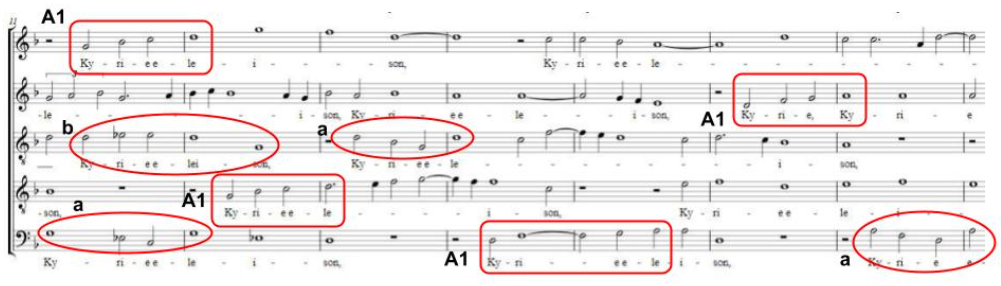
Example 5: Lasso, Kyrie I (m. 11-17): use of soggetti A1, a and b from the chanson.
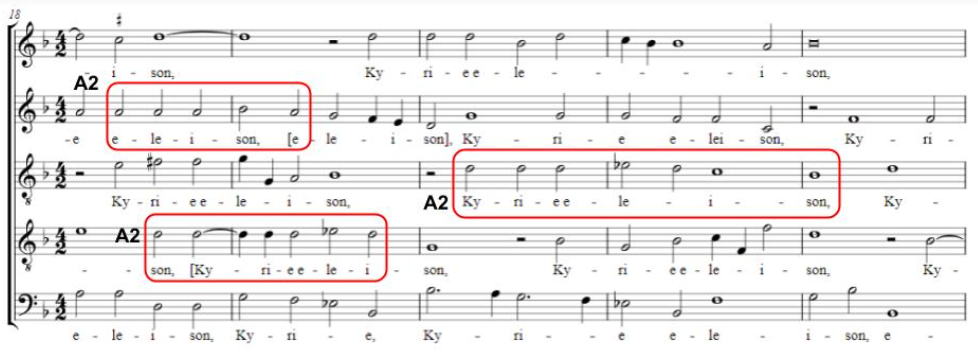
Example 6: Lasso, Kyrie I (m. 18-22): use of soggetto A2 from the chanson.
Merulo’s plan for Kyrie I is not overall different from that of Lasso, but, unlike him, he avoids the full quotation of the beginning of the chanson, and does not replicate either the “double exposition” structure of parts A-A’ of the chanson. He includes, though, a direct quotation of the first ten measures of the chanson’s soprano voice, also in the upper voice (see measures 1-13 of Merulo’s first Kyrie on the CRIM Project site here). [The only changes that Merulo introduces in this quotation of the chanson’s soprano voice is the introduction of four notes between measures 4 and 6 (D-Bb-G-D-Bb) which do not belong to the first ten measures of the chanson.] Merulo opens the Kyrie with the characteristic main soggetto (A1) and counter-soggetto a of the chanson, creating a pair of non-imitative duos (soprano/quintus and tenor/bass), thus imitating the opening of the chanson, just as Lasso does and, as we shall see later, Riquet too. An interesting feature of Merulo’s opening of the first Kyrie is the prominence given to the counter-soggetto a (the motif formed by two descending thirds and an ascending fifth, G-Eb-C-G), which is first displayed in the alto, even before A1 sounds in the soprano. Merulo’s approach of making the counter-soggetto a sound first prior to the main soggetto is not actually found in Lasso’s chanson, but rather in Lasso’s Mass and, particularly, in the opening of the ‘Crucifixus’ section of the Credo. Examples 7a and 7b shows this relationship between Lasso’s Mass and the opening of Merulo’s first Kyrie. It seems quite obvious to suppose that Merulo was familiar with Lasso’s Mass and decided to integrate it into his own Mass setting, introducing thus another layer of intertextuality beyond the chanson.
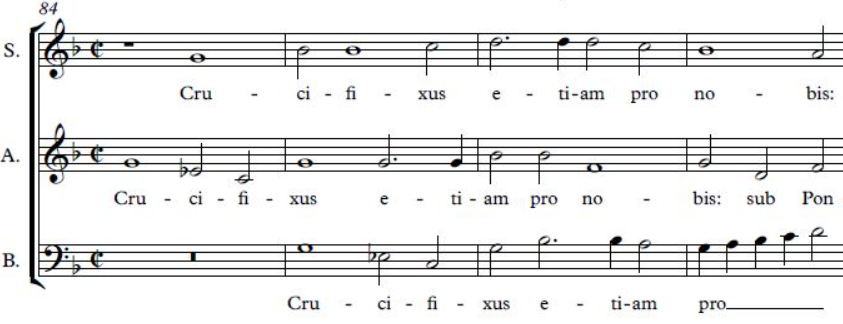
Example 7a: Lasso, Susanne un jour Mass, Credo (m. 84-87).
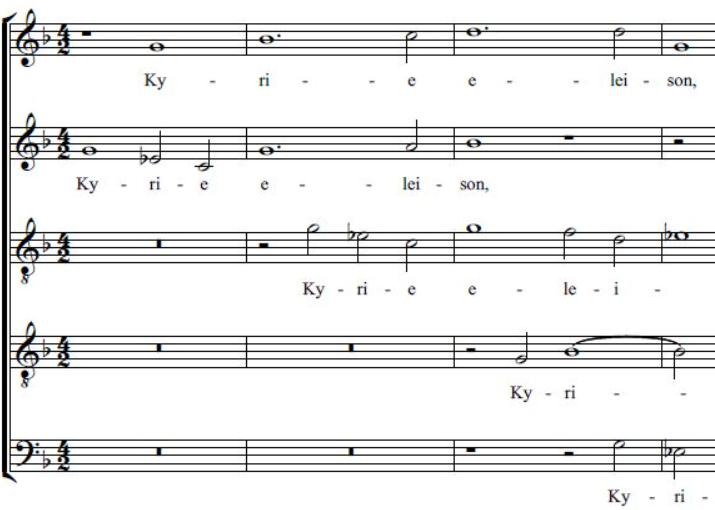
Example 7b: Merulo, Susanne un jour Mass, opening of Kyrie I (m. 1-3).
From measure 8, at the same times he cadences on D, Merulo starts a new point of imitation using thematic material A2 from the chanson’s verse “d’amour sollicitée”. For the next measures he makes extensive use of A2’s rhythmic pattern of three repeated notes but avoiding an exact quotation of the chanson (Example 8).
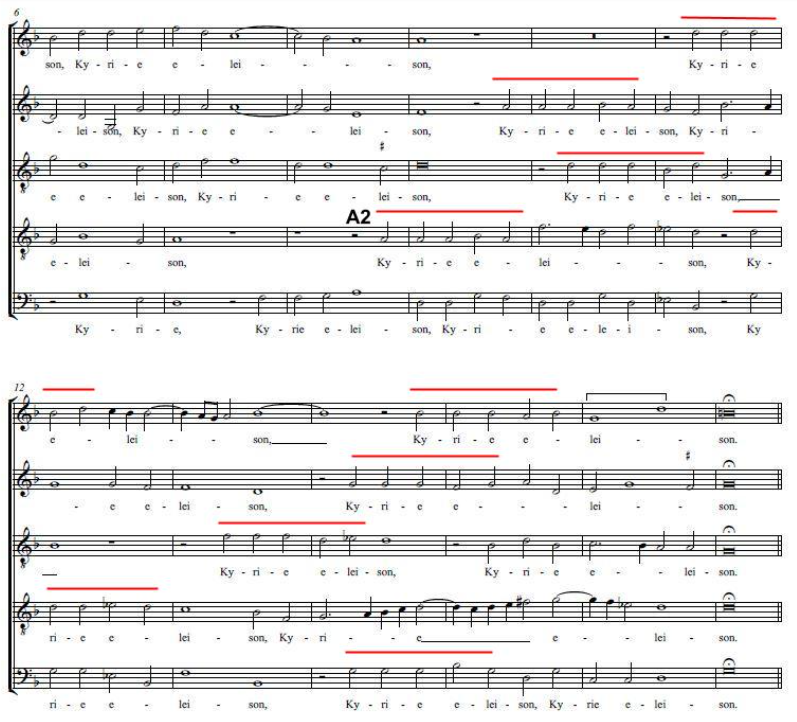
Example 8: Merulo, Susanne un jour Mass, Kyrie I (m. 8-17): use of thematic material A2 and its rhythmic pattern.
Riquet’s choices for the first Kyrie are rather opposed to those of his colleagues. As Lasso and Merulo he also opens the first Kyrie with a pair of non-imitative duos (soprano/alto and tenor/bass), emulating the opening of the chanson. The upper voices of each non-imitative duo sing soggetto A1, but, instead of using the characteristic counter-subject of descending thirds and ascending fifth (soggetto a), Riquet chooses to replace it for what apparently seems like a new thematic idea: a melody that starts with an ascending third and continues with a descending melodic profile. However, the model for this new combination is, again, Lasso’s Mass —as we have just seen in the case of the opening of Merulo’s Kyrie—. We can see the same counter-melody and disposition of voices at the beginning of the Sanctus in Lasso’s Mass. Examples 9a and 9b show this relationship between the opening of Riquet’s first Kyrie and the Sanctus of Lasso’s Susanne un jour Mass.
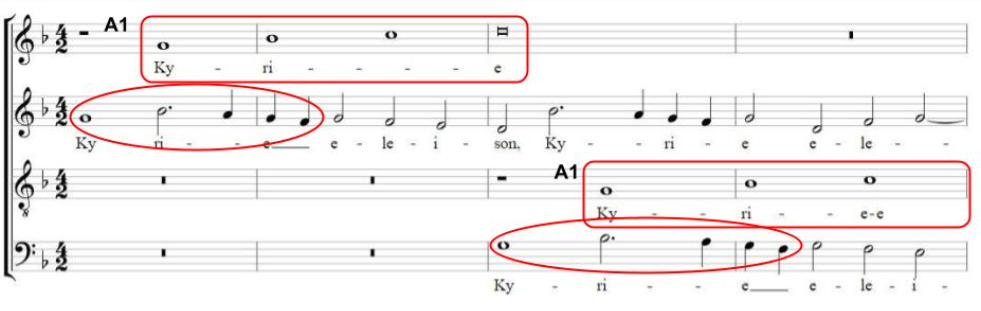
Example 9a: Riquet, Susanne un jour Mass, Kyrie I (m. 1-4).
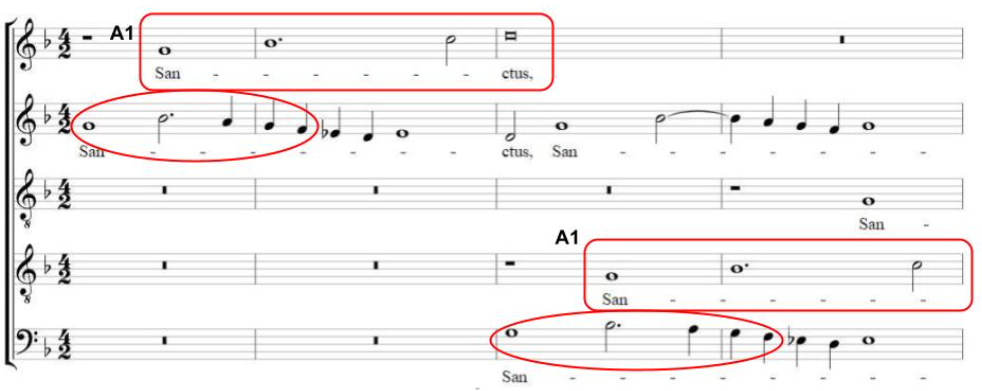
Example 9b: Lasso, Susanne un jour Mass, Sanctus (m. 1-4).
As we have seen earlier, Lasso and Merulo used thematic material A2 (or variants of this thematic material) to build a fuga passage after the first cadential point of their first Kyries. Riquet closes his first Kyrie in a different way (see Example 10 below). After a first cadential point in G (m. 5), he takes the counter-melody used in the opening non-imitative duos (directly derived from Lasso’s Mass), to build a sort of fuga where the different voices are displaying this counter-melody, although in a very flexed way in some instances. While the alto, tenor and bass play with this melody, the soprano presents the chanson’s tenor melody in long values, infusing to the movement a somewhat “archaic” style that we hadn’t seen in the settings of Lasso or Merulo.
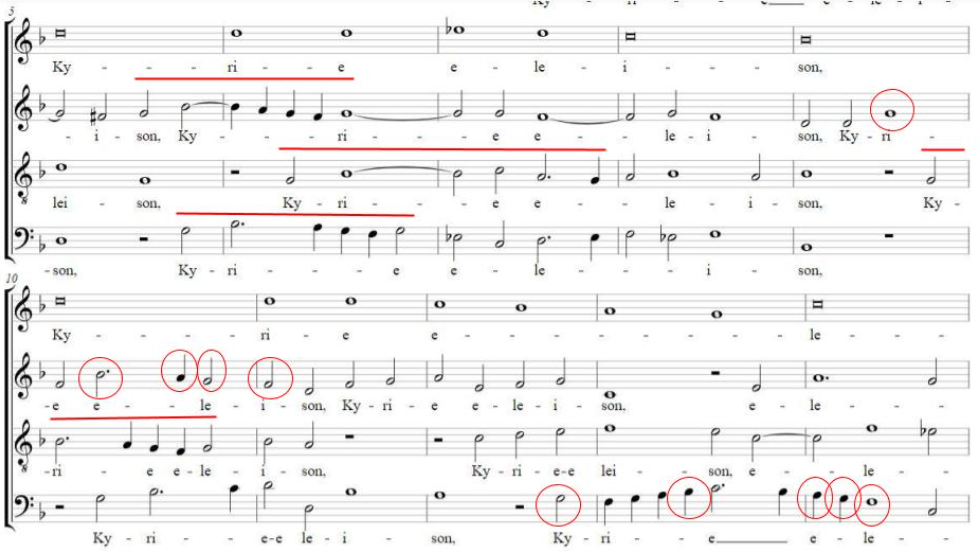
Example 10: Riquet, Susanne un jour Mass, Kyrie I: counter-melody derived from Lasso’s Mass (Sanctus) used on measures 5-14 (out of 16) of Riquet’s Kyrie I.
Christe
The central section of the Kyrie also shows a variety of strategies but, as we shall see, Lasso and Merulo have similar approaches while Riquet’s Christe shows again different choices in the selection of the chanson’s melodic material. They all comply, though, with Pontio’s and Cerone’s rule on choosing a subsidiary soggetto of the model to elaborate this section.
Lasso’s Christe is entirely based on section B of the chanson. He uses two soggetti from part B: soggetti 6 from verse “De ce corps mien vous avez jouissance”, and soggetti 7 from verse “C’est fait de moi”. Soggetti 6 (D-D-D-C#-D-F-E) is presented in a form of a long fuga from the very beginning of the Christe (m. 27) until m. 42 (see Relationship 217 on the CRIM Project site showing this relationship between the chanson —upper example— and the Mass —lower example— ). The alto opens the fuga with the motif transposed a fifth down (G-G-G-F#-G-Bb-A), and then it is presented seven more times in its original pitches in different voices. There are therefore eight entries of the motif spread over seventeenth measures. From measure 42 until the end of the Christe, the soprano presents three more times the initial notes of the motif (D-C#-D) by way of a clausula. This shortened presentation of soggetto 6 is also combined, in the last measures of the Christe, with a short fuga build upon soggetto 7 of the chanson (Bb-D-A-G) from the verse “C’est fait de moi”. For instance in Relationship 2819 on the CRIM Project site soggetto 7 is sung first in the soprano (m. 44-45), then in the alto transposed a fourth down (m. 46-47), and finally in the tenor, again in its original pitches (m. 47-49).
Merulo also bases his Christe on thematic material from part B of the chanson. However, he chooses a soggetto that was already presented in part A, althought in a very discrete way. It is soggetto b sung by the contratenor in the opening of the chanson (D-Eb-Eb-D-G, m. 3-4; see Appendix 2), which is also used in the soprano to sing the verse “Elle leur dit” that opens part B of the chanson —althought with a variant in the final note (D-Eb-Eb-D-A, see soggetto labelled as b’ in the Appendix 2, m. 28-29)—. Merulo borrows the first four notes of this soggetto b/b’ and forms periodic entries between the alto, the quintus, and the soprano and the tenor for the first four measures of his Christe (see Example 11). He introduces then more entries of this soggetto until measure 26.
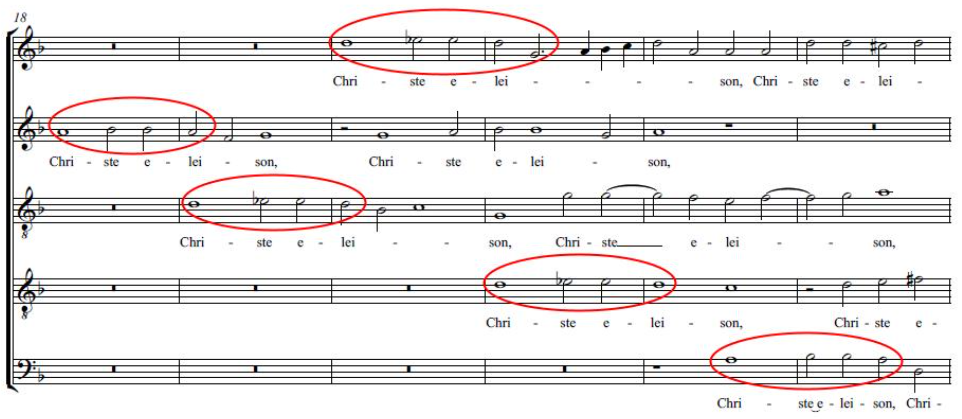
Example 11: Merulo, Susanne un jour Mass, Christe (m. 18-23): use of soggetti b/b’ from the chanson (D-Eb-Eb-D / A-Bb-Bb-A) in periodic entries.
The last entries of soggetto b/b’ around measure 25 overlap with the introduction of soggetto B6 which comes from the chanson verse “De ce corps mien” in part B: D-D-D-C#-C#-D —that is, the same soggetto used by Lasso to open his Christe—. In Merulo’s Christe, the soprano introduces the first notes of this soggetto in measure 25, and it is immediately imitated in the quintus (see Example 12, m. 26), and in the bass (m. 28). From measure 25 until the end of the Christe, the soprano quotes almost verbatim the soprano of the chanson from measure 31 until the end of part B on measure 44.
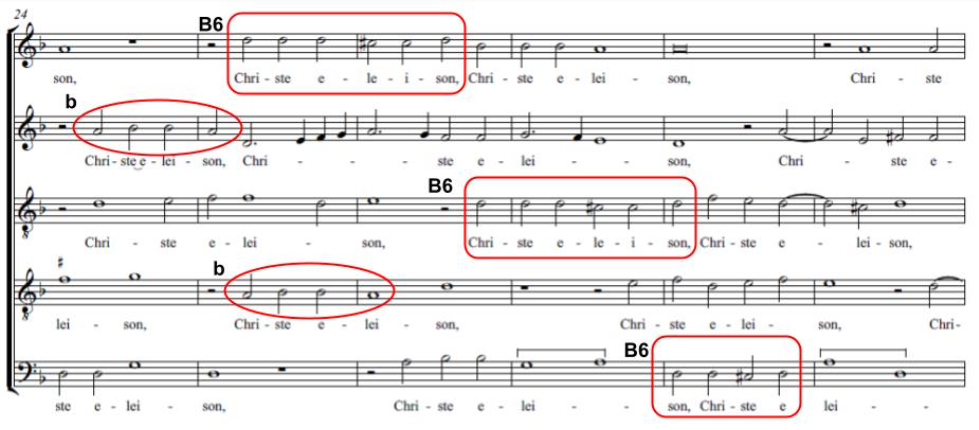
Example 12: Merulo, Susanne un jour Mass, Christe (m. 24-29): use of soggetto B6 from part B of the chanson from m. 25 of the Christe.
With only 16 breves plus the final downbeat, Riquet’s Christe is significantly shorter than Lasso’s (24 breves plus the final downbeat) and Merulo’s (21 breves plus the final downbeat). But the main difference with respect to Merulo’s and Lasso’s Christe lies in the thematic material borrowed from the model. Unlike his colleagues, Riquet continues here to rely on the section A of the chanson. As he had done in the first Kyrie, he quotes Lupi’s tenor melody in long values, although in this case in the alto and transposed down a fourth (see Riquet’s Christe here starting on measure 17). The alto remains therefore independent from the other voices. For the other parts, Riquet borrows a subsidiary soggetto also from section A of the chanson. It is the chanson’s soggetto used for the text “d’amour sollicitée” on the contratenor in measures 8-10, labelled as soggetto c in the Appendix 2: D-G-G-F-D. He borrows this inconspicuous motif from the model —although rhythmically modified— and builds a fuga for the first nine measures of the Christe. The last two entries of this soggetto on the tenor (m. 22) and the bass (m. 23) have some passing notes. (see Example 13).
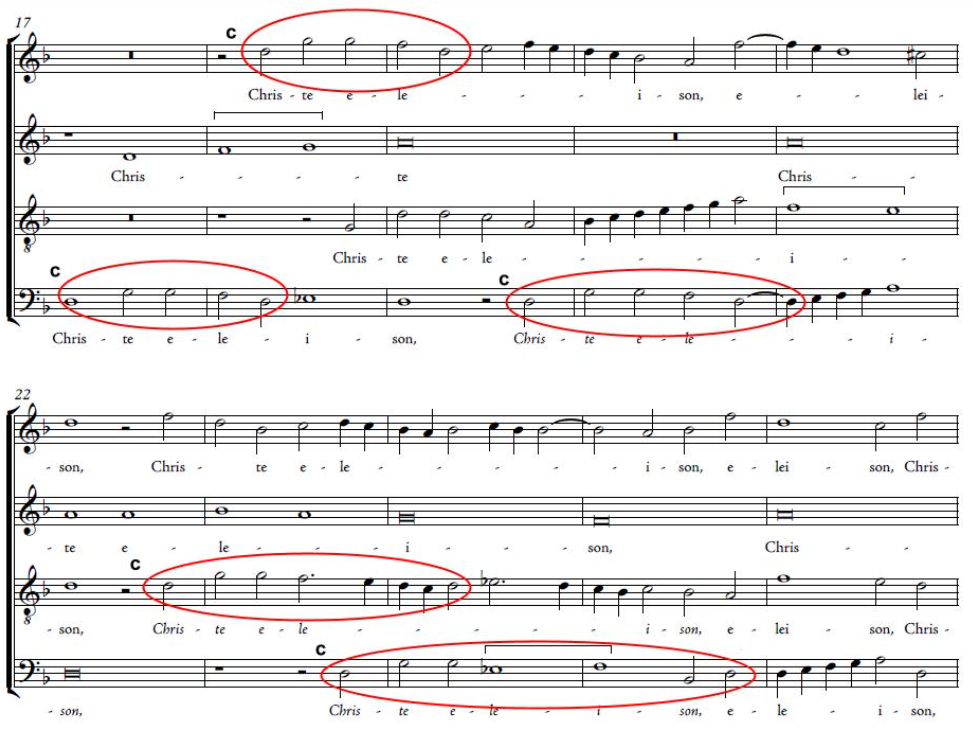
Example 13: Riquet, Susanne un jour Mass, Christe (m. 17-26): borrowing of soggetto c from the chanson (D-G-G-F-D).
Kyrie II
Lasso’s Christe had finished by using soggetti B7 of the chanson (Bb-D-A-G) from the verse “C’est fait de moi”. The Kyrie II continues borrowing from the chanson exactly from this point. It starts with a fuga that presents soggetti B8 from the chanson’s verse “Si je fais résistance” (G-Bb-A-Bb-C-D; see m. 38-40 in the Appendix 2), first in the bass (m. 52-54), then in the soprano (m. 53-55), and next in the contratenor transposed a fourth down (m. 53-55; see Example 14 below). This fuga serves as an introduction to the extensive quotation of the chanson that starts in measure 55. From this measure, the rest of the Kyrie II is quoted almost verbatim from that point of the chanson with just some minor variations. Relationship 2821 from the CRIM Project site shows side by side the chanson and the Kyrie II. The red-coloured notes, in both the chanson and the Mass, indicate the correlation between the two pieces starting on measure 55 on the Mass, and on measure 38 on the chanson. Therefore, Lasso’s Kyrie II starts by borrowing materials from the last part of section B of the chanson and finishes with a large quotation of section A’’.
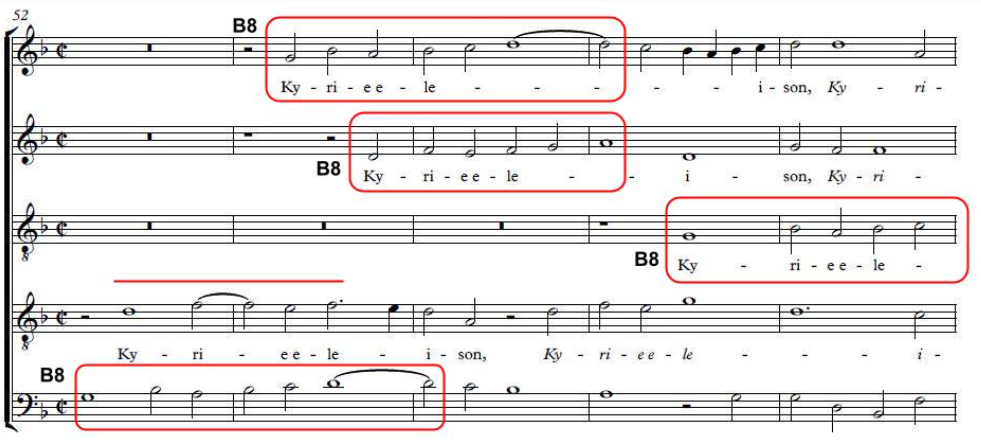
Example 14: Lasso, Susanne un jour Mass, Kyrie II: borrowing of the chanson’s soggetti B8.
Unlike Lasso’s, Merulo’s Kyrie II already starts by borrowing thematic material from the beginning of part A’’ of the chanson. Moreover, he arranges this thematic material through the same presentation type used in that exact point of the chanson: a pair of non-imitative duos in which one of the voices of each duo sings soggetto A2 and the other voice sings the counter-melody d. See the pair of non-imitative duos in the beginning of the chanson’s section A’’ in the previous Example 3, and the corresponding non-imitative duos at the beginning of Merulo’s Kyrie II in Example 15. The remaining measures of Merulo’s Kyrie II follow quite closely the model from that point.
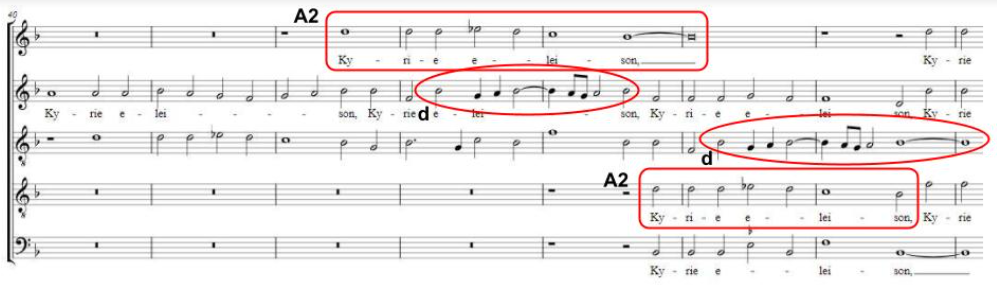
Example 15: Merulo, Susanne un jour Mass, Kyrie II (m. 40-46): non-imitative duos with soggetto A2 and counter-soggetto d.
Riquet’s Kyrie II is again the shortest with respect to those of Lasso and Merulo (15 breves plus the final downbeat against 28 and 18 plus the final downbeat for Lasso’s and Merulo’s Kyrie II, respectively). His approach to the final section of the Kyrie is analogous to that of the previous sections. In the first Kyrie he had quoted Lupi’s tenor melody in long values throughout the soprano; in the Christe he did the same throughout the alto, transposing the melody a fourth down; here, in the second Kyrie, he moves the quotation to the tenor and presents it in its original pitches again (see Riquet’s Kyrie II from m. 34; https://crimproject.org/pdf/CRIM_Mass_0032_1.pdf). In the opening of the first Kyrie Riquet had discarded the counter-soggetto a (two descending thirds and an ascending fifth, G-Eb-C-G) to accompany the main soggetto of the chanson (A1), and used instead, as we had seen, a melody derived from the Sanctus of Lasso’s Mass. To conclude the Kyrie, Riquet finally brings this important motif of the model. He borrows it, though, for a very briefly passage at the beginning of this final section in the soprano and the alto (Example 16). But beyond this short passage and the full quotation of Lupi’s melody in the tenor, the remaining measures of Riquet’s Kyrie II do not contain clear references to either part A/A’, B or A’’ of the chanson.
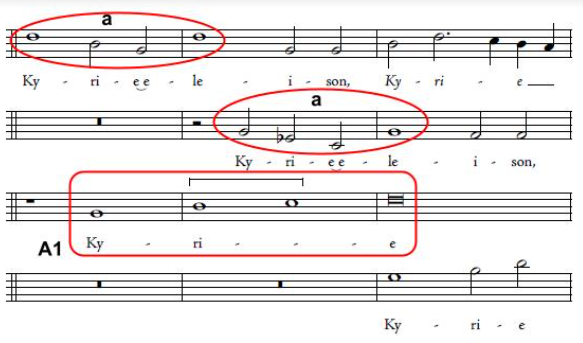
Example 16: Riquet, Susanne un jour Mass, Kyrie II (m. 1-3): counter-soggetto a at the beginning of the Kyrie II.
Some preliminary conclusions about the Kyrie
The previous narrative about the Kyrie of those three Susanne un jour Masses offers a first glimpse of each composer’s approaches to the model. The way each composer reworks the chanson is quite varied. We could sum up the use of thematic material from the chanson in each of the three Kyrie through the following Table 3.
| Mass Section | Lasso | Merulo | Riquet |
| Kyrie I | A/A’ | A | A |
| Christe | B | B | A |
| Kyrie II | B-A’’ | A’’ | A |
Table 3: The use of thematic material from the chanson’s sections A/A’, B or A’’ in the Kyrie of the Susanne un jour Masses by Lasso, Merulo, and Riquet.
Lasso, on one hand, is clearly interested in replicate the chanson’s structure. In the Kyrie I, he borrows thematic material from section A of the chanson, and emulates its double exposition structure (A/A’). In the Christe, he moves to section B of the chanson, and in the Kyrie II, after reworking the last verse of section B, he finishes with a large quotation of section A’’. Indeed, Lasso includes large quotations from his own chanson. As we have seen, the first and the second Kyrie contain, to a great extent, verbatim quotations from the chanson. By doing this, he makes his own model perfectly recognizable to the listener from the beginning of the Mass. Merulo, for his part, follows a similar plan to that of Lasso. He correlates each section of the Kyrie with its corresponding section of the chanson (Kyrie I/section A; Christe/section B; Kyrie II/section A’’), but, unlike Lasso, he avoids extensive literal quotations of the chanson.
On the opposite side, Riquet does not establish a correlation between the thematic material of the chanson and its structure, and the different sections of the Kyrie. Both the Kyrie I, the Christe, and the Kyrie II are exclusively based on thematic material borrowed from section A of the chanson. Riquet seems also more interested in emphasizing single melodies and motives from the model than in building contrapuntal structures from it. As we have seen, he includes in each of the Kyrie sections a full citation of the chanson’s tenor melody in long values, imbuing thus the first movement of the Mass with a somewhat archaic style. Riquet’s choices among the thematic material of the chanson are also less obvious than those of his colleagues. We saw, for example, how he chose to use a melody from Lasso’s Susanne un jour Mass as a counter-melody for the main soggetto of the chanson in the opening of the first Kyrie, making thus the model much less recognizable from the very beginning of the Mass. It is extremely interesting, indeed, that, beyond the chanson, Lasso’s Mass also becomes a model for imitation in the case of Riquet’s and Merulo’s Masses.
A bigger picture through CRIM Intervals digital tools
The Kyrie is one of the shortest movements of the Ordinary of the Mass and, therefore, to do the kind of comparison and analysis we just did in the previous section it is a relatively manageable task. However, if we want to analyze and compare at the same time a given model with all movements of several derivative Masses —and even the different Mass movements with each other— the task becomes more complicated to handle. For this kind of research that involves comparison between different pieces, digital tools, such as those developed in CRIM Intervals, are of extraordinary help. They help us to get a “bigger picture”, and even illuminate patterns and compositional strategies in the imitation Masses that could go unnoticed by doing a traditional manual analysis. Having considered the ‘Kyrie’, in this section we will try to get a “bigger picture” of the Susanne un jour Masses by Lasso, Merulo and Riquet by applying some of the CRIM Intervals digital tools to the other movements. For this purpose, I will use CRIM Intervals tools called “Model Finder”, “HeatMap Notes Ngrams”, and “HeatMap Corpus Comparison”. I will run three different analysis in order to know: (1) the degree of melodic similarity between the different movements of the three Susanne un jour Masses and the model; (2) the use of a given soggetti throughout the three Masses; and (3) how many and which melodies (“entry” soggetti) each Mass movement share with the chanson. This last question also speaks about the degree of melodic similarity between the Masses and the chanson.
Which Mass movements are melodically more similar to the model?
I will try to answer this question through the “Model Finder” tool. “Model Finder” is a CRIM Intervals tool recently created by Alexander Morgan, a scholar participant and programmer developer in the CRIM project. This tool finds the percentage of melodic entries shared in any corpus. These “entries” are soggetti (expressed as melodic n-grams) that begin after a rest or a section break. They are thus the most likely soggetti to be remembered and the most likely to be used in important presentation types. The tool measures, therefore, the similarity between pieces based on their shared soggetti. As explained in the Jupyter Notebook of the tool, this method first finds all the “entry” soggetti in each piece of a given corpus, and then measures the percentage of each model found in a corresponding Mass movement. The results can be visualized through a “driving distance” heatmap showing how likely a given model was a source for each Mass movement. This is represented by a score 0-1 where 0 means that this relationship was highly unlikely, and 1 means that two given pieces are highly likely to be related in this way. This is also visualized as a heatmap where darker colors mean greater relatedness between the corresponding pieces regarding shared entries, and lighter colors represent less relatedness. Through this tool we can answer, for instance, the following question: which Mass movements are melodically more similar to the model?
The three graphics in Figure 2 show the results of applying the Model Finder tool based on shared soggetti to the Susanne un jour corpus. They show the similarity between Lasso’s chanson (the model) and Lasso’s Mass (Graphic a), Merulo’s Mass (Graphic b), and Riquet’s Mass (Graphic c). Since we already analyzed in detail the Kyrie, I have applied the tool to the remaining movements (Gloria, Credo, Sanctus, and Agnus Dei). According to this automated analysis, we could conclude that, for the remaining movements, Merulo’s Mass is the one that has the greatest melodic similarity with Lasso’s chanson because three out of the four movements are closely related to the model (see the darker colors in Graphic b). As we can see in Graphic b, the Sanctus, the Credo, and the Gloria (in this particular order) are the movements with a higher degree of similarity with the model, while the Agnus Dei seems to share little melodic material with the model. On the opposite side, Riquet’s Mass shows apparently less relatedness, since only the Agnus seems to be melodically closer to the model (darker colors in Graphic c), while the Gloria, Credo, and Agnus (lighter colors in Graphic c) are apparently more disconnected to the model. This is exactly the opposite to Merulo’s movements. Lasso’s Mass, for its part, is located at an intermediate point with respect to Merulo and Riquet in terms of melodic similarity with the chanson: his Gloria and Agnus seem to share abundant melodic material with the model (darker colors in Graphic a), while his Credo and Sanctus (lighter colors) show less relatedness.
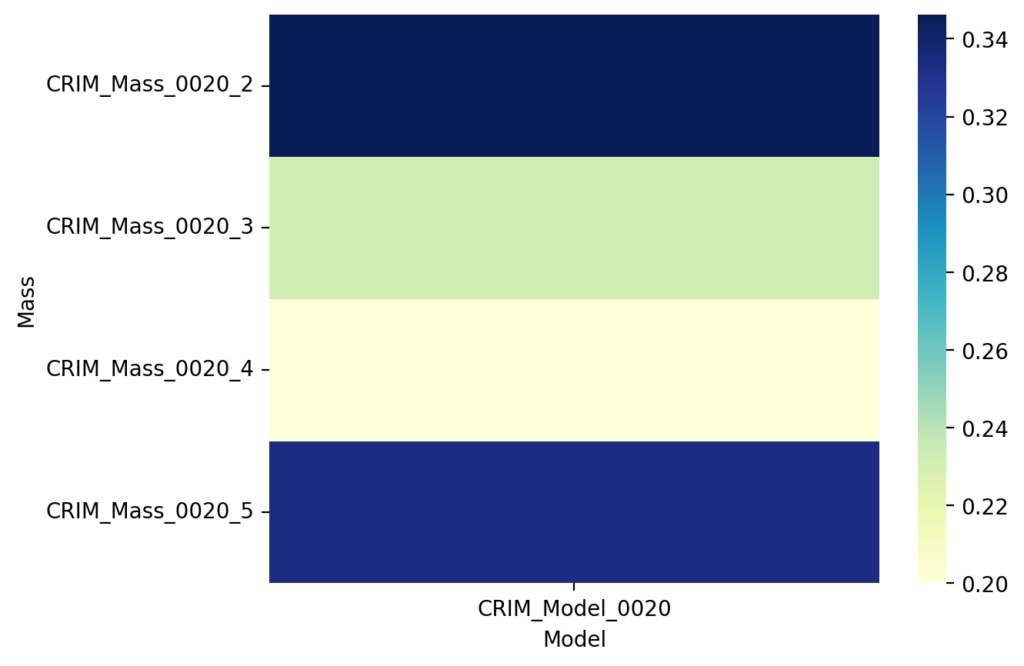
a) Percentage of melodic similarity between Lasso’s Susanne un jour Mass and the chanson (model)
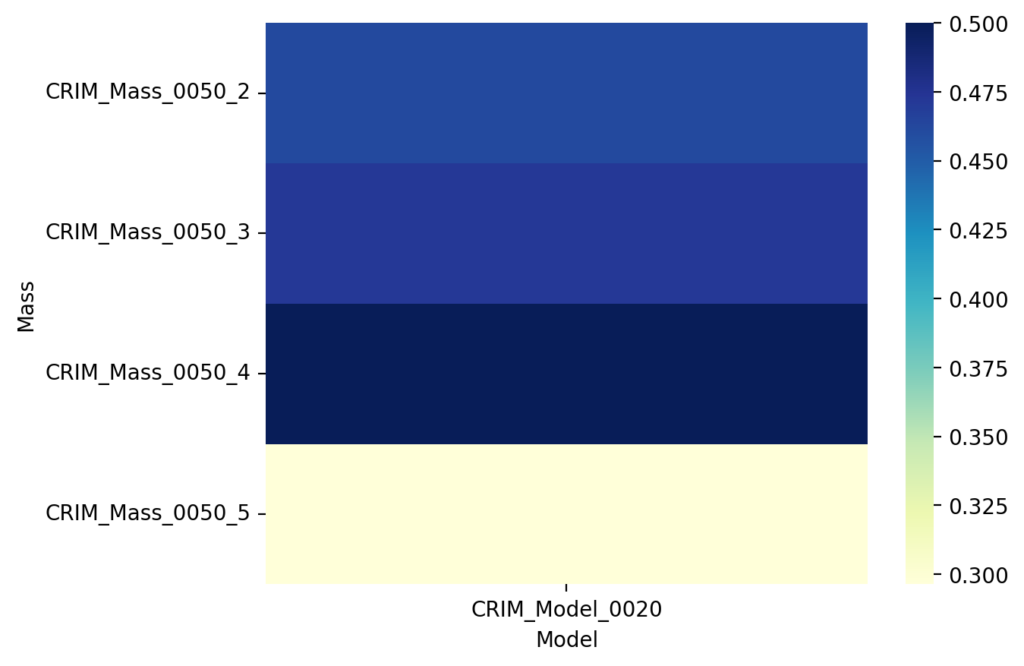
b) Percentage of melodic similarity between Merulo’s Susanne un jour Mass and the chanson (model)
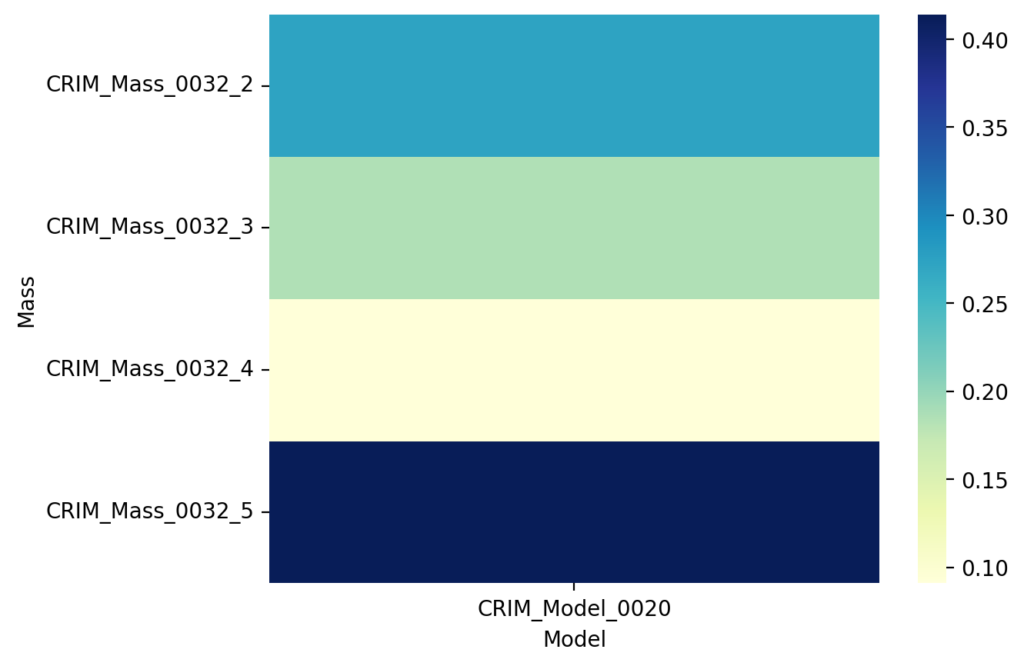
c) Percentage of melodic similarity between Riquet’s Susanne un jour Mass and the chanson (model)
Figure 3. Percentage of melodic similarity between Lasso’s, Merulo’s and Riquet’s Susanne un jour Masses (Gloria, Credo, Sanctus, and Agnus Dei), and Lasso’s chanson according to the automated analysis performed with “Model Finder” CRIM Intervals tool.
Key for reading the graphics: “CRIM_Model_0020” is the ID for Lasso’s Susanne un jour chanson in the CRIM database; “CRIM_Mass_0020” is the ID for Lasso’s Susanne un jour Mass; “CRIM_Mass_0050” is the ID for Merulo’s Susanne un jour Mass; “CRIM_Mass_0032” is the ID for Riquet’s Susanne un jour Mass. The numbers indicated after the ID of each Mass refer to the different movements of the Ordinary of the Mass: 2 = Gloria; 3 = Credo; 4 = Sanctus; 5 = Agnus Dei.
This kind of analysis operates, of course, on a macro level. But CRIM Intervals tools also allow one to zoom into these results —on a micro level— and see which soggetti are shared and how they are used in each pair of pieces. Figures 4a and 4b show, for instance, an example of this micro level analysis that I have applied to the chanson (above) and to the Credo of Riquet’s Mass (below). It shows where do the shared melodies between Lasso’s chanson and Riquet’s Credo appear in each of the pieces, and how similar does the treatment of them seem to be. The results, also obtained using the “Model Finder” tool, are visualized through a timeline (measured in quarter notes) where each soggetto has a different color, but the color code is the same for a given pattern in both the chanson and the Mass movement. As we can see in the list of “patterns” on the right, the two pieces (the chanson and Riquet’s Credo) share eleven “entry” melodies (soggetti).
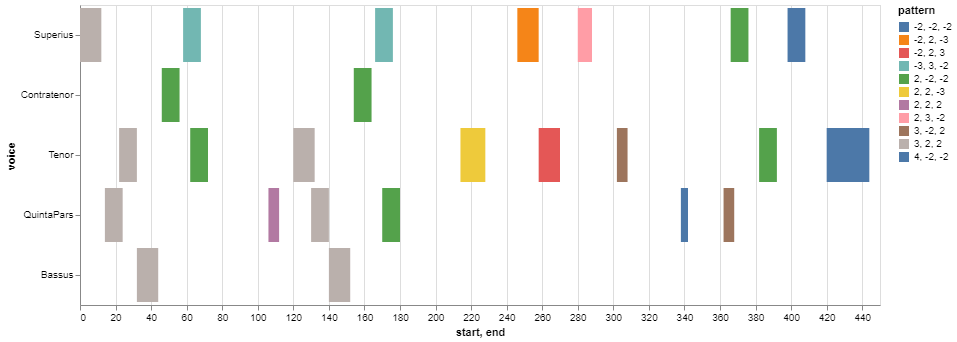
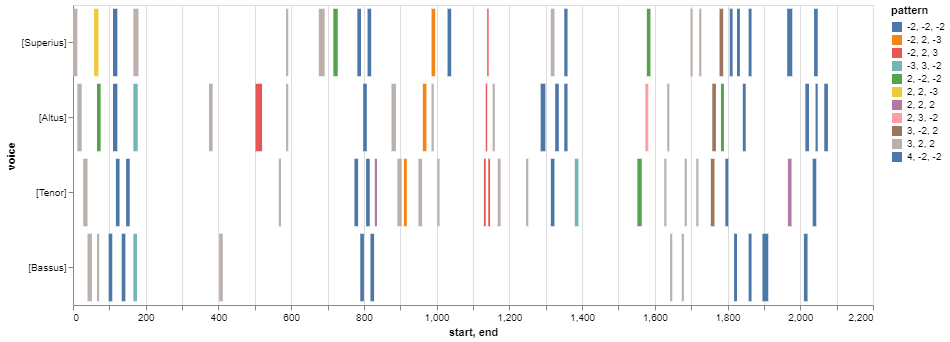
Figures 4a and 4b: Graphics showing in a timeline (measure in quarter notes) the shared melodies (expressed as n-gram patterns) between Lasso’s Susanne un jour chanson (above) and the Credo of Riquet’s Susanne un jour Mass (below).
How is the A1 soggetto used in the three Masses?
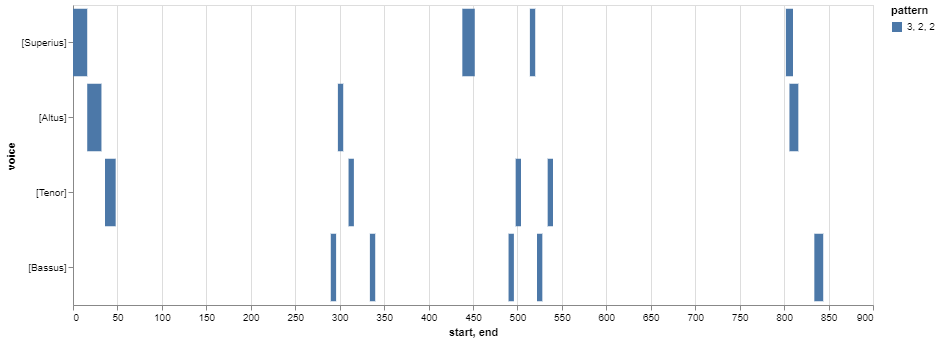
To look in detail to all the shared soggetti between the chanson and each movement of Lasso’s, Merulo’s and Riquet’s Susanne Masses would be beyond the scope of this essay. A narrower and specific analysis of one or two particular soggetti and how they are used through the three Masses would be more appropriate. Using also CRIM Intervals tools, I will look now at where and how the chanson’s soggetto A1 (G-Bb-C-D) and soggetto a (G-Eb-C-G) —i.e., the opening soggetto and counter-soggetto of the chanson— are used through the different movements of Lasso’s, Merulo’s, and Riquet’s Masses. As we had seen before, Lasso’s opening of the chanson features a pair of non-imitative duos using soggetto A1 and soggetto a (see Example 1). Therefore, an interesting question that we can try to answer by using CRIM tools is how this particular contrapuntal combination (soggetti A1 and a combined as pairs of non-imitative duos) is used through the different movements of the Susanne Masses. The CRIM Intervals tool called “HeatMaps Notes Ngrams” allows to do research into this question. Through this tool we can visualize particular soggetti (expressed as n-grams) across an entire piece, with identical items represented in the same color. The results can also be limited by highlighting the particular n-grams (soggetti) we are interested in.
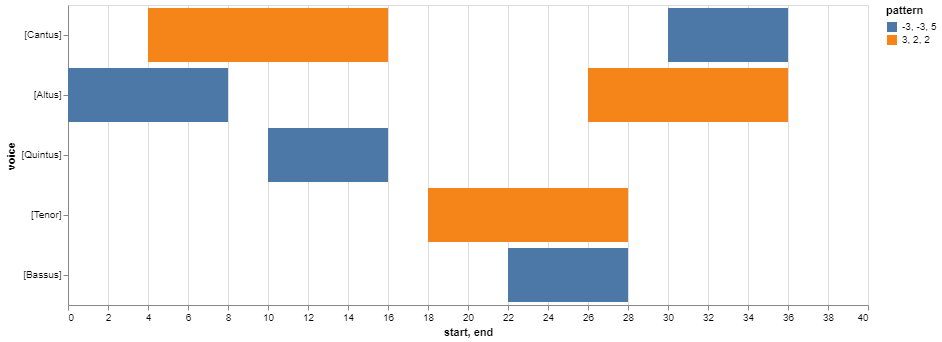
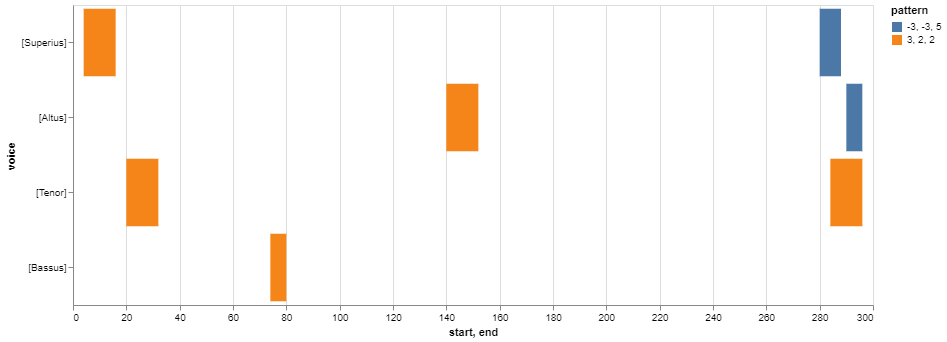
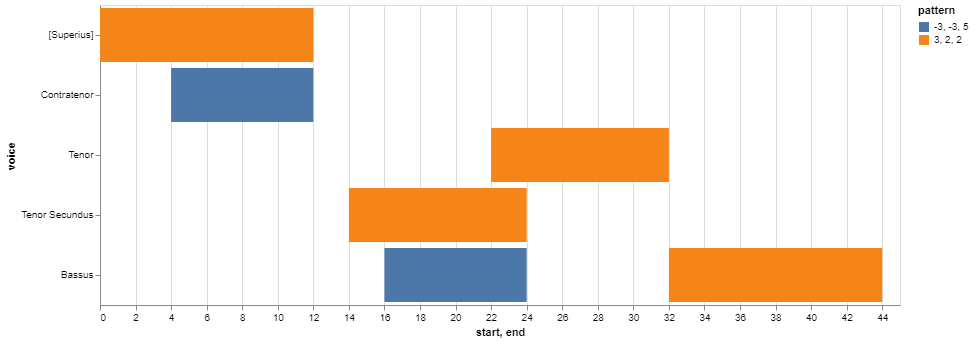
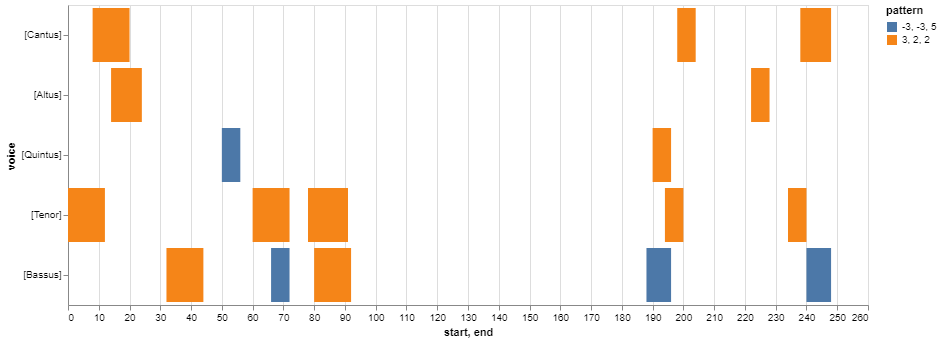
I have performed this analysis in the chanson and in each of the movements of the three Susanne Masses. The full results can be visualized in the Appendix 3. Here we can see the example of the chanson (Figure 5), as well as the Kyrie (Figure 6a-c) and the Gloria (Figures 7a-c) for each of the Masses.
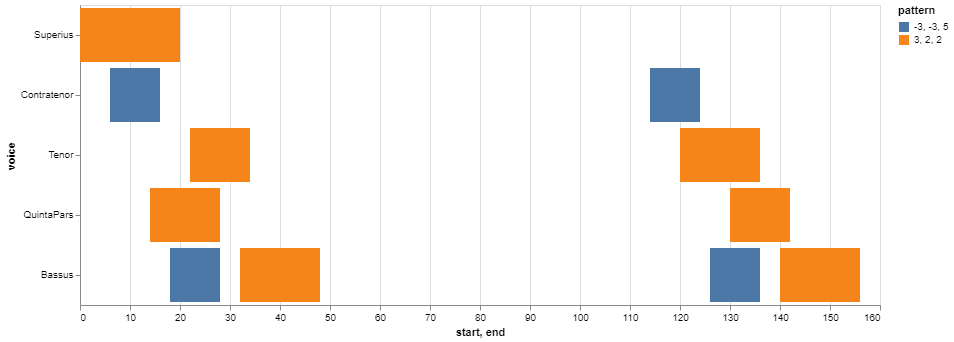
Figure 5: The use of soggetto A1 (n-gram ‘3, 2, 2’) and soggetto a (n-gram ‘-3, -3, 5’) in Lasso’s Susanne un jour chanson.
a) Lasso
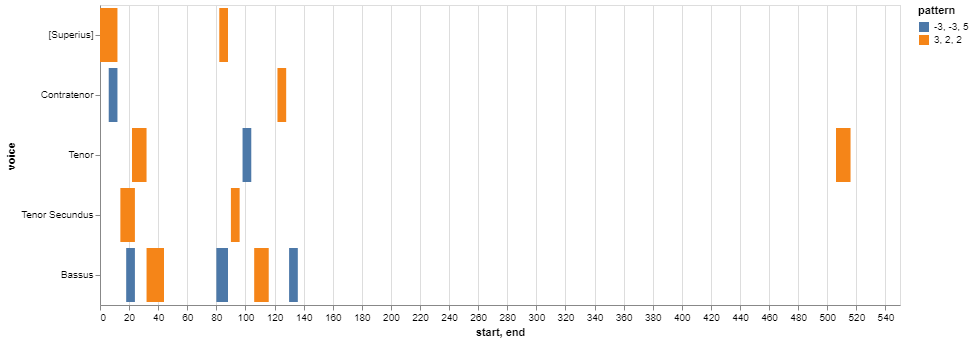
b) Merulo
c) Riquet
Figures 6a, 6b, and 6c: The use of soggetto A1 (n-gram ‘3, 2, 2’) and soggetto a (n-gram ‘-3, -3, 5’) in the Kyrie of Lasso’s Mass (a), Merulo’s Mass (b), and Riquet’s Mass (c).
a) Lasso
b) Merulo
c) Riquet
Figures 7a, 7b, and 7c: The use of soggetto A1 (n-gram ‘3, 2, 2’) and soggetto a (n-gram ‘-3, -3, 5’) in the Gloria of Lasso’s Mass (a), Merulo’s Mass (b), and Riquet’s Mass (c).
Just by looking at these graphics we can see the “big picture” of the use of those particular soggetti and how they are contrapuntally combined (if at all). In the opening of the Kyrie (which we already analyzed in the previous section), both Lasso and Merulo borrow not only the two soggetti but also the contrapuntal structure or presentation type through which they are displayed: the pairs of non-imitative duos through which Lasso presents soggeto A1 (orange, pattern ‘3, 2, 2’) and soggeto a (blue, pattern ‘-3, -3, 5’) in the chanson (Figure 5) are also replicated in the opening of Lasso’s and Merulo’s Kyrie (see Figure 6a for Lasso and Figure 6b for Merulo). But Riquet’s Kyrie does not borrow this same contrapuntal structure with those soggetti. As we can see in Figure 6c, he uses soggetto A1 in the soprano and the tenor (orange, pattern ‘3, 2, 2’) but not accompanied by counter-soggeto a (‘-3, -3, 5). We saw earlier that he certainly opens the Kyrie with a pair of non-imitative duos, but the the counter-melody he uses is not a but a melody derived from Lasso’s Sanctus. Regarding the Gloria (Figure 7), Lasso also uses those two soggetti to form a pair of non-imitative duos at the beginning of the movement (Figure 7a), but not Merulo on this case (Figure 7b), and neither Riquet (Figure 7c), who only use soggetto A1 (‘3, 2, 2’). The following Table 4 summarizes the use of those soggetti combined as non-imitative duos in each of the movements of the three Masses that we can infer from the graphics in the Appendix 3. Lasso uses soggetto A1 and a in pairs of non-imitative duos in the Kyrie, the Gloria, the Credo, and the Sanctus, but not for the final movement of the Mass; Merulo uses them only in the opening of the Kyrie and the Credo; and Riquet, for his part, does not use these soggetti forming non-imitative duos in any of the movements of his Mass.
| Composer | Kyrie | Gloria | Credo | Sanctus | Agnus Dei |
| Lasso | x | x | x | x | |
| Merulo | x | x | |||
| Riquet |
Table 4: The use of soggetti A1 (‘3, 2, 2’) and a (‘-3, -3, 5’) combined as pairs of non-imitative duos in Lasso’s, Merulo’s, and Riquet’s Masses (data derived from graphics on Appendix 3).
How many and which melodies (“entry” soggetti) each Mass movement share with the chanson?
To conclude this essay, I will briefly show the results of applying another CRIM Intervals tool, the “HeatMap Corpus Comparison”, to the Susanne un jour corpus. “HeatMap Corpus Comparison” allows to obtain pairs of graphics that show all the shared entries (that is soggetti or thematic melodic material expressed as melodic n-grams that begin after a rest or a section break) between a given piece model and a given Mass movement. For example, by applying this method we can visualize graphics that show all the shared entries between Lasso’s chanson and each movement of Lasso’s, Merulo’s and Riquet’s Susanne Masses. This is a function that the “Model Finder” also has, but only analyzing one pair of pieces at a time. Since “HeatMap Corpus Comparison” is a corpus method it allows to obtain data in form of graphics for an entire corpus in just one single process. The complete results of applying the “HeatMap Corpus Comparison” method to the Susanne un jour corpus are shown in the Appendix 4. This Appendix shows the html version of applying the “HeatMap Corpus Comparison” to the Susanne un jour corpus. After several lines of code, the graphics show the shared entries between between Lasso’s chanson and each movement of Lasso’s, Merulo’s, and Riquet’s masses. For example, the first pair of graphics displays which melodies Lasso’s chanson shares with Lasso’s Kyrie; the second pair of graphics show which melodies Lasso’s Kyrie shares with Lasso’s chanson; the third pair of graphics show which melodies Lasso’s chanson shares with Lasso’s Gloria; the fourth pair of graphics display which melodies Lassos’s Gloria shares with Lasso’s chanson; and so on. Here, the following Table 5 shows a summary of what we can conclude from those graphics.
| Composer | Kyrie | Gloria | Credo | Sanctus | Agnus Dei |
| Lasso | 12 | 11 | 19 | 9 | 3 |
| Riquet | 7 | 7 | 8 | 4 | 1 |
| Merulo | 10 | 10 | 10 | 8 | 3 |
Table 5: Number of different shared four-note soggetti between the Susanne un jour chanson (Lasso) and each movement of Lasso’s, Merulo’s and Riquet’s Susanne un jour Masses. Summary of the analysis performed with CRIM Intervals tool “HeatMap Corpus Comparison” shown in Appendix 4.
The purpose was to discover and compare how many different “entry” melodies (soggetti) the chanson and each movement of Lasso’s, Merulo’s and Riquet’s Masses share. I have set the tool in order to extract three diatonic melodic intervals for four-note soggetti that occur more than once in the model and the Mass. The tool identifies the soggetti found in both model and Mass for each Mass movement, and displays it through the same type of timeline graphics we saw for the previous analysis (see the full results in the Appendix 4). What we can conclude from the summary of this analysis in Table 5 is the following: Lasso’s Mass, in all of its movements, is the one that shares more four-note soggetti with the chanson (with an equal result with Merulo for the Agnus), while Riquet’s Mass is, apparently, the one less related to the chanson in terms of number of shared four-note soggetti.
Closing remarks
The computer-based analysis that I have performed in all the movements of Lasso’s, Merulo’s, and Riquet’s Susanne Masses are, of course, broad analysis that only show general trends about the relationships between Lasso’s chanson and the derivative Masses. We would need to deep into these results —something that we can also do using CRIM Intervals tools— to reach more accurate conclusions. Nonetheless, the outcomes of the computer analysis applied to all the movements of the three Masses seem to go in the same direction that the conclusions I could arrive to by doing a traditional “by hand” close analysis of just the first movement. Riquet’s Mass seems to be less closely related to its model than Lasso’s and Merulo’s Masses, at least in terms of shared melodic material (which is the analytical parameter that I have privileged throughout this essay). Part of the reason for the apparent less relatedness of Riquet’s Mass to its model could lie in the fact that he wrote this Mass decades after Lasso created his famous chanson, and around a time, the first decades of the seventeenth century, in which polyphonic writing was also undergoing changes. We have been able to see that Lasso’s Mass was also present as a model in Riquet’s Kyrie, as well as in Merulo’s. We could also even explore if Lupi’s chanson was also in Riquet’s, Merulo’s and Lasso’s minds when writing their imitation Masses. This is something that needs further investigation, but CRIM Intervals tools will facilitate enormously this task of exploring the relationships of a relatively large corpus of pieces. From Guéroult’s poem to Riquet’s Mass in the early seventeenth century, the Susanne un jour corpus offers a privileged ground to explore the art of citation and imitation, and the intertextual dimension of Renaissance music.
Bibliography
______. 1999-2002. “Pere Riquet”. In Diccionario de la música española e hispanoamericana, edited by Emilio Casares Rodicio, vol. 9, 209. Madrid: Sociedad General de Autores y Editores.
Cabré i Cercós, Bernat. 1997. “Solsona: un arxiu musical inèdit”. Butlletí de la Societat Catalana de Musicologia 4: 197-200.
Cerone, Pietro. 1613. El Melopeo y Maestro. Naples: Juan Bautista Gargano and Lucrecio Nucci.
Clanton, Dan W. 2002. “The Good, The Bold and The Beautiful: The Story of Susanna and Its Renaissance Interpretations”, PhD diss., The University of Denver (Colorado Seminary).
Cumming, Julie. 2012. “Text Setting and Imitative Technique in Petrucci’s First Five Motet Prints”. In The motet around 1500. On the relationship of imitation and text treatment?, edited by Thomas Schmidt-Beste, 83-110. Turnhout: Brepols.
DIAMM (the Digital Image Archive of Medieval Music). n.d. “D-AAm Chorbuch I (Mangon Choirbook I).” Accessed January 22, 2023. https://www.diamm.ac.uk/sources/4146/#/.
Freedman, Richard. 2001. The Chansons of Orlando di Lasso and Their Protestant Listeners. Music, Piety, and Print in Sixteenth-Century France. Rochester: University of Rochester Press.
Giacomelli, Gabriele. 2006. “‘Susanne un jour’ da Orlando di Lasso a Claudio Merulo”. In A Messer Claudio, Musico. Le arti molteplici di Claudio Merulo da Correggio (1533-1604) tra Venezia e Parma, edited by Marco Capra, 219-259. Parma and Venice: Istituzione Casa della Musica – Parma, and Marsilio Editori.
Hermelink, Siegfried. 1964. Orlando di Lasso Sämtliche Werke, Neue Reihe, 4, Messen 10-17. Kassel: Bärenreiter.
Levy, Kenneth J. 1953. “‘Susanne un jour’: The History of a 16th Century Chanson.” In Annales Musicologiques. Moyen-Age et Renaissance (Tome I), 375-408. Paris: Société de Musique d’Autrefois.
N.a. 1548. Premier livre de chansons spirituelles, par Guillaume Guéroult, mises en musique à 4 parties par Didier Lupi second & aultres. Lyon: Beringer.
Pohl, Rudolf. 1961. Die Messen des Johannes Mangon. Köln: Arno Volk-Verlag.
Pontio, Pietro. 1588. Ragionamento di musica. Parma: E. Viotto.
Pontio, Pietro. 1588. Ragionamento di musica, facsm. ed. Documenta musicologica, Druckschriften-Faksimiles, 16. Kassel and New York: Bärenreiter.
Puentes-Blanco, Andrea. 2018. “Música y devoción en Barcelona (ca. 1550-1626): estudio de libros de polifonía, contextos y prácticas musicales.” PhD diss., Universitat de Barcelona.
______. 2021. “Pere Riquet, Missa Susanne un jour”. In CRIM. Citations: The Renaissance Imitation Mass Project, edited by Richard Freedman. Accessed November 28, 2022. https://crimproject.org/Masses/CRIM_Mass_0032/.
______. “E-Bbc 0859”. In Books of Hispanic Polyphony, ed. Emilio Ros-Fábregas. Last modified January 22, 2023. https://hispanicpolyphony.eu/source/13219.
Riquet, Pere. 1982. Missa Susanne un jour, edited by Francesc Bonastre. Quaderns de música 1. Tarragona: Institut d’Estudis Tarraconenses Ramon Berenguer IV.
Ros-Fábregas, Emilio, ed. n.d. Books of Hispanic Polyphony. Accessed January 5, 2023. https://hispanicpolyphony.eu/home. ISSN 2565-1579.
Strunk, Oliver. 1950. Source Readings in Music History, compiled and edited by Oliver Strunck. New York: W. W. Norton & Company.
______. 1998. Source Readings in Music History, edited by Leo Treitler. New York: W. W. Norton.
Wigoder, Geoffrey, Fred Skolnik, and Shmuel Himelstein, eds. 2002. The New Encyclopedia of Judaism, 2nd ed. New York: New York University Press. [online version; accessed 5 October 2017].